
A construction contract is a legally binding agreement between a client and a contractor that outlines the scope of work, payment terms, and responsibilities of both parties. This contract is essential for any domestic or commercial project.
A well-written construction contract can help prevent disputes and ensure a smooth project execution. For instance, a contract may specify the type of materials to be used, the timeline for completion, and the method of payment.
The contract should also clearly outline the roles and responsibilities of the client and the contractor, including any obligations or liabilities they may have. This can help avoid misunderstandings and ensure that both parties are on the same page.
The contract should be carefully reviewed and negotiated by both parties before signing, to ensure that it meets their needs and protects their interests.
Worth a look: Contract Legal Advice
Types of Construction Contracts
Construction contracts come in various forms, each with its own set of risks and rewards. There are three main types of construction contracts: lump sum contracts, re-measurement contracts, and cost-reimbursable contracts.

In lump sum contracts, the contractor agrees to complete the project for a fixed price, regardless of the actual costs. This type of contract typically transfers the risk of cost overruns to the contractor.
Re-measurement contracts, on the other hand, involve measuring the actual quantities of work done and paying the contractor for the actual costs incurred. This type of contract shifts the risk of cost overruns to the employer.
Cost-reimbursable contracts, also known as cost-plus contracts, involve paying the contractor for the actual costs incurred, plus a fee or markup. This type of contract typically transfers the risk of cost overruns to the employer.
Other types of construction contracts include commercial contracts, domestic building contracts, and percentage rate contracts. These contracts have different contractual purposes and may involve different risks and rewards.
Here are some common types of construction contracts:
- Commercial contract: typically used for business-to-business projects
- Domestic building contract: typically used for residential projects
- Percentage rate contract: involves paying a percentage of the total cost
- Item rate contract or Unit price contract: involves paying for each item or unit of work
- Lump sum and scheduled contract: involves paying a fixed price for a project with a fixed schedule
- Cost plus fixed fee contract: involves paying the actual costs plus a fixed fee
- Cost plus percentage of cost contract: involves paying the actual costs plus a percentage of the total cost
- Subcontract agreement: involves a contract between a contractor and a subcontractor
- Special contracts: may involve customized terms and conditions
Domestic and Commercial Contracts
A commercial contract protects both parties' interests by outlining the work to be performed for a commercial building. This can help minimize risks and increase profitability for the contractor.
On a similar theme: Commercial Letter of Credit

A domestic building contract is an agreement for the construction of a building within a particular country. It's essential to have a clear contract to avoid misunderstandings.
Commercial contracts are typically for non-residential buildings, while domestic contracts can cover both commercial and residential buildings. By having a well-structured contract, you can ensure a smooth construction process.
Additional reading: Types of Building Contracts
Domestic
Domestic building contracts are agreements that outline the work to be done for the construction of a commercial or residential building within a particular country.
These contracts can be for the construction of a new building or the renovation of an existing one. A domestic building contract is typically between a contractor and a homeowner or business owner.
The scope of work in a domestic building contract should include all the tasks and responsibilities of the contractor and the homeowner or business owner. This ensures that both parties are on the same page and understand what needs to be done.
Domestic construction contracts can be complex and involve multiple stakeholders, including architects, engineers, and suppliers.
Readers also liked: How Does Rent to Own Work in Texas
Commercial
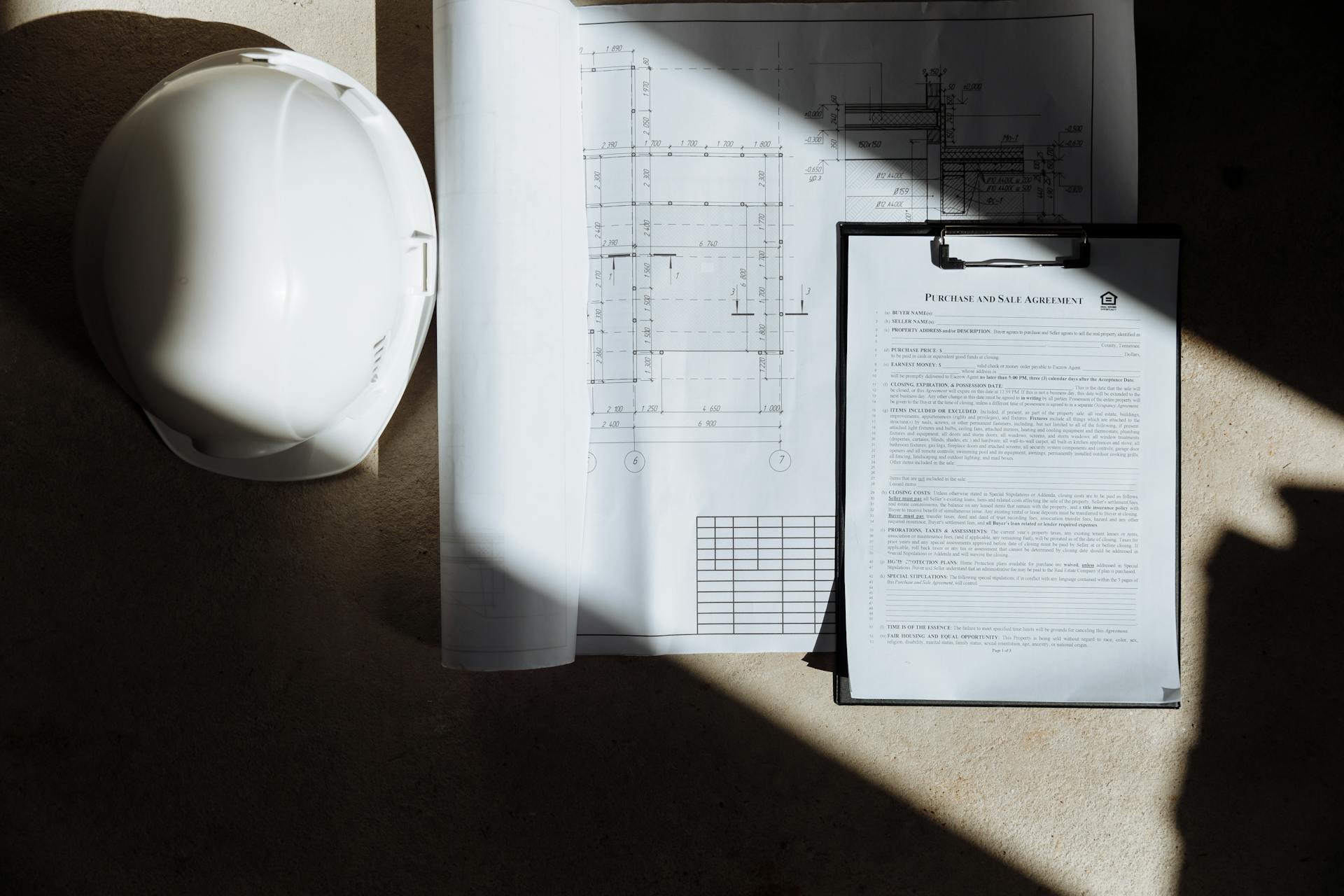
A commercial contract is an agreement containing all the work that should be performed for the construction of a commercial building or non-residential building.
This type of contract is essential for protecting both parties' interests and minimizing risks. A skillfully constructed commercial contract can increase profitability for the contractor.
Commercial contracts are designed to cover all aspects of the construction process, from start to finish. They typically include details such as project timelines, payment schedules, and the scope of work.
A well-written commercial contract can help prevent disputes and ensure a smooth construction process. By clearly outlining the terms and conditions, both parties can avoid misunderstandings and costly delays.
If this caught your attention, see: Legal Work Contract
Firm Selection Announcement
After final selection has taken place, the contracting officer may release information identifying only the architect-engineer firm with which a contract will be negotiated for certain work.
The work should be described in general terms, unless information relating to the work is classified.
For your interest: Contract Work Hours and Safety Standards Act

If negotiations are terminated without awarding a contract to the highest rated firm, the contracting officer may release that information and state that negotiations will be undertaken with another named architect-engineer firm.
Debriefings of successful and unsuccessful firms will be held after final selection has taken place and will be conducted in accordance with certain regulations.
Note that debriefings will be conducted to the extent practicable, in accordance with 15.503, 15.506(b) through (f), and 15.507(c).
Here's an interesting read: Firm Offer
Agreement and Scope
The construction contract is a complex document, but at its core, it's all about defining the agreement and scope of the project. This is where the client and contractor come together to outline the terms of the project, including the total price, payment terms, and the work to be done.
The construction agreement is the central document that spells out the foundational terms of the project, including the agreed-upon total price. It references other documents and addendums that both parties are bound to by signing the agreement. This document is the foundation from which all subsequent project details are defined and developed.
Explore further: Contract Document Automation

The scope of work is a detailed narrative that describes the work to be performed as part of the project. It's usually broken down into smaller chunks using a Work Breakdown Structure, specifying the materials to be used, standards of workmanship expected, and other operational details. This informs the contractors not only what needs to be constructed but also how it should be done.
Agreement
The agreement is the foundation of any construction project. It's the document that outlines the essential deal between the client and contractor, setting the stage for how the project will unfold.
The agreement is typically a single-page document with "the dotted line" where both parties sign, although other pages may require initials. This document references other documents and addendums that both parties are bound to by signing the agreement.
The agreement adapts to the financial strategy chosen for the project, whether it's a lump sum, cost-plus contract, or time and materials contract. It outlines payments and schedules, influencing every aspect of the project from kickoff to completion.
Intriguing read: Transaction Document

The agreement is often incorporated with other documents, such as drawings, which are "incorporated by reference" even if the contractor doesn't physically sign them. This is a common practice in construction projects.
The agreement is the central document that defines the project and states the Government's requirements. It may include criteria and preliminary design, budget parameters, and schedule or delivery requirements.
A different take: Requirements Contract
Practical Completion
Practical completion marks a significant milestone in a construction project, where the contractor returns possession of the site to the owner.
This typically happens when the work has been completed and accepted by the client, and a certificate of practical completion confirms this acceptance.
Half of the retention monies are usually released at this stage, which can be a welcome relief for the contractor who has been holding onto them.
The contractor's potential liability for liquidated damages ends at practical completion, but the defects rectification period begins, so it's essential to ensure that the work meets the required standards.
Additional reading: How to Become a Contractor
Sectional Completion

Sectional completion is a provision in construction contracts that allows for different completion dates for different sections of the works.
This is particularly common in larger projects that are completed in stages, enabling the client to take possession of completed parts while construction continues on others.
In such projects, sectional completion allows for a more flexible and phased approach to project delivery, which can be beneficial for both the client and the contractor.
Contract Features and Terms
A construction contract is a legally binding agreement between a contractor and a client that outlines the scope of work, payment terms, and other essential details. This contract is a crucial document that protects both parties and ensures a successful project.
The contract features and terms are usually outlined in the contract's preamble, which includes the parties' names, addresses, and the project's scope. This information sets the foundation for the entire contract.
Payment terms, such as the method and frequency of payments, are typically specified in the contract. For example, a contractor may require a deposit upfront, with the balance paid in installments as the project progresses.
The contract also outlines the roles and responsibilities of each party, including the contractor's obligations to complete the work and the client's responsibility to provide necessary materials and access to the site.
Curious to learn more? Check out: Contractor down Payment Terms by State
Features

Contract features are what make a contract unique and tailored to the specific needs of the parties involved. They can include provisions for termination, payment terms, and dispute resolution, which can be customized to fit the agreement.
Termination clauses can be set for a specific period, such as 30 days, or can be triggered by a specific event, like a party's bankruptcy. The terms of termination can also include notice periods, which can range from a few days to several weeks.
Payment terms can be structured as a lump sum, installments, or even a percentage of future profits. The contract can also specify the method of payment, such as online transfer or check.
Dispute resolution provisions can include mediation, arbitration, or even a court of law. The contract can also specify the jurisdiction in which disputes will be resolved, such as a state or country.
Take a look at this: Unilateral Termination of Contract
Terms and Conditions
The General Conditions are a crucial part of any construction contract, providing a broad framework for the project.

These conditions cover the standard aspects of the project, including site investigation and conditions affecting the work, which is why contracting officers insert the clause at 52.236-4, Physical Data, in solicitations and contracts when physical data will be furnished or made available to offerors.
Special Conditions, on the other hand, cater to a project's unique aspects, such as environmental sustainability features or specific safety protocols. They serve to fine-tune the contract by addressing the nitty-gritty that makes each construction project different.
Site investigation and conditions affecting the work are often influenced by third-party reports and due diligence findings, which can affect budget considerations and are integral to the contract documents.
Related reading: Payment Terms and Conditions Format
Selection Criteria
Agencies evaluate potential contractors based on six key criteria.
Professional qualifications necessary for satisfactory performance of required services are a top priority.
Specialized experience and technical competence in the type of work required is also crucial, including experience in energy conservation, pollution prevention, waste reduction, and the use of recovered materials.

The capacity to accomplish the work in the required time is another important factor.
Past performance on contracts with Government agencies and private industry in terms of cost control, quality of work, and compliance with performance schedules is thoroughly evaluated.
Location in the general geographical area of the project and knowledge of the locality of the project are also considered, but only if it doesn't reduce the number of qualified firms too much.
The extent of any subcontracting is an important negotiation topic, and firms are limited by the clause prescribed at 44.204(b).
Specifications
Specifications play a crucial role in construction projects, providing the technical data and material requirements needed to bring a project to life.
Specifications, or "specs", contain the project's technical data and material requirements, setting quality standards for the work. They are often organized according to MasterFormat or CSI divisions.
A spec book typically details the materials and methods for particular scopes of work, ensuring adherence to industry standards. This helps ensure that the project is built to last and meets the necessary building codes.
Shop drawings may or may not be needed, depending on the project's requirements. If reproducible shop drawings are needed, the specifications clause with its Alternate I is used.
Intriguing read: Material Transfer Agreement
Schedule of Values

A Schedule of Values (SOV) is a crucial part of any construction contract, outlining the distribution of the total contract value across different tasks and materials.
This detailed breakdown helps ensure that payments are made accurately and on time, as it shows the percentage of each work item that is complete based on expenditures for each category.
In a lump sum contract, the contractor will typically prepare a continuation sheet to show the progress of each work item, which is then used to determine payment amounts.
A SOV is also essential for big and complicated jobs, where detailed planning methods like the Critical Path Method (CPM) are used to outline important tasks and their dependencies.
Regular updates to the SOV are necessary to reflect changes in the project's progress and ensure that payments are made in accordance with the contract terms.
The contract stipulates that any updates to the SOV must be made through a formal change order or contract amendment process to safeguard against schedule disputes.
By including a detailed SOV in the contract documents, all parties involved can stay informed about the project's progress and any changes to the schedule.
If this caught your attention, see: Schedule of Values
Contract Pricing and Payment

Contract pricing and payment methods vary, but some common types include lump sum contracts, unit price contracts, and cost-plus contracts. Lump sum contracts are suitable when the number of items are limited or when it's possible to work out exact quantities of work to be executed.
A lump sum contract involves a single fixed fee for all services provided by the contractor, and it requires clear and accurate specifications for what is included in the job from the outset. This helps to ensure that there are no misunderstandings over costs or services throughout the project.
In a lump sum contract, the contractor will be paid at regular intervals, typically every 2-3 months, as per the progress of work on the basis of a certificate issued by the engineer in charge. A schedule of rates is included in the agreement for making payment of extra items.
Contractors can also use a cost-plus contract, where they are paid the actual cost of work plus a certain percentage as profit. This type of contract is suitable for emergency work or when the scope of work is unclear.
Worth a look: Vehicle Leasing Services
Lump Sum and Schedule

A lump sum contract is a type of contract where the contractor agrees to complete the work for a fixed price, regardless of the actual cost.
This type of contract is suitable when the number of items are limited or when it is possible to work out exact quantities of work to be executed.
The contract includes detailed specifications of all items of work, plans, and detail drawings, security deposit, penalty, progress, and other conditions of contract.
The contractor will be paid at regular intervals of 2-3 months as per progress of work on the basis of a certificate issued by the engineer in charge.
A lump sum contract can be more of a risk to the contractor as there are fewer mechanisms to allow them to vary their price.
The contract value is broken down into a schedule of values (SOV), an itemized list of work segments with the corresponding value of each one.
Worth a look: Progress Billing Software

The schedule of values is pivotal to the payment process, as it outlines the distribution of the total sum for different tasks and materials throughout the project's duration.
The bill of quantities serves as a predictive tool, providing an itemized forecast of materials, labor, and other costs associated with the project.
This helps the contractor to prepare accurate bids and facilitates the client in evaluating these bids more efficiently.
The document's precision in detailing quantities and costs is instrumental in providing transparency and helping manage the financial expectations of both the client and the contractor.
Explore further: Time and Materials
Percentage Rate
A percentage rate contract is used when the lowest rate and comparative position among contractors are already specified prior to the tender opening.
This type of contract eliminates the possibility of unbalanced tenders, making the process more streamlined.
The contractor's payment is based on a percentage rate, rather than a fixed amount, which can be beneficial in certain situations.
Discover more: Failure Rate

In a cost plus percentage contract, the owner pays more than 100% of the documented cost, requiring detailed expense accounting.
This type of contract is often used for emergency work, such as construction projects with difficult foundation conditions or expensive structures.
The U.S. Federal Acquisition Regulations specifically prohibit the use of cost plus percentage contracts for U.S. Federal Government contracting.
A retention is a sum of money withheld by the owner as security against incomplete or defective works, typically a percentage of the completed work.
Consider reading: Federal Public Benefit
Plus Fixed Fee
In a cost plus fixed fee contract, the owner pays the contractor an agreed amount over and above the documented cost of work.
This type of contract is negotiated among parties, where actual and direct costs are paid for, and an additional fee is given for overhead and profit.
The owner is in more control of the project, but the risks are transferred to the owner.
On a similar theme: Cost-plus-incentive Fee

A cost plus contract guarantees the contractor a profit, which reduces their risk.
This type of contract is an alternative to lump sum agreements and allows flexibility and transparency for the homeowner.
It's an open book contract, often used when the scope of work is unclear, and it provides the contractor with a maximum fee that's guaranteed regardless of any cost overruns or unexpected increases in scope.
The client can be sure that their budget won't be exceeded, but the contractor has little incentive to keep a close eye on costs.
The contractor is responsible for any overruns if they exceed the guaranteed maximum price (GMP), which is an upper limit on total construction costs and fees for which an owner is responsible.
If the contractor runs over the GMP, they are responsible for such overruns, which incentivizes them to work together with the owner as efficiently as possible.
Readers also liked: Contractor Payment Terms Example
Contract Administration and Management
Effective contract administration and management are crucial in construction projects. A comprehensive document management system is essential to oversee the evolving nature of contract documents.
Consider reading: Asset Management Software Small Business

Use a robust system to track revisions, manage approvals efficiently, and ensure all parties are working from the most updated documents available. This helps prevent misunderstandings and miscommunications that can lead to costly delays.
Clear guidelines on expense allocation between parties can also help manage construction costs. Contracts can specify how expenses should be allocated between the general contractor, subs, vendors, and clients, protecting each party from unexpected financial losses.
Re Measurement
Re Measurement is a type of contract where the price to be paid is determined by measuring the work in detail and valuing it against a schedule of prices included in the contract.
The FIDIC Red Book 4th edition is sometimes used as a re-measurement contract for civil engineering works.
In a re-measurement contract, the price is ascertained by measuring the various parts of the work, which can be a time-consuming and complex process.
The FIDIC Red Book 4th edition is a predecessor to the 1999 Red Book and is used in some parts of the world for civil engineering works.
Here's an interesting read: Dominion Engineering Works
Snagging

Snagging is a crucial process in contract administration where the owner or their agent checks for any defects that the contractor needs to fix before the final payment is made.
The UK consumer organisation Which? has identified the most common issues picked up by snagging surveys for residential properties, including completion of plastering, tiling, skirting boards, and external brickwork.
It's essential to catch these defects early on to avoid costly rework and ensure the property is handed over to the owner in a satisfactory condition.
Site Inspection and Data Review
Site inspection and data review are crucial steps in the contract administration process. They allow prospective offerors to assess the site conditions and understand the scope of the work.
Contracting officers should make arrangements for site inspections and data examination. This includes assembling data such as boring samples, original boring logs, and records of previous construction in one place and making it available for examination.

The solicitation should notify offerors of the time and place for the site inspection and data examination. If it's not feasible for offerors to inspect the site or examine the data on their own, the solicitation should designate an individual to show the site or data to the offerors.
Significant site information and data should be made available to all offerors in the same manner, including information about utilities to be furnished during construction. A record should be kept of the identity and affiliation of all offerors' representatives who inspect the site or examine the data.
Here's a breakdown of the data that should be provided to offerors:
This data should be provided in the solicitation notice, or the address of an agency-specific publicly accessible website containing this information should be included.
Government Contracts and Regulations
Government contracts and regulations are crucial to understand when it comes to construction contracts. Agencies must follow specific requirements, especially when it comes to construction and architect-engineer contracts.

The Federal Acquisition Regulation (FAR) Part 36 outlines the requirements for construction contracts. For example, the contracting officer must use the two-phase selection procedures when entering into a contract for the design and construction of a public building, facility, or work, if the contracting officer makes a determination that the procedures are appropriate for use.
Agencies must also implement high-performance sustainable building design, construction, renovation, repair, commissioning, operation, and maintenance practices. This includes designing, constructing, and maintaining new construction and modernization projects to meet and exceed Federal sustainable design and operations principles.
For another approach, see: China Construction Design International
36.101 Applicability
Construction and architect-engineer contracts are subject to the requirements in other parts of the regulation, which shall be followed when applicable.
The regulation takes precedence if a requirement in this part is inconsistent with a requirement in another part of the regulation, especially when acquiring construction or architect-engineer services is involved.
If a contract is divided into parts, the clauses applicable to each portion must be followed.
Construction contracts are governed by the requirements in other parts of the regulation, which must be followed when applicable.
If this caught your attention, see: Part Performance of Contract
36.104 Policy

The government has specific policies in place for public building projects, which is outlined in 36.104 Policy. Unless a traditional acquisition approach is used, contracting officers must employ two-phase selection procedures for design and construction contracts.
A two-phase selection procedure is required for public building projects if the contracting officer deems it necessary. This is mandated by 10 U.S.C. 3241 or 41 U.S.C. 3309.
High-performance sustainable building design is a priority for government agencies. Agencies must implement sustainable building practices, including designing and constructing buildings to meet and exceed federal sustainable design and operations principles.
Federal sustainable design and operations principles for new construction and modernization projects are outlined in the Council on Environmental Quality's Guiding Principles for Sustainable Federal Buildings. This includes projects over 25,000 gross square feet.
Agencies must also identify alternatives to renovation that reduce existing assets' deferred maintenance costs. This is a key aspect of sustainable building practices.
Curious to learn more? Check out: Shawmut Design and Construction
Rehabilitation of Federally-owned historic buildings requires best practices and technologies in retrofitting to promote long-term viability. This ensures the buildings remain viable for future generations.
Contracting officers must ensure that Federal construction projects meet specific requirements. This includes requiring the use of a project labor agreement for projects with a total estimated construction cost at or above $35 million.
Contracting officers conducting market research for Federal construction contracts must examine market conditions to determine national, regional, and local entity interest in participating on a project that requires a project labor agreement.
Intriguing read: Alien Contract Labor Law
36.207 Pricing
Firm-fixed-price contracts are the preferred choice for construction projects, and they can be priced on a lump-sum, unit-price, or combination basis.
Lump-sum pricing is generally preferred, except in situations where large quantities of work are involved, such as grading or paving, or when quantities of work can't be estimated with confidence.
Fixed-price contracts with economic price adjustment may be used when customary in the type of work being acquired, or when omitting an adjustment provision would prevent firms from submitting offers.
A fresh viewpoint: Contract Price

The Government estimate is a crucial factor in price negotiation, and contracting officers should evaluate proposals and compare them to the estimate.
When a proposed price is significantly lower than the Government estimate, the contracting officer should ensure both the offeror and the Government estimator understand the scope of the work, and errors in the estimate should be corrected and documented.
Additional pricing tools, such as comparing proposed prices to current prices for similar work, may be used to ensure a fair and accurate contract price.
See what others are reading: Bcbs Contracting
36.212 Preorientation
The contracting officer will inform the successful offeror of significant matters of interest, including statutory matters such as labor standards and subcontracting plan requirements.
These matters also include who has authority to decide on contractual, administrative, and construction responsibilities. This information is crucial for the successful offeror to understand their role and responsibilities in the project.
The contracting officer may issue an explanatory letter or conduct a preconstruction conference to further discuss these matters. This is a great opportunity for the offeror to ask questions and clarify any doubts they may have.
See what others are reading: Performance-based Contracting

If a preconstruction conference is to be held, the contracting officer must conduct it prior to the start of construction at the work site. They must also notify the successful offeror of the date, time, and location of the conference, as well as the proposed agenda and any need for attendance by subcontractors.
36.213-2 Presolicitation Notices
When a construction requirement is expected to exceed the simplified acquisition threshold, the contracting officer must issue a presolicitation notice. This notice is a crucial step in the procurement process.
The presolicitation notice must be issued sufficiently in advance of the invitation for bids to stimulate the interest of the greatest number of prospective bidders. This allows potential contractors to prepare and submit their bids in a timely manner.
The notice must describe the proposed work in sufficient detail to disclose the nature and volume of work. This includes physical characteristics and an estimated price range. The contracting officer must also ensure that the notice complies with the requirements outlined in 36.204.
You might like: What's the Difference of Contract Contracting a Mss P

A presolicitation notice must specify a date by which requests for the invitation for bids should be submitted. This gives potential contractors a clear deadline to respond.
The contracting officer must also specify any amount to be charged for solicitation documents. This is an important consideration for contractors who may need to obtain the documents in order to submit a bid.
To ensure transparency and fairness, presolicitation notices must be publicized through the Governmentwide point of entry in accordance with 5.204.
Take a look at this: Contractors Errors and Omissions Coverage
Architect-Engineer Contracts
Architect-Engineer Contracts are a crucial part of the construction process, and there are specific rules and procedures that must be followed.
The government requires that contracting officers use Standard Form 252, Architect-Engineer Contract, to award fixed-price contracts for architect-engineer services when the services will be performed in the United States or its outlying areas.
Before awarding a contract, a firm must file with the appropriate office or board the Standard Form 330, "Architect-Engineer Qualifications", Part II, and when applicable, SF 330, Part I.
Suggestion: Standard Form Contract

The SF 330, Part I-Contract-Specific Qualifications, is used to obtain information from an architect-engineer firm about its qualifications for a specific contract when the contract amount is expected to exceed the simplified acquisition threshold.
A firm's qualifications data is reviewed and updated at least once a year by the office or board maintaining the data files, which includes encouraging firms to submit annually an updated statement of qualifications and performance data on a SF 330, Part II.
Evaluation boards and other appropriate Government employees, including contracting officers, use data files on firms to make informed decisions about contract awards.
After final selection has taken place, the contracting officer may release information identifying only the architect-engineer firm with which a contract will be negotiated for certain work, described in general terms unless information relating to the work is classified.
Worth a look: What Is Specific Performance in Contract Law
Dispute Resolution and Liability
Disputes can arise in construction projects, but it's essential to have a contract that includes a dispute resolution clause. This clause specifies how disagreements will be resolved.

Mediation, arbitration, and litigation are common methods of dispute resolution. General contractors should ensure the dispute resolution clause is fair and reasonable, protecting their interests.
If an architect-engineer contractor is found liable for errors or deficiencies in their services, the contracting officer may demand payment from the firm. This decision is made after considering the recoverable cost and administrative cost involved.
Dispute Resolution
Dispute resolution is a crucial aspect of construction projects. Disputes can arise due to various reasons, and it's essential to have a clear plan in place to resolve them.
A well-written contract should include a dispute resolution clause that outlines how disagreements will be resolved. This clause should specify methods such as mediation, arbitration, and litigation.
General contractors need to ensure that the dispute resolution clause is fair and reasonable, protecting their interests. This clause should be carefully crafted to avoid any potential conflicts.
Liability for Design Deficiencies
Architect-engineer contractors can be held liable for government costs resulting from design errors or deficiencies. This means they may be responsible for paying back the government for any additional costs incurred due to their mistakes.

The contracting officer will consider the extent to which the architect-engineer contractor may be liable and enforce their liability if the recoverable cost exceeds the administrative cost involved. This decision is typically made with the advice of technical personnel and legal counsel.
A written statement of the reasons for the decision to recover or not recover costs will be included in the contract file. This statement will outline the basis for the decision and provide a clear explanation of the contractor's liability.
If the government requires the contractor to correct errors in their design, the corrections must be made at no cost to the government. This is a requirement for fixed-price architect-engineer contracts.
For another approach, see: How to Fill Out a Cash Flow Statement
Comprehensive Document Management System
A comprehensive document management system is essential for overseeing the evolving nature of contract documents throughout negotiations and the construction process. This system should be capable of tracking revisions, managing approvals efficiently, and ensuring all parties are working from the most updated documents available.
On a similar theme: LS Cable & System

To implement such a system, you can use a robust system to manage contract documents, which should be able to track revisions and manage approvals efficiently. This will ensure that all parties are working from the most updated documents available.
It's essential to monitor revisions diligently and communicate updates across all project stakeholders to maintain clarity and continuity. This will prevent discrepancies and ensure that everyone is on the same page.
By adopting a comprehensive document management system, you can establish a clear hierarchy among the contract documents, which is vital for resolving discrepancies. This can be achieved by implementing an order of precedence clause in the agreement.
A clear document hierarchy is established by implementing an order of precedence clause in the agreement, which determines which document prevails in the face of conflicting information. This clause is essential for resolving discrepancies and ensuring clarity.
Regularly updating all contract documents, especially schedules and technical specifications, is crucial for maintaining clarity and continuity. This ensures that all parties are working from the most updated documents available.
It's also important to track revisions, manage approvals efficiently, and communicate updates across all project stakeholders to maintain clarity and continuity. This will prevent discrepancies and ensure that everyone is on the same page.
If this caught your attention, see: Delivery Order
Project Management and Best Practices

Setting clear timelines and milestones is crucial in project management. By specifying when certain tasks must be completed, both parties have a better understanding of the project's progress.
Construction contracts often include clauses that detail how to handle cost overruns. This ensures that both parties are prepared for any unexpected financial losses.
Including specific timelines helps to prevent delays or unnecessary spending. It's a simple yet effective way to keep the project on track.
Requiring communication to occur in construction management software can help keep a record of all interactions. This can be especially helpful in complex projects.
By setting out specific timelines and milestones, construction contracts can help minimize costs associated with a project.
You might like: Debt Collectors Keep Calling Me
Frequently Asked Questions
What are the 5 elements of a construction contract?
A construction contract typically includes 5 essential elements: a detailed scope of work, project cost and payment schedule, construction timeline, change order process, and project issue resolution procedures. Understanding these elements is crucial for a successful construction project.
What is meant by construction contract?
A construction contract is a legally binding agreement between property owners and contractors outlining the terms of a project. It's a vital document that protects both parties' interests and ensures a successful construction project.
Featured Images: pexels.com