
Standard form contracts are often lengthy and complex documents that can be overwhelming to navigate. These contracts are typically presented on a take-it-or-leave-it basis, with the terms and conditions already set in place by the drafter.
They can be used in various contexts, including consumer contracts, employment agreements, and commercial transactions. In a consumer contract, for example, the terms may be presented on the back of a receipt or on a website.
The terms of a standard form contract can be binding, even if the consumer or employee has not read or understood them. This can lead to disputes and legal issues if the terms are unfair or unclear.
Standard form contracts are often used to protect the interests of the drafter, rather than the consumer or employee.
Take a look at this: Consumer Insurance (Disclosure and Representations) Act 2012
What is a Standard Form Contract?
A standard form contract, also known as a "boilerplate contract", is a pre-prepared agreement where most of the terms are set in advance and not subject to negotiation.

These types of contracts are common in many everyday transactions, such as cellphone plans, car rentals, and insurance policies. They're designed to save time and resources by offering a consistent framework that addresses common industry practices and regulatory requirements.
Standard form contracts are widely adopted in the construction and commercial property sectors due to their efficiency and ability to reduce negotiation time for routine matters. They're also used in mass transactions where the same terms and conditions apply to multiple parties.
One party typically prepares these contracts, and the other party has little or no ability to modify them. This can put the party in a disadvantaged position, especially if they have little to no bargaining power compared to the other party.
Intriguing read: Servicenow Time Tracking
Characteristics and Elements
Standard form contracts are designed to be used across multiple projects and transactions, ensuring uniformity in contractual terms and provisions. This uniformity is one of the key characteristics of standard form contracts.
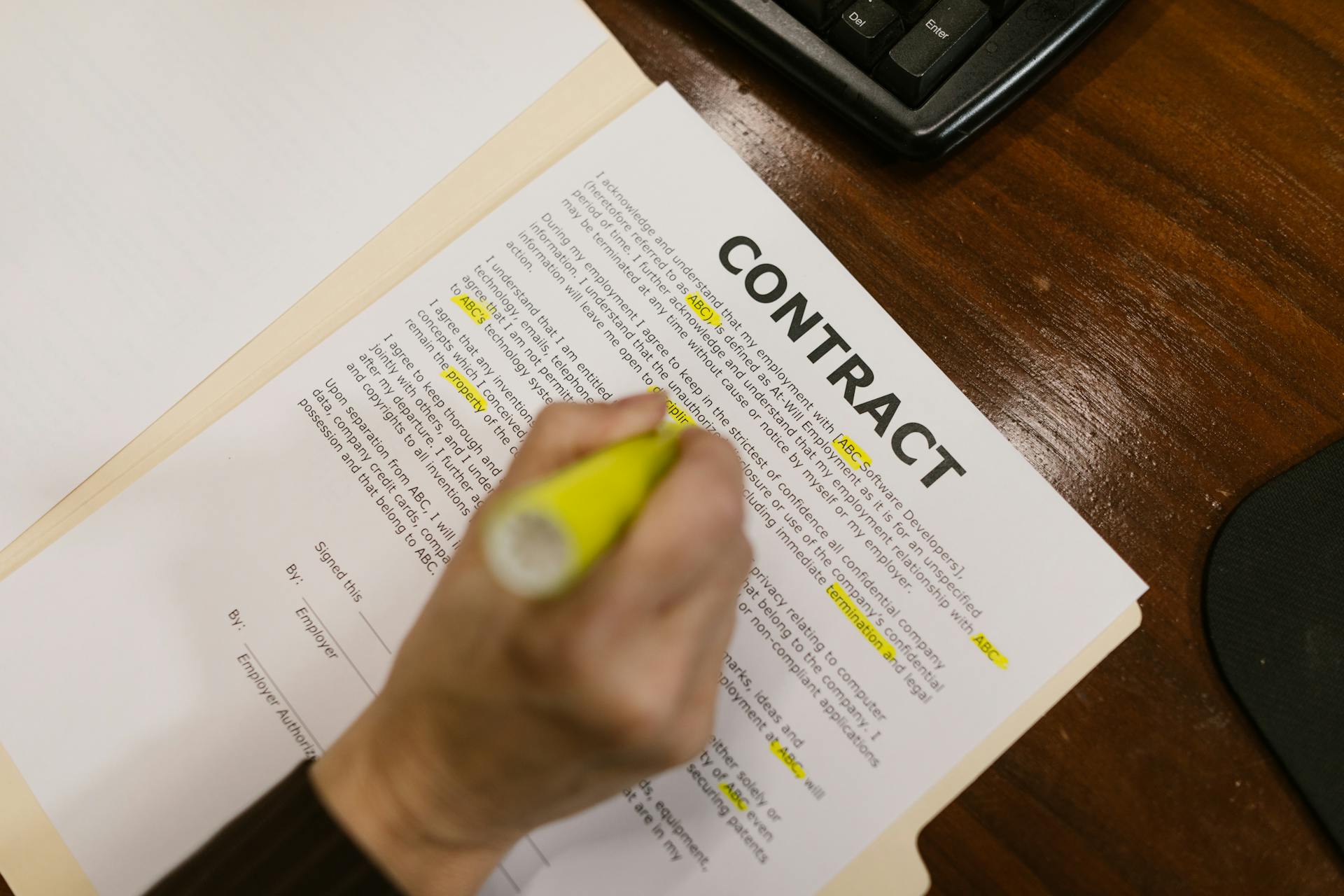
These contracts are typically drafted and regularly updated by industry experts, legal professionals, and trade associations to reflect current best practices and legislation. This ensures that the contracts are well-drafted and balanced.
Standard form contracts often have limited room for negotiation, especially regarding fundamental provisions, which streamlines the contractual process. This means that parties can quickly agree on the terms of the contract without getting bogged down in lengthy negotiations.
A standard form contract typically encompasses a wide range of relevant clauses, addressing matters such as scope of work, payment terms, dispute resolution, warranties, insurance, indemnities, and more. This comprehensive coverage is designed to address common industry practices and issues.
The key elements of a standard form contract include its uniformity, preparedness by experts, limited negotiation, comprehensive coverage, and risk allocation. These elements work together to create a consistent framework for similar transactions.
Standard form contracts are widely adopted in the construction and commercial property sectors due to their efficiency and ability to reduce negotiation time for routine matters. This is because the contracts are designed to save time, resources, and legal costs.
Broaden your view: Time and Materials
Types of Standard Form Contracts

Standard form contracts come in various forms, each designed to suit specific needs and industries. The construction and commercial property sectors have their own set of standard form contracts.
In the UK, JCT Contracts are widely used in construction projects, covering traditional procurement, design and build, and more. NEC Contracts are known for their flexibility and focus on collaboration, gaining popularity in construction and engineering projects. RIBA Contracts are tailored to suit architectural services and projects. FIDIC Contracts are widely used in international construction projects, providing a framework for various parties involved.
These contracts are designed to streamline contractual processes, mitigate risks, and focus on successful project execution. By using these contracts, companies can save time, resources, and legal costs.
Explore further: Legal Purpose Is a Term Used in Contract Law Meaning
Shrink Wrap
Shrink wrap contracts are a type of standard form contract that has been debated in courts in the United States.
Courts have split on the issue of shrink wrap contracts, with one line of cases holding them enforceable, as seen in ProCD v. Zeidenberg, and another line holding them unenforceable, as seen in Klocek v. Gateway, Inc.

The enforceability of shrink wrap contracts hinges on the question of assent, with the former holding that only objective manifestation of assent is required.
The two lines of cases are based on different interpretations of how a party's assent is obtained, with the former focusing on outward signs of agreement and the latter requiring some level of subjective understanding.
This split highlights the importance of clear and transparent communication in standard form contracts, as seen in the example of a cellphone plan in Provo, where the service provider hands over a pre-prepared contract that includes essential elements like offer, acceptance, and consideration.
Here are some key differences between the two lines of cases:
- ProCD v. Zeidenberg: Enforceable shrink wrap contracts require only objective manifestation of assent.
- Klocek v. Gateway, Inc: Unenforceable shrink wrap contracts require at least the possibility of subjective assent.
UK Construction & Commercial Property
In the UK, the construction and commercial property sectors rely heavily on standard form contracts to streamline their contractual processes. Several standard form contracts are widely recognised and used in these sectors.
JCT Contracts, or Joint Contracts Tribunal, are used extensively in the construction industry, covering various types of projects. They cover traditional procurement, design and build, and more.

NEC Contracts are known for their flexibility and focus on collaboration, making them a popular choice in construction and engineering projects.
RIBA Contracts are tailored to suit architectural services and projects, providing a specific framework for these types of projects.
FIDIC Contracts are widely used in international construction projects, offering a framework for various parties involved. They provide a consistent approach to project management and risk mitigation.
Standard form contracts have become an integral part of the construction and commercial property sectors in the UK due to their efficiency, clarity, and consistency.
Check this out: Construction Contract
Benefits and Uses
Standard form contracts offer numerous benefits, and their uses are widespread across various industries. They reduce the cost of contracting by eliminating the need for custom contracts for individual tenders.
By using standard form contracts, companies can save time and resources that would otherwise be spent on extensive contract drafting. This efficiency is a significant advantage, especially for businesses that require repeated, high-volume transactions.

Standard form contracts are commonly used in industries that require repeated, high-volume transactions, such as employment agreements, online services, insurance policies, retail and consumer sales, and real estate transactions. These contracts ensure operational consistency, reduce negotiation time, and enhance legal clarity.
Using a standard form contract in these contexts ensures operational consistency, reduces negotiation time, and enhances legal clarity. For example, employment agreements are used by companies to streamline onboarding for similar roles, while online services use standardized terms and conditions users must accept to access services.
Standard form contracts are drafted in clear and concise language, reducing the likelihood of misunderstandings or disputes. This clarity is a significant advantage, especially in industries where contracts are complex and multifaceted.
By using the same contract for multiple projects, companies can ensure consistency in their contractual arrangements and management. This consistency is a key benefit of standard form contracts, as it prevents employers from making any changes to the contract without informing their clients.
Over time, standard form contracts establish a body of case laws that can be referred by parties in case of disagreement over any issues. This benefits the whole industry, as it provides a clear and predictable framework for resolving disputes.
For your interest: Employment Contract

Here are some common uses of standard form contracts:
- Employment agreements: Used by companies to streamline onboarding for similar roles.
- Online services: Most digital platforms use standardized terms and conditions users must accept to access services.
- Insurance policies: Providers use standard forms for policy coverage, exclusions, and claims procedures.
- Retail and consumer sales: Warranties, return policies, and purchase terms are often standardized for consistency.
- Real estate transactions: Leases and purchase agreements typically rely on pre-approved templates with fillable variables.
Drawbacks and Limitations
Standard form contracts can be a minefield, and one of the biggest drawbacks is the language problem. Every word has a specific meaning, and even a small change can alter your legal position.
You should never sign a standard contract without going through it, as the boilerplate section often contains clauses that can leave you at a disadvantage. This section is usually found at the end of the contract, but it's crucial to read it thoroughly to look out for sections you don't agree with.
The price fixing issue is another major problem with standard contracts. If prices are standardized, it can amount to price fixing, which is a serious issue. You should always ask for a provision to renegotiate the price at a later date.
Favoring one party is another drawback of standard contracts. The company issuing the contract often standardizes it, which means it may not be fair to both parties. You should always ask whose standard contract it is and review it carefully.
Standard form contracts can also have theoretical issues, such as promoting economic efficiency but also allowing for inefficient and unjust terms to be accepted. This can include clauses that limit liability, restrict remedies, or impose excessive penalties.
On a similar theme: Oil Price Information Service
Disadvantages of Boilerplate

Boilerplate can be a major disadvantage of using standard contracts. It's often the standardized language used in most contracts, and most people don't bother to read it, considering it just a legal formality.
The issue is not with what the boilerplate contains, but rather with what it leaves out. For instance, if the person offering you the contract has removed the part that requires the losing party to pay the attorney fees of the winning party, you may be at a disadvantage despite winning a case.
You should always make it a point to read the whole of the boilerplate thoroughly to look out for the sections you don't agree with. This is especially important if you want to reserve the suing right, as some contracts may include a condition to resolve disputes through arbitration.
If you don't read the boilerplate, you may end up signing a contract that limits your access to the courts or places the risk of a negative outcome on you.
On a similar theme: Boilerplate Clauses in a Contract

Standard form contracts often include boilerplate that's designed to favor the company issuing the contract. In fact, most of the time, it's the company that standardizes the contract, not a group of attorneys discussing and agreeing on the terms.
This means that the boilerplate may contain unfair terms that create a significant imbalance between the rights and obligations of the parties.
Recommended read: Is Simple Mobile a Good Company
Disadvantages of Price Fixing
Price fixing can be a major problem in standard contracts. If a contract has specific product prices stated in it, you could be at risk of price fixing.
A standard contract should leave the price up to parties for negotiation. This allows for flexibility and can help prevent price fixing.
Standardizing prices through trade associations can lead to price fixing. Trade associations have been found guilty of price fixing when issuing standardized contracts for member-vendors to follow.
Standardizing prices amounts to price fixing. It's essential to have a provision to renegotiate the price at a later date.
Additional reading: Contract Price
Legally Enforceability and Risks

Standard form contracts are legally binding, but their enforceability can be challenged if the terms are found to be unfair or unconscionable. Courts may refuse to enforce specific clauses or entire contracts in cases where one party had no opportunity to negotiate the terms, or where terms are buried in fine print or presented after an agreement is made.
To ensure enforceability, businesses should periodically review their standard form contracts to remain compliant with evolving regulations and consumer fairness standards. This includes reviewing contracts for clauses that are substantially one-sided, limiting liability or consumer rights.
In Utah, standard form contracts are generally enforceable as long as they meet the essential elements of a contract and do not include unconscionable terms. Courts scrutinize these contracts closely to ensure fairness, especially when one party has significantly more bargaining power.
Here are some reasons why standard form contracts may be challenged:
- Lack of meaningful choice
- Unfair surprise
- Substantially one-sided clauses
- Violations of consumer protection laws
Theoretical Issues
Theoretical issues surrounding standard form contracts are complex and multifaceted. There is much debate on whether courts should enforce these contracts, with some arguing they promote economic efficiency by reducing transaction costs.

Standard form contracting can reduce transaction costs substantially by avoiding the need for buyers and sellers to negotiate the details of a sale contract each time the product is sold.
However, there is also the potential for inefficient and unjust terms to be accepted by signatories to these contracts. Such terms might be seen as unjust if they allow the seller to avoid all liability or unilaterally modify terms or terminate the contract.
Forum selection clauses and mandatory arbitration clauses can limit or foreclose a party's access to the courts, while liquidated damages clauses can set a limit to the amount that can be recovered or require a party to pay a specific amount.
Some contend that in a competitive market, consumers have the ability to shop around for the supplier who offers them the most favorable terms and are consequently able to avoid injustice. However, this may not be the case in oligopolies, where consumers have limited access to different suppliers.
Many people do not read or understand the terms of standard form contracts, which can make it difficult for firms to offer favorable conditions. Even if firms do offer better terms, it may not be worth it for them as they would only gain a small amount of business.
In practice, standard form contracts are often drafted by lawyers to minimize the firm's liability, not necessarily to implement managers' competitive decisions. This can result in contracts that are homogeneous and difficult for consumers to navigate.
Consider reading: What Are Contract Clauses
Common Law Status

The common law treats standard form contracts like any other contract, binding the signor to the contract with their signature or objective manifestation of intent to be legally bound.
In standard form contracting, many common law jurisdictions have developed special rules to account for the reality of these contracts.
The courts will interpret standard form contracts contra proferentem, or against the party that drafted the contract, in the event of an ambiguity.
This means the party that drafted the contract is the only one responsible for removing ambiguity from the contract.
The courts will not hold the other party responsible for understanding the terms they did not draft.
You might enjoy: Common Form
Enforceability
Standard form contracts are legally binding, but their enforceability may be challenged if the terms are found to be unfair or unconscionable.
Courts may refuse to enforce specific clauses or entire contracts in cases of lack of meaningful choice, unfair surprise, substantially one-sided clauses, or violations of consumer protection laws.
Suggestion: Unfair Terms in Irish Contract Law

To ensure enforceability, businesses should periodically review their standard form contracts to remain compliant with evolving regulations and consumer fairness standards.
In some jurisdictions, like Utah, standard form contracts are generally enforceable as long as they meet the essential elements of a contract and do not include unconscionable terms.
Unconscionable terms refer to clauses that are so one-sided or unfair that they shock the conscience. Courts are generally reluctant to enforce contracts that are found to be unconscionable.
To avoid potential legal challenges, businesses must ensure that their standard-form contracts do not contain any unconscionable provisions.
A contract is considered unconscionable if one party has significantly more bargaining power than the other, and the contractual terms are oppressive or unjust.
Here are some common reasons why courts may refuse to enforce specific clauses or entire contracts:
- Lack of meaningful choice
- Unfair surprise
- Substantially one-sided clauses
- Violations of consumer protection laws
In general, courts will interpret standard form contracts contra proferentem, which means against the party that drafted the contract, as that party had the ability to draft the contract to remove ambiguity.
Dispute Resolution

Dispute Resolution is an essential aspect of standard form contracts, and Utah provides several avenues for resolving disputes.
Mediation and arbitration are commonly used methods in Utah, governed by the Utah Uniform Arbitration Act (Utah Code Title 78B, Chapter 11). This act provides a framework for resolving disputes in a fair and efficient manner.
If a dispute arises, mediation can be a good option as it allows parties to work together to find a mutually acceptable solution.
Suggestion: Dispute Apple Services Charge
Regulatory Frameworks and Jurisdictions
In Utah, the state-specific regulations govern the formation and enforcement of contracts.
Standard form contracts are governed by specific laws on a state level, which aim to protect consumers from unfair clauses. These laws vary greatly, but some require notice to be given for clauses to be effective, while others prohibit unfair clauses altogether.
In the United Kingdom, the Unfair Contract Terms Act 1977 limits the ability of the drafter of a consumer or standard form contract to exclude liability in an exclusion clause.
The Act does not render ineffective provisions in other areas that appear unfair, but rather protects consumers from unfair terms in contracts.
Section 17 of the Act specifically addresses standard form contracts in Scotland.
A unique perspective: Conflict of Contract Laws
Common Misconceptions and Scenarios
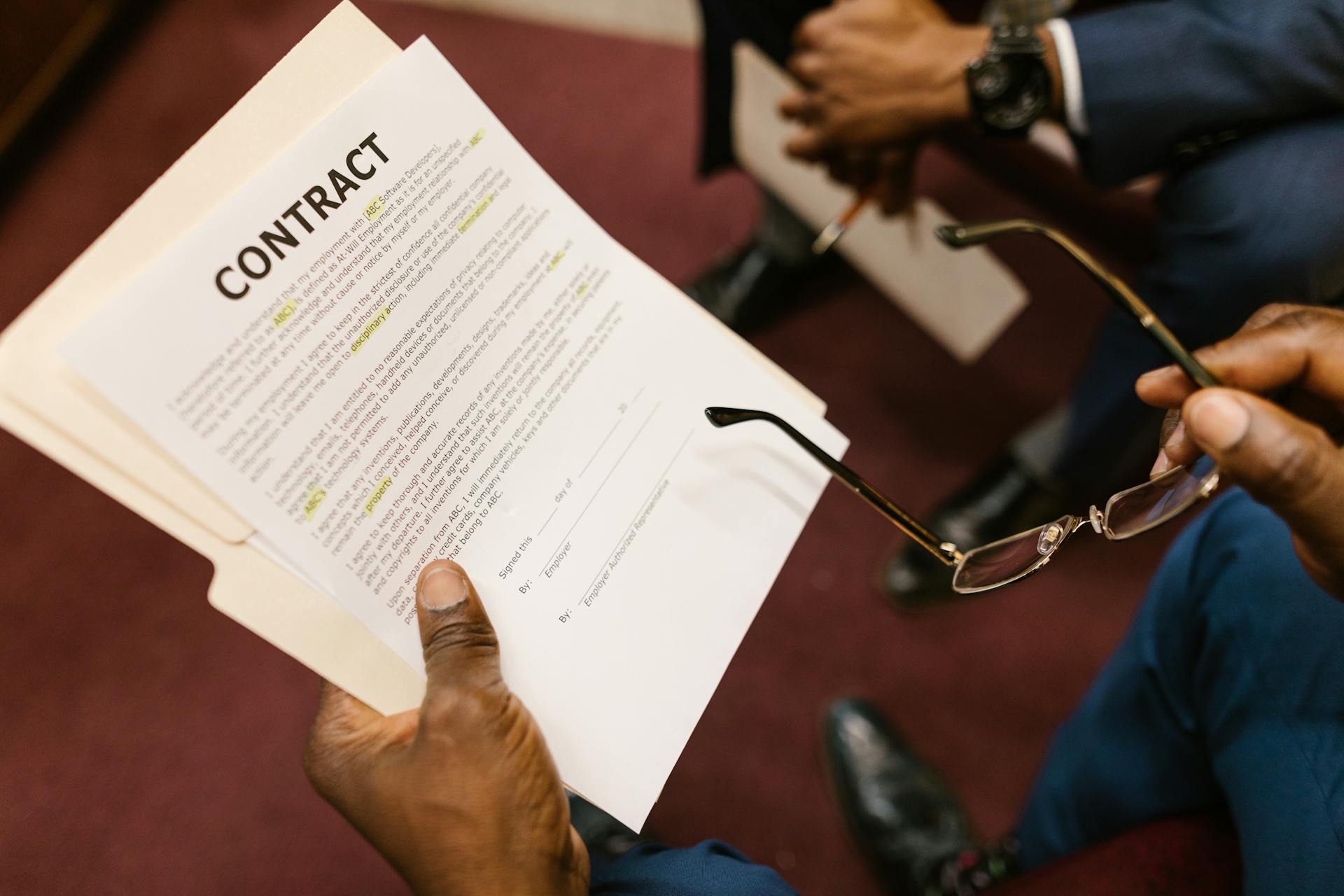
Standard form contracts can be intimidating, but they're not entirely non-negotiable. Some terms can still be modified, especially when it comes to payment schedules, service inclusions, or penalties for early termination.
It's essential to read the fine print carefully to avoid unpleasant surprises later. The fine print often contains critical details that affect your rights and obligations under the contract.
Common Misconceptions
Standard form contracts are often misunderstood, but one common misconception is that they're non-negotiable. However, this isn't entirely true.
Some terms in standard form contracts can still be negotiated. Don't be afraid to ask for modifications, especially in terms of payment schedules, service inclusions, or penalties for early termination.
You might think that standard form contracts are set in stone, but the truth is, they can be tailored to your specific needs. This is especially important when it comes to payment schedules.
Standard form contracts are pre-prepared, but that doesn't mean you can't make changes. Be sure to review the contract carefully and ask for modifications where necessary.
Scenario 3: Car Rental
Renting a car is a common scenario where you'll encounter a standard form contract. You'll typically sign a contract provided by the rental company that details the rental period, charges, and responsibilities of both the renter and the rental company.
The contract will likely contain fine print that contains critical details affecting your rights and obligations. Always read the fine print carefully to avoid unpleasant surprises later.
The courts will interpret standard form contracts, like car rental contracts, contra proferentem (against the party that drafted the contract) in the event of an ambiguity. This is because the party that drafted the contract had the ability to remove ambiguity.
Signing a standard form contract, even if you don't read or understand the terms, will bind you to the contract. This is the reality of standard form contracting.
For your interest: Life Insurance Policy Info
Frequently Asked Questions
How to write a standard contract?
To write a standard contract, start by creating a comprehensive template that outlines key terms, conditions, and requirements, and then tailor it to your specific needs. By following these essential steps, you'll be well on your way to creating a solid contract that protects all parties involved.
Featured Images: pexels.com