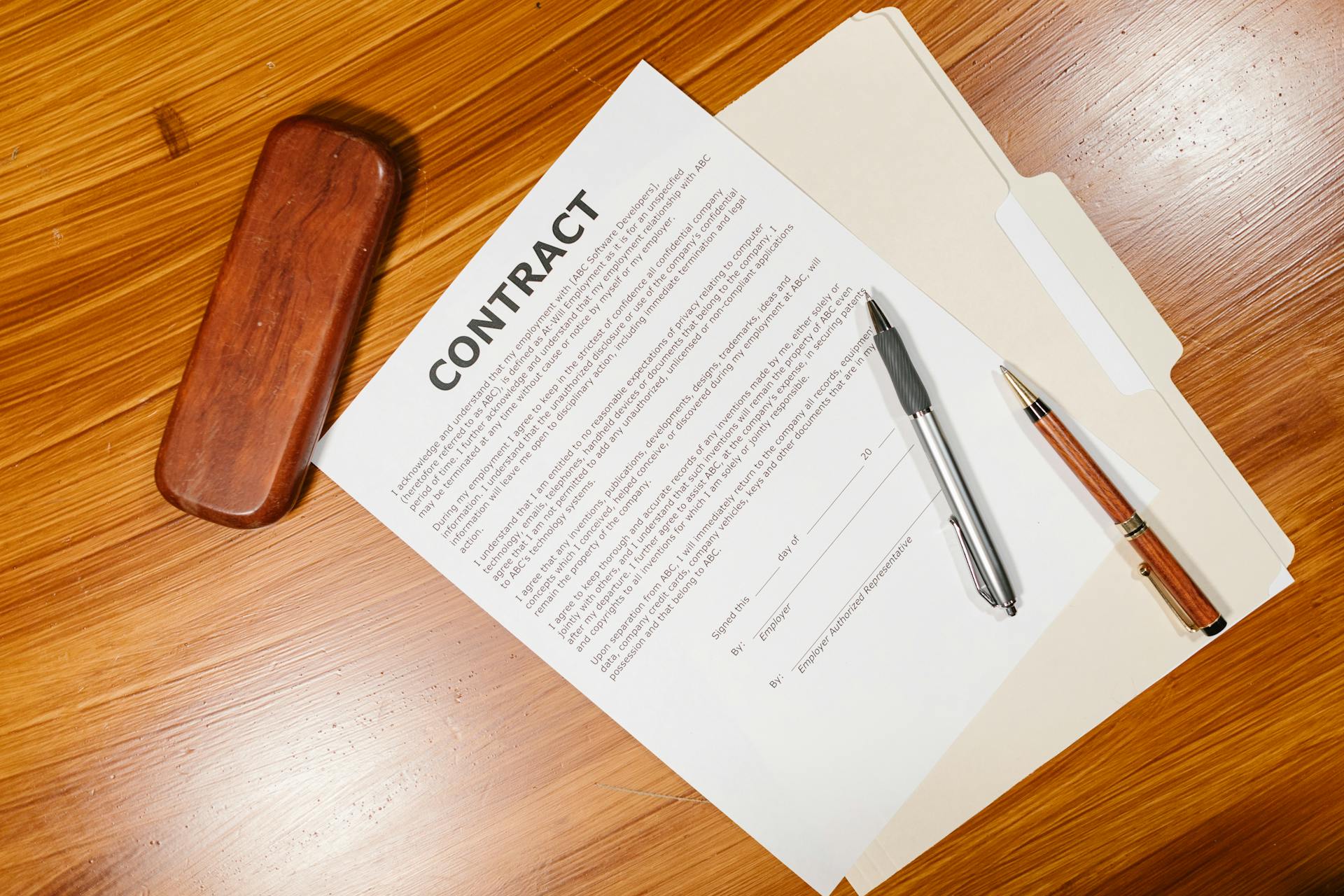
A contract price is the total cost of a project or service agreed upon by the parties involved. It's a crucial aspect of any contract, as it outlines the financial obligations of both parties.
The contract price can be fixed or variable, depending on the type of project. For example, a fixed-price contract has a predetermined price, whereas a cost-plus contract has a variable price based on the actual costs incurred.
A contract price can include various components, such as labor costs, materials, and overheads. This breakdown helps ensure that both parties understand their financial responsibilities.
Related reading: Is a Contract Binding If Not Signed by All Parties
What Is a Contract Price?
A contract price is a fixed amount agreed to by two parties in a contractual agreement. It's determined by factors such as materials, labor, and overhead costs.
The contract price may also include additional costs like taxes, freight charges, and any other applicable fees or duties.
It typically takes into account the time frame for delivery of the goods or completion of the services.
Both parties understand what they're paying for and what type of product or service they receive in return.
Importance of Contract Price

A clear contract price is essential for both parties to understand their financial obligations.
It provides clarity and certainty about the payment terms, ensuring that both parties are on the same page.
This is particularly important for small businesses, where a well-defined contract price helps avoid disputes over payment and ensures proper budgeting.
A clear contract price also establishes accountability in fulfilling the financial terms of the contract.
This helps businesses plan for future projects more effectively, as they can budget their expenses over time with confidence.
Contracted pricing can also help protect both parties from unforeseen changes in economic conditions and fluctuations in demand.
By providing fixed prices for specified amounts of product or services over an extended period of time, contracted pricing reduces the risk associated with unstable market forces.
This allows businesses to make informed decisions and plan for the future with more accuracy.
Expand your knowledge: Asset Pricing
Contract Price Clauses
Contract price clauses are essential components of contracts, particularly in industries where costs can fluctuate dramatically. They allow adjustments to the contract price if certain conditions are met.

A well-drafted escalation clause should include clearly defined trigger events, such as significant changes in material costs or inflation indices. These events justify price adjustments.
Contractors often bear the full risk of rising costs without escalation clauses, which can erode profit margins or render projects unprofitable. This is because they are not protected from unlimited cost exposure.
A key element of a well-drafted escalation clause is a transparent adjustment formula, which recalculates the contract price based on industry indices or actual cost changes. This provides a clear and predictable method for adjusting prices.
Notification requirements are also crucial, obliging contractors to provide timely notice of cost changes. This helps ensure that both parties are aware of any changes and can adjust accordingly.
A ceiling or cap on price adjustments is also important, limiting how much the price can be adjusted to protect the buyer from unlimited cost exposure. This helps maintain a stable and predictable contract price.
Here are the key elements of a well-drafted escalation clause:
- Trigger Events: Clearly defined conditions that justify price adjustments (e.g., material price increases beyond a certain percentage).
- Adjustment Formula: A transparent method for recalculating the contract price based on industry indices or actual cost changes.
- Notification Requirements: Obligations for contractors to provide timely notice of cost changes.
- Ceiling or Cap: A limit on how much the price can be adjusted to protect the buyer from unlimited cost exposure.
Certified Contract Prices

Certified contract prices are often more reliable than non-certified prices, as they are typically audited and verified by a third-party organization.
Certified contract prices can provide a level of assurance that the prices listed are accurate and up-to-date, reducing the risk of disputes or misunderstandings.
In some industries, such as construction, certified contract prices are often required by law or industry standards.
15.403 Obtaining Certified
Obtaining Certified Contract Prices is a crucial step in ensuring transparency and fairness in government contracting. The contracting officer is responsible for determining a fair and reasonable price for the prime contract, including subcontracting costs.
The contracting officer should consider whether a contractor or subcontractor has an approved purchasing system, has performed cost or price analysis of proposed subcontractor prices, or has negotiated the subcontract prices before negotiation of the prime contract.
A prime contractor or subcontractor must conduct appropriate cost or price analyses to establish the reasonableness of proposed subcontract prices. They must also include the results of these analyses in the price proposal.
For another approach, see: What's the Difference of Contract Contracting a Mss P

Contractors or subcontractors required to submit certified cost or pricing data must obtain and analyze certified cost or pricing data before awarding any subcontract, purchase order, or modification expected to exceed the certified cost or pricing data threshold.
The threshold is the lower of either $20 million or more, or both more than the pertinent certified cost or pricing data threshold and more than 10 percent of the prime contractor's proposed price.
You might enjoy: What Is Bond Pricing
15.407-1 Defective Certified
The contracting officer is responsible for determining a fair and reasonable price for the prime contract, including subcontracting costs. The contracting officer should consider whether a contractor or subcontractor has an approved purchasing system, has performed cost or price analysis of proposed subcontractor prices, or has negotiated the subcontract prices before negotiation of the prime contract.
Certified cost or pricing data is required for subcontracts that exceed the certified cost or pricing data threshold, which is the lower of $20 million or more, or more than 10 percent of the prime contractor's proposed price. The contractor must submit certified cost or pricing data to the Government for these subcontracts.
A different take: Bond Pricing Formula

The contracting officer should require the contractor or subcontractor to submit subcontractor certified cost or pricing data below the thresholds if necessary for adequately pricing the prime contract. The contractor shall update subcontractor's data as appropriate during source selection and negotiations.
Certified cost or pricing data must be submitted in the format provided in 15.408 Solicitation provisions and contract clauses, or an alternate format specified in the solicitation. The data must be current, accurate, and complete as of the date of price agreement, or an earlier date agreed upon by the parties.
Broaden your view: Payment Terms and Conditions Sample Text
Proposal Analysis Techniques
Proposal analysis techniques can help CROs make informed decisions about contract pricing. Built-in analytics tools within CPQ software can provide real-time insights into how contract pricing has performed over time.
Analyzing contract pricing data can reveal trends and patterns that may not be immediately apparent. This sales analysis helps CROs adjust pricing based on customer needs and preferences while still meeting profitability goals.
Effective proposal analysis involves comparing different pricing scenarios and evaluating their potential impact on the business. Contracted pricing analysis can help CROs identify areas for improvement and optimize their pricing strategy.
Intriguing read: Contractual Provisions Relating to Time
Contract Price Policy and Guidelines

Contract price policy and guidelines are crucial in ensuring fair and reasonable prices for government contracts. The contracting officer must obtain certified cost or pricing data when required by 15.403-4.
To establish a fair and reasonable price, the contracting officer should obtain data other than certified cost or pricing data, such as data related to prices, cost data, and data on the prices at which the same or similar items have been sold previously.
The contracting officer should use techniques like price analysis, cost analysis, and cost realism analysis to establish a fair and reasonable price. If a fair and reasonable price cannot be established, the contracting officer should require the submission of additional data.
Each contract should be priced separately and independently, and proposed price reductions under other contracts should not be used as an evaluation factor.
Discover more: Performance-based Contracting
Contract Price Types and Structures
Contract price types and structures are crucial to understand when navigating contracts. The most common structures include Fixed-Price Contracts, where the total amount is set at the beginning and does not change, regardless of actual costs incurred.

In contrast, Cost-Plus Contracts involve paying the actual cost of work plus a fee for the contractor's profit. This reduces the contractor's risk but can make the final price less predictable. Unit Price Contracts and Time and Materials Contracts also exist, with the former based on agreed-upon rates per unit of work and the latter on hourly labor rates and material costs.
Here are the main types of contract price structures:
- Fixed-Price Contracts: The total amount is set at the beginning and does not change.
- Cost-Plus Contracts: The buyer agrees to pay the actual cost of work plus a fee for the contractor's profit.
- Unit Price Contracts: Payments are based on agreed-upon rates per unit of work.
- Time and Materials Contracts: Payment is based on hourly labor rates and the cost of materials used.
Types of Structures
There are several types of contract price structures, each with its own set of characteristics and implications for both parties involved.
A fixed-price contract is one where the total amount is set at the beginning and does not change, regardless of actual costs incurred. This gives the client certainty, but places more risk on the contractor.
Cost-plus contracts, on the other hand, involve the buyer paying the actual cost of work plus a fee for the contractor's profit. This reduces the contractor's risk, but can make the final price less predictable.
On a similar theme: External Risk

Unit price contracts are based on agreed-upon rates per unit of work, such as per square foot or per cubic yard. These are common when quantities are uncertain.
Time and materials contracts involve payment based on hourly labor rates and the cost of materials used. This is often used when the project scope is uncertain or likely to change.
The right pricing model depends on project complexity, market conditions, and the level of risk each party is willing to accept.
Here are the main types of contract price structures:
- Fixed-Price Contracts: The total amount is set at the beginning and does not change.
- Cost-Plus Contracts: The buyer pays the actual cost of work plus a fee for the contractor's profit.
- Unit Price Contracts: Payments are based on agreed-upon rates per unit of work.
- Time and Materials Contracts: Payment is based on hourly labor rates and the cost of materials used.
Contract price
Contract price structures can be a complex and nuanced topic, but understanding the basics can help you make informed decisions for your project.
The most common contract price structures include fixed-price contracts, cost-plus contracts, unit price contracts, and time and materials contracts.
Fixed-price contracts set a total amount at the beginning of the project, which doesn't change regardless of actual costs incurred. This gives clients certainty, but places more risk on the contractor.
If this caught your attention, see: Fixed-price Contract

Cost-plus contracts, on the other hand, require the buyer to pay the actual cost of work plus a fee for the contractor's profit. This reduces the contractor's risk, but can make the final price less predictable.
Here are the common contract price structures in a quick reference table:
Time and materials contracts are often used when the project scope is uncertain or likely to change, as they allow for flexibility in project scope and adaptations. This can sometimes lead to better outputs, as contractors aren't pressured to cut corners to maintain profit.
Firm vs
Firm vs Firm Price and Fixed Price contracts can be confusing, but let's break it down. In the UK government's definition, a Firm Price Contract has a total, all-inclusive price that will not change, with adjustments only possible through an agreed change control.
The main difference between Firm and Fixed Price contracts is whether adjustments are contracted and have a mechanism to treat them in the contract. For example, if inflation is being contracted, it's essential to ensure the agreed economic adjustment is suitable for your industry.

You should use Fixed Price contracts where the requirements and program plan are clear, the budget is limited, or the project scope is small. This way, the majority of the risk lies with the contractor, who should price that risk accordingly.
Here's a quick summary of the differences between Firm and Fixed Price contracts:
By understanding these differences, you can make informed decisions about which contract type is best for your project.
What Makes CPQ Special
Special pricing in CPQ is a feature that enables businesses and customers to customize their purchasing agreements.
It offers a way to modify prices when criteria are met to benefit both the customer and the seller.
Special pricing may be applied for bulk orders or for meeting other specific conditions, such as purchasing multiple products from the same vendor.
This helps drive more sales by offering incentives like loyalty discounts.
CPQ software can automate the process of setting up and managing special prices, ensuring accuracy, consistency, and scalability.
A comprehensive view of all price structures is provided by the CPQ platform, allowing users to easily see what incentives have been agreed upon with each customer.
This enables users to assign the correct pricing accordingly, streamlining the process of offering customized deals and contracted prices.
Forward Rate Agreements

Forward pricing rate agreements, or FPRAs, are a type of contract price structure that allows for the establishment of a forward pricing rate.
Offerors are required to describe any FPRAs in their specific pricing proposal and identify the latest cost or pricing data submitted in accordance with the FPRA.
Contracting officers will use FPRA rates as bases for pricing all contracts, modifications, and other contractual actions during the period covered by the agreement.
Conditions that may affect the agreement's validity must be reported promptly to the ACO, who will then determine if the agreement is invalidated.
Contracting officers do not require certification at the time of agreement for data supplied in support of FPRAs or other advance agreements.
The certificate supporting a contract action that requires certification will cover the data supplied to support the FPRA or other advance agreement, as well as all other data supporting the action.
A clause with its Alternate II is used if copies of the proposal are to be sent to the ACO and contract auditor.
Consider reading: Will Paying Debt Collectors Help My Credit
Contract Price Negotiation and Best Practices

Contract price negotiation is a crucial aspect of contract management. The contracting officer must document the negotiation in the contract file, including the principal elements of the negotiated agreement.
The documentation should include the purpose of the negotiation, a description of the acquisition, and the names and organizations of the individuals representing the contractor and the government. It's essential to have a clear and transparent record of the negotiation process to avoid disputes and ensure financial stability.
According to best practices, parties should approach contract price negotiations strategically. This includes breaking down costs into labor, materials, overhead, and profit margins, and using reliable third-party indices for objective price adjustments.
Negotiation Best Practices
Negotiation best practices are crucial to ensure financial stability and minimize disputes. Breaking down costs into labor, materials, overhead, and profit margins is a good starting point for transparency.
Requesting a detailed breakdown of costs can help parties understand each other's needs and expectations. This can be done by referencing reliable third-party indices, such as the Producer Price Index, for objective price adjustments.

Considering contingencies and building them into the contract price can also help mitigate unforeseen events. It's essential to periodically review and update the scope of work to reflect changes before they impact costs.
Documenting all variations, including change orders and variations that affect the price, is also vital. This should be done in writing and approved by all parties involved.
Here are some key elements to include in negotiation documentation:
- The purpose of the negotiation
- A description of the acquisition, including identifying numbers
- The names and positions of parties involved
- The current status of contractor systems that affected the negotiation
- An explanation of any exceptions used or recognized during the negotiation
- A summary of the contractor's proposal and the negotiated position
- The most significant facts or considerations controlling the establishment of the prenegotiation objectives and the negotiated agreement
By following these best practices, parties can significantly reduce the likelihood of legal disputes and financial losses due to unclear pricing terms.
Can Do
When negotiating a contract price, it's essential to know what you can do to get the best deal. One crucial step is to clearly define the scope of work, as seen in the example of the software development contract, where the client and vendor agreed on a specific set of features and deliverables.
Know your numbers is key to successful negotiation. The example of the construction contract shows how the client's detailed breakdown of costs helped them secure a better price.
For another approach, see: Know Your Rights with Debt Collectors

The right mindset is also crucial. Being open to compromise and creative solutions can make a big difference, as seen in the example of the marketing services contract, where the vendor offered a flexible pricing model that met the client's needs.
Having a clear understanding of your goals and priorities will help you stay focused during negotiations. In the example of the IT consulting contract, the client's clear communication of their needs led to a mutually beneficial agreement.
Don't be afraid to walk away if the terms aren't right. The example of the manufacturing contract shows how the client stood firm and ultimately secured a better deal.
Here's an interesting read: Right of First Refusal
Target
In a target cost contract, both parties agree on a "target cost" for the work to be done, which is based on the contractor's initial estimate and includes both the contractor's overhead and profit.
This target cost is the foundation of the contract, and it's essential to get it right to avoid cost overruns or savings. The contractor keeps track of the actual costs as the project progresses, and this is where the pain/gain share mechanism comes into play.
Consider reading: How to Become a Contractor

The pain/gain share mechanism decides how cost savings or overruns are shared between the client and the contractor. For instance, if there's a 60/40 gain share, and the project comes in 100,000 units under budget, the client might save 60,000 units, and the contractor might gain an additional 40,000 units as a bonus.
If the project is completed for less than the target cost, the savings are typically shared between the client and the contractor based on a pre-agreed formula. Conversely, if there are cost overruns, both parties will share the additional costs.
Here's a breakdown of the target cost contract:
- Target Cost: The agreed-upon cost for the work to be done, including contractor's overhead and profit.
- Actual Cost: The contractor keeps track of the actual costs as the project progresses.
- Cost Savings or Overruns: The contractor and client share the savings or additional costs based on a pre-agreed formula.
- Pain/Gain Share: The mechanism that decides how cost savings or overruns are shared between the client and contractor.
Contract Price Software and Tools
Contract price software and tools can greatly simplify the process of managing contracted pricing. CPQ systems allow sales teams to select contracted pricing and apply it directly to quotes and orders.
Using CPQ software reduces the time spent manually entering pricing into orders, ensuring accuracy throughout the process. This is particularly helpful for sales reps who need to create records related to customer accounts for pricing exceptions and discounts.
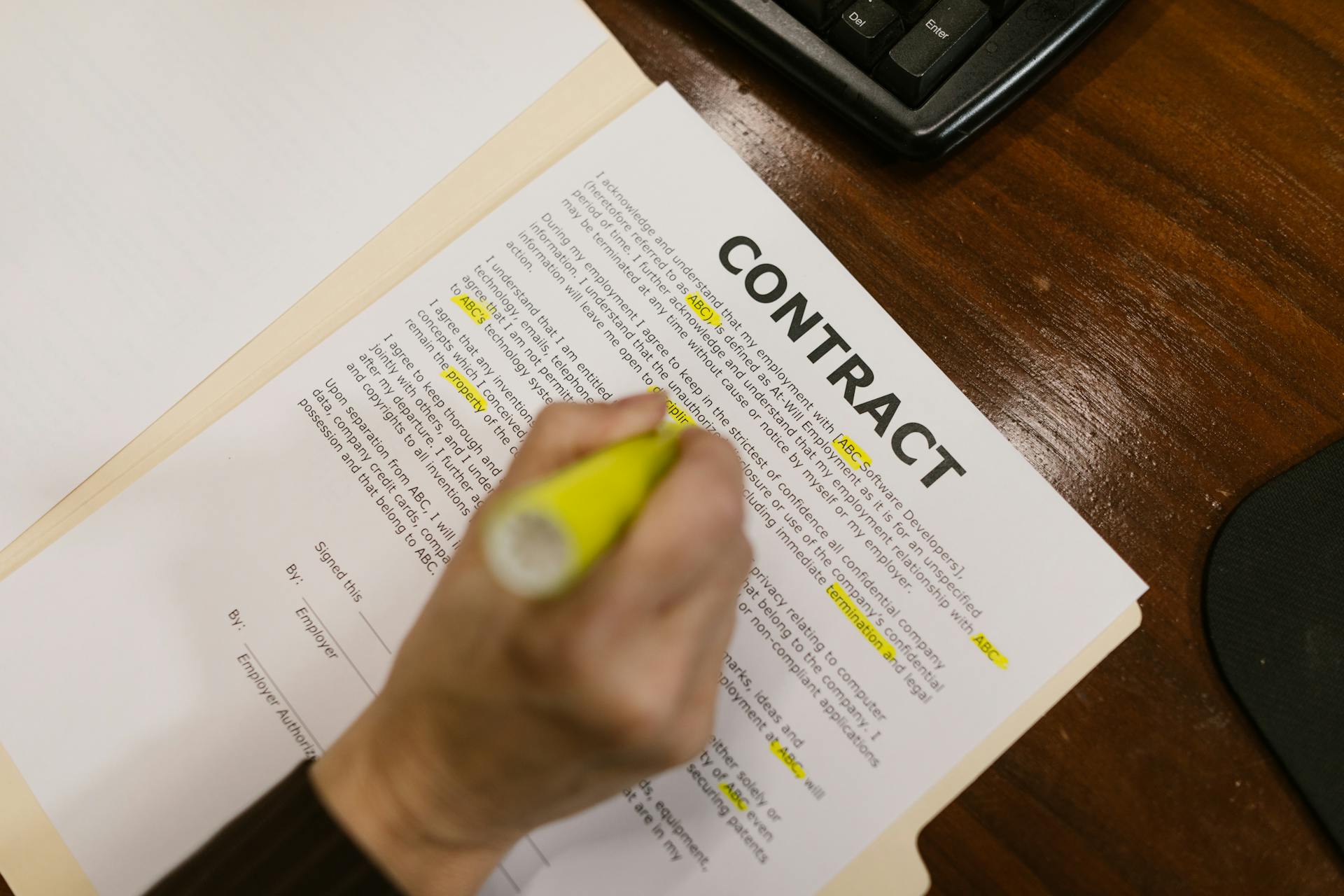
Contracted pricing in CPQ enables sales reps to select a negotiated price for a product and continue using that price on future contracts. This can be applied to new, renewal, and amendment quotes, making CPQ an essential tool in managing contracted pricing.
Special pricing in CPQ offers a way to modify prices when criteria are met, benefiting both the customer and the seller. This can include bulk orders or meeting other specific conditions, such as loyalty discounts that can drive more sales.
Contract Price Analysis and Understanding
Contract price analysis is a crucial aspect of contract management. It helps businesses understand how their contract prices are performing over time.
Contracted pricing can be structured in various ways, such as a fixed contract price or a time-and-materials arrangement. For example, a contractor may be entitled to receive a fixed contract price of $50,000, paid in installments, or an IT company may charge an hourly rate of $100 for development work.
Built-in analytics tools can provide insights into how contract pricing has performed, helping companies adjust pricing based on customer needs and preferences while meeting profitability goals. This sales analysis can also help businesses identify areas for improvement and optimize their pricing strategies.
For more insights, see: Time and Materials
Understanding Through an Example

The contract price is a critical component of any agreement, and understanding how it works can make all the difference in the outcome. In an example, an SMB hires a contractor to renovate its office space with a fixed contract price of $50,000.
This price includes labor, materials, and permits, and is paid in three installments: 30% upfront, 50% midway through the project, and 20% upon completion and approval of the work. The contractor's entitlement to this amount is clearly specified in the contract.
The contract price can also be structured as a time-and-materials arrangement, as seen in an IT company's agreement to develop custom software for a client. The hourly rate for development work is $100.
A contract price clause might appear in a contract as a detailed breakdown of the costs involved, including all relevant factors that affect the final price. Brad, an agent for big music artists, knows the importance of including all relevant factors in the contract price clause.
The final contract price depends on many factors, including how much the artist is paid per tour or concert, how much they are paid for each album, the cost of accommodations and travel, as well as for their living expenses.
Take a look at this: What Is a Non Compete Agreement
Analysis

Contract price analysis is a crucial process that helps businesses understand how their pricing strategies are performing. This analysis can be done through built-in analytics tools within CPQ software.
The contract price can be structured in various ways, such as a fixed price or a time-and-materials arrangement, like in the example of the IT company developing custom software for a client. The hourly rate of $100 for development work is a significant factor in determining the total cost.
Analyzing the contract price can provide valuable insights into customer needs and preferences, as seen in the example of the SMB hiring a contractor to renovate its office space. The contractor's entitlement to receive the contract price in three installments is a common practice in the industry.
Contracted pricing analysis can help CROs adjust pricing based on customer needs and preferences while still meeting profitability goals. This is achieved by analyzing the sales data and adjusting the pricing strategy accordingly.
The contract price can be paid in installments, such as the 30% upfront, 50% midway, and 20% upon completion and approval of the work, as seen in the example of the SMB contractor. This payment structure can help manage cash flow and ensure timely completion of the project.
For more insights, see: Contract Legal Advice
Contract Price Incentives and Fees

Contract price incentives and fees are a great way to motivate contractors to deliver excellent performance and keep costs under control. In a Cost Plus Incentive Fee contract, the contractor is reimbursed for their costs and receives an award fee for achieving specific milestones.
A Target Cost Incentive Fee contract is similar, but focuses on cost reduction. The contractor can earn increased fees for achieving cost savings, with a "Gain-Share" ratio applied to determine the share between the parties.
The Target Cost contract is a type of contract where both the client and contractor share the risk of cost overruns or savings. This promotes collaboration and alignment of interests between the two parties.
Here are some common contract price incentives and fees:
These contract types can be tailored to suit specific needs, but they all aim to encourage cost-effective performance and collaboration between the client and contractor.
Plus Incentive Fee
Cost Plus Incentive Fee contracts are an advanced contract mechanism that require good commercial management skills from both supplier and customer. They're an open book contract, meaning both parties have access to all costs, and are designed to lead to a better relationship between buyer and seller.

This type of contract consists of a base contractual fee and an award fee determined by the achievement of specific milestones. The fee should be adjusted proportionately if the performance of the contract is at a lower threshold than expected.
One of the key benefits of Cost Plus Incentive Fee contracts is that they provide an incentive for the supplier to deliver excellent performance in accordance with the performance criteria stated in the contract. This is achieved through the award fee, which is based on the supplier's ability to meet specific milestones.
In a Cost Plus Incentive Fee contract, the supplier is reimbursed for the costs of performing work, and the fee is adjusted based on the supplier's performance. This type of contract is often used in situations where the supplier has a high degree of control over the costs of the project.
Here's a summary of the key elements of a Cost Plus Incentive Fee contract:
- Base contractual fee
- Award fee based on achievement of specific milestones
- Fee adjustment based on supplier performance
- Supplier reimbursement for costs of performing work
Overall, Cost Plus Incentive Fee contracts are a powerful tool for incentivizing supplier performance and promoting a collaborative relationship between buyer and seller.
Plus Fixed Fee

A cost-plus fixed fee contract price type is an open book contract that reimburses the contractor for allowable costs and pays a fixed fee for delivery.
This arrangement is more suitable for transactional contracting where output-based performance criteria are already optimized or hard to define.
The contractor is reimbursed allowable costs, as defined within the contract, which means they can recover their expenses.
A fixed fee for delivery is paid to the contractor, providing a predictable income stream.
This type of contract is often used in situations where the contract price is not heavily dependent on the contractor's performance.
Broaden your view: Is It Legal for Debt Collectors to Charge a Fee
Contract Price Documentation and Review
Contract price documentation is crucial for transparency and accountability in contract negotiations. The contracting officer must document the principal elements of the negotiated agreement in the contract file.
The documentation, such as a price negotiation memorandum (PNM), should include the purpose of the negotiation. This is essential for understanding the context and goals of the negotiation.

A description of the acquisition, including the RFP number, should also be included in the documentation. This helps to identify the specific contract action and its requirements.
Each person representing the contractor and the Government in the negotiation should be identified, along with their organization and position. This provides a clear record of who was involved in the negotiation.
The current status of any contractor systems that affected the negotiation, such as purchasing or estimating systems, should be documented. This helps to understand the contractor's capabilities and limitations.
If certified cost or pricing data were not required, the exception used and the basis for it should be stated. This ensures that the contracting officer's decision is clear and justifiable.
If certified cost or pricing data were required, the contracting officer should document their reliance on the data, any inaccuracies or incompleteness, and the action taken as a result. This provides a clear record of the data's impact on the negotiation.
A summary of the contractor's proposal, any field pricing assistance recommendations, and the Government's negotiation objective should be included. This helps to understand the negotiation's outcome and the factors that influenced it.
On a similar theme: Texas the Contract Provides Express Remedy

The most significant facts or considerations controlling the establishment of the prenegotiation objectives and the negotiated agreement should be documented. This provides a clear record of the negotiation's key factors and decisions.
Documentation of fair and reasonable pricing is also essential, including a discussion of the data used to support the determination. This ensures that the negotiated price is justifiable and reasonable.
Contract Price Risk Management and Escalation
Contract price risk management and escalation are crucial aspects of contract price management. A well-drafted escalation clause can help mitigate the risk of rising costs, which can erode profit margins or even render projects unprofitable.
In industries like construction, where costs for materials like steel, lumber, and concrete can fluctuate dramatically, price escalation clauses are essential. These clauses allow adjustments to the contract price if certain predefined conditions are met, such as significant changes in material costs or inflation indices.
A key element of a well-drafted escalation clause is the trigger event, which clearly defines the conditions that justify price adjustments. For example, a trigger event might be a material price increase beyond a certain percentage.
Take a look at this: Contract Document Management

The adjustment formula is another critical element, as it provides a transparent method for recalculating the contract price based on industry indices or actual cost changes. This helps prevent disputes and ensures that both parties understand how the price will be adjusted.
To manage contracted pricing effectively, it's essential to have clear notification requirements for contractors to provide timely notice of cost changes. This helps prevent surprise price increases and allows buyers to plan accordingly.
A ceiling or cap on price adjustments can also help protect the buyer from unlimited cost exposure. This limits the amount by which the price can be adjusted, preventing unexpected and potentially crippling costs.
Here are the key elements of a well-drafted escalation clause:
- Trigger Events: Clearly defined conditions that justify price adjustments
- Adjustment Formula: A transparent method for recalculating the contract price
- Notification Requirements: Obligations for contractors to provide timely notice of cost changes
- Ceiling or Cap: A limit on how much the price can be adjusted
Contract Price Key Takeaways and Guidance
The contract price is a total amount agreed upon by two parties, which is paid by the client to the contractor when the project is completed. This amount is based on the terms and conditions of the contract and any modifications.

Understanding the different pricing structures is critical for negotiating fair and predictable terms. This includes fixed-price, cost-plus, unit price, and time-and-materials.
External factors like inflation, supply chain disruptions, and material cost escalation can significantly affect the final contract price if not addressed in the agreement. It's essential to include price adjustment clauses or escalation provisions to protect both parties.
Detailed documentation and negotiation of the scope of work, payment schedule, and variation clauses help avoid disputes over payment obligations. This includes providing a detailed price breakdown, unit rates, quantities, and other information on pricing.
A contract price is often based on one lump sum price, which can be a risk for the contractor if costs change after their design. To mitigate this, tenders might require a breakdown of the price, which can help assess interim payments.
Here are some key factors to consider when determining the contract price:
- Fixed-price: a fixed amount for the entire project
- Cost-plus: the contractor is reimbursed for actual costs plus a markup
- Unit price: a price per unit of work or material
- Time-and-materials: the contractor is paid for time and materials used
Featured Images: pexels.com