
iShares can be a great addition to your investment portfolio, offering a wide range of ETFs that track various asset classes and sectors.
iShares has over 800 ETFs listed on major exchanges, providing investors with a vast selection of investment options.
These ETFs are designed to track specific market indexes, sectors, or asset classes, allowing you to diversify your portfolio with a single investment.
Some iShares ETFs have lower expense ratios compared to actively managed funds, which can help you save on costs and potentially earn higher returns over time.
Investment Options
iShares offers a range of investment options to suit different investor needs.
You can choose from over 800 exchange-traded funds (ETFs) in various asset classes, including stocks, bonds, commodities, and currencies.
Some of these ETFs track a specific market index, such as the S&P 500, while others focus on a particular sector or geographic region.
iShares also offers actively managed ETFs, which are managed by a fund manager who actively selects securities to include in the portfolio.
These options give investors flexibility and control over their investments, allowing them to diversify their portfolios and potentially reduce risk.
For example, the iShares S&P 500 ETF (IVV) tracks the S&P 500 index, providing exposure to the largest US companies.
The iShares Core U.S. Aggregate Bond ETF (AGG) tracks a broad bond market index, offering a diversified portfolio of US investment-grade bonds.
These ETFs are designed to be cost-effective and efficient, often with lower fees compared to actively managed mutual funds.
Intriguing read: Ishares Muni Bond Etf
Index Funds
Index funds are a great way to invest with iShares. In fact, iShares Core ETFs have outperformed 91% of their ETF and mutual fund peers in the last 10 years. This is likely due to their low costs, which are less than 1/10th the cost of the typical mutual fund.
One of the benefits of index funds is that they tend to have low fees. The iShares Core S&P Total U.S. Market ETF, for example, has an expense ratio of just 0.03%. This means that for every $10,000 invested, you'll pay only $3 in fees annually.
A different take: Mutual Fund Portfolio Analysis
Investing in index funds can also provide diversification, which can be especially helpful during economic downturns. The iShares Core S&P Total U.S. Market ETF, for instance, tracks the S&P Total Market Index, giving you exposure to a collection of roughly 3,550 stocks, including micro-, small-, and mid-cap stocks. This can provide an edge in times of economic recovery.
You might enjoy: Marketability of Stocks and Bonds Is
S&P 500 Index
The S&P 500 Index is a widely followed benchmark of the US stock market, tracking the performance of 500 of the largest and most liquid US stocks.
This index is a market-cap-weighted index, meaning that the largest companies have a greater influence on the overall performance of the index. The iShares S&P 500 Index fund is essentially the same portfolio as its ETF counterpart, just in a different wrapper.
The iShares Core S&P 500 ETF provides exposure to US large-cap stocks at a low cost, with an expense ratio of 0.03% and a dividend yield of 1.7%. It replicates the S&P 500 index, which is a market-cap-weighted index of 500 of the largest US stocks.
Explore further: Enterprise Value Market Cap
Here are some key statistics about the iShares Core S&P 500 ETF:
Investing in the iShares Core S&P 500 ETF will give you exposure to a collection of roughly 500 stocks, with the largest stocks making up the bulk of the portfolio due to the index's market-cap weighting.
Consider reading: Ark Invest Ai Stocks
TIPS Bond Index
The iShares Short-Term TIPS Bond Index is a fund that invests mainly in US Treasury notes.
This fund seeks to beat the Bloomberg US Treasury Inflation-Protected Securities 0-5 Year Index.
It offers exposure to the short end of the curve, which correlates more closely with inflation than portfolios that include longer-term TIPS portfolios.
This strategy can be beneficial for investors who want to minimize their risk and maximize returns in a short-term investment.
The iShares Short-Term TIPS Bond Index focuses on US Treasury notes, which are considered to be a low-risk investment.
Discover more: Tuttle Capital Short Innovation ETF
Investment Strategies
iShares offers a range of ETFs that can serve as core building blocks for an investment portfolio. These include US stocks, US bonds, and international stocks.
The iShares Core MSCI Total International Stock ETF (IXUS) and iShares Core S&P 500 ETF (IVV) are two of the top-rated ETFs that earn a Morningstar Medalist Rating of Gold with 100% analyst coverage. They are considered essential for a diversified portfolio.
Some iShares ETFs also target more refined parts of the market, including style, market cap, sector, and global strategies. These may earn Morningstar Medalist Ratings of Silver or Bronze and are worth considering.
Here are some of the top-rated iShares ETFs that can be used as building blocks for an investment portfolio:
- iShares Core MSCI Total International Stock ETF (IXUS)
- iShares Core S&P 500 ETF (IVV)
- iShares Core S&P Total U.S. Stock Market ETF (ITOT)
- iShares Core Total USD Bond Market ETF (IUSB)
- iShares Core US Aggregate Bond ETF (AGG)
Enhances growth in low to moderate equity returns
If you're looking to enhance growth in low to moderate equity returns, consider iShares BuyWrite ETFs. These funds use a systematic approach to invest in a combination of large-cap stocks and S&P 500 Index futures, allowing for potential growth participation in market upswings.
The iShares BuyWrite ETFs, such as BALI, offer a cutting-edge systematic approach managed by a team with over a decade of experience and $5B in AUM of income-oriented strategies. This approach can help investors reach their goals by targeting clearer outcomes over a known period.
Curious to learn more? Check out: Sbi Dividend Yield Fund Direct Growth
Some iShares BuyWrite ETFs, like TLTW and LQDW, have a high 30-day SEC yield, with TLTW at 3.59% and LQDW at 4.15%. This can be attractive to investors seeking higher returns. However, it's essential to note that these yields are subject to change and may not be sustainable in the long term.
Here are some key facts about iShares BuyWrite ETFs:
- TLTW has a 30-day SEC yield of 3.59% and a 12-month trailing yield of 15.87%.
- LQDW has a 30-day SEC yield of 4.15% and a 12-month trailing yield of 17.35%.
- HYGW has a 30-day SEC yield of 5.80% and a 12-month trailing yield of 13.51%.
Keep in mind that these yields are subject to change and may not be sustainable in the long term. It's essential to carefully review the fund's performance and fees before investing.
Do You Use Vanguard?
I use neither Vanguard nor iShares, as I have a brokerage account with M1 Finance that allows me to create a portfolio that auto-rebalances.
You can mirror the portfolios that Vanguard or iShares makes up and plug them into M1 Finance to get a fee-free ETF with no expense ratio.
One of the reasons I prefer M1 Finance is that they have no trading fees or commissions, which can save you money if you're not with a commission-free broker yet.
You might enjoy: Venture Capital Finance Innovation
I do use iShares more than Vanguard, and that's because I've found it's easy to duplicate iShares ETFs in M1 Finance, but not always with Vanguard ETFs.
Vanguard rarely has an ETF for certain foreign markets, and when they do, it's often a basis point or two higher than iShares ETFs.
Risk Management
Risk management is a crucial aspect of investing, and iShares offers several strategies to help mitigate potential losses.
MARKET PARTICIPATION helps guard against drawdowns while still allowing for some upside potential, up to a predetermined cap. This can be especially helpful during volatile market periods.
By implementing DOWNSIDE PROTECTION, investors can seek to mitigate drawdowns and dampen volatility within a downside buffer range. This can provide a sense of security and stability in uncertain markets.
To navigate risk, iShares offers CLEARER OUTCOMES, which seeks to provide clearer outcomes over a known period to stay invested in volatile markets.
For more insights, see: Equity Market Averages
Navigate Risk
Navigating risk is a crucial aspect of risk management. By implementing strategies like market participation, downside protection, and clearer outcomes, you can effectively mitigate potential losses and stay invested in volatile markets.
Check this out: Country Risk Premium Aswath Damodaran
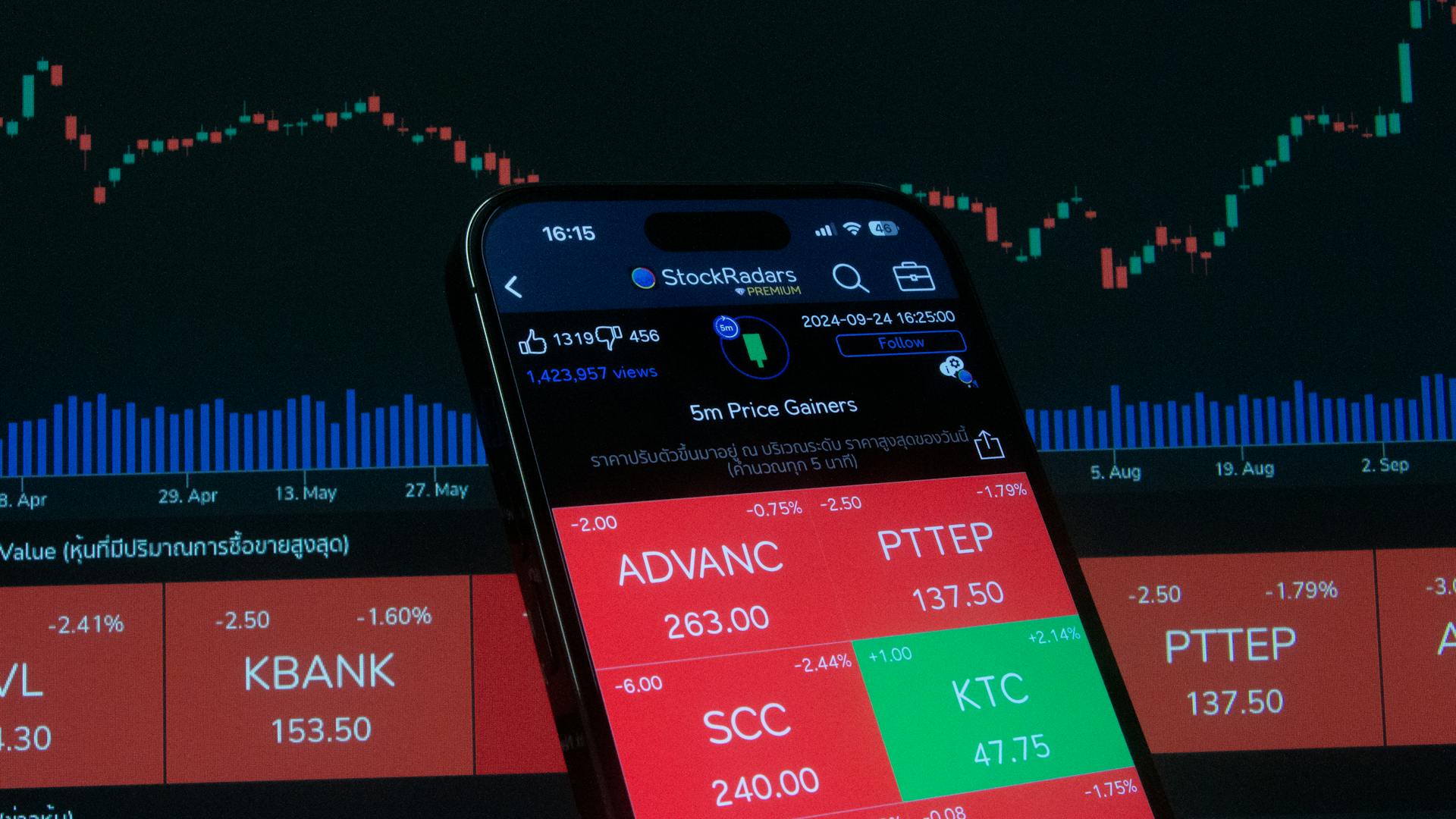
Market participation can help guard against drawdowns while still allowing for some upside potential, up to a pre-determined cap. This means you can limit your losses while still benefiting from market gains.
Downside protection is another key strategy, which seeks to mitigate drawdowns and dampen volatility within a downside buffer range. This can provide peace of mind and help you stay invested during turbulent times.
Here are some key strategies for navigating risk:
- Market Participation: Guards against drawdowns while still maintaining some upside potential, up to a pre-determined cap.
- Downside Protection: Seeks to mitigate drawdowns and dampen volatility within a downside buffer range.
- Clearer Outcomes: Seeks clearer outcomes over a known period to stay invested in volatile markets.
By understanding and implementing these strategies, you can better navigate risk and achieve your financial goals.
What's Better Than Expense Ratios?
The two ETF brands, iShares and Vanguard, are nearly identical, making it a toss-up which one is better in the long-run, except for expense ratios.
Their investment strategies are also very similar, with the main difference being that iShares seems to favor companies that are more international-oriented, while Vanguard is slightly more domestically oriented.
For non-US tax residents, such as European citizens, Vanguard ETFs have a disadvantageous dividend taxation, whereas iShares has a friendlier tax structure.
This tax difference is minimal, even in the long-run, but it's worth considering if you're a non-US tax resident.
Vanguard vs. Others: Lower Fees?
Vanguard and iShares ETFs have similar fees in the form of expense ratios, generally within 0.01% to 0.03% of each other.
Considering fees alone can be misleading, as what matters more is the unique elements each ETF has to offer.
Ultimately, both Vanguard and iShares ETFs charge around 0.03% in fees for their like-kind ETFs, such as VOO and IVV.
It's essential to think beyond fees and consider the risk of ETF bankruptcy and your current tax strategy.
Define Your Goal
Defining your goal is the first step to choosing the right investment. Discovering iShares ETFs that meet your financial goals is key to making informed decisions.
To get started, consider what you want to achieve with your investment. This might be saving for a down payment on a house, retirement, or a big purchase.
Your investment goal will help you determine the level of risk you're willing to take. If you're looking for long-term growth, you may be willing to take on more risk. If you're looking for stability, you may prefer more conservative options.
Understanding your goal will also help you choose the right asset allocation. For example, if you're saving for a down payment, you may want to focus on stable, low-risk investments.
Recommended read: Odyssey Re
Mutual Funds
If you're considering iShares ETFs and BlackRock mutual funds, you may want to look beyond the top-rated ones. You can visit Morningstar's asset-management company hubs for iShares and BlackRock to review lists of their mutual funds and ETFs.
You can segment those lists by criteria such as stock or bond, and more. This will give you a better idea of the types of investments BlackRock and iShares offer.
Building your own screen using the Morningstar Investor Screener tool is another option. You can choose mutual fund or ETF as the investment type, and then drill down further based on asset class, category, ratings, and other metrics that matter to you.
For example, if you're interested in BlackRock mutual funds, you can type "BlackRock" as the keyword and then filter the results by asset class, such as stocks or bonds.
Suggestion: SBI Mutual Fund
Frequently Asked Questions
What is the advantage of iShares?
iShares offers diversified, low-cost investment options with tax-efficient benefits. This makes it an attractive choice for investors seeking efficient access to global markets.
What is the best performing iShares ETF?
Unfortunately, the provided text does not contain performance data, making it impossible to determine the best-performing iShares ETF. To find the top-performing iShares ETF, please visit the official iShares website or consult a financial advisor for the most up-to-date information.
Featured Images: pexels.com