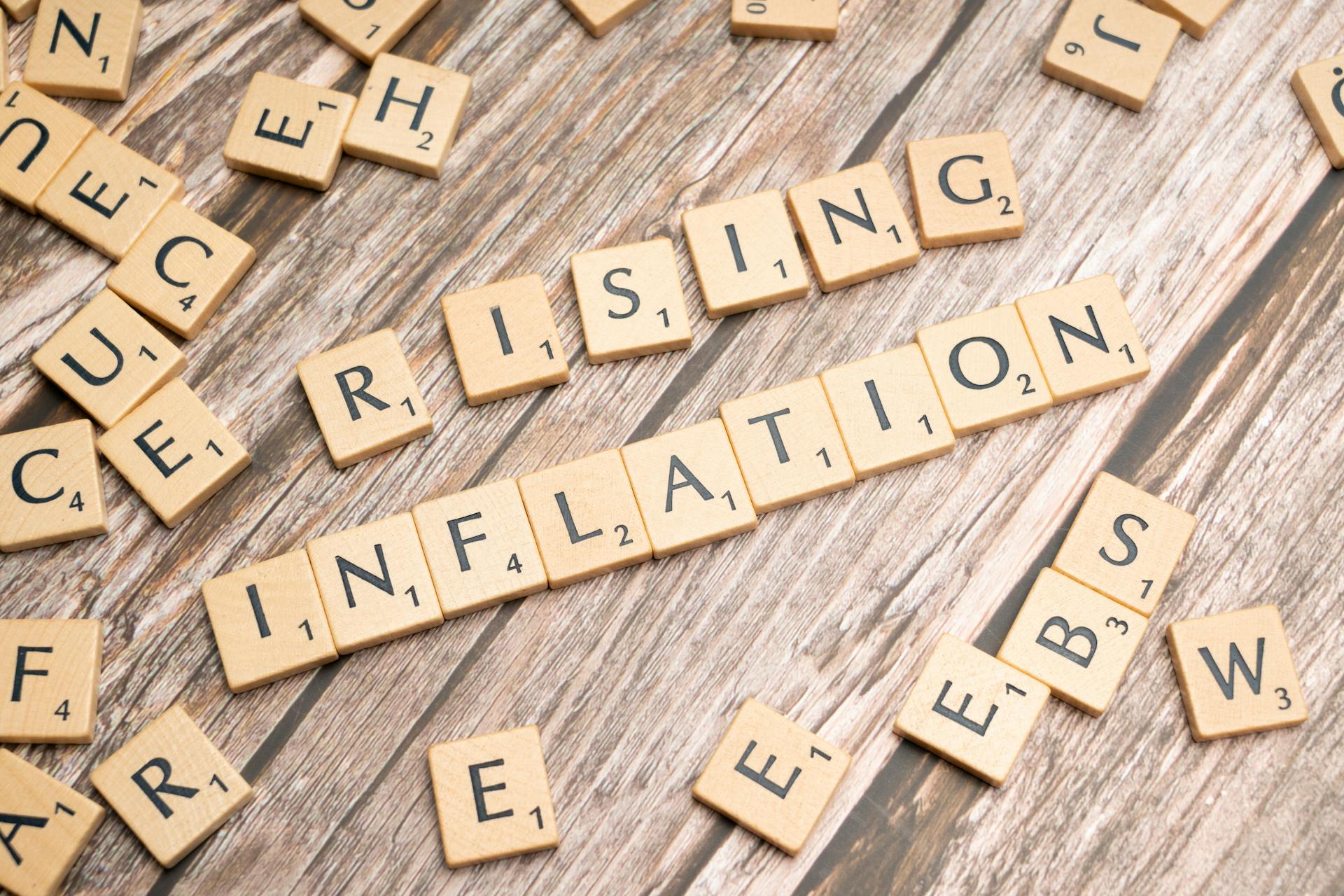
Argentina's inflation rate has been consistently high over the years, with some of the highest rates in the world. This is largely due to a combination of factors, including the country's economic policies and structural issues.
One major contributor to Argentina's inflation is the government's reliance on monetary financing, which involves printing more money to finance fiscal deficits. This has led to a surge in the money supply, causing prices to rise.
The country's high inflation rate has also been exacerbated by a lack of price controls and a weak regulatory framework. This has allowed businesses to raise prices freely, contributing to the inflationary spiral.
Argentina's economic history has been marked by periods of high inflation, dating back to the 1970s. The country's inflation rate has averaged around 100% per year since 1975.
Curious to learn more? Check out: Inflation and Share Prices
Causes of High Inflation
Argentina's inflation has been a persistent issue since the 1940s, with an average annual inflation rate of 189% between 1944-2024.
The government's introduction of new social policies and subsidies in the 1940s, aimed at redistributing wealth from the rich to the working classes, ended up increasing production costs and prices, leading to inflation.
A key factor contributing to Argentina's high inflation is its reliance on the International Monetary Fund (IMF), which has led to unsustainable foreign debt obligations and a collapse of the Argentine Peso against the US dollar.
The president, Mauricio Macri, requested a $57 billion relief package from the IMF in 2018, but inflation continued to rise despite the promise of reducing inflation and public spending.
Argentina's money supply has nearly quadrupled over a 30-year period, from 711 billion pesos in 1990 to 2.5 trillion pesos in 2020, and has since increased tenfold in less than four years to 22 trillion pesos as of September 2023.
The massive increase in the money supply is a major contributor to Argentina's inflation, as it leads to a decrease in the value of money and an increase in prices.
In 2019, the government failed to make an interest payment of $500 million to foreign creditors, leading to a default and a loss of access to finance, further exacerbating the economic stress and inflation.
The COVID-19 pandemic added to the economic stress, forcing the government to print more money and further contributing to the soaring inflation rates.
Consider reading: Why Are Prices so High
Understanding Argentina's Economic History
Argentina's economic history is a complex and troubled one. Since 1945, the country has averaged 189% annual inflation, one of the highest rates in the world.
The government's decision to introduce new social policies and subsidies in the 1940s to redistribute wealth to the working class led to increased production costs and prices, ultimately causing inflation.
In recent decades, Argentina has struggled with massive increases in its money supply, which has contributed to its high inflation rate. Between 1990 and 2020, the money supply nearly quadrupled, and by 2023, it had grown by nearly tenfold in just four years.
Argentina has defaulted on its debt nine times and has experienced multiple currency devaluations, including a 50% devaluation under the current government.
Consider reading: Changing the Money Supply Can Affect
Argentina's Inflation History
Argentina has struggled with high inflation rates for decades, averaging 189% annually between 1944 and 2024.
The country's inflation problems began in the 1940s when the government introduced new social policies and subsidies to redistribute wealth.
In 1990, Argentina had a relatively stable money supply of 711 billion pesos, but by 2020, this number had grown to 2.5 trillion pesos, a nearly fourfold increase.
This massive increase in the money supply is a key contributor to Argentina's inflation woes, as it leads to a decrease in the value of each peso.
The government's decision to quadruple the money supply over a 30-year period set the stage for the country's ongoing inflation struggles.
In recent years, Argentina's money supply has grown even more rapidly, with the total money supply reaching 22 trillion pesos as of September 2023, a nearly tenfold increase in less than four years.
This rapid expansion of the money supply has led to a sharp increase in inflation, making it difficult for Argentinians to afford basic necessities.
Argentina has been heavily reliant on the International Monetary Fund (IMF) for financial support, but this has not helped to alleviate the country's inflation problems.
In 2018, Argentina's foreign debt obligations reached unsustainable levels, leading to a collapse in the value of the peso against the US dollar.
The government's subsequent decision to print more money to finance its spending has only exacerbated the inflation problem, leading to a default on its debt obligations in 2020.
Wretched Economic History
Argentina's economic history is a complex and wretched tale that spans decades. The country has averaged 189% annual inflation between 1944 and 2024, one of the highest rates in the world.
Rampant government spending and massive government borrowing have contributed to this economic mess. The government has defaulted on its debt nine times, a staggering number that highlights the country's financial struggles.
The Argentine peso has been devalued multiple times, with a 30% devaluation in 2015 and another in 2016. This has only added to the country's economic woes.
Argentina's reliance on the International Monetary Fund (IMF) has also played a significant role in its economic history. In 2018, the country requested a $57 billion relief package from the IMF, but inflation continued to soar despite this aid.
The COVID-19 pandemic has only exacerbated Argentina's economic stress, forcing the government to print more money and further fueling inflation.
Impact on Argentinians and Solutions
The high inflation in Argentina has a significant impact on the daily lives of its citizens. Many Argentinians are struggling to make ends meet due to the rapid devaluation of the peso.
The purchasing power of Argentinians has decreased dramatically, with prices increasing by 50% in just one year, as seen in the sharp rise in food prices. This has made it difficult for people to afford basic necessities like food and housing.
The government's inability to control inflation has led to a loss of trust in the economy, causing many Argentinians to seek alternative currencies like the US dollar.
Worth a look: Why Are Gold Prices so High
What Does This Mean for Argentinians?
In Argentina, people often pay with wads of cash because the value of money declines dramatically over time due to high inflation rates.
Karla, a guide in Buenos Aires, shared that saving money is pointless, so people spend it as soon as they get it.
The annual inflation rate in Argentina is 67%, making it challenging to save or invest money.
A one-month CD in Argentina pays an annual rate of about 27%, which is still below the inflation rate.
A fresh viewpoint: Rubles Inflation Rate
Getting a loan is extremely difficult in Argentina due to the high inflation rate and the risk of default.
The country has a history of widespread bank failures, including in 2001, which has led to a lack of trust in banks.
U.S. banks don't have operations in Argentina due to the unpredictable economy, making it a challenging environment for foreign investment.
Exchanging pesos for dollars is highly desirable for those who can afford it, with the current exchange rate being about 1,069 pesos to $1.
For major purchases, $100 bills are often the preferred payment method, and people even hide bundles of dollars in safe deposit boxes.
Check this out: Rate of Inflation in Us
Hyperinflation and Dollarization for Argentina's Stability
Argentina's economy has been plagued by hyperinflation, with the money supply nearly quadrupling over a 30-year period, from 711 billion pesos in 1990 to 2.5 trillion pesos in 2020.
This massive increase in the money supply is a major contributor to Argentina's high inflation rates. In fact, the government nearly quadrupled the amount of money in circulation over a 30-year period.
As of September 2023, the total money supply stood at 22 trillion pesos, a staggering increase of nearly tenfold in less than four years. This extreme money printing has led to drastic price increases, making the cost of living in Argentina comparable to countries like Spain.
The cost of living in Argentina has increased significantly, with prices not too different from those in Spain, and in some cases even more expensive than in the UK or US.
Argentina's new president, Javier Milei, has plans to improve the economy by dolarizing it, replacing the Argentine Peso with the US dollar. He also wants to remove the central bank and privatize many areas of industry.
It's estimated that by the second half of 2024, a decrease in inflation will be seen, although some disagree. Surprisingly, since Milei's inauguration, the exchange rate between the Argentine Peso and the US dollar has remained stable.
For another approach, see: Why Is the Canadian Dollar so Weak
Argentina's Economic Woes
Argentina's economic woes are a complex issue, but one major contributor is the country's history of printing more money to pay its bills. Since 1945, Argentina has averaged 189% annual inflation, making it one of the countries with the world's highest inflation rates.
The problem began in the 1940s when the government introduced new social policies and subsidies, which weren't backed by anything, leading to an increase in production costs and prices.
Argentina's reliance on the International Monetary Fund (IMF) has also contributed to its economic struggles. In 2018, foreign debt obligations reached unsustainable levels, and the peso collapsed against the US dollar.
The government's decision to print more money in 2020, when it defaulted on a $500 million interest payment to foreign creditors, further exacerbated the inflation problem.
Today, inflation remains high in Argentina, with prices increasing drastically. The cost of living has become so high that prices are comparable to those in countries like Spain, and in some cases, even higher than in the UK or US.
Argentina's new president, Javier Milei, has plans to improve the economy by dollarizing it, replacing the Argentine Peso with the US dollar, and privatizing many areas of industry.
On a similar theme: New Albion Brewing Company
Featured Images: pexels.com