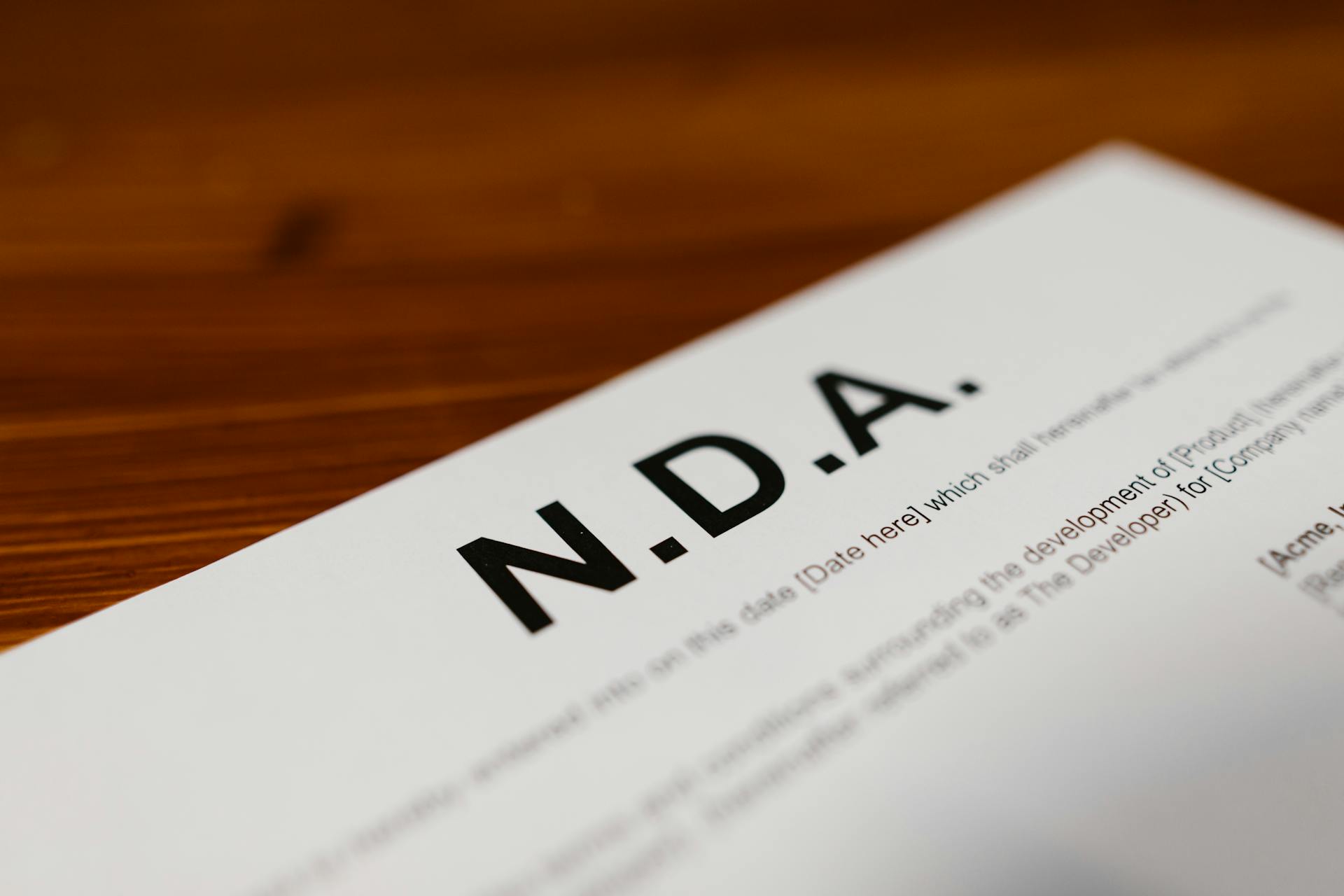
A Non-Disclosure Agreement, or NDA, is a legally binding contract that requires parties to keep confidential information secret. It's often used in business settings to protect sensitive information.
The purpose of an NDA is to prevent the disclosure of confidential information to unauthorized parties. This is crucial in situations where businesses are sharing sensitive data with partners, employees, or contractors.
Key components of an NDA include the definition of confidential information, the obligations of the parties involved, and the consequences of breaching the agreement.
Related reading: Protected Disclosure
What is a NDA
A non-disclosure agreement, or NDA, is a legally binding contract that establishes a confidential relationship between two parties. This contract is essential for businesses that need to share sensitive information with others.
An NDA is also referred to as a confidentiality agreement, and its primary purpose is to protect confidential information from being shared with competitors or third parties. This can include everything from product specs to client rosters.
Take a look at this: A Written Contract between Two Parties Is
The NDA creates a legal framework to protect ideas and information from being stolen or shared, and breaking an NDA agreement can trigger lawsuits, financial penalties, and even criminal charges. This is a serious matter, and businesses take NDAs very seriously.
An NDA classifies information, allowing parties to work freely within the boundaries created by the confidentiality agreement. This means that protected information is clearly defined, and parties know what can and cannot be shared.
Signing an NDA creates a legal obligation to keep sensitive information confidential, and any leak of that information is a breach of contract. This is a crucial aspect of an NDA, as it ensures that sensitive information remains confidential.
An NDA can protect patent rights by preventing public disclosure of a pending invention, which can sometimes void patent rights. This is especially important for inventors who are developing new products or concepts.
Most NDAs don't last forever, and many confidentiality agreements explicitly state the number of years that sensitive information must be kept secret. Even those with an indefinite time frame will often indicate when information is no longer protected by the agreement.
Here are some types of information that are typically protected by an NDA:
- Product specs
- Client rosters
- Business models
- Test results
- Embargoed press releases or product reviews
These are just a few examples of the types of information that can be protected by an NDA. The specific types of information protected will depend on the terms of the NDA.
Types of NDAs
A non-disclosure agreement (NDA) can come in different forms, each with its own rules and purposes. There are three main types of NDAs: unilateral, bilateral, and multilateral.
Unilateral NDAs are one-sided, where one party agrees not to reveal confidential information. An employment contract is an example of a unilateral NDA.
In a mutual NDA, both parties agree not to share confidential information. This type of NDA is often used in mergers and acquisitions, joint ventures, and teaming agreements.
Whether you need a unilateral or mutual NDA depends on the type of business activity, the level of reciprocity, and the number of parties involved. If there's a mutual exchange of information or multiple actors, a mutual NDA might be the way to go.
Here are some key questions to consider when drafting your NDA:
- Business Type: Does the activity involve a mutual exchange of information or multiple actors?
- Reciprocity: Are both sides equally protected and obligated?
- Number of Parties: Are there more than two parties participating?
These factors will help you determine whether a unilateral or mutual NDA is the right choice for your situation.
Components and Structure
An NDA, or non-disclosure agreement, has specific components that are essential to its structure and effectiveness. These components include the identification of parties, definitions of confidential information, and obligations of the parties involved.
A clearly defined scope is crucial to ensure the NDA's enforceability. Using general terms like "proprietary information" isn't specific enough and won't hold up in a legal setting. The scope should lay out what specific information the NDA covers.
The obligations section outlines the consequences of breaching the agreement, including what happens if protected information is shared. This section should be specific and clear to avoid any confusion.
An NDA may also include a return of information clause, which requires the recipient to confirm that sensitive information has been returned or destroyed after the conclusion of business between the parties.
Exclusions are also a key component of an NDA, defining the types of information that do not need to be kept confidential. This might include public knowledge, previously disclosed details, or information someone knew before entering a business or financial relationship with a company or firm.
Worth a look: Do Employment Background Checks Include Credit
Here are the essential components of an NDA:
These components work together to create a comprehensive and enforceable NDA that protects sensitive information and ensures confidentiality.
Confidentiality and Exclusions
Defining confidential information is a crucial part of a non-disclosure agreement (NDA). A company must identify the information that must not be shared, but it's not always easy to define.
A company can't assume everyone will understand what is proprietary information, so it's their responsibility to identify it. They might broadly assign confidentiality to a large group for this reason.
For example, a company might state that any information disclosed from or regarding its research and development department is confidential.
Exclusions to confidentiality can be defined in an NDA, making it easier to catch exceptions that might slip by. This can be done by stating that all information shared with an external party is to be confidential except for specific items determined by the company.
You might like: Confidentiality Provisions in Settlement Agreements
NDAs can't contain information that is common knowledge or already in the public domain. This includes information that becomes publicly known at no fault of the signer of the NDA.
Information that the signer of the NDA already knows before receiving the agreement can't be included in the agreement. Similarly, information that could be determined via independent research or rightfully obtained from a third party can't be defined as confidential.
Here are some examples of information that might be excluded from confidentiality:
- Publicly available information
- Information already known by the signer
- Information obtainable through independent research
- Information rightfully obtained from a third party
Agreement Participants and Duration
An NDA typically involves two or more parties, including the disclosing party and the recipient of confidential information. These parties can be individuals, companies, or business partners, and their roles are clearly defined in the agreement.
The duration of an NDA can vary greatly, ranging from one year to 10 years, depending on the type of information being protected. In some cases, an NDA can even be indefinite, but it must be specific and enforceable to be valid.
If you're asked to sign an NDA, it's essential to understand who the parties involved are and for how long the agreement will last. This will help you navigate your obligations and ensure you're not bound by an overly restrictive contract.
Here are some common scenarios where you may be asked to sign an NDA:
- Starting a new job with an employer
- Beginning a work contract with a new client
- Exploring an investment opportunity
- Negotiating a business partnership or joint venture
- Merging with or acquiring a business
Signing an agreement
Signing an agreement is a crucial step in any business or professional relationship. You may be asked to sign an NDA in various situations, including starting a new job, beginning a work contract, exploring an investment opportunity, negotiating a business partnership or joint venture, or merging with or acquiring a business.
It's normal to be asked to sign an NDA when you'll be given access to sensitive information. Expect to see the parts of an NDA listed above, including the identification of parties, definitions, obligations, scope, time frame, return of information, exclusions, and remedies.
For your interest: A Sign
Before signing an NDA, take time to read it carefully and ensure you understand the contract. If you find broad or vague language that unreasonably restricts you, it may make sense to refuse to sign until that is resolved.
Some NDAs may include clauses about mutual non-disclosure or non-solicitation, as well as one stating the jurisdiction for handling disputes. It's essential to understand these clauses before signing the agreement.
Here are some common situations where you may be asked to sign an NDA:
- Starting a new job with an employer
- Beginning a work contract with a new client
- Exploring an investment opportunity
- Negotiating a business partnership or joint venture
- Merging with or acquiring a business
If you're unsure about signing an NDA, don't hesitate to ask questions or seek advice from a professional. It's always better to be safe than sorry when it comes to protecting sensitive information.
Agreement Participants
When creating a non-disclosure agreement, it's essential to specify the participants involved. A unilateral NDA involves one party agreeing not to reveal confidential information, whereas a mutual NDA involves both parties agreeing to keep confidential information private.

Every non-disclosure agreement must specifically designate each party involved. The individual receiving the sensitive information can be a specific person, all employees of another specific company, or any representative of the company.
The company must determine which legal entity has ownership of the information. In many cases, a company may simply list any legal entity under a broad ownership umbrella. This ensures that the agreement is enforceable and protects the confidentiality of sensitive information.
To determine the type of NDA needed, consider the following questions:
- Is the activity a mutual exchange of information or involves multiple actors?
- Are both sides equally protected and obligated?
- Are there more than two parties participating, or is each participating party providing information?
Here are some examples of participants in a non-disclosure agreement:
- Employee: An employee signing a unilateral NDA agrees not to share information learned on the job.
- Company: A company signing a mutual NDA ensures that none of the parties participating in the process divulge confidential information.
- Investor: An investor signing an NDA may prevent competitors from obtaining trade secrets or business plans.
How long does an agreement last?
An NDA can last anywhere from one year to 10 years, depending on the information that's to be kept private.
The length of time an NDA lasts can vary significantly, with some lasting a year and others lasting a decade.
In some cases, an NDA can even be indefinite, but it must be carefully crafted to be enforceable in court.
To be enforceable, an NDA can't be too open-ended or generic, or the courts may throw it out.
Legal Considerations
A non-disclosure agreement (NDA) is a legally binding contract, so if it's broken, the aggrieved party can take legal action. This can include seeking an injunction to prevent further disclosure.
The specific claims that can be made for a breached NDA include breach of the contract, breach of fiduciary duty, misappropriation of trade secrets, copyright infringement, and other intellectual property law violations. These claims can lead to financial damages for all losses related to the breach of confidentiality obligations.
If a business learns that an employee has broken an NDA, it may file a lawsuit seeking financial damages. This is in addition to seeking an injunction to prevent further disclosure.
For another approach, see: Avoid Prevent Burnout Work
Law by Jurisdiction
In some jurisdictions, the law is clear on what happens when a confidentiality agreement is breached. The successful party may choose between damages based on commercial profits or the price of releasing the other party from its obligations.
Commercial entities need to be careful when drafting their confidentiality agreements, as they can be held unenforceable if they go beyond what's necessary to protect commercial information. This was the case in Jones v Ricoh, where the High Court ruled that the agreement was too broad and breached EU competition law.
For another approach, see: Fmla Confidentiality Violations
The scope of a confidentiality agreement is crucial, and it's essential to ensure it doesn't restrict employees from disclosing certain information. For example, the 2024 Act renders void any NDA that prohibits an employee from disclosing allegations of discrimination, harassment, or victimization.
In summary, confidentiality agreements must be carefully drafted to avoid being held unenforceable. Here's a summary of the key points to consider:
- The successful party may choose between damages based on commercial profits or the price of releasing the other party from its obligations.
- The agreement must not go beyond what's necessary to protect commercial information.
- The 2024 Act prohibits NDAs that restrict employees from disclosing allegations of discrimination, harassment, or victimization.
Legal action for violation
Legal action for violation can be a serious matter. If a non-disclosure agreement (NDA) is broken, the aggrieved party can take legal action.
The party can claim breach of the contract, which is a common outcome when an NDA is violated. This can lead to financial damages for all losses related to the breach of confidentiality obligations.
Breach of fiduciary duty is also a possible claim, particularly if the individual had access to sensitive information. They may have been entrusted with confidential information and failed to uphold their duties.
Misappropriation of trade secrets is another potential claim, which can occur if confidential information is shared or used without permission. This can cause significant financial losses for the business.
Copyright infringement may also be a claim, especially if confidential information includes intellectual property. This can include things like trade secrets, patents, or trademarks.
Claims stemming from broken NDAs can be serious, and businesses may seek an injunction to prevent further disclosure. This can be a powerful tool to prevent further damage.
Here are some examples of claims that may be made when an NDA is broken:
- Breach of the contract
- Breach of fiduciary duty
- Misappropriation of trade secrets
- Copyright infringement
- Other intellectual property law violations
Benefits and Drawbacks
Signing a non-disclosure agreement (NDA) can be beneficial for protecting private information from becoming public. NDAs are clear, specifying what can and can't be disclosed to avoid confusion.
Having a clear NDA agreement can help deter competitors from stealing trade secrets, as seen with companies like Apple, which keeps its technology and future products closely guarded.
Signing an NDA can also generate buzz, as it creates an air of secrecy around exciting and important information, making it a marketing ploy for companies like Apple.
Readers also liked: Is Signing up for Too Many Credit Cards Bad
Core Uses of Info

An NDA is essential when sharing sensitive information with someone outside your organization. This includes licensing, sponsored projects, commercialization, and research collaboration communications.
You'll need a Mutual NDA if both parties are disclosing information, but a One Way NDA if only the University of Kentucky is sharing information.
A company may limit how the external party can use the information, such as prohibiting sharing with a competitor or replicating it for personal financial benefit.
Here are some key uses of information that are commonly restricted by an NDA:
- Sharing with third parties
- Replicating for personal financial benefit
- Sharing with competitors
In some cases, a company may disclose operating processes but restrict how the external party can use that information. This can help protect the company's sensitive data and prevent unauthorized use.
Advantages and Disadvantages
Signing a non-disclosure agreement, or NDA, can be a powerful way to keep private information under wraps, as seen with companies like Apple that keep their technology and future products closely guarded.
NDAs are clear and specific, avoiding any confusion by outlining what can and can't be disclosed.
Signing an NDA is a way to deter competitors from stealing trade secrets and copying products, which is especially important for companies that have been pioneers in their industry for a long time.
Keeping exciting and important information private can also generate buzz and create a sense of anticipation, as Apple has done with its closely guarded products.
NDAs can be a valuable tool for protecting sensitive information, but they also have their downsides.
Related reading: Howard Marks the Most Important Thing
Cost
The cost of a non-disclosure agreement (NDA) can vary greatly depending on its complexity. It can range from free, if you use a template available online, to over $1,000 if a lawyer creates it.
If you're looking to create a basic NDA, you can explore free templates online. However, if you need a more complex or customized agreement, be prepared to pay a higher price.

The cost of an NDA can be a significant factor in your decision-making process. It's essential to consider your budget and the level of protection you need before investing in an NDA.
Here's a rough estimate of the costs involved in creating an NDA:
Ultimately, the cost of an NDA will depend on your specific needs and the level of protection you require.
Other/Miscellaneous Provisions
Other/Miscellaneous Provisions can be a crucial part of an NDA, as they outline the specific requirements and regulations that apply to the agreement.
Various industries have different needs and government agencies often have stricter rules for keeping sensitive information private.
An NDA may detail applicable state law or laws that apply to the agreement, which is especially important to consider.
The party responsible for paying attorney fees in case of a dispute is also typically specified in the agreement.
If the agreeing party fails to comply with the terms, the course of action to be taken is usually defined in the NDA.
Featured Images: pexels.com