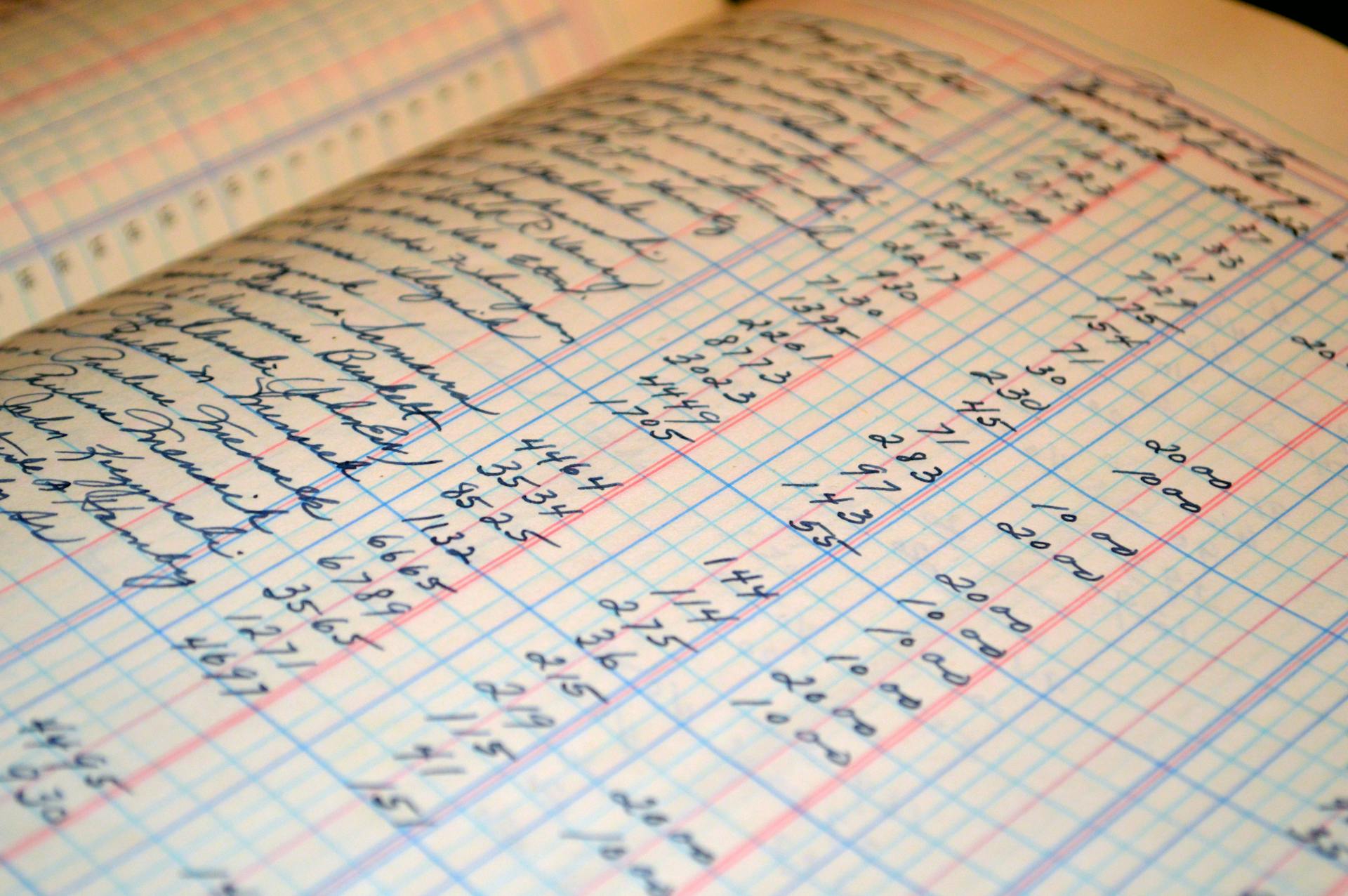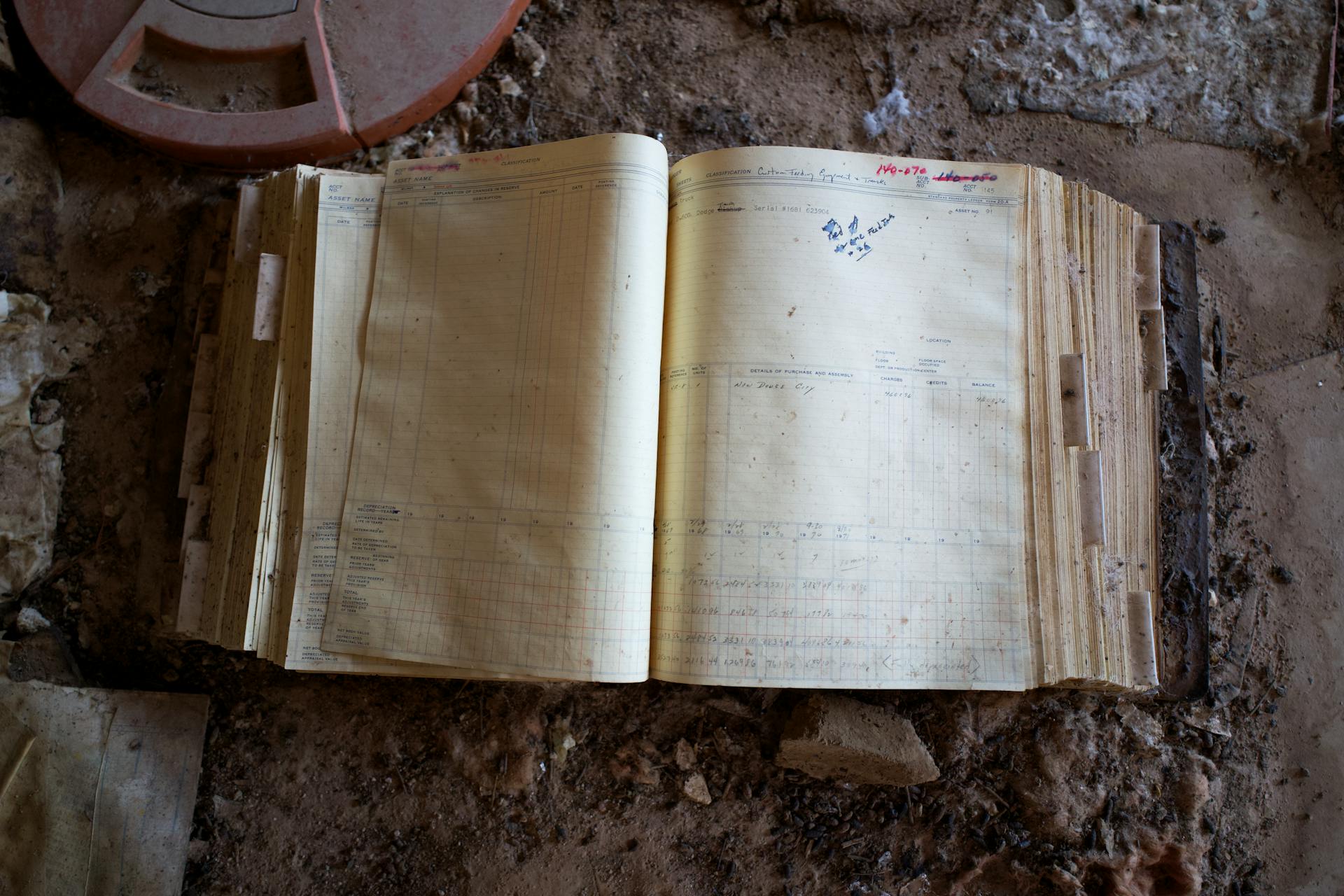
A ledger is a record-keeping system that helps you keep track of your financial transactions. It's a tool that's been around for centuries, and it's still widely used today.
The first ledgers were made of paper, and they were used by merchants and traders to keep track of their sales and purchases. Today, ledgers can be digital, making it easier to access and update your records.
A ledger typically consists of a series of pages or screens that are divided into columns, with each column representing a different type of information, such as date, account number, and amount. This makes it easy to scan and understand your financial data.
By using a ledger, you can stay on top of your finances and make informed decisions about your money.
Related reading: Profit Track 100
What is a Ledger?
A ledger is a book or digital file that stores bookkeeping entries, categorizing and recording all financial transactions. It's a core component of the accounting process, providing a structured way to track and analyze financial information.
In accounting, a ledger is essentially a collection of individual accounts, each representing a specific type of financial activity, like assets, liabilities, or expenses. Companies can maintain ledgers for all types of balance sheet and income statement accounts.
Transactions from subsidiary ledgers are periodically summarized and transferred to the general ledger, which contains transaction data for all accounts in the chart of accounts. This is important as it serves as a master document for all your financial transactions.
The general ledger helps you compile a trial balance, spot unusual transactions, and create financial statements. It reports revenue and expenses in real-time, helping you stay on top of your spending.
Here are the 5 main types of ledger accounts:
Preparing a ledger is important as it provides a clear and organized record of all financial transactions. This helps you make informed decisions about your business.
Setting Up a Ledger
To set up a ledger, start with the 5 account types: Assets, Liabilities, Equity, Revenue, and Expenses. Within each account type, list the accounts you need, such as a Cash account and an Accounts Receivable account.
You can break down these account types into subcategories, but for now, let's focus on the basics. A ledger is a tool that helps you keep track of your business's financial transactions, so it's essential to have a solid foundation.
Here's a quick rundown of the account types and their subcategories:
By setting up these account types and subcategories, you'll be well on your way to creating a comprehensive ledger that helps you manage your business's finances.
Create Columns
Start by making columns on the far left of the page for the date, transaction or journal entry number, and description. This will help you keep track of the transactions as you go along.
Make columns on the right side for debits, credits, and running balance. Debits increase asset and expense accounts and decrease liability, revenue, and equity accounts. Credits increase liability, revenue, and equity accounts and reduce assets and expenses.
The columns for debits and credits are crucial in double-entry accounting, where each transaction is recorded twice. This helps ensure that the total of all debit and credit entries balances out.
Here's a breakdown of the columns you'll need:
Set Up Accounts
Setting up accounts is a crucial step in creating a ledger. You'll need to start with the 5 basic account types: Assets, Liabilities, Equity, Revenue, and Expenses.
Assets account for the resources your business owns, such as cash, property, and inventory. Liability accounts record debts or obligations your business owes to others, like loans payable and accounts payable. Equity accounts reflect the owner's investment in the business, including capital and retained earnings.
Revenue accounts track income earned from your business operations, while Expense accounts record costs incurred in generating revenue. For example, rent expense, utilities expense, salaries, and taxes are all types of expense accounts.
Here are the 5 basic account types with their corresponding sub-accounts:
By setting up these accounts, you'll have a solid foundation for creating a ledger that accurately tracks your business's financial activities.
Recording Transactions
Recording transactions is a crucial part of maintaining a ledger. You should record financial transactions day-to-day as they occur.
To ensure accuracy, it's essential to post journal entries to the ledger immediately. This helps prevent errors and ensures that your records are up-to-date.
A company's ledger records can serve as proof that accurate information was presented to shareholders or creditors. This is especially important for businesses in certain sectors.
Recording transactions in detail provides a safeguard against errors or fraud. It also allows you to make informed decisions by having access to the original records.
Ledger vs. Journal
A ledger contains the same information as a journal, but it's presented by category rather than in chronological order. This helps with organization and makes it easier to track specific accounts.
In a ledger, transactions are organized by account, making it simpler to see how much money is coming in and going out. This is particularly useful for businesses with multiple accounts.
A journal, on the other hand, contains transactions in chronological order, which can be helpful for tracking changes over time.
A different take: Chronological Resume
Journal vs. Ledger
A journal is the primary book of accounting where financial transactions are initially recorded in chronological order. This is where bookkeepers keep track of every transaction, including detailed descriptions.
Both journals and ledgers have the same two-column format, with debits on the left and credits on the right. However, journals are more focused on recording transactions in the order they occur.
In double-entry bookkeeping, financial transactions are recorded in the journal first, and then summarized in the ledger. The journal is also known as the book of original entry.
A company's general journal is where everyday transactional information is stored. Special journals are used for high-volume transaction types, like accounts payable or accounts receivable.
Companies may use single-entry bookkeeping in journals, which records each transaction as either a debit or a credit, not both. This method is simpler and faster but not as robust as double-entry bookkeeping.
In double-entry bookkeeping, the journal must include detailed descriptions for every transaction. The ledger, on the other hand, has summarized information in the "T-account" format.
Readers also liked: What Business Does Every Small Town Need
The general ledger is the master chart of accounts where all business transactions are recorded. A sub-ledger, or subsidiary ledger, is a set of intermediary accounts linked to the general ledger that contain transaction information.
For larger companies, individual transactions are recorded in sub-ledgers and the totals are then transferred to an account within the general ledger. This helps to keep the general ledger from becoming overwhelmed.
Account
An account is a record of all transactions affecting a particular account within the general ledger. It's a crucial component of the accounting process, providing a structured way to track and analyze financial information.
Individual transactions are identified within the ledger account with a date, transaction number, and description. This makes it easier for business owners and accountants to research the reason for the transaction.
There are several types of ledger accounts, including general ledger, asset accounts, liability accounts, equity accounts, revenue accounts, and expense accounts. These accounts track different aspects of a business's financial activities.
Curious to learn more? Check out: Railroad Track Maintenance Tax Credit
Here are some common types of ledger accounts, grouped by category:
Each financial transaction affects at least two different ledger accounts, making it essential to understand the basics of double-entry bookkeeping.
Importance and Benefits
A ledger is a crucial tool for businesses, and its importance can't be overstated. It's a record of financial transactions that helps you keep track of your business's finances.
Companies need to maintain accurate ledger records to prove they've presented accurate information to shareholders or creditors. This is especially important in certain business sectors.
High-level indicators like ratios can be useful for making quick decisions, but they often miss out on important details. A company's ledger provides a more detailed picture of its financial situation.
Being able to check the original ledger records is an important safeguard against errors or fraud. This is because summaries can be misleading and miss out on crucial details.
Having a general ledger helps you stay coordinated and in control of your business's finances. It's one place where everything is organized, giving you a clear sense of your financial health.
Readers also liked: Fair and Accurate Credit Transactions Act
A general ledger is essential for creating income statements, balance sheets, and cash flow reports. It also simplifies the tax preparation process and ensures compliance.
Keeping your ledger up to date makes creating financial reports easier and more accurate. This is especially important when preparing reports for prospective investors or meeting quarterly and annual reporting deadlines.
Related reading: Creating Brand Identity for Small Business
Tools and Format
A journal format is simple, including the transaction date, particulars of the transaction, folio number, debit amount, and credit amount. There's no need to balance journal entries.
The ledger uses the T-account format, where the date, particulars, and amount are recorded for both debits and credits. Ledger accounts almost always start out with an opening balance.
Digital tools and cloud-based accounting software, such as QuickBooks and Xero, make maintaining a general ledger easier. These tools offer automation, error reduction, and real-time reports, making it easier to stay on top of your spending.
Broaden your view: What Tools Do Pawn Shops Pay the Most for
Tools for Small Businesses
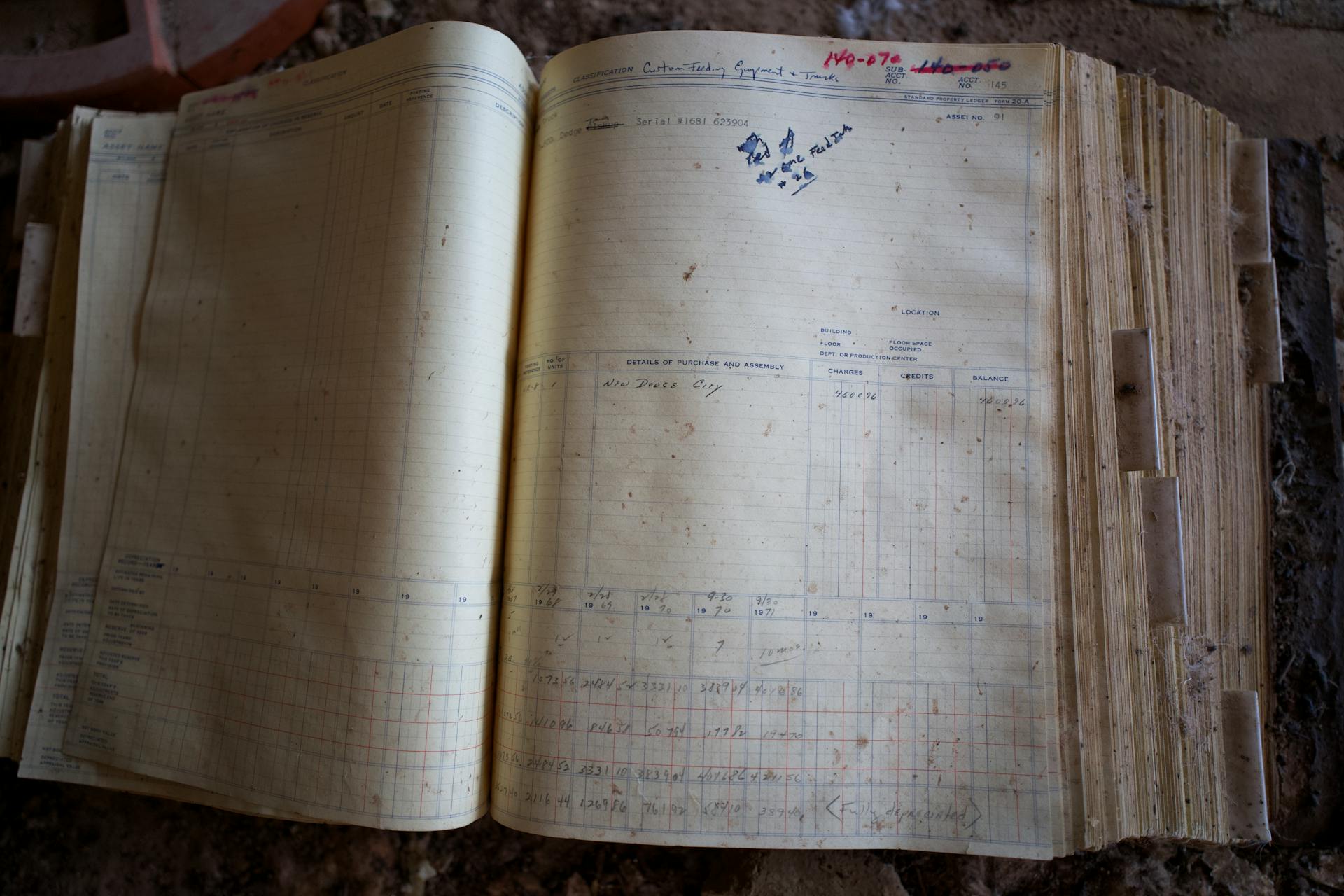
Using modern tools can make a big difference in managing your business's finances. For small businesses, digital tools and cloud-based accounting software can automate tasks, reduce errors, and provide real-time reports.
These tools, such as QuickBooks, Xero, Wave, and 1-800Accountant's proprietary ClientBooks, offer benefits like tax filing integration.
Some examples of these benefits include automation, error reduction, real-time reports, and tax filing integration.
Curious to learn more? Check out: Merger Filing Fee Modernization Act of 2021
Format
The T-account format is commonly used in ledgers, where dates, particulars, and amounts are recorded for both credits and debits with a line going down the middle to divide the two.
A journal format, on the other hand, is simple and includes the transaction date, particulars of the transaction, folio number, debit amount, and credit amount.
There's no need to balance journal entries, but ledger accounts almost always start out with an opening balance, which is usually the closing balance from the previous period for balance sheet accounts.
A fresh viewpoint: Interac E Transfer Maximum Amount

Income statement accounts start with an opening balance of zero because revenues and expenses should have been closed to retained earnings at the end of the prior period.
At the end of the period, all ledger amounts should balance, which means debts must equal credits.
This balance is crucial because it helps you maintain an accurate record of your business's financial transactions and generate financial reports.
Examples and Mechanics
A general ledger report from FreshBooks shows all the activity for accounts receivable for a month, including debits and credits to the general ledger account and the net change to the account.
In traditional ledger books, pages are divided into two columns: debit transactions are entered into the left-hand column, and credit transactions are entered into the right-hand column.
The records in these columns should always be equal, which is what it means to say that "the books are balanced."
A trial balance is essentially a snapshot of a company's accounts at a given point in time, like a balance sheet. It's used to check for errors in the accounts by comparing the credit and debit entries.
Here's a key point to remember: getting the trial balance correct does not guarantee that the general ledger is correct.
Broaden your view: How to Total a Column in Excel
Examples of

A general ledger report can show all activity for accounts receivable for a month, including debits and credits.
Smaller businesses often have broad categories for their accounts, such as assets, liabilities, and revenues.
Larger businesses typically have more detailed accounts that reflect key categories in their financial statements.
General ledgers are usually subdivided into separate accounts to make management easier.
Each account holds transactions for a particular type of transaction, making it easier to track and manage financial data.
Recommended read: Scalable Creative Solutions Large Businesses
The Mechanics of
In traditional ledger books, pages are divided into two columns. The left-hand column is for debit transactions, while the right-hand column is for credit transactions. If the records are correct, the debit and credit transactions should always be equal.
A trial balance is essentially a snapshot of a company's accounts at a given point in time, similar to a balance sheet. It's used to periodically check for errors in paper ledger books.
See what others are reading: Lended a Helping Hand

The credit entries and debit entries in the trial balance should be equal. If they are not, there is a problem with the accounts and hence the general ledger.
Here's a breakdown of the three financial statements that the general ledger helps prepare:
- Balance sheet
- Income statement
- Cash flow statement
These statements provide stakeholders with insights into your business's financial health and performance.
Accounting and Reporting
A ledger is a book or digital file that stores bookkeeping entries, categorizing and recording all financial transactions. It's a core component of the accounting process, providing a structured way to track and analyze financial information.
The ledger shows the account's opening balance, all debits and credits to the account for the period, and the ending balance. This helps businesses stay on top of their spending and make informed financial decisions.
In accounting, a ledger account is a record of all transactions affecting a particular account within the general ledger. Individual transactions are identified within the ledger account with a date, transaction number, and description to make it easier for business owners and accountants to research the reason for the transaction.
See what others are reading: Bank of America Atm near Me within 0.2 Mi
Here are the 5 main types of ledger accounts: Assets, Liabilities, Equity, Revenue, and Expenses.
The company's bookkeeper records transactions throughout the year by posting debits and credits to these accounts. The transactions result from normal business activities such as billing customers or purchasing inventory.
To create a ledger, you'll need to set up ledger accounts for assets, liabilities, revenue, equity, and expenses. Within each account type, list the accounts you need. For example, under the Asset account type, you'll create a Cash account and an Accounts Receivable account.
The double-entry system is used to record financial transactions in the ledger. Each transaction is posted as an entry on both the credit and the debit accounts. The total of all debit and credit entries must balance.
Here's a basic outline of what goes into your general ledger:
The basic accounting equation is Assets = Liabilities + Equity. This equation is foundational to the double-entry bookkeeping system used for general ledgers.
Related reading: Capital Spending Equation
Crypto and Accounting
In the world of crypto, a ledger is a record-keeping system that tracks value as it moves around, so the viewer can see exactly what value resides where at a given moment.
Blockchains, like the Bitcoin blockchain, are digital ledgers that validate and store all transactions within their network. They operate an immutable and autonomous record-keeping network, which means that once data is stored on the blockchain, it can't be changed.
In accounting, a ledger is a book or digital file that stores bookkeeping entries, categorizing and recording all financial transactions. It's a core component of the accounting process.
The ledger in accounting shows the account's opening balance, all debits and credits to the account for the period, and the ending balance. This helps companies stay on top of their spending and compile financial statements.
Companies can maintain ledgers for all types of balance sheet and income statement accounts, including accounts receivable, accounts payable, sales, and payroll. Transactions from subsidiary ledgers are periodically summarized and transferred to the general ledger.
Preparing a ledger is important as it serves as a master document for all financial transactions. It reports revenue and expenses in real-time, helping companies identify unusual transactions.
You might like: Blockchain LLC
Accounting Entries and Reports
A ledger is a book or digital file that stores bookkeeping entries, categorizing and recording all financial transactions. It's a core component of the accounting process, providing a structured way to track and analyze financial information.
In accounting, a ledger is essentially a collection of individual accounts, each representing a specific type of financial activity, like assets, liabilities, or expenses. Companies can maintain ledgers for all types of balance sheet and income statement accounts, including accounts receivable, accounts payable, sales, and payroll.
The ledger shows the account's opening balance, all debits and credits to the account for the period, and the ending balance. This helps with accuracy, as credits and debits should cancel each other out.
To create a ledger, you'll first need to understand the basics of double-entry bookkeeping. In the double-entry system, each financial transaction affects at least 2 different ledger accounts.
Here are the 5 main types of ledger accounts:
Individual transactions are identified within the ledger account with a date, transaction number, and description to make it easier for business owners and accountants to research the reason for the transaction.
The ledger might be a written record if the company does its accounting by hand or electronic records when it uses accounting software. According to CPA Practice Advisor, only 18% of small- to medium-sized businesses do not use accounting software.
Learn
A chart of accounts (COA) is an index of all the different accounts within a company’s ledger.
Ledgers are foundational to any company that moves money at scale, and understanding the accounting fundamentals behind the ledgering process is crucial.
A Ledger Database is a database that stores accounting data, specifically the current and historical value of a company’s financial data.
Data immutability is the idea that information within a database cannot be deleted or changed, and immutable databases can only ever add new data.
Every Account in a double-entry ledger is categorized as debit normal or credit normal, with debit-Normal Accounts representing uses of funds and Credit-Normal Accounts representing sources of funds.
An API call is idempotent if it has the same result, regardless of how many times it is applied, providing protection against unintended consequences for a business.
A ledger API allows companies to access, track, audit, and unify all of their financial data in one place, making it easier to move money at scale.
Intriguing read: Stock Market History Database
Frequently Asked Questions
What are the three types of ledgers?
There are three primary types of ledgers: Sales, Purchase, and General. These main ledgers serve as the foundation for subsidiary ledgers, such as accounts receivable and payable.
Featured Images: pexels.com