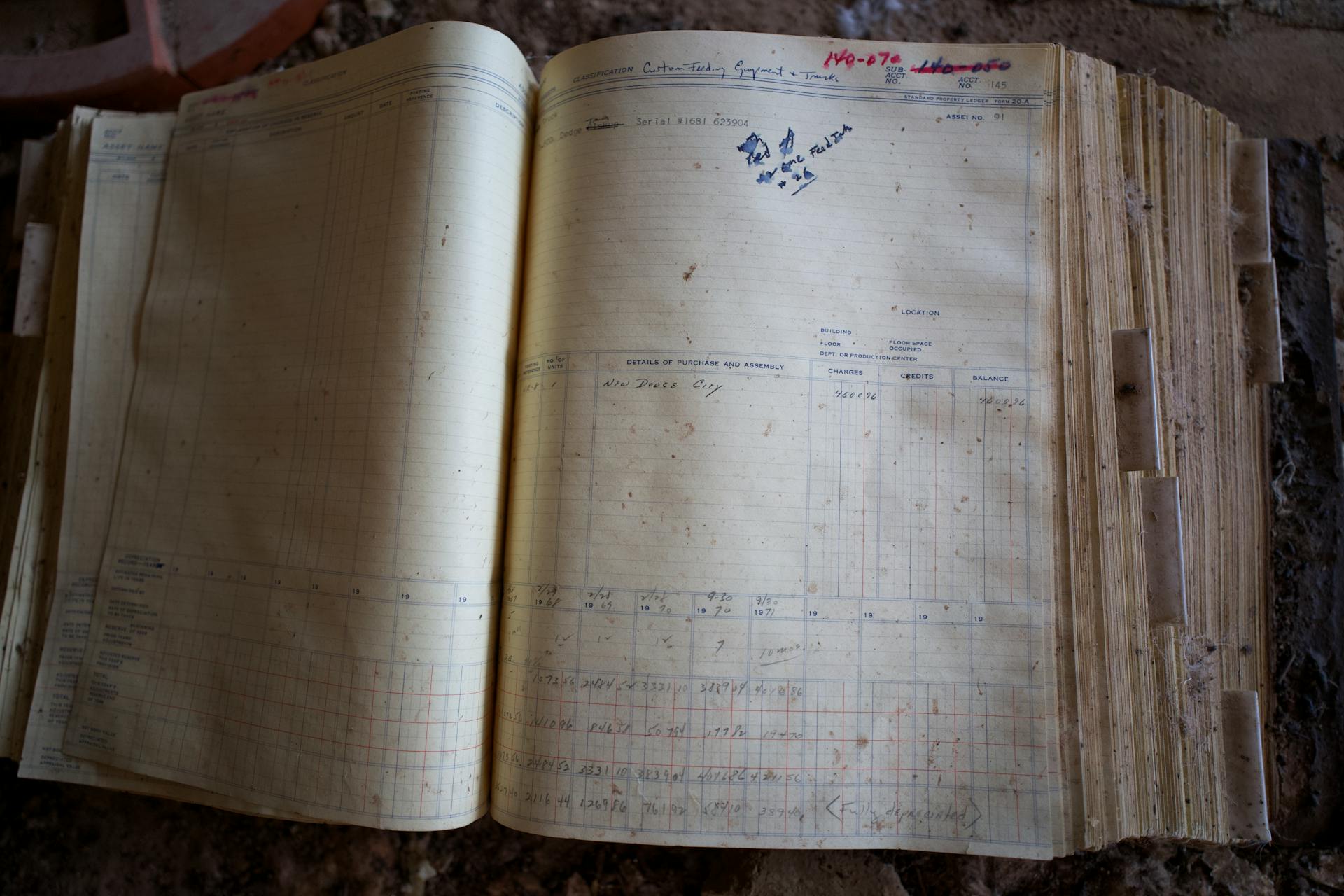
A general ledger is a master file that contains all financial transactions of a company. It's a comprehensive record of every financial event, no matter how small.
The general ledger is the core of a company's accounting system, and it's used to track every transaction, from sales and purchases to payroll and expenses. This includes both cash and credit transactions.
A general ledger is a must-have for any business, regardless of its size or industry. It's essential for making informed financial decisions and for meeting tax and regulatory requirements.
The general ledger is typically maintained by the accounting department and is updated regularly to reflect changes in the company's financial situation.
Here's an interesting read: Ledger - Nano S plus Crypto Hardware Wallet
What Is a General Ledger
A general ledger is a central accounting record that captures all financial transactions of a business, including income, expenses, assets, liabilities, and equity.
It's essentially a master spreadsheet that helps accountants and bookkeepers keep track of every financial event that occurs within a company.
A general ledger typically includes accounts for assets, such as cash, accounts receivable, and inventory, as well as accounts for liabilities, like accounts payable and loans.
Each account in the general ledger has its own unique identifier, known as an account number, which helps to quickly locate and update specific transactions.
The general ledger is often used in conjunction with other financial statements, such as the balance sheet and income statement, to provide a comprehensive view of a company's financial health.
It's a powerful tool that helps businesses make informed decisions by providing a clear picture of their financial strengths and weaknesses.
Additional reading: General Account
Types of Accounts
A general ledger is made up of various types of accounts that help track a company's financial transactions. These accounts are categorized into different types to make it easier to manage and understand the company's financial data.
Asset accounts represent resources owned by the company, such as cash and accounts receivable. These accounts are debited when assets enter and credited when they leave.
Liability accounts, on the other hand, denote obligations or debts that a company owes, such as accounts payable and notes or loans. These accounts are credited when more debt is incurred and debited when payments are made.
Equity accounts provide insights into the ownership interests of shareholders, including stock, retained earnings, and additional paid-in capital. Stockholders' equity is determined by deducting liabilities from assets.
Here are the main types of accounts found in a general ledger, categorized for easy reference:
These types of accounts work together to provide a complete picture of a company's financial situation and help businesses make informed decisions about their operations.
Double Entry Bookkeeping
Double entry bookkeeping is a method of recording financial transactions that affects at least two accounts, one account is debited, while another is credited. The total debit amount must always be equal to the total credit amount.
The accounting equation, Assets = Liabilities + Shareholder’s Equity, is a mathematical representation of the double-entry system of accounting. This equation is broken down in CFI’s Accounting Fundamentals Course.
Related reading: Tsp General Purpose Loan Maximum Amount
Each entry in the general ledger must appear in two places: once as a debit and once as a corresponding credit. And the two added together must equal zero.
In double-entry bookkeeping, the terms debit and credit differ from their commonplace meanings. Debiting an income account causes it to increase, while the same action on an expense account results in a decrease.
A company that uses a double-entry bookkeeping method uses the general ledger method of storing company financial data. Each transaction impacts at least one debit and one credit transaction, appearing in two columns, a debit column and a credit column, whose totals must balance.
The accounting equation that underlies double-entry accounting is Assets = Liabilities + Stockholders’ Equity. The balance sheet follows this format and shows information at a detailed account level.
The double-entry accounting method works based on the accounting equation’s requirement that transactions posted to the accounts on the left of the equal sign in the formula must equal the total of transactions posted to the account (or accounts) on the right.
Here is a simple example of what a double-entry general ledger may look like:
Recording Transactions
Recording transactions in a general ledger is a crucial step in maintaining accurate financial records. It involves documenting every financial event, including income and expenses, in a systematic and organized manner.
To record transactions, organizations must gather essential source documents, such as bank and credit card statements, invoices, receipts, and more. These documents provide the necessary data to accurately record financial transactions.
Financial transactions are recorded in journals, capturing both debit and credit aspects according to the double-entry accounting system. Each entry includes a date, affected accounts, debited or credited amounts, and a brief description.
Debit and credit entries are recorded in the ledger using a T-shaped entry with columns for debits and credits. Debits are recorded in the left-hand column, while credits are recorded in the right-hand column.
Here's a breakdown of the steps involved in recording transactions:
- Gather source documents
- Record transactions in journals
- Categorize transactions into specific accounts (assets, liabilities, equity, revenues, and expenses)
- Post transactions to the general ledger
- Prepare a trial balance to ensure accuracy
By following these steps, organizations can ensure that their general ledger accurately reflects their financial position and performance.
Benefits and Purpose
A general ledger is a powerful tool that helps businesses stay organized and make informed decisions. It's used to record a company's ongoing transactions and organize transactional data into assets, liabilities, revenues, expenses, and owner's equity.
By using a general ledger, companies can generate financial statements, such as balance sheets and income statements, which are essential for making business decisions. These financial statements provide valuable information about a company's financial health and performance.
A general ledger also provides accounting records that help accountants spot unusual or fraudulent transactions. This is especially important for businesses with many transactions, as it helps them stay on top of their finances and identify any potential issues.
Here are the key benefits of using a general ledger:
- Generates financial statements
- Provides accounting records
- Optimizes cash flow management
- Facilitates auditability
- Helps create a trial balance
Purpose
A general ledger is used to record a company's ongoing transactions, organizing transactional data into assets, liabilities, revenues, expenses, and owner's equity.
This data is then used to create the company's financial statements, such as its balance sheet, income statement, statement of cash flows, and other financial reports.

A general ledger is a crucial tool for businesses, offering several benefits that help them make informed decisions and stay on top of their finances.
Here are some key reasons why companies use general ledger accounts:
- Generates financial statements: GLs create important financial statements for internal stakeholders, helping them make business decisions.
- Provides accounting records: A GL offers financial accounting records for business transactions and account balances, helping accountants spot unusual or fraudulent transactions.
- Optimizes cash flow management: GLs can generate cash flow statements to facilitate cash flow management.
- Facilitates auditability: Organized transactional records simplify audits and bolster compliance.
- Helps create a trial balance: A GL enables a business to compile a trial balance where all debits and credits are totaled.
Benefits of Company Ownership
As a business owner, you have the freedom to make your own decisions and take calculated risks, which can lead to increased innovation and creativity.
By being in control of your company, you can make decisions that align with your personal values and goals, rather than those of a larger corporation.
This autonomy can result in higher job satisfaction and a sense of purpose among employees.
In fact, studies have shown that employee engagement and motivation are higher in employee-owned businesses.
Employee ownership can also lead to increased productivity and efficiency, as employees are more invested in the company's success.
This can be seen in the example of John Lewis Partnership, where employee ownership has led to a culture of teamwork and collaboration, resulting in high-quality products and excellent customer service.

With company ownership, you have the ability to create a positive work-life balance and prioritize your personal well-being.
This can be especially beneficial for entrepreneurs who are looking to start a business that aligns with their values and allows them to spend time with loved ones.
By being in control of your company, you can also create a more sustainable business model that benefits both the environment and the community.
This can be achieved through practices such as reducing waste, using renewable energy sources, and supporting local suppliers.
Accounting and Balance Sheet
A general ledger is the backbone of accounting, and it plays a crucial role in creating the balance sheet and income statement. It records all transactions that affect a company's accounting elements, such as assets, liabilities, equity, expenses, and revenues.
The general ledger is used by businesses that employ the double-entry bookkeeping method, which means that each financial transaction affects at least two sub-ledger accounts, and each entry has at least one debit and one credit transaction. This method is based on the accounting equation: Assets = Liabilities + Equity.
If this caught your attention, see: How to Calculate Liabilities in Accounting
The general ledger is structured with two columns: one for debit transactions and the other for credit transactions. Debit transactions appear on the left side, while credit transactions are recorded on the right side. Each entry is accompanied by comprehensive transaction details, including the transaction date, description, and references to the original journal entry.
The general ledger is compiled and summarized at various levels to produce a trial balance, income statement, balance sheet, statement of cash flows, and other financial reports. This helps accountants, company management, analysts, investors, and other stakeholders assess the company's performance on an ongoing basis.
Here is an example of a general ledger entry:
In this example, a sale of goods is made on credit for $5,000, and the revenue is credited to the Sales account and debited to the Accounts Receivable account. On January 12th, a cash payment of $2,000 is received, reducing the Accounts Receivable balance and increasing the Cash balance.
Explore further: Accounting Profits and Cash Flows Are Generally
Accounting Concepts
A general ledger account is a primary component of a general ledger, recording all transactions for that account, including assets, liabilities, equity, revenues, expenses, gains, and losses.
Each asset, such as cash and account receivables, has its own general ledger account. These accounts are used by businesses that employ the double-entry bookkeeping method, where each financial transaction affects at least two sub-ledger accounts.
The accounting equation, Assets = Liabilities + Stockholders’ Equity, underlies double-entry accounting, and the total of transactions posted to the accounts on the left of the equal sign must equal the total of transactions posted to the accounts on the right.
The double-entry accounting method works by ensuring that transactions are posted in two columns, with debit entries on the left and credit entries on the right, and the total of all debit and credit entries must balance.
A general ledger can generate several important financial statements, including a balance sheet, which shows information at a detailed account level, and a cash flow statement, which facilitates cash flow management.
See what others are reading: What Is a Trial Balance
There are several types of general ledger accounts, including asset accounts, liability accounts, equity accounts, revenue accounts, expense accounts, non-operating revenue accounts, and non-operating expense accounts.
Here are some examples of general ledger accounts:
A general ledger can also provide accounting records for an organization's business transactions and account balances, which can help accountants spot unusual, erroneous or fraudulent transactions.
Frequently Asked Questions
Is the general ledger the same as a balance sheet?
No, a general ledger and a balance sheet are not the same, with the general ledger being a master list of company transactions and the balance sheet a snapshot of net worth at a specific point in time. Understanding the difference between these two financial tools can help you make informed business decisions.
What are the five types of general ledger?
The five main types of transactions in a general ledger are: assets, liabilities, equity, revenue, and expenses. These categories help businesses track their financial performance and make informed decisions.
Featured Images: pexels.com