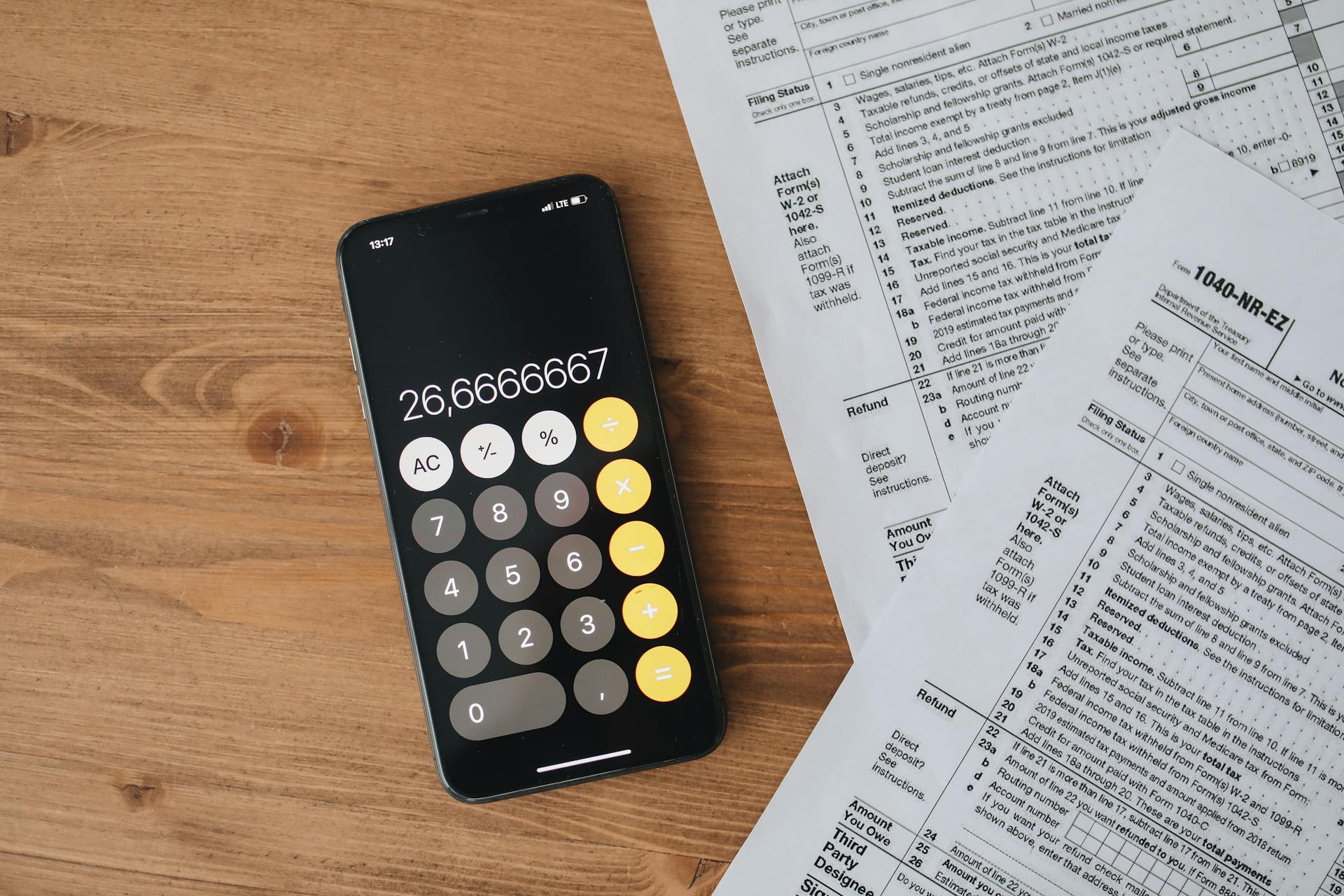
Small business owners often struggle with 1099 forms, but they're a crucial part of tax season. You'll need to issue 1099 forms to freelancers, independent contractors, and other non-employees who earned more than $600 from your business in a calendar year.
The IRS requires you to file 1099 forms by January 31st of each year, which can be a tight deadline. You'll also need to provide a copy of the 1099 form to the recipient by the same deadline.
To ensure you're meeting the IRS requirements, you'll need to determine who needs to receive a 1099 form. This includes anyone who earned more than $600 in a calendar year, regardless of the type of payment method used.
Related reading: Do I Need to Submit 2 Bank Statements
Understanding 1099 Forms
Form 1099-MISC is used for specific types of payments, such as royalties, rents, and prizes, and is required for payments of $10 or more. Farmers who rent out crop pastures and organizations that buy or sell fish and other aquatic life use this form as well.
Business owners reporting $5,000 or more of sales of consumer products on a commission basis may use Form 1099-MISC or Form 1099-NEC. Different rules exist for foreign agricultural workers, coin-operated amusements, and certain punitive damages and awards.
You'll need to send Form 1099-NEC to vendors or independent contractors who received more than $600 in payments from your business. This includes freelance creatives, professional service providers, and vendors operating as sole proprietors.
You'll also need to send a 1099-K form to self-employed individuals and small businesses that received payments totaling $600 or more through platforms like PayPal, Venmo, and CashApp. Credit card companies and payment apps are now required to send 1099-K forms to these individuals and businesses.
To generate a 1099, you'll need your contractor's details, which can be found on their W-9 form. This includes their home address, taxpayer identification number, and reconciled income payments.
Here are the types of payments that require a 1099-NEC:
- Services performed by someone who is not an employee (including parts and materials)
- Cash payments for fish (or other aquatic life) purchased from anyone engaged in the trade or business of catching fish
- Payments to an attorney
Note that a 1099-MISC is no longer used for compensation paid to vendors for their services, and businesses must now issue Form 1099-NEC for that purpose.
Vendor Onboarding and Requirements
As a small business owner, onboarding vendors is a crucial step in ensuring you're meeting your tax obligations. You should always collect a W-9 from every contractor you work with, as this will help you get their Taxpayer Identification Number (TIN) and name correct for tax reporting purposes.
To make the 1099 filing process easier, you can collect Form W-9 from every contractor you work with, if you anticipate paying them more than $600. This will ensure you have the proper name and TIN combination the IRS requires when filing your 1099-NEC or 1099-MISC tax forms.
You can also use TIN matching to verify the accuracy of your contractor data. The IRS offers two types of TIN matching: Bulk TIN matching and Interactive TIN matching. Bulk TIN matching is useful for checking records just before or during reporting season, while Interactive TIN matching can be incorporated into your contractor onboarding processes prior to reporting season.
Explore further: Transaction-Based Reporting
Here are some key details to keep in mind:
- Bulk TIN matching checks many records against the IRS’s database all at one time.
- Interactive TIN matching enables payors to quickly verify that information is correct.
By following these steps, you can ensure you're meeting your tax obligations and avoiding potential penalties.
Who Needs the Form
Businesses in certain industries may use Form 1099-MISC to report specific types of payments, such as royalty payments or prize winnings. If a business pays more than $600 to a vendor or independent contractor, it must send Form 1099-NEC.
You'll need to send Form 1099-NEC to freelance creatives, professional service providers, and vendors operating as sole proprietors. This includes people like writers, graphic designers, photographers, consultants, lawyers, accountants, tax advisors, and caterers.
Form 1099-NEC is also required for vendors who have provided services to a business, but are not employees or owners. This means that anyone who worked for the company, except for payrolled employees and owners, will need a 1099-NEC from the business.
If a vendor has incorporated their company or has elected for S Corporation or C Corporation tax treatment, a 1099 shouldn't be necessary. To determine if a vendor needs a 1099, business owners should ask vendors to provide a completed W-9 form before the individual works for their company.
Here's a list of examples of people to whom businesses may have to send a 1099-NEC:
- Freelance creatives (e.g., writers, graphic designers, photographers, etc.)
- Professional service providers (e.g., consultants, lawyers, accountants, tax advisors, etc.)
- Vendors operating as sole proprietors (e.g., caterers, computer repair technicians, business remodeling contractors, etc.)
Integrate Document Validation into Vendor Onboarding
Collecting W-9s is crucial for tax reporting purposes, as it provides the necessary information for 1099 filing, including the Taxpayer Identification Number (TIN), which can be a Social Security Number (SSN) or Employer Identification Number (EIN).
You can make the 1099 filing process easier by collecting Form W-9 from every contractor you work with, if you anticipate paying more than $600. This will ensure you have the proper name and TIN combination required by the IRS.
TIN matching is also essential to avoid errors and penalties. If the TIN and name don't match what the IRS has on file, you may receive a "B Notice" and eventually a penalty notice.
There are two types of TIN matching offered by the IRS: Bulk TIN matching and Interactive TIN matching. Bulk TIN matching checks many records against the IRS's database at once, while Interactive TIN matching enables you to quickly verify individual records.
Worth a look: Penalty for Filing Business Taxes Late
Here are the key benefits of integrating document validation into vendor onboarding:
- Bulk TIN matching is useful for checking records just before or during reporting season.
- Interactive TIN matching can be incorporated into your contractor onboarding processes prior to reporting season.
- It allows you to check for name/TIN consistency in real-time throughout the year and correct errors one at a time.
By incorporating these steps into your vendor onboarding process, you can ensure accurate and compliant tax reporting, and avoid costly mistakes and penalties.
Filing and Reporting
You'll need to file many common 1099 forms with the IRS and send a copy to your contractors by January 31st. The deadline to send 1099 reporting information to independent contractors whom you paid more than $600 is January 31.
The IRS introduced a new form, the 1099-NEC, for non-employee compensation in tax year 2020. This form is used for self-employed individuals operating a sole proprietorship, single member Limited Liability Company (LCC), Limited Partnership, or Estate.
To file electronically, you must have an IRS E-Services account and a Transmitter Control Code (TCC) for your organization. This application process can take 4-6 weeks to complete.
You can use digital tools like QuickBooks, Gusto, or Tax1099 to simplify the 1099 process and reduce the likelihood of errors. These tools can automatically track payments made to vendors and contractors, generate Forms 1099-NEC and 1099-MISC, and e-file them with the IRS.
Broaden your view: When Do Brokerages Send 1099
The deadline to send 1099 reporting information to the IRS is March 2 (paper filing) or March 31 (e-filing). You may also need to report information to the state by a certain deadline, depending on where you live.
To issue a 1099-MISC report, you can either do it yourself using online tax preparation services like QuickBooks and TurboTax, or hire a CPA or tax preparer.
A unique perspective: Deferred Tax Deadline
Deadlines
The deadlines for small business 1099 forms can be overwhelming, but understanding the requirements can help you stay on track. January 31st is the deadline to print and mail out all Forms 1099-NEC and 1099-MISC forms.
You must file Form 1099-NEC with the IRS and send a copy to all recipients by January 31. If you're filing fewer than 10 forms, you can file them by mail or electronically, but if you're filing more than 10 forms, they must be filed electronically.
The deadline for filing the 1099-MISC varies depending on the types of payments and falls on either February 28 or March 31. The recipient and filing deadlines for the most common information reporting forms are included in the table below:
Remember, missing the deadline can result in penalties, which currently vary from $50 to $280, increasing to $290 in 2023.
Penalties and Errors
Penalties for late or incorrect 1099 filings can add up quickly, ranging from $50 to $110 per form, depending on how long past the deadline you file. You'll also face a minimum penalty of $550 per statement if the IRS proves intentional disregard.
The IRS takes name/TIN mismatches seriously, and you'll receive a B-notice (CP2100 or CP2100A) for each mismatch if you submit returns with errors. This notice requires you to send it to your contractor and request an updated W-9 to avoid future penalties.
Here's a breakdown of the penalty table for 1099 filings in 2022:
You can avoid these penalties by proactively checking your Name/TIN data with the IRS before filing.
Potential Penalties
Late or incorrect filing of a 1099 can lead to penalties that add up quickly, ranging from $50 to $110 per form, depending on how late you file.
Filing even a single form late can result in a penalty, and the amount increases as the deadline passes. If you file more than 30 days late, the penalty jumps to $110.
Readers also liked: Filing Business Taxes Late

If you intentionally disregard the requirement to provide a correct payee statement, the IRS can charge a minimum penalty of $550 per statement, with no maximum. Interest on top of the penalties will also be charged.
Penalties for name/TIN mismatches can also be a concern, especially if you file multiple forms with errors. If you submit returns with name/TIN mismatches and the number of forms with errors exceeds 50, you'll receive an IRS B-notice.
Here's a breakdown of the penalty amounts for late filing:
Repeatedly filing returns with incorrect name/TIN combinations can lead to penalty notices, potentially setting you back up to $290 for every TIN that was reported incorrectly.
Handling Errors or Corrections
Making a mistake on a 1099 form is more common than you might think. It's easy to use the wrong form type or file a 1099 for the wrong tax year.
You only have to submit a corrected form if you've already filed it with the IRS. Otherwise, you can simply void the form. To send a corrected form, mark the "Corrected" box at the top of the form and fill it out with the correct information. Make sure to keep records of the original and corrected forms.
If you issue a 1099-MISC form with a mistake, you'll need to amend and re-issue it to both the individual and the IRS. This can be a hassle, but it's better than facing penalties.
If you receive a 1099-MISC form with a mistake, notify the IRS and the business that issued the form. And if you receive a 1099 for services you never provided, it could be a sign of fraud or identity theft.
Late or incorrect filing can lead to penalties, which can add up quickly. The fine for not filing a correct 1099 can range from $50 to $110 per form, depending on how late you file.
Additional reading: Venmo Will I Receive 1099-k for Personal Account
Digital Tools and Resources
Digital tools can simplify the 1099 process and reduce errors. Using software like QuickBooks, Gusto, or Tax1099 can automate tasks and generate forms for you.
QuickBooks is a great option for small and growing businesses, as it automatically tracks payments to vendors and contractors and generates Forms 1099-NEC and 1099-MISC. You can also e-file these forms directly with the IRS.
Related reading: How Does Quickbooks Work for Small Business
Gusto allows you to automate your payroll and 1099 filings, generating 1099s for contractors and W-2s for employees, and you can e-file them with the IRS.
Tax1099 is a good choice for businesses that need a bulk filing option for tax forms, as it integrates with most popular accounting software and automates TIN verification to reduce IRS penalties.
Here are some popular digital tools for simplifying 1099 preparation and filing:
- QuickBooks: Tracks payments and generates Forms 1099-NEC and 1099-MISC
- Gusto: Automates payroll and 1099 filings
- Tax1099: Integrates with popular accounting software and automates TIN verification
Digital Tools for Preparing and Filing
Digital tools can simplify the 1099 preparation and filing process, reducing errors and stress. QuickBooks is a popular option for small and growing businesses, automatically tracking payments to vendors and contractors and generating Forms 1099-NEC and 1099-MISC.
You can also use Gusto to automate your payroll and 1099 filings, generating 1099s for contractors and W-2s for employees, and e-filing them with the IRS. Gusto makes it easy to stay on top of your tax obligations.
Tax1099 is a great choice for businesses that need a bulk filing option for tax forms. It integrates with most popular accounting software and automates TIN verification to reduce the likelihood of IRS penalties. This can save you time and money in the long run.
Here are some popular digital tools for preparing and filing 1099 forms:
- QuickBooks: Automatically tracks payments and generates Forms 1099-NEC and 1099-MISC.
- Gusto: Automates payroll and 1099 filings, generating 1099s and W-2s.
- Tax1099: Integrates with popular accounting software and automates TIN verification.
Where to Get

There are many online platforms where you can access digital tools and resources.
Canva is a popular graphic design platform that offers a wide range of templates and design tools.
Adobe Creative Cloud is a subscription-based service that provides access to a suite of creative apps, including Photoshop and Illustrator.
Google Workspace is a cloud-based productivity suite that includes Google Drive, Docs, and Sheets.
Microsoft Office Online is a free version of Microsoft Office that allows you to create and edit documents, spreadsheets, and presentations online.
Trello is a project management tool that uses boards, lists, and cards to organize tasks and projects.
Asana is a task management tool that allows you to create and assign tasks, set deadlines, and track progress.
Khan Academy is a free online learning platform that offers courses and tutorials on a wide range of subjects, including math, science, and programming.
Additional reading: Does 401k Grow Tax Free
State Considerations and Exceptions
Small businesses that work with contractors or vendors in multiple states need to pay attention to various state 1099 reporting obligations. This adds complexity to the process, as each state has its own rules, thresholds, and filing deadlines. In many cases, state reporting can be satisfied through the IRS Combined Federal State Filing Program (CF/SF), but some states don't participate in this program.
See what others are reading: States with Highest Business Taxes
Some states require direct filing of 1099 returns, and the 1099-NEC is a good example, as 26 states and the District of Columbia currently require direct filing. To learn more about specific state reporting requirements, you can visit our 1099-NEC Direct State Reporting Service page.
Here are some types of vendors that don't get 1099-MISC or 1099-NEC forms:
- Those businesses with S Corporation or C Corporation entity structures
- Limited Liability Companies (LLCs) that are taxed as C Corporations or S Corporations
- Companies that sell merchandise, storage, freight, or other similar things
Exceptions When 'a' Isn't Necessary
Businesses with S Corporation or C Corporation entity structures don't receive 1099-MISC or 1099-NEC forms.
If you hire a service to keep your business property neatly mowed and landscaped, and they charge $50 each time, you don't need to report payments below the $600 threshold.
The $600 threshold is for the payer only, so independent contractors still have to pay applicable state and federal taxes on that income.
Businesses don't need to send 1099s for personal service expenses, such as hiring a freelance writer to paint your home office.
See what others are reading: Do You Need Tax Returns for Heloc

However, if the same independent contractor also paints your bedroom, you don't need to report the money you paid him to perform that service.
Here are some common exceptions where a 1099 isn't necessary:
- Businesses with S Corporation or C Corporation entity structures
- Limited Liability Companies (LLCs) that are taxed as C Corporations or S Corporations
- Companies that sell merchandise, storage, freight, or other similar things
Note that these exceptions apply to the payer, not the independent contractor.
State Considerations
State Considerations can be overwhelming, especially when you have to deal with multiple states and their varying 1099 reporting obligations. Some states require filing at different thresholds than others.
If you work with contractors or vendors in multiple states, you'll need to pay attention to these state-specific requirements. This adds complexity to the process, as you'll have to navigate multiple sets of rules.
26 states and the District of Columbia currently require the 1099-NEC form to be filed directly with the state department of revenue. Some states still participate in the IRS Combined Federal State Filing Program (CF/SF), where the IRS will electronically file original and corrected information returns to participating states.
The challenge is that not all states participate in this program, so you'll need to check if your state requires direct filing. This can be a time-consuming process, especially if you're dealing with multiple states and vendors.
Take a look at this: IRS Volunteer Income Tax Assistance Program
Featured Images: pexels.com