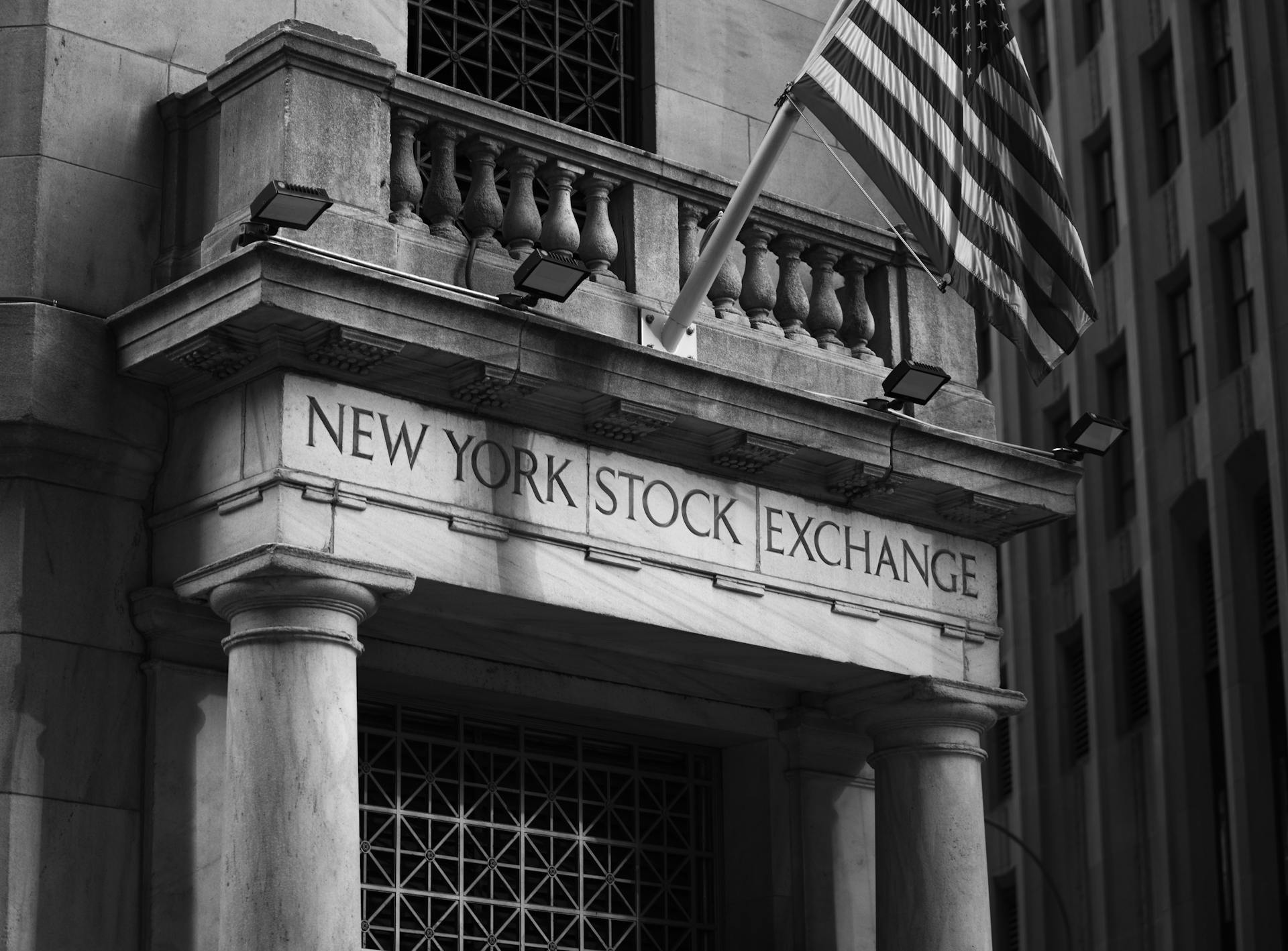
The Shanghai Stock Exchange has a rich history that dates back to 1990, when it was established as one of the two stock exchanges in mainland China.
Located in Shanghai, the exchange is the largest in China, with over 1,000 listed companies.
The Shanghai Stock Exchange is a key player in China's economic growth, with a market capitalization of over $3 trillion.
With a strong foundation in place, the Shanghai Stock Exchange has become a vital component of China's financial system, supporting the country's economic development.
What is SSE?
The Shanghai Stock Exchange, or SSE for short, is a nonprofit organization. It's the largest stock exchange in mainland China.
The SSE is run by the China Securities Regulatory Commission, or CSRC for short. This regulatory body oversees the exchange's operations.
Stocks, funds, bonds, and derivatives are all traded on the SSE. This variety of options makes it a hub for investors looking to diversify their portfolios.
As the largest stock exchange in mainland China, the SSE plays a crucial role in the country's financial landscape.
You might enjoy: List of Largest Banks in Africa
History and Overview
The Shanghai Stock Exchange (SSE) was established in 1990 as a non-profit organization under the supervision of the China Securities Regulatory Commission (CSRC). It was created to provide a platform for Chinese companies to raise capital and for investors to trade securities.
The SSE initially only traded bonds, but in December 1990, it began trading stocks. This marked the beginning of a new era for the exchange and paved the way for its growth in the years to come.
The SSE has experienced significant growth over the years, with the benchmark Shanghai Composite Index (SCI) rising from around 2,000 points in 2014 to over 3,000 points in 2020. This growth is a testament to the exchange's success and its ability to adapt to changing market conditions.
The SSE operates under a market-oriented system, with two main market segments: the Main Board and the STAR Market. The Main Board is the primary market for established companies, while the STAR Market is a new board aimed at innovative and technology-focused companies.
Discover more: One Main Financial Vehicle Collateral Requirements
The SSE has a wide range of market participants, including individual investors, institutional investors, and foreign investors. Foreign investors can invest in the SSE through the Qualified Foreign Institutional Investor (QFII) program and the Stock Connect program, which allows investors from Hong Kong and mainland China to trade stocks on each other's exchanges.
The SSE has experienced significant volatility in the past, with the SCI falling by over 30% during the 2015-2016 market crash. However, the exchange has implemented a range of measures to regulate the market and protect investor interests, including circuit breakers.
The SSE is regulated by the CSRC, which is responsible for maintaining market stability and protecting investor interests. The CSRC has implemented a range of measures to regulate the market, including circuit breakers, which are triggered when the market experiences significant volatility.
The SSE has come a long way since its establishment in 1990, and it continues to play a significant role in China's economy. Its growth and success are a testament to the exchange's ability to adapt to changing market conditions and its commitment to providing a platform for Chinese companies to raise capital and for investors to trade securities.
Take a look at this: Regulate the Operations and Compliance of Health Insurance Companies
Structure and Requirements
The Shanghai Stock Exchange (SSE) is a major stock exchange in China, and it's home to a diverse range of securities, including stocks, bonds, and funds. The SSE has a robust structure in place to ensure transparency and fair competition.
There are two main types of stocks traded on the SSE: "A" shares and "B" shares. A shares are priced in the local renminbi yuan currency, while B shares are quoted in U.S. dollars. Initially, trading in A shares was restricted to domestic investors only, but after reforms were implemented in 2002, foreign investors are now allowed to trade in A shares under the Qualified Foreign Institutional Investor (QFII) program.
The SSE requires companies to meet specific listing requirements, including a minimum total share capital of RMB 50 million and a minimum publicly-offered stock of 25% of total issued shares. However, for companies with a total share capital exceeding RMB 400 million, the percentage is reduced to 10%.
Here's an interesting read: 1 Usd to Yuan Today
Here's a summary of the SSE's listing requirements:
The SSE also requires companies to meet certain conditions, including three consecutive years of profitability and the absence of any major adverse changes in their main business, directors and senior managers.
Structure
The Shanghai Stock Exchange has a diverse range of securities listed, including stocks, bonds, and funds. This variety provides opportunities for investors to diversify their portfolios.
Bonds traded on the SSE include treasury bonds, corporate bonds, and convertible corporate bonds. The SSE T-bond market is the most active of its kind in China.
There are two types of stocks being issued in the Shanghai Stock Exchange: "A" shares and "B" shares. "A" shares are priced in the local renminbi yuan currency.
Initially, trading in A shares was restricted to domestic investors only. However, after reforms were implemented in December 2002, foreign investors are now allowed to trade in A shares under the Qualified Foreign Institutional Investor (QFII) program.
A total of 98 foreign institutional investors have been approved to buy and sell A shares under the QFII program. Quotas under the QFII program were initially set at US$30 billion and increased to US$80 billion as of April 2012.
A fresh viewpoint: Institutional Investor Advisory Services
SSE Requirements
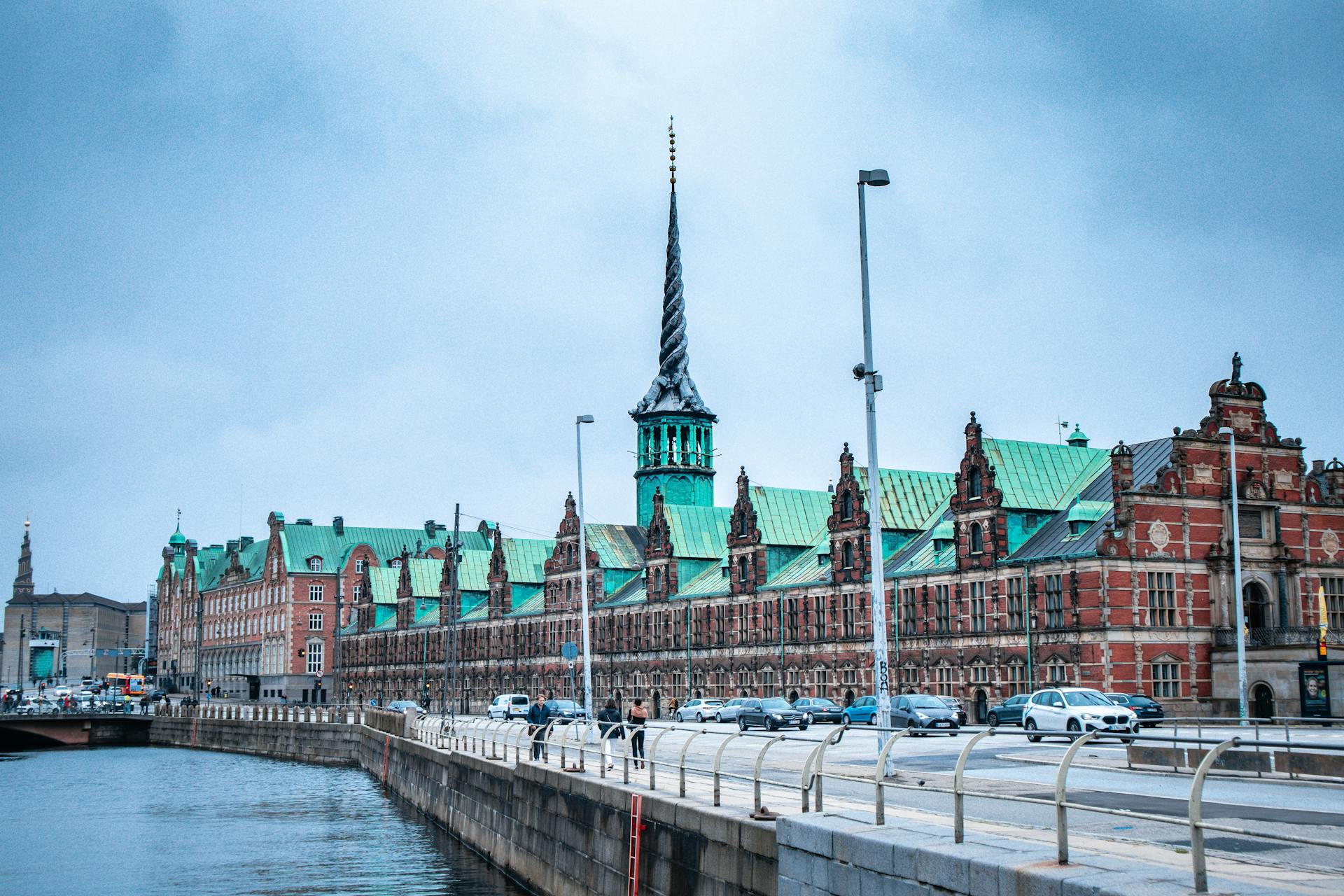
To list on the Shanghai Stock Exchange (SSE), a company must meet certain requirements. The SSE requires companies to have a total share capital of more than RMB 50 million, and the amount of publicly-offered stock must be greater than 25% of total issued shares unless a company's total share capital is more than RMB 400 million, in which case the percentage is reduced to only 10%.
Companies must also have gained the approval of the China Securities Regulatory Commission (CSRC). The company must have made profits over the last three consecutive years and not have committed any major illegal acts or financial report falsehoods over the past three years.
In addition to these requirements, the SSE requires companies to prepare and disclose periodic reports within the time limit specified in laws, administrative regulations, and various applicable rules. The annual report should be disclosed within four months from the end of each financial year, the interim report within two months of the end of the first half of each financial year, and the quarterly report within one month from the end of the first three months and the end of the first nine months of the financial year.
Related reading: 5 Years
Here are the key SSE requirements summarized:
The SSE also requires companies to have a board of directors and to establish committees to oversee areas such as audit, remuneration, and nomination of directors. Companies must also disclose information about their management structure, ownership structure, and related-party transactions.
On a similar theme: Worker Representation on Corporate Boards of Directors
Trading and Indices
The SSE Composite Index is the most commonly used indicator to reflect SSE's market performance, and it's calculated based on the total market capitalization of all listed stocks. The index was launched on July 15, 1991, and its base day is December 19, 1990.
Monitoring the SSE Composite Index can provide valuable insights into the performance of the Shanghai Stock Exchange. The index was at 2,675.47 at the end of 2006, and other important indexes used in the Shanghai Stock Exchanges include the SSE 50 Index and SSE 180 Index.
Investors can also use the SSE Composite Index to gauge the overall health of the Chinese economy. A high index value often indicates a robust economy, which can lead to increased investment in the stock market.
For another approach, see: Shanghai Stock Exchange Composite Index Etf
Trading Times

The Shanghai Stock Exchange (SSE) is open for trading every Monday to Friday from 09:15 to 15:00, with a morning session that begins with centralized competitive pricing from 09:15 to 09:25.
The morning session continues with consecutive bidding from 09:30 to 11:30, followed by the afternoon consecutive bidding session, which starts from 13:00 to 14:57. This is a crucial time for investors to monitor market trends and make informed decisions.
The SSE is closed on Saturday and Sunday, and other holidays announced by the SSE, so it's essential to keep track of the market's schedule to avoid missing out on trading opportunities.
During the trading hours, the market goes through various phases, including centralized competitive pricing from 14:57 to 15:00, and block trading from 15:00 to 15:30. This is a great time to analyze market trends and adjust your investment strategies accordingly.
The SSE's trading schedule is designed to provide a smooth and efficient trading experience for investors, with a clear structure that allows for informed decision-making.
Broaden your view: The Scmp
Indices
The SSE Composite Index, also known as the Shanghai Composite Index, is the most commonly used indicator to reflect the Shanghai Stock Exchange's market performance. It was launched on July 15, 1991, and its Base Day is December 19, 1990.
The index tracks the performance of all listed stocks on the Shanghai Stock Exchange, including A shares and B shares. The Base Value of the index is 100, and its Base Period is the total market capitalization of all stocks on the Base Day.
The SSE Composite Index is a widely followed benchmark index that provides a snapshot of the overall market sentiment. It's often used as a barometer for China's economic health, and its performance has a significant impact on the global economy.
Other important indexes used in the Shanghai Stock Exchange include the SSE 50 Index and SSE 180 Index.
Related reading: Base Erosion and Profit Shifting
Largest Companies and Listings
The Shanghai Stock Exchange is home to some of the world's largest and most influential companies. The largest companies on the exchange include a number of banks and insurance companies, as well as some of the world's biggest companies.
If this caught your attention, see: The World's Billionaires 2010
Kweichow Moutai, the world's largest beverage company, is the largest stock on the exchange, with a market capitalization of 2,174 billion. It's the maker of China's top liquor brand.
The Shanghai Stock Exchange lists companies on two boards: the Main Board and the STAR Market. The Main Board consists of large, well-established companies, while the STAR Market is where shares of smaller companies are traded.
Shares of stock traded on the Shanghai exchange can be either A shares or B shares. A shares are denominated in Chinese renminbi currency, while B share prices are stated in U.S. dollars.
Here are the top 10 largest stocks on the Shanghai Stock Exchange, ranked by market capitalization:
- Kweichow Moutai (2,174 billion)
- Industrial and Commercial Bank of China (1,339 billion)
- Agricultural Bank of China (1,027 billion)
- China Life (897 billion)
- Ping An Insurance (829 billion)
- China Merchants Bank (761 billion)
- PetroChina (717 billion)
- Bank of China (691 billion)
- Haitian Flavouring & Food (593 billion)
- Hoyoverse (499 billion)
Regulations and Governance
The Shanghai Stock Exchange has a robust regulatory framework in place to ensure transparency, protect investors, and promote fair competition. The SSE requires listed companies to provide timely and accurate financial information to investors, including annual reports and interim reports.
To maintain their listing, companies must comply with Chinese accounting standards and other relevant regulations. They must also disclose information about their management structure, ownership structure, and related-party transactions.
The SSE has strict trading rules to ensure a fair and orderly market. Insider trading, market manipulation, and short selling are strictly prohibited. The SSE also has circuit breakers in place to prevent excessive volatility in the market.
Listed companies must disclose information about material events that could affect their share price, such as mergers, acquisitions, or major changes in management. This ensures that investors have access to relevant information to make informed investment decisions.
The SSE has a compensation fund that compensates investors for losses caused by fraudulent activities. The China Securities Regulatory Commission (CSRC) oversees the market and enforces regulations to protect investors.
To list on the SSE, companies must meet certain criteria, including having a total share capital of at least RMB 30 million and having been in business for more than 3 years with profits over the last three consecutive years. They must also not have committed any major illegal activities or false accounting records in the last three years.
Here's an interesting read: SSE Composite Index
Here are the key listing requirements for the Shanghai Stock Exchange:
The Shanghai Stock Exchange has two main classes of stock: A-shares and B-shares. Most of the total market cap of the SSE is made up of formerly state-run companies like major commercial banks and insurance companies.
Economic Impact and Role
The Shanghai Stock Exchange plays a significant role in China's economy, with a market capitalization of over $5 trillion. It's one of the largest stock exchanges in the world and has been growing rapidly since its establishment in 1990.
The SSE is a major source of funding for Chinese companies and provides a platform for foreign investors to invest in Chinese companies. In fact, it's now the second-largest stock exchange in the world by market capitalization, after the New York Stock Exchange.
China's GDP growth rate has been around 6-7% per year, which is a significant indicator of a healthy economy. This growth rate has a direct correlation with stock market performance, and a robust economy often leads to increased corporate profits and investor confidence.
A fresh viewpoint: List of Largest Companies in Canada
Inflation has been relatively stable in China, with an average inflation rate of around 2-3%. However, a sudden increase in inflation can have a significant impact on the Shanghai Stock Exchange.
The Shanghai Stock Exchange is heavily influenced by government policies and regulations, such as changes in fiscal policies and monetary policies implemented by the People's Bank of China. These policy decisions can impact investor sentiment and ultimately affect stock market performance.
The SSE is also impacted by key economic indicators such as GDP growth rate, inflation rate, interest rates, trade balance, and consumer confidence. Monitoring these indicators can provide valuable insights into the performance of the Shanghai Stock Exchange and help investors make informed decisions.
China's GDP growth rate has been growing at an average rate of around 6-7% per year, which is a significant indicator of a healthy economy. This growth rate has a direct correlation with stock market performance, and a robust economy often leads to increased corporate profits and investor confidence.
The Shanghai Stock Exchange has become increasingly important in the global economy, as China has become a major economic power. The SSE is now a key indicator of the health of the Chinese economy, reflecting the performance of Chinese companies.
In summary, the Shanghai Stock Exchange plays a vital role in China's economy and has a significant impact on the global economy. By understanding the key economic indicators and government policies that influence the SSE, investors can make informed decisions and navigate the complexities of the Chinese stock market.
Check this out: Management by Wandering around
Investing and Liquidity
The Shanghai Stock Exchange has a relatively short history compared to other major stock exchanges, but it has grown rapidly since its establishment in 1990.
To invest in the SSE, investors need to meet certain qualifications, including having a securities account with a broker for domestic investors, or a Qualified Foreign Institutional Investor (QFII) or a Renminbi Qualified Foreign Institutional Investor (RQFII) status for foreign investors.
A high GDP growth rate, typically above 6-7% per year, is usually an indicator of a healthy economy and can lead to increased investment in the stock market.
The Shanghai Stock Exchange is not entirely open to foreign investors, and most investors in the SSE do so by buying and selling exchange-traded funds and American Depositary Receipts.
The SSE has various regulations to protect investors and maintain a fair and orderly market, including strict trading rules and disclosure requirements for listed companies.
A high Purchasing Managers' Index (PMI) above 50 indicates expansion in the manufacturing sector, which can be associated with increased demand for stocks of manufacturing companies.
For another approach, see: Non Qualified Deferred Comp Taxation
Industrial production measures the output of industrial sectors such as manufacturing, mining, and utilities, and a high level of industrial production is usually associated with a healthy economy and can lead to increased investment in the stock market.
Lower interest rates can lead to increased investment in the stock market as investors seek higher returns, but can also lead to higher inflation, which can negatively impact the stock market.
Suggestion: Increased Limit Factor
Policy and Trends
The Shanghai Stock Exchange has implemented various policy measures to promote healthy market development. The government's decision against introducing a "T+0" trading mechanism was a move to curb speculation and protect retail investors.
Recent years have witnessed a moderation in the number of IPOs, with 2023 seeing fewer listings compared to 2022. This moderation was a strategic move to balance market dynamics.
The IPO landscape in China has been vibrant, with Shanghai and Shenzhen leading the charge globally in terms of funds raised. The outlook for 2024 remains optimistic, with expectations of significant capital raising through new listings, indicating robust investor confidence in the A-share IPO market's prospects.
Market regulations play a crucial role in building investor confidence, and the SSE has introduced various regulations to achieve this goal. The introduction of a registration-based IPO system in 2019, for example, increased transparency and reduced the time required for IPO approvals.
Here's an interesting read: Agency Workers Regulations 2010
Policy Trends
The government's decision to reject a "T+0" trading mechanism was a cautious approach to market reforms, aimed at curbing speculation and protecting retail investors.
In 2016, the Shanghai Stock Exchange (SSE) introduced circuit breakers to prevent excessive volatility in the market, but they were removed after only four days due to unintended consequences.
Reducing trading costs has been a key measure to invigorate the market, and the SSE has encouraged equity investment to promote market development.
The SSE introduced a registration-based IPO system in 2019, which increased transparency and reduced the time required for IPO approvals, leading to an increase in IPOs and improved investor confidence.
The SSE has also introduced a T+0 trading system, which allowed investors to buy and sell shares on the same day, but it led to a surge in trading volumes and increased market volatility.
The government's policy measures have aimed to balance market stability, investor confidence, and market efficiency, and the SSE has taken steps to achieve this balance, such as introducing circuit breakers and a trading suspension system.
The SSE's shanghai-Hong Kong Stock Connect, introduced in 2014, has been a success, increasing market integration and attracting foreign investors to the SSE.
Here's an interesting read: Local Volatility
IPO Trends and Prospects
The IPO landscape in China has been vibrant, with Shanghai and Shenzhen leading the charge globally in terms of funds raised. This vibrancy is a testament to the strategic issuance of IPOs and the appeal of China's economic prospects to both domestic and international investors.
2023 saw a moderation in the number of IPOs compared to 2022, a strategic move to balance market dynamics. The outlook for 2024 remains optimistic, with expectations of significant capital raising through new listings, indicating robust investor confidence in the A-share IPO market's prospects.
Key Takeaways
The Shanghai Stock Exchange (SSE) is the largest exchange in mainland China.
There are two main classes of stock for every company listed on the SSE—A-shares and B-shares. This classification system is a key feature of the SSE.
Most of the total market cap of the SSE is made up of formerly state-run companies like major commercial banks and insurance companies.
The SSE ranks fourth in the world in terms of total market cap for equity exchanges, behind only the NYSE, Nasdaq, and Tokyo Stock Exchange.
Companies listed on the SSE must prepare and disclose periodic reports within the specified time limit. This ensures transparency and accountability in the market.
Take a look at this: SSE 50 Index
Featured Images: pexels.com