
A school voucher system allows parents to redirect their child's public education funds to a private school of their choice, giving them more control over their child's education.
Parents can use these vouchers to pay for tuition, transportation, and other educational expenses at participating private schools.
The idea of school vouchers is to provide equal access to quality education for all students, regardless of their zip code or financial situation.
In the United States, the first school voucher program was implemented in Milwaukee, Wisconsin in 1990, as a way to help low-income students attend private schools.
For more insights, see: Working Parents Pick
What Are School Vouchers?
School vouchers are a type of government funding that allows parents to choose which school their child attends. They're often distributed to enable students to attend private schools, charter schools, and publicly-funded schools.
The definition of a school voucher is a government voucher or cash grant given to a parent or guardian to be used toward paying the fees for their child to attend a private or parochial school of choice. This can include "scholarship" programs, tuition tax credits, and education savings accounts.
Consider reading: Casino Voucher
School vouchers typically give parents funds to use toward the cost of private school, but the amount often falls short of the actual tuition cost. Parents have to pay the difference between the voucher amount and the school's tuition.
There are three types of voucher programs: traditional voucher programs, education savings accounts (ESA), and tax credit scholarships. Traditional voucher programs give parents a certain amount of public education funding to put toward private school tuition.
A unique perspective: Notional Amount
Economics and Implementation
Milton Friedman argued that school vouchers would improve schools, cost less, and yield superior educational outcomes than publicly-funded schools.
Friedman's theory has been supported by two-thirds of economists in a random survey of 210 members of the American Economic Association, who believe that parents should have educational vouchers for low-income students or those in poorly performing schools.
Proponents of Friedman's theory, including Friedrich Hayek, argue that voucher systems provide consumer sovereignty, increasing school performance and accountability.
You might like: Equal Educational Opportunities Act of 1974
Economics

Economics plays a crucial role in the debate around school vouchers. Milton Friedman argued in the 1950s that vouchers would improve schools, cost less, and yield superior educational outcomes than publicly-funded schools.
Friedman's theory suggests that free market competition among private schools would increase school performance and accountability. Proponents of his theory, including Friedrich Hayek, argue that voucher systems provide consumer sovereignty, allowing parents to choose the best school for their child.
A random survey of 210 economists found that over two-thirds support giving parents educational vouchers, particularly for low-income students or students in poorly performing schools. This suggests that many experts believe vouchers can be an effective way to improve education.
However, critics argue that voucher systems can divert public funding away from public education, potentially weakening public schooling standards. The United States's National Education Association has criticized the random nature of lottery-style voucher allocation systems and the inherent inequality in some students having to attend less preferred schools.
Suggestion: Current Ratio Less than 1
Administrative Issues
Administrative issues can be a major hurdle for voucher programs to effectively reach the students who need them most. In Louisiana, for example, only 5,000 students out of an estimated 380,000 eligible students knew about, applied for, and accepted vouchers in the school year the bill was passed.
This lack of awareness is a significant problem, as many people who could benefit from vouchers may not even know they exist. In the United States, as of 2016, there are currently no state laws that require voucher programs to not discriminate against marginalized communities.
Voucher programs often lack the necessary safeguards to prevent institutions from discriminating against marginalized communities. This can lead to unequal access to educational opportunities for those who need them most.
Taxpayers may also have concerns about the accountability of school voucher systems. Tax credit systems, which allow donations to voucher-distributing non-governmental organizations to be used as a means to reduce taxes, may not substantially benefit low-income students.
Additional reading: Pension Benefit Guaranty Corporation
History and Programs
The concept of school vouchers has a long history, dating back to the late 19th century when France proposed a voucher system to improve schools after losing the Franco-Prussian War. This proposal never moved forward, but similar ideas have been implemented in various countries, including the United States.
The oldest extant school voucher programs in the US are the Town Tuitioning programs in Vermont and Maine, which began in 1869 and 1873, respectively. These programs allowed students from towns without local schools to attend public or private schools in other towns.
Some states in the US have introduced voucher programs to address educational issues, such as low-performing schools. For example, in Chile, a universal school voucher system was introduced in 1981, leading to a significant increase in private school enrollment.
The three main types of voucher programs are traditional voucher programs, education savings accounts (ESAs), and tax credit scholarships. Traditional voucher programs provide public funding for private school tuition, while ESAs allow parents to use state funds for private school tuition or homeschooling costs. Tax credit scholarships, on the other hand, incentivize businesses to donate to scholarship organizations, which students can then use for private school tuition.
Here are some eligibility criteria for voucher programs in various states:
- Students with disabilities
- Kids from low-income families who meet certain income thresholds
- Students who are zoned for a school that’s failing
Eligibility Programs

School voucher programs have specific eligibility criteria to ensure that the benefits reach those who need them most.
School vouchers are currently available in nearly 30 states, plus Washington, DC.
Students with disabilities are one group that can qualify for voucher programs in many states.
Kids from low-income families who meet certain income thresholds are also eligible for vouchers in some states.
Students who are zoned for a school that's failing may also be able to participate in voucher programs.
If you're considering applying for a voucher program, it's essential to check the specific eligibility criteria for your state.
Expand your knowledge: Maastricht Criteria
History
The concept of educational vouchers has been around for a while, and its history is quite fascinating. The French lost the Franco-Prussian War in 1870-1871, and many blamed their inferior military education system.
The French Assembly proposed a voucher system to improve schools, allowing students to seek out the best education. However, this proposal never moved forward due to the reluctance of the French to subsidize religious education.
For your interest: Currency French Guiana
In the United States, the oldest extant school voucher programs are the Town Tuitioning programs in Vermont and Maine, respectively beginning in 1869 and 1873. These programs provide vouchers for students in towns that don't have local high schools or elementary schools, allowing them to attend public schools in other towns or secular private schools.
The Netherlands introduced a system of educational vouchers in 1917, which has led to over 70% of pupils attending privately run but publicly funded schools. These schools are often split along denominational lines.
Here's a brief timeline of some notable educational voucher programs:
- 1869: Vermont introduces the Town Tuitioning program
- 1873: Maine introduces the Town Tuitioning program
- 1917: The Netherlands introduces a system of educational vouchers
Programs
There are three main types of voucher programs available in the US. Traditional voucher programs allow parents to use public education funding to pay for private school tuition at participating schools.
In some states, Education Savings Accounts (ESAs) are offered, which put money in individual accounts for students. Parents can then use this money to pay for private school tuition or homeschooling costs, and ESAs can be used at any school.
Tax credit scholarships are another type of voucher program, where states give businesses or individuals tax credit incentives to donate money to a scholarship organization. This money can then be used by eligible students to pay for private school tuition.
School vouchers are available in nearly 30 states, plus Washington, DC. Some states offer vouchers only to students who apply and fall into certain groups.
Here are some examples of groups that may be eligible for voucher programs:
- Students with disabilities
- Kids from low-income families who meet certain income thresholds
- Students who are zoned for a school that’s failing
Chile
Chile's education system underwent significant changes in the 1980s with the introduction of a universal school voucher system in 1981.
This led to the establishment of over 1,000 private schools and a 20–40% increase in private school enrollment by 1998, with some urban areas exceeding 50% enrollment.
Urban private school enrollment grew 11% faster than in rural areas from 1981 to 1988.
The voucher system allowed private schools to be selective, and voucher values were not income-based, unlike public schools which accepted all students.
Check this out: Urban Design Group

Low international test scores prompted major educational reforms in 2008, which included changes to the voucher system.
The 2008 Preferential School Subsidy Law adjusted vouchers to account for family income, providing 50% higher vouchers to students from the lowest 40% income bracket.
Schools with more students from this income bracket received additional per-student bonuses.
Most public schools and two-thirds of private subsidized elementary schools participated in the program in 2008.
Participating schools were required to join an accountability system monitoring financial and academic performance.
For your interest: Bulge Bracket Banks
Empirical Effects
Research on school vouchers has produced mixed results, with some studies concluding that private and public schools perform similarly after adjusting for demographic factors.
A 2017 review of the economics literature on school vouchers found that the evidence is not sufficient to recommend widespread adoption, but multiple positive findings support continued exploration.
Some studies suggest that voucher programs can contribute to segregation and lack accountability for taxpayer funds.
Recommended read: Center for Insurance Studies and Research
A 2018 study found that disadvantaged students who won a lottery to get vouchers to attend private schools had worse education outcomes than disadvantaged students who did not win vouchers.
Researchers have found that private schools opting to become voucher-eligible often experience swift enrollment declines prior to joining the voucher program, indicating those schools may be struggling to maintain enrollment.
The Louisiana Scholarship program evaluation found that voucher students had reduced academic achievement in reading, science, social studies, and math compared to students who did not use vouchers.
Voucher students at private schools did poorly academically compared to similar public school students, and the decline persisted over time.
The Milwaukee Parental Choice Program (MPCP) evaluation found no consistent difference in achievement growth rates between voucher and public school students.
Researchers also found that the MPCP students had higher reading growth in their fifth year of participation, but no differences in math and reading growth for students who participated for four years.
A 7-year study comparing students in the Cleveland Voucher Program with public school students found there was no significant difference in student achievement.
The D.C. Opportunity Scholarship Program (OSP) evaluation found that after four years of participation, overall reading and math scores were not significantly affected.
Challenges and Controversies
Administrative issues can be a major challenge in voucher programs. Only 5,000 students out of an estimated 380,000 eligible students in Louisiana knew about, applied for, and accepted vouchers in 2012.
Lack of awareness is a significant barrier to accessing vouchers. This highlights the need for better outreach and education efforts to inform eligible families about the availability of vouchers.
In the United States, as of 2016, there are currently no state laws that require voucher programs to not discriminate against marginalized communities.
Explore further: Pay over Time Eligible Chase
Enrollment and Discipline Policies
Enrollment and discipline policies can vary significantly between private schools, even if you have a voucher. A private school doesn't have to admit your child like a public school does.
Private schools can set their own policies for enrollment, so it's essential to ask about these policies before taking a voucher. This includes understanding what factors might lead to rejection or expulsion.
Even if your child is admitted, they can be expelled for poor behavior or academic performance. This means you'll want to carefully review a school's policies before enrolling your child.
It's crucial to ask about a school's enrollment and discipline policies before making a decision about using a voucher. This can help you make an informed choice that's right for your family.
For more insights, see: Active Labour Market Policies
Webinar Series Summaries Issues

The Coalition for Public Schools hosted a series of webinars to inform the public about the issues surrounding school vouchers. These webinars covered a range of topics, including the constitutionality of school vouchers.
One of the key subjects discussed was the constitutionality of school vouchers. The Supreme Court weighed in on this issue in Zelman v. Simmons-Harris (2002), ruling that Ohio's voucher plan did not violate the Establishment Clause.
The webinars also touched on special education vouchers, highlighting the importance of ensuring that students with special needs have access to quality education.
In 2013, the Louisiana Supreme Court ruled that the state's voucher program was unconstitutional, citing the Louisiana Constitution's requirement that public school funds be used for public schools.
The webinars also explored the concept of virtual vouchers, which allow students to access online educational resources.
Here's a summary of the key topics covered in the webinars:
- Constitutionality of school vouchers
- Special education vouchers
- Virtual vouchers
- Federal vouchers and the different types of vouchers proposed
Dangers of Private Institutions
Private institutions can set their own policies for enrollment and discipline, which means they don't have to admit your child like a public school does. After admittance, they can expel your child for poor behavior or academic performance.
The lack of accountability in some school voucher systems can be a concern for taxpayers. In Louisiana, for example, only 5,000 students out of 380,000 eligible students knew about, applied for, and accepted vouchers in 2012.
Some private institutions may discriminate against marginalized communities, as there are no state laws that require voucher programs to not discriminate. This can be a problem, especially for communities that are already underserved.
Research on vouchers suggests that they can undermine strong public education and student opportunity. In Texas, for example, Raise Your Hand Texas claims that voucher programs result in declines in student performance.
Here are some specific concerns about private institutions:
- Vouchers can take scarce funding from public schools and give it to unaccountable institutions.
- There is ZERO statistical significance that voucher programs improve overall student success.
- Vouchers do not support students with disabilities, fail to protect the human and civil rights of students, and exacerbate segregation.
In North Carolina, many private schools have more vouchers than students, according to a new analysis by the North Carolina Justice Center. This raises questions about the effectiveness of voucher programs in providing quality education to students.
State-Specific Information
Some states require parents who accept a voucher to give up their rights entirely under IDEA.
You should know what your state requires of both you and of the schools participating in the program, as this can vary widely from state to state.
In states that don't require this, you may still be out of luck if your child isn't getting the services or support he needs, and your only option may be to leave.
Save Arizona Network
The Save Our Schools Arizona Network is a group that's been actively opposing the expansion of universal ESA vouchers in the state. They're concerned about the potential impacts on public education.
Arizona's experience with universal ESA vouchers is a key part of their argument. The state's "Impacts of Universal ESA Vouchers: Arizona's Cautionary Tale" report highlights the negative effects of such policies.
The Save Our Schools Arizona Network is working to educate the public about these issues and to advocate for policies that benefit all students, not just those from wealthy families.
A fresh viewpoint: Gofundme save Hank and Helen's Home
Voters of PA Educated
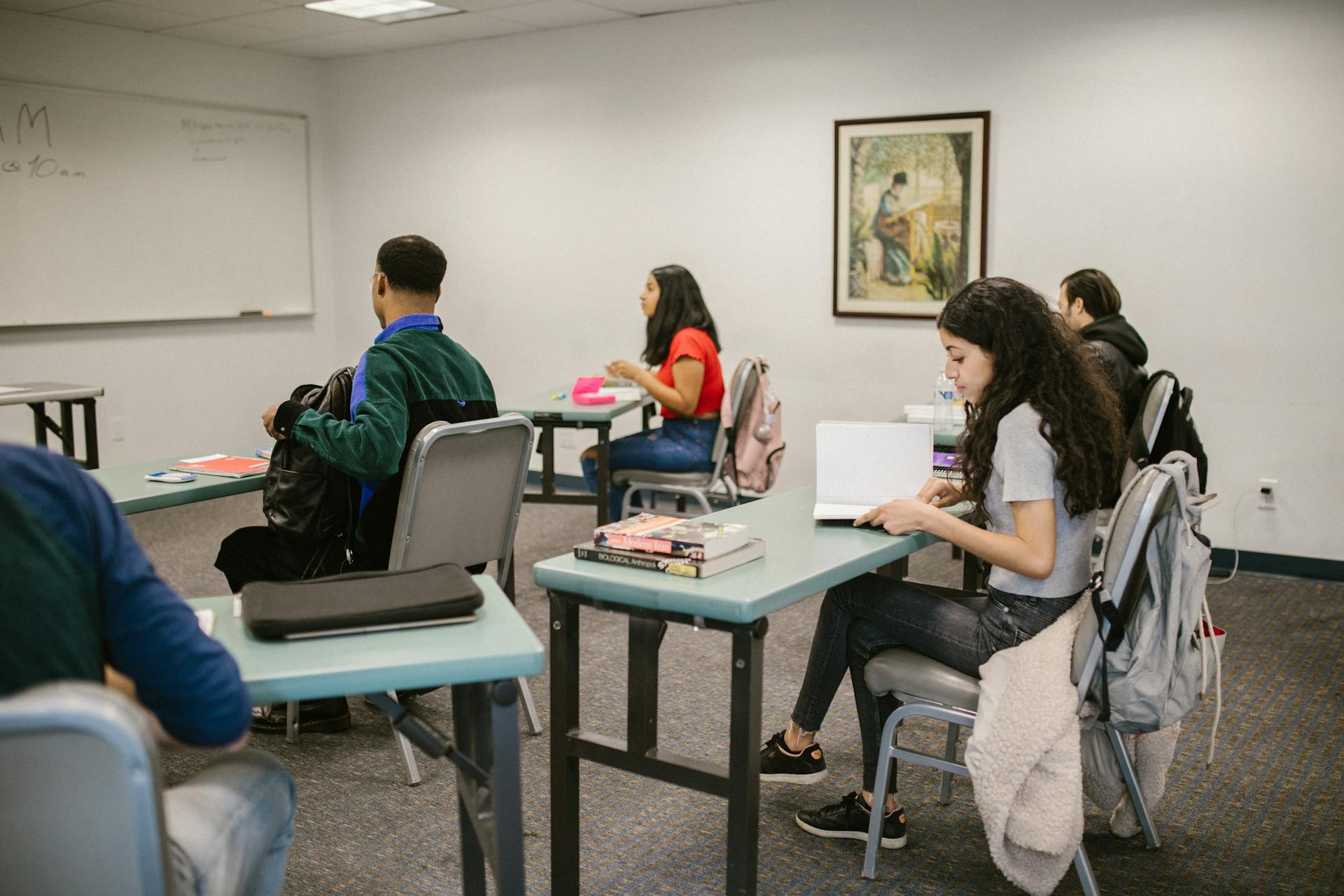
In Pennsylvania, a group called Education Voters of PA is working to shed light on the issue of voucher schools using tax dollars to advance discrimination.
Education Voters of PA has specifically highlighted the problem in the state.
Varying Rules by State
Some states require parents who accept a voucher to give up their rights entirely under IDEA.
Parents who accept a voucher in states with this requirement may not have any recourse if their child isn't getting the services or support they need.
You can go back to public school and resume supports and services under an IEP, but you may have to start the evaluation process again.
Public schools that lose funding to voucher programs have fewer resources for the students who stay.
This can be a bigger issue for public schools, especially if they're already struggling.
News and Updates
The Supreme Court has ruled that states cannot exclude religious schools from their tuition assistance programs, allowing parents to use vouchers to send their children to private schools.
The ruling in Carson v. Makin has been criticized for breaching the separation between church and state, requiring states to fund private religious schools even for religious instruction or worship.
Governor Abbott has announced that there will be multiple special sessions, including one on "education freedom", aka school vouchers, which could be called by the governor at any time.
The Economic Policy Institute has found that school vouchers are not a proven strategy for improving student achievement.
The National Education Association has stated that the Supreme Court decision paves the way for public funds to flow to religious schools.
Chairman Ken King has announced that the bill HB 100 would not be passed out of the House due to disagreements over vouchers and education finance legislation.
The Austin American Statesman has expressed concerns that a school voucher program is not right for Texas education.
Key Takeaways
Before taking a school voucher, know what the rules are in your state.
Private schools are not subject to the same special education law that public schools are. This means your child may receive fewer supports and services than they did in public school.
If you take a voucher, your child may receive fewer supports and services than they did in public school, and you may have to pay for an evaluation and services on your own.
Here are some key things to consider when it comes to school vouchers and special education:
- Private schools are not required to offer the same special education services that public schools offer.
- Private schools are not subject to the same special education law that public schools are.
- You may have to pay for an evaluation and services on your own if you take a voucher.
Frequently Asked Questions
What is the $8000 school voucher in Florida?
The Florida universal school voucher program provides parents with a voucher of approximately $8,000 to use towards private school or homeschooling expenses. This program aims to give families more education options.
Featured Images: pexels.com