Schneider Kreuznach is a German optics company that has been around since 1913. It's been a family-owned business for over a century.
The company is known for its high-quality lenses and optical components. They've been used in various applications, including photography, telescopes, and binoculars.
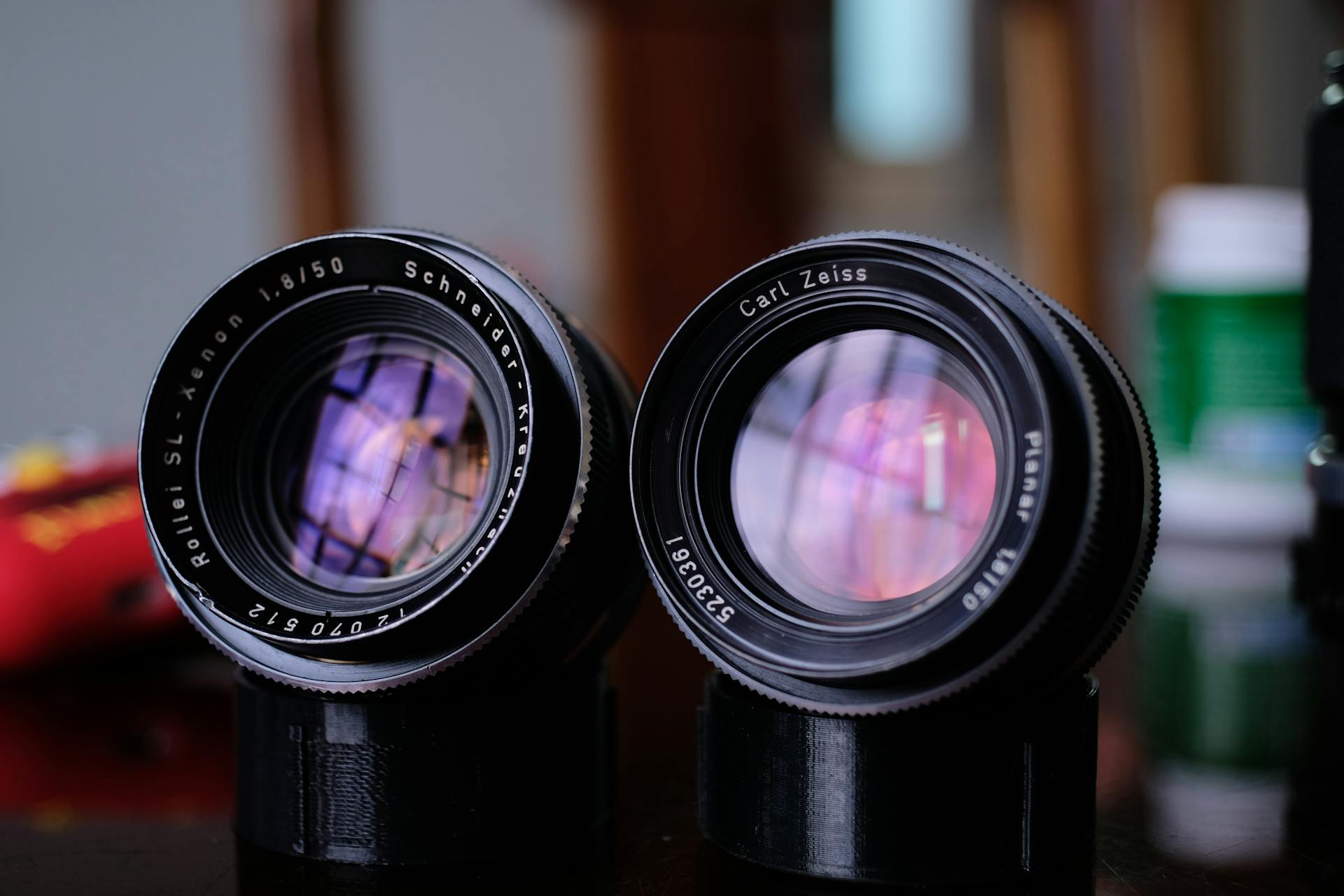
Schneider Kreuznach is particularly famous for its Xenon lenses, which are highly regarded for their sharpness and contrast. These lenses are used in a wide range of photographic equipment, from DSLRs to large-format cameras.
Their products are used by professionals and hobbyists alike, and are often sought after for their exceptional optical performance.
Lens Types
Schneider Kreuznach offers a wide range of lenses, including wide-angle lenses, telephoto lenses, and enlarger lenses.
Their wide-angle lenses, such as the Angulon and Super Angulon series, are known for their high-quality construction and durability. The Angulon series, introduced in 1930, is a 6-element, 2-group, symmetric anastigmat design with a coverage of 80°. The Super-Angulons, on the other hand, are Biogon designs with huge, heavy lenses but generous angles of coverage, ranging from 95° to 105°.
The company also produces telephoto lenses, such as the Tele Xenar and Tele Arton series, which are designed for specific formats like 4x5" and 8x10". These lenses are often used for portrait and landscape photography.
Here's a list of some of the lens types offered by Schneider Kreuznach:
- Wide-angle lenses (Angulon and Super Angulon series)
- Telephoto lenses (Tele Xenar and Tele Arton series)
- Enlarger lenses (introduced in 1914)
- Motion picture lenses (produced since 1915)
Lens Names
Schneider lens names can be quite confusing, but they're actually quite interesting. Schneider's lens names often reflect their design or functionality, such as the Super Angulon, which is a wide-angle lens with a generous angle of coverage.
The Super Angulon is a Biogon design, which means it's a bit on the heavy side, but it's also very capable. The f/4 lenses, for example, give a 95° angle of coverage, while the f/8 models give a 100° coverage angle.
Here are some common Schneider lens names and their characteristics:
Schneider's lens names often reflect their design or functionality, making it easier to understand what to expect from each lens. Whether you're a professional photographer or just starting out, knowing the different Schneider lens names can help you make informed decisions about which lenses to use for your projects.
Related reading: Canadian Currency Coin Names
Leaf Shutter
Leaf Shutter lenses offer a range of focal lengths, from 28 mm to 240 mm.
The LS 28 mm f/4.5 Aspherical lens is a great option for wide-angle shots.
You can also consider the LS 35 mm f/3.5 lens for capturing everyday scenes.
The LS 55 mm f/2.8 lens is ideal for portraits and close-ups.
If you need a telephoto lens, the LS 80 mm f/2.8 is a good choice.
The LS 40-80mm LS f/4.0-5.6 lens offers flexibility with its zoom range.
For extreme telephoto shots, the LS 240 mm f/4.5 IF lens is a good option.
Here are some of the Leaf Shutter lenses mentioned:
- LS 28 mm f/4.5 Aspherical
- LS 35 mm f/3.5
- LS 40-80mm LS f/4.0-5.6
- LS 75–150 mm f/4,0-5,6
- LS 240 mm f/4,5 IF
These lenses also include some macro options, like the LS 120 mm f/4.0 Macro Lens.
Check this out: Banco Macro Atención Al Cliente 24 Horas
Vario Curtar
The Vario-Curtar lens is a type of projector lens that comes in different designs. The Schneider Kreuznach Vario-Curtar 0.75 x is printed around the beauty ring of the lens barrel.
There are two distinct designs for the 0.75x projector lens. One has a black lens barrel with zebra bars around it, while the other has a shorter lens barrel with the same 0.75x designation printed around the outside near the main lens element.
If you're looking at a Vario-Curtar lens, check the beauty ring for the 0.75x designation.
Additional reading: United States V. Univis Lens Co.
Company Information
Schneider Kreuznach is a German company that has been around since 1913. They're a well-established player in the optics industry.
The company is headquartered in Heidelberg, Germany, and has a strong presence in the global market. They're known for their high-quality lenses and optical components.
Schneider Kreuznach has a long history of innovation, having developed the first anamorphic lens in 1958. This was a major breakthrough in the film industry.
Their products are used in a variety of applications, including cinema, photography, and industrial inspection. They're a trusted brand in the industry.
Schneider Kreuznach has a strong commitment to quality and customer service. They're known for their excellent support and technical expertise.
Additional reading: Currency Also Known as the Renminbi Crossword
People and Roles
At Schneider Kreuznach, you'll find a diverse team of experts working together to bring innovative solutions to the market.
Piet Thiele, Geschäftsbereichsleiter Photo/Cine, is responsible for the strategic and operational management of the Business Unit Photo/Cine, overseeing the development of structures, organization, processes, and systems.
Consider reading: Retained Cash Flow / Net Debt
The company values collaboration and teamwork, as seen in the words of Piet Thiele, who finds motivation in working with "great people, both internally and externally."
Magnus Greger, Geschäftsbereichsleiter Industrie, brings extensive knowledge in Optik, mechanical design, and electro-software technology to the table, having studied physical technologies and worked as an optical engineer.
Lena Förster, an Auszubildende Industriekauffrau, is currently in the second year of her apprenticeship, having gained experience in various departments, including Einkauf, Buchhaltung, and Supply Chain Management.
History
The history of Schneider lenses is a fascinating story that spans over a century. The company was founded in 1914 and introduced one of its original lens designs, a symmetric double gauss design, the same year.
The Symmar is one of the original Schneider designs, introduced in 1920, and is still relevant and used today. It has a 6-element, 4-group, symmetric design, and gives a 70° angle of coverage.
The Symmar-S is an incremental improvement to the original Symmar design, adding multicoating to the feature set. It was introduced later than the Symmar, but the exact date is not specified in the article.
You might enjoy: Original Brand Manufacturer

Schneider's inexpensive, classic Xenar asymmetrical, anastigmatic, 4-element, 3-group lens design was introduced in 1919, and is largely unchanged from the original Zeiss Tessar formula. It features an angle of coverage of 60–62°.
The Tele Xenar and Tele Arton are two types of telephoto lenses designed by Schneider, both using a 5-element variation of the Tele-Xenar design. They can be used on subjects as close as 2 meters without a loss of resolution.
Here is a list of some of the Schneider lens designs mentioned in the article:
- Angulon and Super Angulon
- Radionar and Isconar: triplet lenses
- Tele Xenar (4 element) and Tele Arton (5 element) Telephoto lenses
- Symmar: Initially a 3+3 Dagor-type sold as triple convertible, later a Plasmat sold as convertible
- Variogon: range of zoom lenses
- Xenar: mostly four element designs, copies of the Carl Zeiss Tessar, though some f/2.8 Xenars were a five element design (5 elements in four groups)
- Xenon: six element design, for high aperture lenses
Piet Thiele - Business Division Manager
Piet Thiele is a Business Division Manager at Schneider-Kreuznach, responsible for leading the Photo/Cine business unit.
Piet has a strong background in the photography industry, having worked as a photographer and even earning a Gesellenbrief as a photographer.
He has also worked as a sales manager for a photography equipment company and has a degree in Photo+Medientechnik.
Piet's passion for film and photography started at a young age, and he was thrilled to join Schneider-Kreuznach, where he can work with talented people and contribute to the development of innovative products.
He appreciates the company's unique culture, which allows employees to work on exciting projects and collaborate with customers to bring their stories to life.
Piet's experience and expertise have been instrumental in driving the growth of the Photo/Cine business unit at Schneider-Kreuznach.
He is known for his ability to bring people together and facilitate collaboration, which has been essential in the development of the company's products and services.
Piet's commitment to his work and his passion for innovation have made him a valuable asset to the company.
He is always eager to learn about new technologies and trends, and he enjoys reading, listening to podcasts, and baking in his free time.
New Products and Partnerships
Schneider Kreuznach has been pushing the boundaries of optical excellence for over 175 years. The company's expertise in lens design and manufacturing has led to the development of innovative products.
Their partnership with Leica Camera is a significant one, having supplied lenses for the renowned camera manufacturer since 1907. This collaboration has resulted in the creation of high-quality lenses that meet the demands of professional photographers.
One notable product from Schneider Kreuznach is the Xenon lens, which features a high-quality glass and a robust design.
Readers also liked: Gender Lens Investing
Cinelux Première
Cinelux Première is a line of projection lenses that feature aspheric elements to correct for spherical aberration. These lenses are available in both normal and anamorphic models.
One of the key features of Cinelux Première lenses is their variable aperture, which allows for a range of f-stops from f/1.7 to f/4. This flexibility is a big plus for filmmakers who need to adapt to changing lighting conditions.
The Cinelux Première lenses are also available in different focal lengths, including 10 mm, 16 mm, and 70 mm. These focal lengths can be useful for a variety of applications, from close-ups to wide shots.
Here are some of the specific models available in the Cinelux Première line:
- 10 mm f/1.8
- 16 mm f/2.0
- 70 mm f/2.0
These lenses are a great option for anyone looking for high-quality projection optics with a range of features and flexibility.
Current Activities and Products
Schneider-Kreuznach is a company that specializes in the development and production of high-performance objectives. They offer a wide range of products, including optics design, mechanical design, and precision engineering.
Their expertise in optics design and manufacturing allows them to produce high-quality objectives for various applications. They use advanced technologies such as aspheric technology to achieve exceptional optical performance.
Schneider-Kreuznach is also known for its precision engineering capabilities, including the design and production of thin-film systems. Their expertise in precision engineering enables them to create complex optical systems with high accuracy.
Their product portfolio includes high-performance objectives for various applications, such as photography, cinematography, and industrial inspection. They also offer a range of accessories, including optical filters and software filters for digital image processing.
Here are some of the key areas where Schneider-Kreuznach is currently active:
- Berührungslose Messtechnik mittels digitaler Bildverarbeitung
- Bildaufnahme und -verarbeitung
- Digitale Projektion (LCD, DMD)
- Gerätebau für optische Instrumente
Zusammenarbeit mit LK Samyang führt zu neuem Superweitwinkel-Zoom-Objektiv
The partnership between Schneider-Kreuznach and LK Samyang has led to the development of a new Superweitwinkel-Zoomobjektiv.
This new lens is the AF 14-24mm F2.8 FE, which was unveiled at the CP+ 2025 imaging conference in Japan. The conference took place from February 27 to March 1.
Schneider-Kreuznach brought its renowned optical expertise to the table, while LK Samyang contributed its advanced technology.
The result is a significant product for the mirrorless market.
Featured Images: pexels.com