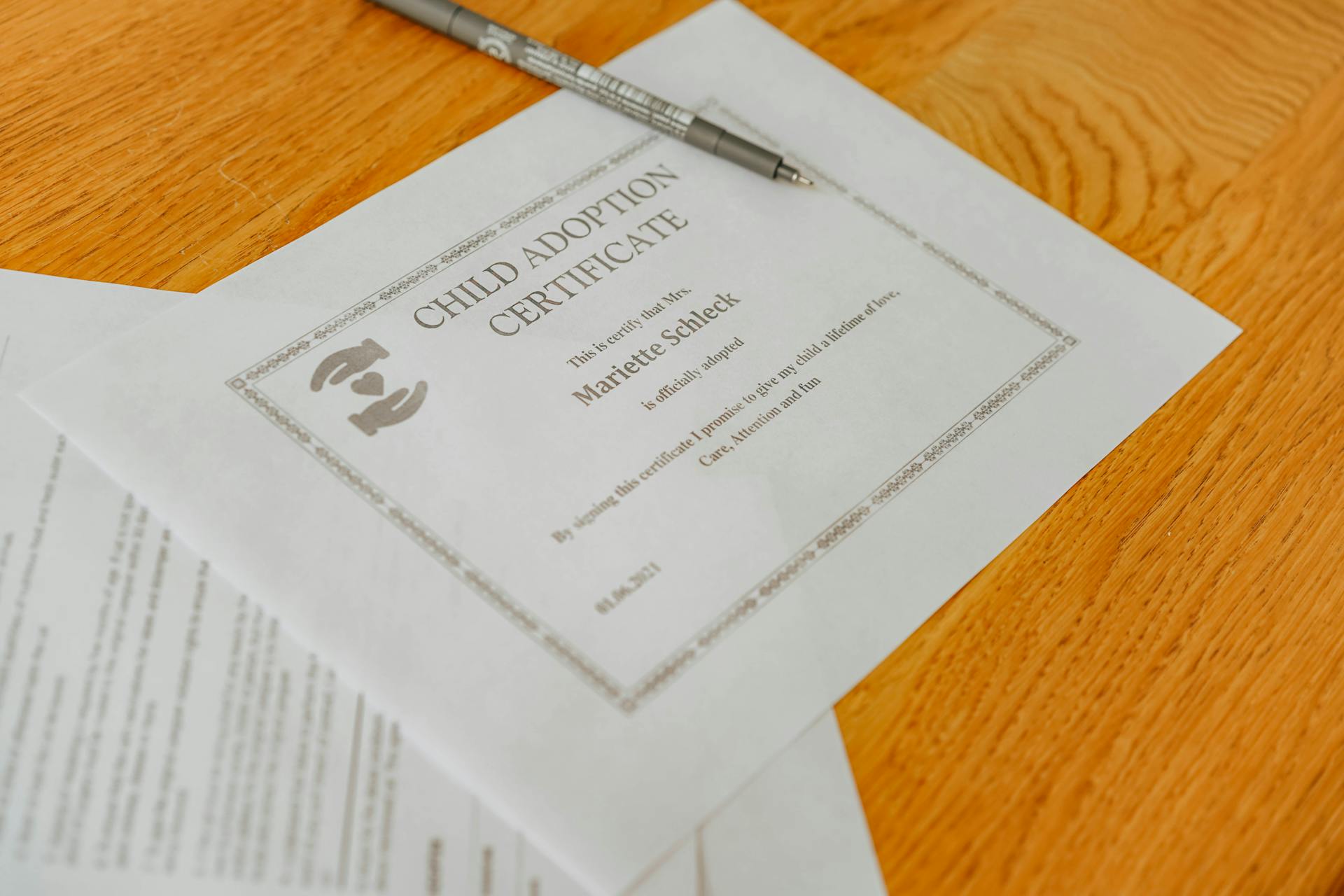
A legal guardianship agreement is a formal document that outlines the responsibilities and rights of a guardian, who is tasked with making decisions on behalf of a minor or incapacitated individual. This agreement is typically created when a parent or caregiver is unable to care for a child due to death, disability, or absence.
The guardian's primary responsibility is to act in the best interest of the individual, making decisions about their health, education, and well-being. This can include managing their finances, arranging medical care, and determining their living arrangements.
A legal guardianship agreement can be created through a court order or by agreement between the parties involved. In some cases, a parent or caregiver may appoint a guardian through a will or power of attorney.
Check this out: Duty of Due Care
Types of Guardianship
There are several types of guardianship agreements, each with its own unique circumstances.
A guardianship of an adult provides care and support to a special needs adult or elderly person who cannot make decisions on their own. The guardian is responsible for providing daily essentials such as shelter, food, clothing, medical attention, and treatment.
Discover more: Car Lease to Own Contract
A guardianship of a minor is necessary when parents are unable to provide proper care and supervision, often due to incarceration, illness, or physical and mental conditions. The guardian is responsible for providing day-to-day care needs such as clothing, education, shelter, food, health treatment, and more.
Temporary guardianship is a short-term solution that authorizes an informal guardianship without court approval. This type of guardianship is usually determined by the parents of a minor child and provides authority for a temporary amount of time, often in emergency situations.
Here are the types of guardianship agreements:
- Guardianship of an adult
- Guardianship of a minor
- Temporary guardianship
Forms and Documents
To navigate the complex process of creating a legal guardianship agreement, it's essential to understand the various forms and documents involved. The first step is to gather the necessary paperwork, which can be found in the Adult Guardianship Forms section. This includes the Petition for Appointment of Guardian - Adult, Certificate of Incapacity - Adult, and Declaration of Service on Adult Proposed Protected Person.
The Adult Guardianship Forms section provides a comprehensive list of required documents, including the Order Appointing Guardian - Adult and Notice of Entry of Order Appointing Guardian - Adult. These forms serve as a foundation for establishing a guardianship agreement. Additionally, the Child Guardianship Forms section offers similar documents for minors, such as the Petition for Appointment of Guardian(s) over a Child and Order Appointing Guardian(s) over a Minor Child.
The following table outlines some of the key forms and documents involved in the guardianship process:
Keep in mind that the specific forms and documents required may vary depending on the jurisdiction and circumstances of the case.
Adult Forms
Adult Forms are essential documents for managing the affairs of an adult who is unable to care for themselves. You can find these forms on the Adult Guardianship website.
Petition for Appointment of Guardian - Adult is a crucial form that initiates the legal process of appointing a guardian. This form is available in both pdf fillable and pdf formats.
Here's an interesting read: Legal Document Subject a and B
Citation to Appear and Show Cause - Adult is another important document that requires the proposed protected person to appear in court. This form is also available in both pdf fillable and pdf formats.
Certificate of Incapacity - Adult is a document that certifies the incapacity of the adult person. It's essential to have this certificate before proceeding with the guardianship process.
A Declaration of Service on Adult Proposed Protected Person is required to prove that the proposed protected person has been served with the necessary documents. This form is available in both pdf fillable and pdf formats.
Letters of Guardianship - Adult are issued to the appointed guardian, granting them the authority to manage the affairs of the protected person. These letters are available in pdf fillable format.
The Initial Plan of Care for the Protected Adult Person outlines the necessary care and support for the protected person. This plan is essential for the guardian to understand the needs of the protected person.
The Guardian's Acknowledgment of Duties and Responsibilities of the Guardian of the Person (Adult) and the Guardian's Acknowledgment of Duties and Responsibilities of a Guardian of the Estate (Adult) are documents that acknowledge the duties and responsibilities of the appointed guardian.
Recommended read: A Corporation Is an Artificial Person Created by Law
Forms
If you're dealing with a guardianship case, you'll likely need to fill out various forms. You can find these forms online, and they vary depending on the type of guardianship and the state you're in.
For child guardianship, you can visit the Child Guardianship website to learn more about the legal process. From there, you can access various forms, such as the Petition for Appointment of Guardian(s) over a Child and the Confidential Information Sheet - Guardianship.
Temporary guardianship forms are also available, including the Petition for Appointment of Guardian(s) over Child Including Request for Temporary Guardianship and the Order Appointing Temporary Guardian(s) over Minor.
For adult guardianship, you can visit the Adult Guardianship website to learn more about the legal process. You'll find forms like the Petition for Appointment of Guardian - Adult and the Citation to Appear and Show Cause - Adult.
In some cases, you may need to file a petition to transfer guardianship to another state, such as Nevada. You can find the necessary forms, including the Petition to Transfer Adult Guardianship to Nevada and the Provisional Order to Accept Guardianship/Conservatorship from Sending State.
For another approach, see: You Need to Create a Legal Structure
Here are some common guardianship forms you may need to fill out:
Post-Petition Process
Once a guardianship petition is filed, the post-petition process can be complex and time-consuming.
A petition to remove a guardian can be filed, which requires a court order to remove the guardian from their role.
The court may issue an order to remove the guardian, which can be downloaded as a pdf fillable document or a pdf.
A guardian can choose to resign from their position by filing a petition to resign as guardian, which can be found in pdf format.
The court will then issue an order approving the resignation of the guardian, available in both pdf fillable and pdf formats.
If a guardianship is no longer needed, a petition to terminate guardianship can be filed, requiring a court order to end the guardianship.
Petitions to terminate guardianship are available in pdf fillable and pdf formats for minors and adults.
A different take: Pdiddy Court Case
A petition for visitation or contact can also be filed, allowing the court to approve or deny visitation or contact between the ward and their family members or friends.
The court will issue an order approving the petition for visitation or contact, which can be downloaded as a pdf fillable document.
Proof of publication, such as for the sale of real property, may be required and can be found in pdf fillable and pdf formats.
A certificate of service and declaration of service are also necessary, available in pdf and pdf fillable formats.
A notice of entry of order will be issued by the court, which can be downloaded as a pdf.
A different take: Bill Browder Freezing Order
Guardianship Requirements
As a guardian, you'll be responsible for making important decisions on behalf of your ward. This can be a big responsibility, but it's also a great opportunity to make a positive impact on someone's life.
From a day-to-day perspective, guardians must provide proper care, maintenance, education, and support. This includes supplying essentials like food, clothing, and shelter.
Guardians must also provide access to medical care and treatment, and authorize medical decisions related to surgery, dental, mental, and physical care. This can be a challenging but important part of being a guardian.
In addition to these responsibilities, guardians must provide opportunities for education, growth, and learning. This can include things like enrolling your ward in school or finding extracurricular activities they enjoy.
Guardians must also communicate with family members regularly, according to the court's appointed order. This can help ensure that everyone is on the same page and that your ward's needs are being met.
Here are some of the key responsibilities of a guardian:
- Provide proper care, maintenance, education, and support
- Supply essentials like food, clothing, and shelter
- Provide access to medical care and treatment, and authorize medical decisions
- Provide opportunities for education, growth, and learning
- Communicate with family members regularly
- Communicate with the court and attend hearings, as required
Person vs. Estate
A guardianship of a person is a big responsibility, but it's a fulfilling and rewarding position, too. You assume legal responsibility for a minor child, special needs adult, or elderly adult when they can't care for themselves.
A guardianship of an estate is used to preserve and manage the assets of an estate when the owner is no longer able. This helps provide care, maintenance, education, housing, and support for the person in your care.
A different take: Legal Real Estate Contract
You can choose to have a guardianship of a person or an estate, or both. A guardianship can be temporary or permanent, and it's essential to understand the differences to make informed decisions.
A guardianship of a person and an estate can be voluntary or involuntary, and all guardians have a fiduciary duty to put the loved one's interests ahead of their own. This means putting the person's needs above your own.
Frequently Asked Questions
What is the disadvantage of legal guardianship?
Undergoing legal guardianship means your child will lose independence and autonomy, with the guardian making key decisions on their behalf. This includes financial, healthcare, and residency choices, among others.
How to get legal guardianship without going to court?
To establish temporary guardianship without court involvement, you can use a written agreement or power of attorney with clear parental consent and notarization. This allows for quick arrangements in emergency situations, but it's essential to follow the necessary steps for legal validity.
Featured Images: pexels.com