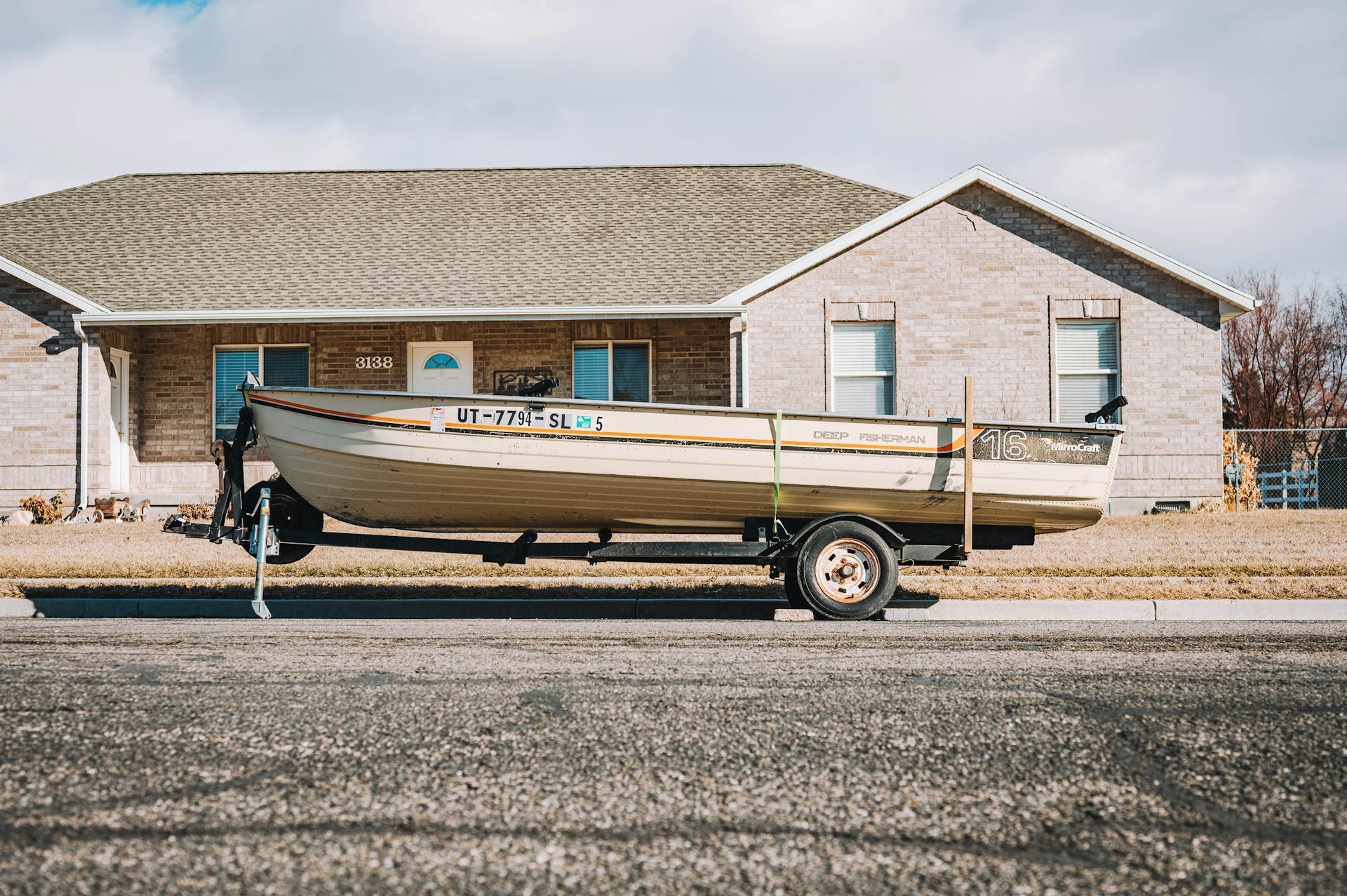
Financing a mobile home can be a bit tricky, but don't worry, I've got the lowdown.
There are two main types of mobile home financing: personal property loans and real estate loans. The type you need depends on your situation, so it's essential to understand the difference.
To qualify for a personal property loan, you'll typically need to have a good credit score and a stable income. This type of loan is usually offered by banks and credit unions.
A real estate loan, on the other hand, is secured by the land the mobile home is on. This type of loan is often used for mobile homes that are permanently attached to the land and considered real property.
On a similar theme: Everything You Need to Know about Work from Home Trend
Financing Options
Financing a mobile home can be a bit more complicated than financing a traditional house, but there are still many options available. Consider seeking out other types of loans, such as chattel loans or FHA loans, which can be used to finance a mobile home.
You may be able to finance just the home, without the land, using an FHA Title 1 loan, which allows you to purchase a manufactured home without owning the land. However, not all lenders offer these loan types, so it's essential to shop around.
To qualify for a manufactured home loan, the home must meet certain requirements, such as being manufactured on or after June 15, 1976, and being placed on property owned by the borrower with deeded access or access directly to a state-maintained road. The loan must also cover the home and the land on which it stands.
Here are some key differences between chattel loans and conventional mortgages:
Chattel loans are a good option for homes on a leased lot or if the owner already has land available, while conventional mortgages cover the manufactured or modular home, the land, or other improvements.
Broaden your view: Mortgage Loans for Mobile Homes on Land
Loan Options
You can finance a mobile home through various loan options, including chattel loans and government-backed loans like FHA and VA loans.
Chattel loans are a good option for homes on a leased lot or if the owner already has land available.
These loans can be up to 25 years in length and have a simplified application and closing process.
They're especially fast to close since appraisals and other steps are not needed.
FHA loans, on the other hand, allow you to finance just a manufactured home without land using an FHA Title 1 loan.
This program is designed to assist borrowers in purchasing manufactured homes, even if they lease the land where the home will be situated.
Government-backed loans can be a solid option for those who qualify, but they come with restrictions like the inability to rent out the property and the need to comply with restrictions.
Here are some key facts about FHA loans:
VA loans for manufactured housing are available to qualified veterans, spouses, and other beneficiaries for primary homes.
As with any government-backed loans, those eligible for VA loans apply through private lenders.
VA loans have funding fees from about 1.4 to 3.6% of the purchase price.
It's essential to compare different lenders' offerings to find a loan that has low fees and interest rates.
This can save you thousands of dollars over the life of the loan and help you secure more favorable loan terms.
A fresh viewpoint: Hard Money Lenders for Mobile Homes
Low Options
If you're looking for low-money down options for mobile home financing, you're in luck. In Arizona, you can purchase a manufactured home with as little as 3.5% down.
FHA loans are a great option, offering competitive interest rates and a low down payment. This can be a huge advantage for first-time homebuyers or those with limited savings.
Even if you have issues with your credit history and credit score, you may still qualify for a home loan from Cascade Loans. They have a more lenient qualifying process.
Chattel loans are another unique option available only for manufactured homes, not site-built homes.
You might enjoy: How to Buy a Mobile Home with No Money down
Understanding Loans
Title I loans can be used to finance various aspects of a manufactured home, including the home itself, the land it sits on, or a combination of both.
Maximum loan amounts vary depending on the type of loan, ranging from $43,377 for a manufactured home lot to $237,096 for a multisection manufactured home and lot.
The loan program has specific requirements, including a minimum floor area of 400 square feet and a construction date after June 15, 1976.
To qualify for a manufactured home loan, the home must be manufactured on or after June 15, 1976, and placed on property owned by the borrower with deeded access.
Some lenders, like SECU, offer loan options with a 20-year maximum term for financing single- or double-wide manufactured homes.
Here's a breakdown of the maximum loan amounts and terms:
- Manufactured home only: $105,532 for single section, $193,719 for multisection
- Manufactured home lot: $43,377
- Manufactured home and lot: $148,909 for single section, $237,096 for multisection
Maximum loan terms also vary, ranging from 15 to 25 years, depending on the type of loan and the home's specifications.
FHA Loans
If you're looking to finance a mobile home, you should know that the Department of Housing and Urban Development (HUD) offers mobile home loans through the Federal Housing Administration (FHA) loan program, including Title I and Title II loans.
The FHA loan program is a great option for those who want to finance a mobile home, but you need to understand the distinction between "mobile home" and "manufactured home." Mobile homes were built before June 15, 1976, and were not subject to federal construction and safety standards, while manufactured homes were built on or after that date and meet HUD's national safety and construction standards.
To qualify for an FHA loan, your home must be a manufactured home built on or after June 15, 1976, and display a HUD Certification Label. The home must also be your primary residence, at least 400 square feet, and meet FHA's minimum property standards.
For another approach, see: Cash Out Refinance Mobile Home
Here are the key pros and cons of an FHA loan for mobile homes or manufactured homes:
Keep in mind that FHA manufactured home guidelines also require an FHA appraisal to ensure the home meets value and condition standards, and the loan must be obtained through an FHA-approved lender.
You might enjoy: Fha Loan Indiana Application
What Determines a Loan's Maximum
A loan's maximum is determined by several factors, including the type of loan and the property being financed. The loan-to-value (LTV) ratio is a key factor, which compares the amount of your mortgage to the value of your property.
For manufactured home loans, the maximum financing and LTV ratio are determined based on either the sales price or appraised price of the home, whichever is less. You're responsible for paying appraisal costs.
The maximum loan amount for a manufactured home loan varies depending on whether you're financing the home only, the home and lot, or just the lot. Here are the maximum loan amounts:
The loan term also plays a role in determining the maximum loan amount, with different terms available for different loan types. For example, a manufactured home loan can have a maximum term of 20 years, plus 32 days, while a manufactured home lot loan can have a term of 15 years, plus 32 days.
Recommended read: Spectrum Mobile Surpasses 10 Million Mobile Lines in Six Years
Chattel Loans
Chattel loans are a type of financing for manufactured homes that's different from regular home loans. They're considered personal property, so the interest rates are higher, but you can still keep your land if you default.
Chattel loan rates are higher than personal loan rates, but lower than regular home loan rates. This is because the loan is considered personal property, not a traditional home loan. I've seen people get confused about this, so it's good to clarify.
Chattel loans have shorter loan terms, typically up to 25 years, and you can't borrow as much as you could with a regular mortgage. This is because the loan is secured by the manufactured home, not the land.
Here are some key differences between chattel loans and other types of financing:
Chattel loans work well for homes on a leased lot or if the owner already has land available. This is because the loan is secured by the manufactured home, not the land.
Related reading: Land Equity Loan Rates
What Are and
Loans are a type of credit that allows you to borrow money from a lender to cover expenses or finance a purchase. You can use loans for various purposes, such as buying a car, paying for education, or consolidating debt.
There are different types of loans, including secured and unsecured loans. Secured loans require collateral, such as a house or car, to secure the loan.
Interest rates on loans can vary depending on the lender and the type of loan. For example, personal loans often have higher interest rates than mortgages.
Repayment terms for loans can also differ. Some loans, like credit cards, have shorter repayment periods, while others, like mortgages, can have longer terms.
Loans can have fees associated with them, such as origination fees or late payment fees. These fees can add up quickly and increase the overall cost of the loan.
See what others are reading: Bad Credit Home Mobile Mortgage
Housing Costs and Financing
Financing a manufactured home can be a bit more complicated than traditional home financing, but it's definitely doable.
One thing to keep in mind is that you won't be charged an application fee or credit report fee when applying for a loan, which is a nice surprise.
An origination fee, however, will be assessed at closing, which is 1% of the loan amount, capped at $2,500. This fee is paid directly to SECU, and you'll also need to pay for an appraisal, which is paid to a third-party company.
You'll also need to pay for title insurance, attorney fees, homeowners insurance, and property taxes, which are paid to third-party companies.
On a similar theme: How Does T Mobile Insurance Work
Fannie Mae
Fannie Mae offers two programs for manufactured homes, one of which features a down payment as low as 3%.
The Manufactured Home Advantage (MH Advantage) program also allows for flexible sources of down payment, such as funds from multiple sources.
Financing through Fannie Mae is available for up to 30 years, and lower interest rates may be available compared to other manufactured home options.
You'll need a 5% down payment and a minimum credit score of 620 to qualify for standard manufactured housing financing through Fannie Mae.
Once you've built 20% equity in your manufactured home, you can cancel private mortgage insurance.
If this caught your attention, see: Borrow Money against Mobile Home
Housing Costs
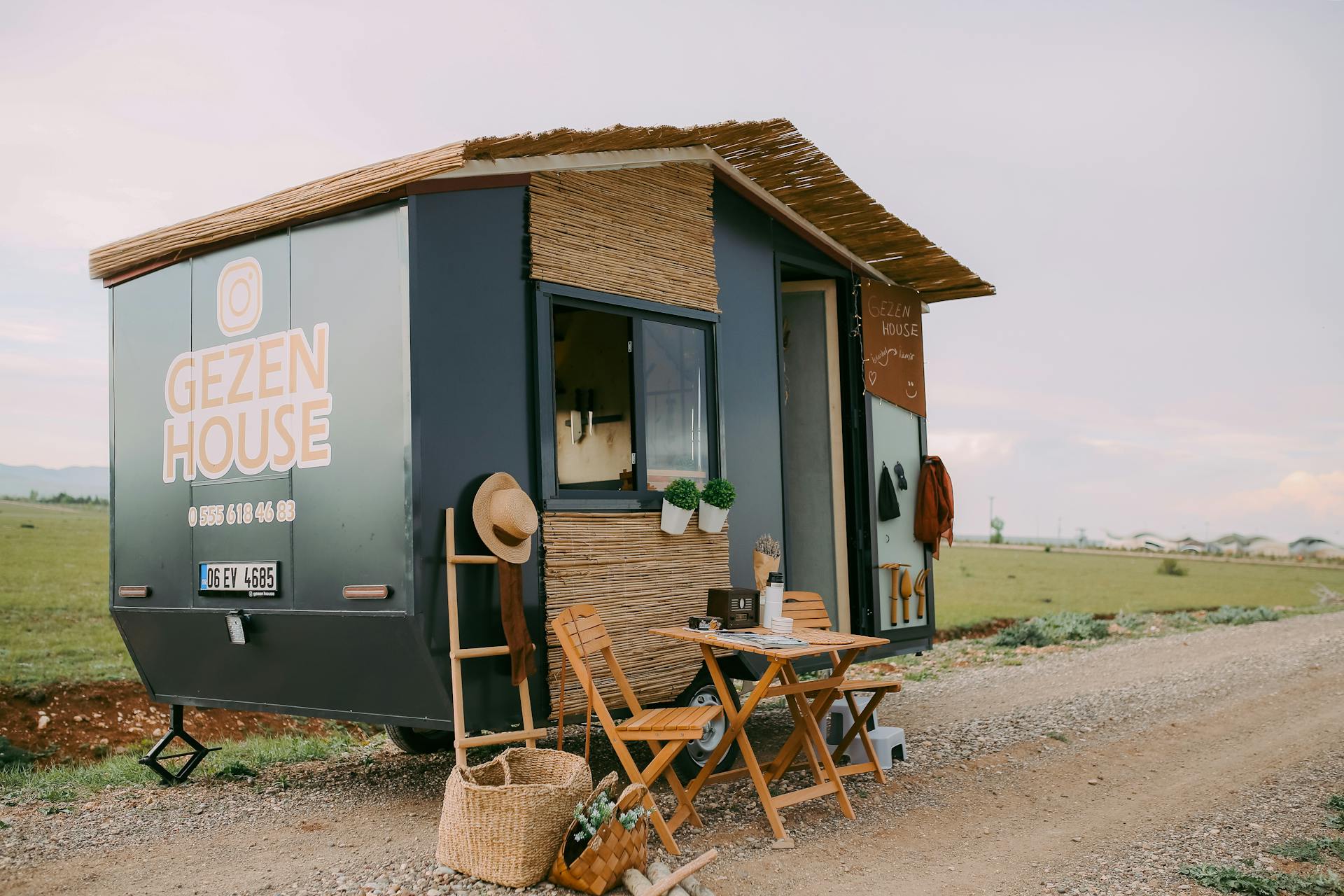
Housing costs can be a significant burden for many people. The average cost of a manufactured home before accounting for land is $108,100, which is significantly lower than the average cost of a site-built home at $365,904.
One of the main advantages of manufactured homes is their affordability. They cost almost half as much per square foot as site-built homes, with an average cost of $72.21 per square foot compared to $143.83 for site-built homes.
An origination fee of 1% of the loan amount, capped at $2,500, is assessed at closing when financing a manufactured home. You'll also need to pay for an appraisal, which is paid to a third party by SECU.
In addition to these costs, you'll also need to pay for title insurance, attorney fees, homeowners insurance, and property taxes. These charges are paid to third parties.
Here's a breakdown of the average costs associated with manufactured and site-built homes:
These costs can add up quickly, but financing options like conventional mortgages can make homeownership more affordable. In fact, the combination of smaller loan sizes and lower interest rates means that more people will be able to afford a home.
Should I Buy Land?
Buying land can be a smart move when financing a mobile home. If you own the land and your mobile home has had the axle and wheels removed, it's less likely that you'll pick up and move, making more lending institutions open to financing a mobile home.
If you plan to rent a plot for your home, you'll be eligible for fewer loans. This is because renting a plot is considered less stable than owning the land.
You can still finance your mobile home with an FHA loan even if it's located in a mobile home park. However, you must lease the land long-term to satisfy FHA's occupancy requirements.
Lenders may not allow lending for leasehold properties, meaning you don't own the land. Neighbors Bank, for example, will not finance a manufactured home that is located in a mobile home community.
A fresh viewpoint: Make Your Own Hours Work from Home
More Affordable
Manufactured homes are a more affordable option compared to traditional site-built homes. The average cost of a manufactured home before accounting for land is $108,100, which is significantly lower than the average cost of a site-built home at $365,904.
For another approach, see: Cash Out Refinance Manufactured Home
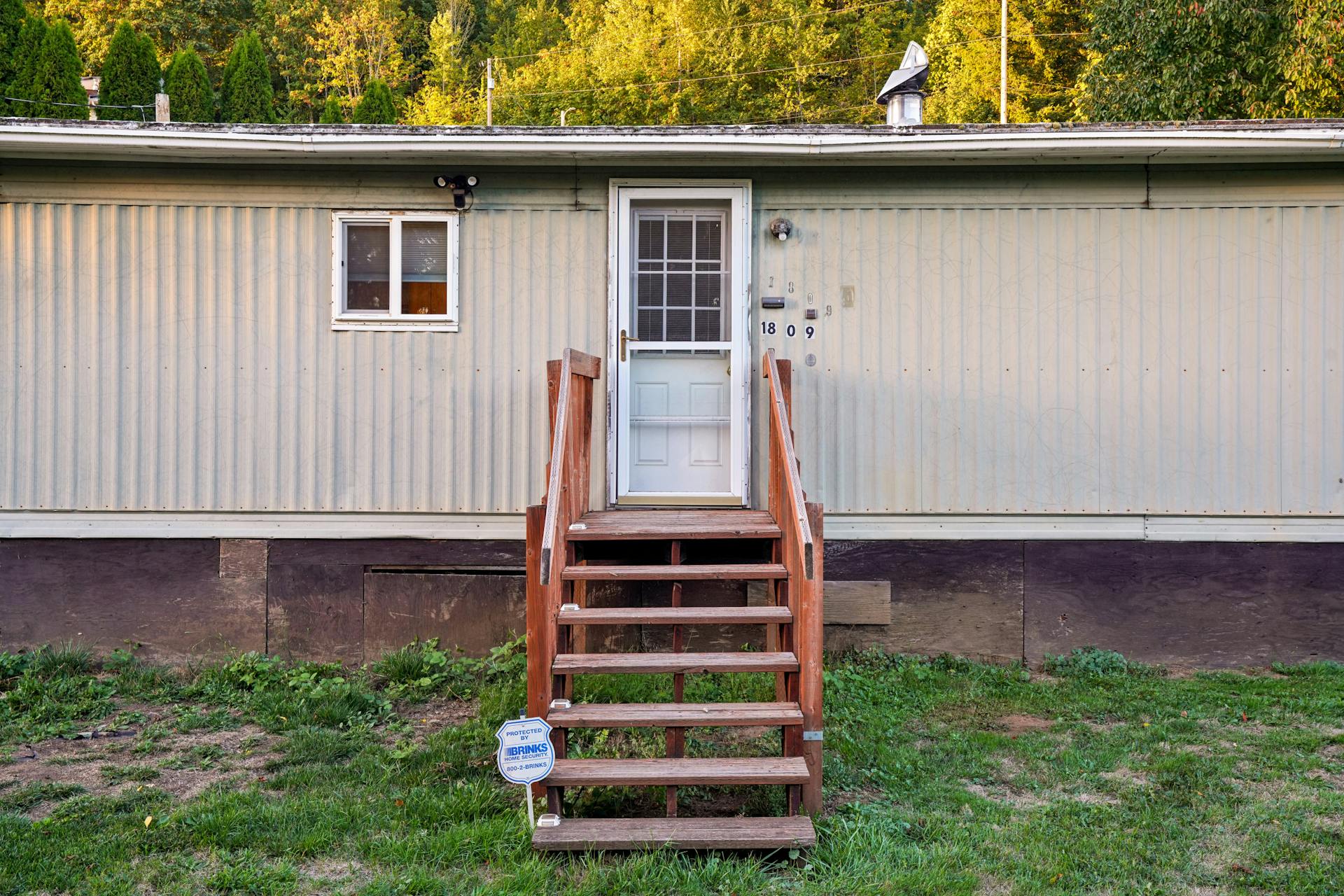
This affordability is due to the cost and operational efficiencies that come with building in a factory with standardized blueprints and materials. As a result, the price per square foot of a manufactured home is almost cut in half, at $72.21 compared to $143.83 for a site-built home.
The lower cost of manufactured homes means that more people will be able to afford a home, which is one of the biggest predictors of the ability to pass on generational wealth.
Here are some key statistics comparing manufactured homes to site-built homes:
This affordability also means that buyers will be able to receive financing on more attractive terms, making it easier for them to purchase a home.
Compare Options
Compare options is key when it comes to financing a mobile home. You may need to seek out other types of loans since traditional mortgages may not be a viable solution.
You have several financing options to consider, including chattel loans and government-backed loans like FHA, USDA, and VA. Government-backed loans can be a solid option for those who qualify, but they come with restrictions like not being able to rent out the property.
Additional reading: Home Remodel Finance Options
FHA loans are available for financing or refinancing manufactured homes with terms of up to 30 years and loans that offer low down payments and loosened credit restrictions. They're only for primary residences, though.
VA loans for manufactured housing are available to qualified veterans, spouses, and other beneficiaries for primary homes. These loans have funding fees from about 1.4 to 3.6% of the purchase price.
To find the best loan for your situation, you'll want to compare different lenders' offerings. Mobile home interest rates and manufactured home loan rates and fees can vary widely between lenders.
Broaden your view: Hard Money Heloc Loans
Guidelines and Eligibility
To qualify for financing, a manufactured home must be built on or after June 15, 1976, and display a HUD Certification Label. This label confirms the home meets federal safety and construction standards.
To be eligible for an FHA loan, the home must be the borrower's primary residence, have a minimum of 400 square feet, and meet FHA's minimum property standards. The loan must also be obtained through an FHA-approved lender and undergo an FHA appraisal to ensure it meets value and condition standards.
See what others are reading: Minimum Home Loan Amount
The loan amount will depend on the location, but the maximum FHA loan limit amount varies by location. To give you an idea, Title I loans have a maximum loan amount of $105,532 for a single-section manufactured home, $193,719 for a multisection home, and $43,377 for a manufactured home lot.
Freddie Mac
Freddie Mac offers conventional financing for manufactured homes through their Home Possible mortgage program, allowing you to secure a loan with as little as 3 percent down.
You can also use gifted or grant money to help cover your down payment in some cases.
To qualify for Freddie Mac's CHOICEHome Mortgage program, manufactured homes must meet the same requirements as site-built homes.
You'll need a minimum credit score of 680 to secure a manufactured home loan through the CHOICEHome Program.
Your credit history in the last 24 months must show no unpaid judgments, tax liens, or collections, no payments 60 days or more past due, and no other housing payments past due.
These are geared toward multisectional manufactured homes that are at least 1,000 square feet and serve as your primary residence.
For your interest: How to Buy a Mobile Home Park with No Money
FHA Guidelines
To qualify for an FHA loan, your manufactured home must be built on or after June 15, 1976, and display a HUD Certification Label.
The home must be used as your primary residence, and it must be at least 400 square feet. The loan must be obtained through an FHA-approved lender, and the manufactured home and property (if applicable) must undergo an FHA appraisal to ensure it meets value and condition standards.
The maximum FHA loan limit amount varies by location. You'll need to check the current limits for your area.
Here are the key FHA guidelines for manufactured homes:
- The home must be built on or after June 15, 1976, and display a HUD Certification Label.
- The home must be used as your primary residence.
- The home must be at least 400 square feet.
- The loan must be obtained through an FHA-approved lender.
- The manufactured home and property (if applicable) must undergo an FHA appraisal.
These guidelines are crucial to ensure your manufactured home meets the FHA's minimum property standards, ensuring safety, security, and structural integrity.
Interest Rates and Refinancing
Interest rates play a significant role in financing a mobile home. To qualify for low mobile home interest rates, you'll want to aim for a credit score of at least 700, with 750 or higher being the absolute best.
Related reading: Bob Housing Loan Interest Rate
A good credit score can save you money in the long run. If you're looking for a loan with a lower interest rate, consider the FHA loan, which has an average rate of 6.45% as of August 9, 2024.
The type of loan you choose can also impact your interest rate. Here's a quick rundown of the average rates and typical minimum credit scores for different types of loans:
Cash-Out Refinance Limits
Cash-out refinance limits can be a bit tricky, but it's essential to understand them before making a decision.
You can refinance up to 65% loan-to-value for a manufactured home, which means you can borrow a significant amount of money based on the value of your home.
This means that if your home is worth $100,000, you can borrow up to $65,000 cash-out refinance.
Worth a look: Is an Heloc Based on Home Equity or Home Value
Current Interest Rates
To qualify for low mobile home interest rates, you'll need a credit score of at least 700. A score of 750 or higher will get you the absolute best rates available.
The average interest rates for mobile home loans vary based on several factors, including your credit score, down payment amount, and type of home. For example, FHA loans have an average rate of 6.45%, while Chattel loans start at 8%.
You can expect to pay varying interest rates depending on the type of loan you choose. Here's a breakdown of the average rates for different types of loans:
Key Information
Mobile homes can be a cost-effective alternative to traditional homes, with the average manufactured home selling for about $127,250. This is a significant difference from the median price of traditional homes, which exceeds $412,000.
Most traditional mortgage lenders don't offer financing options for mobile homes due to their lower cost and depreciating value. This can make financing more complicated than purchasing a traditional home.
There are some financing options available, including FHA Title I and Title II loans, Freddie Mac loans, Fannie Mae loans, and personal loans.
Here's an interesting read: How Much Do Home Equity Loans Cost
Key Takeaways
Mobile homes can be a more cost-effective alternative to traditional homes, with an average price of $127,250 compared to the $412,000 median price of traditional homes.
Most mortgage lenders don't offer financing options for mobile homes due to their lower cost and depreciating value. This means you'll need to dig a bit deeper to find financing options.
Some ways to finance the purchase of a mobile or manufactured home include FHA Title I and Title II loans, Freddie Mac loans, Fannie Mae loans, and personal loans.
To qualify for these loans, homes must meet foundation and property standards, and only FHA-approved lenders offer them.
On a similar theme: Pnb Housing Finance Share
The Bottom Line
Mobile and manufactured homes can be much more affordable than a traditional site-built home.
Financing options for mobile and manufactured homes are available, but you'll need to research and understand the eligibility requirements.
You'll want to ensure the home is not too old to qualify for a loan or mortgage, typically 20 years or newer.
A suitable location is also crucial, so be sure to find a spot that meets the lender's requirements.
Curious to learn more? Check out: Usda Loan for Modular Home
Loan Details
Financing a mobile home can be a bit tricky, but understanding the loan options and details can make a big difference. One option is to explore available loan options at SECU, which offers a 20-year maximum term for single- or double-wide manufactured homes.
You can finance your mobile home with a loan from SECU, giving you the flexibility to choose from different terms and rates.
If you're considering an FHA loan, you should know that it allows for a low down payment of as low as 3.5%. This can be a huge relief for buyers who might not have the funds for a larger down payment.
However, FHA loans also come with mortgage insurance premiums, which can add to your monthly payments.
Here are the key pros and cons of an FHA loan for mobile homes:
Keep in mind that FHA loans do come with some limitations, such as the need for a HUD-approved permanent foundation.
Frequently Asked Questions
Can you finance a mobile home without a down payment?
Yes, you can finance a mobile home without a down payment through the USDA RD program, but be aware of the restrictions and qualifications that apply. Manufactured homes are eligible, but must meet specific criteria.
Featured Images: pexels.com