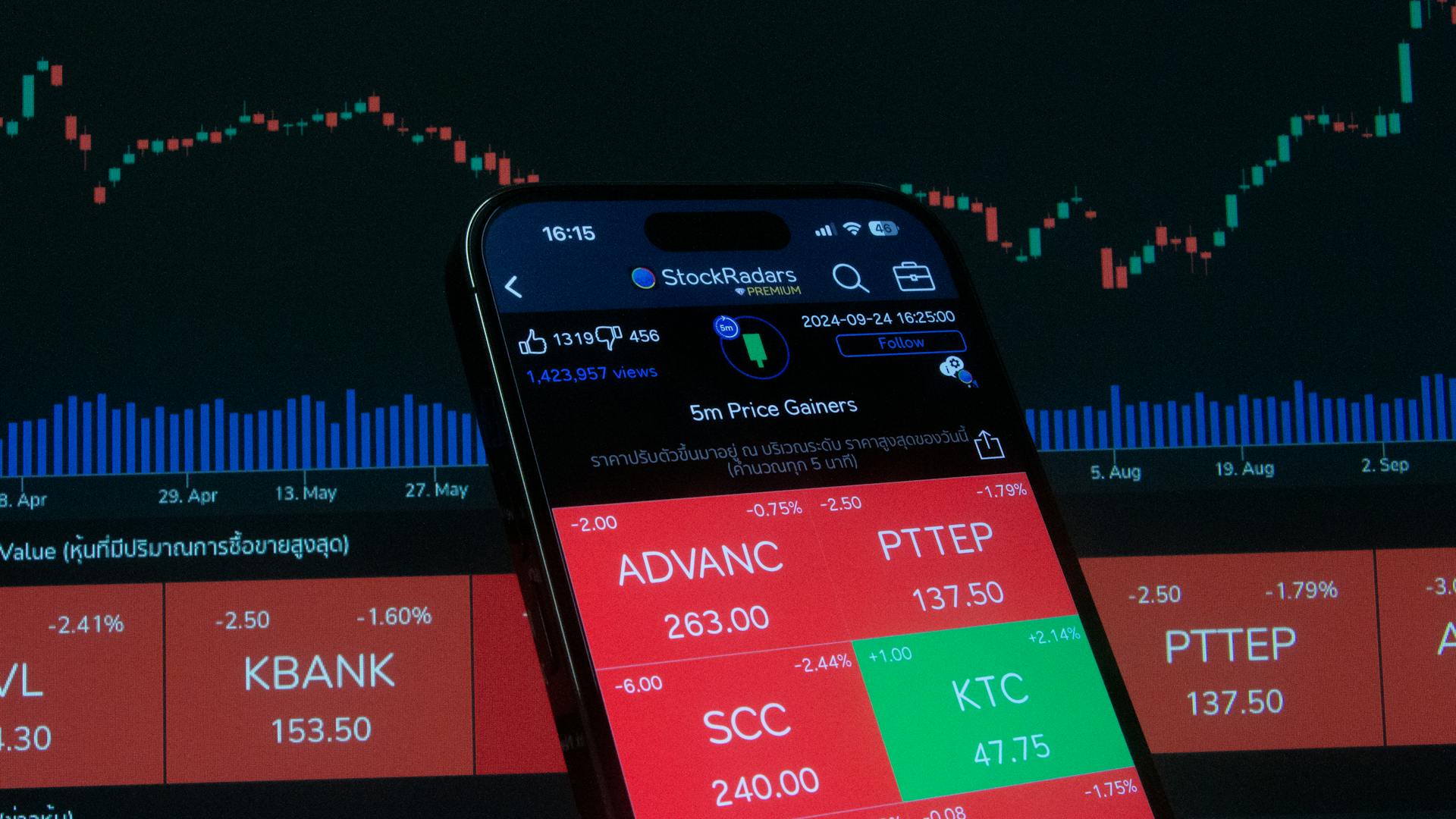
Shorting a stock can be a bit daunting at first, but it's actually a straightforward process once you understand the basics.
To short a stock, you need to borrow shares from a broker or another investor, which is known as a short sale.
The goal of shorting is to profit from a stock's decline in value, not its rise.
You can short a stock by selling shares you don't own, but must buy them back later to return to the lender.
A short sale typically involves selling shares at the current market price, with the expectation of buying them back later at a lower price.
Worth a look: Shorting Penny Stocks
Getting Started
To get started with short selling, you'll need to establish a margin account to hold eligible assets like bonds, cash, mutual funds, or stocks as collateral. This account will allow you to borrow shares from a brokerage firm.
You'll be charged interest on the value of the outstanding shares until they're returned, and interest rates can vary significantly. In some cases, you may be able to short the most liquid shares for nothing, while the least liquid shares could come with an annualized interest rate of more than 100% of the value of your position.
Intriguing read: Transfer Brokerage Account to Robinhood
Your broker will also need to "locate" the security you're targeting before you can do a short sale, which is a regulatory requirement aimed at preventing "naked shorting." This means your broker must have a reasonable belief the security can be borrowed and delivered on a specific date before you can short it.
To identify potential short-sale candidates, traders use various approaches, including:
- Fundamental analysis: Analyzing a company's financials to decide if its stock may be a candidate for a decline in price.
- Technical analysis: Patterns in a stock's price movement to decide if it could be on the cusp of a downtrend.
- Thematic: Betting against companies whose business models or technologies are deemed outdated.
Understanding the Risks
Short selling can be a complex and high-risk strategy, and it's essential to understand the potential pitfalls before diving in. Short selling carries significant risks, particularly with leveraged products like CFDs.
These risks include unlimited loss potential, where the stock price could theoretically rise indefinitely, and the losses grow without a cap. Unlimited losses can be devastating, making it crucial to carefully weigh the risks before engaging in short selling.
The main risks associated with short selling include timing risks, where stocks can remain overvalued for longer than expected, and the costs of maintaining the short position can erode your profits or result in a loss.
Readers also liked: Palantir Stock Price Growth Potential
The Risks

Short selling carries significant risks, particularly with leveraged products like CFDs, which can amplify potential gains but also increase exposure to losses.
One of the main risks associated with short selling is the possibility of unlimited losses, as the stock price could theoretically rise indefinitely, making this strategy inherently risky.
If the stock price increases, your losses grow without a cap, making it essential to understand these risks before engaging in this strategy.
Short selling can also result in substantial losses if the stock price doesn't decline quickly, causing the costs of maintaining the short position to erode your profits or even result in a loss.
For example, if you short 100 shares of a stock at $100 per share and the stock rises to $200, you'll face a significant loss, which in this case would be $1,500 if the stock is closed at $65.
The potential for big rewards is real, but so are the risks, especially when using leveraged products like CFDs, making timing and patience crucial in short selling.

The stock can remain overvalued for longer than expected, causing you to hold your position and incur additional interest on borrowed shares, which can further increase your losses.
The most you could profit in a short position is the initial value of the stock you shorted, which is limited compared to the potential gain of buying the stock and watching it rise indefinitely.
Here's an interesting read: What Is a Short Position in Stocks
Is Available Worldwide?
Short selling is available in many global financial markets, including Europe, but its availability can be restricted during periods of extreme volatility.
Regulations in the European Union, governed by the European Securities and Markets Authority (ESMA), require traders to borrow or locate shares before initiating a short sale.
Naked short selling, selling shares that haven't been borrowed, is prohibited in the EU.
CFDs are a popular way to short-sell in Europe and other regions, offering traders access to global markets.
Regulators often impose temporary bans on short selling during times of crisis, such as the 2008 financial crisis and the COVID-19 pandemic.
Some argue that short selling can exacerbate market downturns or lead to unfair manipulation, while others see it as a valuable tool that adds liquidity to markets and helps expose overvalued or poorly managed companies.
Curious to learn more? Check out: Global X Stock
Key Concepts
Short selling is a high-risk strategy where investors bet on a security's price drop, but it can also offer big profits.
To short a stock, you borrow shares from a broker and immediately sell them, expecting the price to fall shortly after.
Short selling has a high risk/reward ratio, offering big profits, but losses can mount quickly and may result in margin calls.
The process is facilitated through CFDs, which allow traders to speculate on price movements without borrowing physical shares.
Here are the key steps involved in short selling:
- Borrow shares from a broker.
- Sell the borrowed shares on the open market.
- Buy back the shares at the lower price, hoping to profit from the difference.
Keep in mind that short selling involves serious risks, including the potential for losses to exceed your initial margin.
A Step-by-Step Process
To short a stock, you'll need to follow a few key steps. First, you'll need to open a margin account with a broker, which requires a minimum balance, known as the maintenance margin, to cover potential losses.
You'll then need to identify a stock that you believe will decline in value by analyzing financial reports, industry trends, technical indicators, or broad market sentiment. This involves speculation based on the expectation that the stock's price will drop, allowing you to profit by buying it back later at a lower price.
To locate borrowable shares, your broker will handle the process automatically, finding shares from other clients' accounts or even institutional lenders. Once you've identified the stock and located borrowable shares, you'll place a short sale order through your brokerage platform.
After opening the short position, you'll need to actively monitor the market and the stock's performance. If the stock price increases, your losses can grow, and you'll need to account for any interest charges on the borrowed shares and keep track of the margin requirements.
To close the position, you'll need to buy the stock at a lower price than you sold it for, and then return the borrowed shares to the brokerage. The difference between the sell and buy prices is your profit (or loss).
Here are the key steps to short a stock:
1. Open a margin account with a broker
2. Identify a stock that you believe will decline in value
3. Locate borrowable shares through your broker
4. Place a short sale order through your brokerage platform
5. Monitor the market and the stock's performance
6. Close the position by buying the stock at a lower price and returning the borrowed shares
For more insights, see: What Is a Stock Stop Order
Costs and Risks
Short selling comes with some significant costs and risks that you should be aware of before diving in. Margin interest can add up quickly, especially if you're holding a short position for an extended period.
There are several types of costs to consider, including margin interest, stock borrowing costs, and dividends or other costs. For example, hard-to-borrow fees can be substantial, with an annualized rate that can range from a small fraction of a percent to over 100% of the value of the short trade.
These costs can erode your profits or even result in a loss if you're not careful. Timing is also a crucial factor in short selling, as stocks can remain overvalued for longer than expected, causing you to incur additional interest on borrowed shares.
Here are some key costs and risks to consider:
- Margin interest: Can add up quickly, especially for extended periods
- Stock borrowing costs: Can be substantial, with annualized rates ranging from a small fraction of a percent to over 100%
- Dividends and other costs: Short sellers must pay dividends or interest on borrowed shares
- Timing risks: Stocks can remain overvalued for longer than expected, causing additional costs and potential losses
Margin Calls
Margin calls are a crucial aspect of short selling and margin trading. If the stock price rises significantly and the value of your account falls below the maintenance margin level, the broker will issue a margin call.
You'll need to deposit additional funds into your margin account to bring the account back to the required level. If you fail to meet the margin call, the broker may close your position automatically to prevent further losses.
The minimum maintenance requirement is 25%, which means you must meet this level or face a margin call. If your account slips below this, you're subject to a margin call and forced to put in more cash or liquidate your position.
Brokers may require additional funds to maintain your position if the market moves against you. Failure to meet these margin calls can result in forced liquidation at a loss.
The risks of short selling, particularly with leveraged products like CFDs, carry significant risks. Without proper risk management, traders can quickly face losses that exceed their initial investment.
Worth a look: How Long before I Receive Funds Fro Selling Stock
Costs
Short selling involves more than just the usual trading commissions. Margin interest can add up quickly, especially if you hold your short position for an extended period.

The cost of borrowing shares can be substantial, with "hard-to-borrow" fees ranging from a small fraction of a percent to over 100% of the value of the short trade. These fees are prorated for the number of days the short trade is open.
You'll also need to make dividend payments on the shorted stock to the entity from which you borrowed it. For shorted bonds, you'll pay the lender the coupon or interest owed.
Here's a breakdown of the additional costs you can expect to incur with short selling:
- Margin Interest: The interest payable on short trades can add up, especially if you hold your position for an extended period.
- Stock Borrowing Costs: "Hard-to-borrow" fees can range from a small fraction of a percent to over 100% of the value of the short trade.
- Dividends and Other Costs: You'll need to make dividend payments on the shorted stock, and pay the lender the coupon or interest owed for shorted bonds.
Strategies
To short a stock, you need to understand the different strategies involved.
One common strategy is to use a put option, which gives you the right to sell a stock at a specified price.
Short selling is often used to bet against a stock that's overvalued, like in the case of Tesla's high valuation.
A bear put spread is another strategy where you sell a put option on a stock and buy a put option with a lower strike price.
For another approach, see: Espp Strategy
This can be an effective way to profit from a stock that's expected to decline in value, as seen with the decline of GameStop's stock price.
Another strategy is to use a short call spread, where you sell a call option on a stock and buy a call option with a higher strike price.
Selling a Stock
Selling a stock is a crucial part of shorting a stock. You'll need to sell the stock you don't own into the market.
To do this, you'll place a sell order, just like you would if you were selling stock you owned. Many brokers won't distinguish between a short sale and a regular sale, so you'll enter the order as if you were selling stock you owned.
The short position will typically show up in your account as a negative number of shares, such as -100 shares of XYZ stock. This is because you're essentially selling stock you don't have.
Here's an interesting read: Tradestation Order Entry
You can close the short position by buying the stock back at a lower price, ideally. The difference between the sell and buy prices is your profit (or loss).
To short a stock, you'll need to have margin trading enabled on your account, allowing you to borrow money. The total value of the stock you short will count as a margin loan from your account, meaning you'll pay interest on the borrowing.
Here are the key costs associated with shorting a stock:
- Margin interest: You'll pay interest on the borrowed shares while the position is open.
- Cost of borrow: You'll pay a fee to the broker for the service of finding stock to sell short.
- Dividend payments: You'll be responsible for any dividends paid by the company.
These costs will be rolled into your margin balance, so it's essential to consider them when deciding whether to short a stock.
Calculating Profit and Loss
Calculating profit and loss when shorting a stock is straightforward. You need to know the opening and closing values of the stock.
If the stock price falls, you can close your short position by buying back the shares at a lower price, and your profit will be the difference between the opening and closing values. For example, if you shorted 100 shares at $50 and closed at $40, your profit would be $1,000.
However, if the stock price rises, you'll need to buy back the shares at a higher price, and you'll incur a loss. In this case, if you shorted 100 shares at $50 and closed at $65, your loss would be $1,500.
The difference between the opening value and the closing value is your gross profit, but fees, holding costs, and interest will reduce the net profit.
A fresh viewpoint: Crowdstrike Stock Loss
Loss
Losses can be significant when short selling, as seen in the example where a trader closed a short position at $65, resulting in a $1,500 loss.
If you're short selling, you're essentially selling a stock you don't own with the expectation of buying it back later at a lower price. However, if the stock price rises instead, you'll have to buy it back at a higher price, leading to a loss.
The loss is calculated by subtracting the selling price from the buying price, multiplied by the number of shares. For instance, if the trader sold at $50 and bought back at $65, the loss would be $15 per share, or $1,500 for 100 shares.
One of the most significant risks of short selling is unlimited loss potential, as the stock price could theoretically rise indefinitely. This means your losses can grow without a cap, making this strategy inherently risky.
A unique perspective: What Is a Stock Trader
Calculate Your Profit

To calculate your profit, you need to determine the difference between the opening and closing values of your trade. This difference is your gross profit.
The gross profit is calculated by subtracting the opening value from the closing value. For example, if the opening value is $10,000 and the closing value is $7,000, your gross profit would be $3,000.
Fees, holding costs, and interest will reduce your net profit, so be sure to factor these costs into your calculation.
Example and Conclusion
Shorting a stock can be a tricky business, but let's break it down with an example. Imagine you sell 100 shares of XYZ at $100 per share, borrowing the stock against the equity in your account.
You'll have a margin balance of $10,000 and the cash proceeds of $10,000 credited to your account. This cash is essential to repurchase the stock later.
If the stock falls to $60 a share, you can repurchase the stock for $6,000 and pocket the difference of $4,000 between your sale and purchase. However, if the stock rises to $140 and you want to close the position, you'll need to pay $14,000 to repurchase the 100 shares, which could trigger a margin call from your broker.
If this caught your attention, see: Abbvie Stock 10 Year Investment Return
Example
Short selling can be a complex process, but let's break it down with an example. You borrow shares of a stock, sell them at the current market price, and then wait for the price to drop so you can buy them back at a lower price to return to the lender.
You can short sell a stock with a margin account, which allows you to borrow money from your broker to make trades. This means you can sell 100 shares of XYZ, which trades at $100 per share, and receive $10,000 in cash proceeds.
If the stock price falls to $60, you can repurchase the 100 shares for $6,000 and pocket the difference of $4,000. However, if the stock price rises to $140, you'll need to pay $14,000 to repurchase the shares, which could lead to a margin call from your broker.
A margin call is when your broker requires you to deposit more cash or liquidate positions to meet the loan requirements. This can be stressful, especially if you're not prepared. It's essential to understand the risks and consequences of short selling before entering into a trade.
The cost of borrow or any dividends paid while you were short also need to be repaid when you close the position. This can eat into your profits or even result in a loss if the stock price rises instead of falls.
Recommended read: When a Mutual Insurer Becomes a Stock Company
The Bottom Line
So, let's summarize the key takeaways from our discussion. The bottom line is that the benefits of a well-structured example are numerous.
By following a clear and concise example, you can reduce confusion and increase understanding. This is especially true when explaining complex concepts to others.
A good example can also help to build trust with your audience. As we saw in the article, a well-crafted example can make even the most difficult topics seem accessible.
In fact, research has shown that people are more likely to engage with content when it includes relevant and relatable examples. This is because examples help to illustrate key points and make them more memorable.
Ultimately, the value of a well-structured example lies in its ability to convey complex information in a simple and clear way. This is a skill that can be developed with practice and patience.
See what others are reading: Examples of Penny Stocks
Frequently Asked Questions
Is shorting stocks illegal?
Short selling is generally legal, but naked short selling, which involves selling stocks without owning them, is considered illegal in most major stock exchanges. However, the specifics can vary depending on the exchange and jurisdiction.
Featured Images: pexels.com