
A short position in stocks is essentially a bet that a stock's price will go down. This is done by selling a stock you don't own with the expectation of buying it back at a lower price to make a profit.
To short a stock, you borrow shares from a broker or another investor, which can be a risk in itself. The borrowed shares are then sold at the current market price.
The key to managing risks when shorting a stock is to limit your losses if the price suddenly surges. This can be achieved by setting a stop-loss order, which automatically sells the stock if it reaches a certain price.
As we'll explore further, short selling involves a high level of risk, including the potential for unlimited losses if the stock price rises significantly.
Curious to learn more? Check out: Fidelity Blue Chip Growth Fund Stock Price
Setting Up a Short Position
To set up a short position, you'll need to open a margin account, which allows you to borrow shares to sell. This entails interest and margin requirements.
Additional reading: M1 Finance Margin Rates
A margin account is a type of brokerage account that enables you to trade with borrowed funds. It's essential to have this type of account to establish a short position.
You'll also need to check if your brokerage account allows for short selling, as this may require additional permissions. Some accounts may have restrictions on short selling, so it's crucial to confirm before proceeding.
To place a short order, enter the required details on your brokerage platform, just as you would for a long trade. However, the intent is to sell first, which is a key difference.
Regularly monitor the trade and manage your position, keeping an eye on the security's price and accumulating interest and margin requirements. This will help you stay on top of your short position and make adjustments as needed.
Here are the key steps to set up a short position:
Understanding Short Selling
Short selling is a complex strategy that involves selling a stock that you don't own, with the expectation of buying it back later at a lower price. To sell short, you need to borrow the shares from someone else, sell them in the open market, and then buy back the same number of shares to return to the owner.
A fresh viewpoint: Sell Stock and Buy Back at Lower Price
The goal of short selling is to profit from a decline in the stock's price, but it's a risky strategy that can result in significant losses if the stock's price increases instead. For example, if you short a stock at $50 and it rises to $60, you'll lose $10 per share.
There are two main reasons people sell short: concern about a company's fundamentals and hedging long transactions. Professional short sellers do careful research and may uncover information that is contrary to a positive market opinion.
Here are the two main reasons people sell short:
- Concern about a company's fundamentals
- Hedging long transactions
Short selling is not for the faint of heart, as the stock market has an upward bias and theoretically the price of the stock can increase indefinitely.
Long vs. Short
A long position is essentially buying shares in a company and holding on to them, hoping the price will go up. This is the opposite of short selling.
To take a long position, all you need to do is buy the stock through a broker and add it to your portfolio. Long position sales are much simpler than short positions.
Investors take a short position when they think the price of a stock is going to go down. They borrow stock from someone else, sell it in the open market, and eventually buy back the same number of shares to return to the owner.
Short selling is not for the faint of heart because the stock market has an upward bias and theoretically, the price of the stock can increase indefinitely.
Here's a simple way to think about it:
Professional traders and analysts use short selling to uncover information that's contrary to a positive market opinion. They might short a stock if they think a company's management is too optimistic about its future prospects.
Suggestion: Vanguard Index Funds S
Price Discovery
Price discovery is the ultimate goal of the market. It's the process by which prices are determined through the interaction of buyers and sellers.
Short selling, like going long, can be a key part of price discovery. It helps to reveal the true value of a stock by allowing traders to bet against its price.
Short selling can have its negative aspects, but in the long run, price discovery is what drives the market.
Options: Long
So, you're interested in learning about options and how they work. An investor has a long position when they buy or hold a call or put option.
This means they own the right to buy or sell the security at a specified price.
Having a long position means the investor is essentially betting on the security's price to rise with a call option or fall with a put option.
On a similar theme: Acreage Investor Relations
Managing Risks and Rewards
A short position can be a high-risk investment, with unlimited potential losses. The potential profit is limited to the stock's distance to zero.
To mitigate these risks, it's essential to do thorough research and think carefully before taking a short position. This is especially true since the investing company you borrowed from can demand you return its shares at any time.
A short squeeze can happen at any moment, making a series of higher highs, and causing the stock price to surge. This is exactly what happened with Volkswagen in October 2008, when the stock price jumped from €200 to €1,000 in just over a month.
For more insights, see: Position Trading Strategy
Risks and Mechanics
The risks of short selling are significant, and it's essential to understand them before taking a short position. A trader's potential profit is limited, but their potential loss is unlimited.
A stock could potentially rise for years, making a series of higher highs, which means the longer you hold a short position, the more money you could lose. Theoretically, the price of an asset has no upper bound and can climb to infinity.
One of the most dangerous aspects of being short is the potential for a short squeeze. A short squeeze happens when a heavily shorted stock's price spikes as traders rush to cover their positions.
The investing company you borrowed from can demand you return its shares at any time, which means you could be forced to buy back the shares at a higher price, resulting in a significant loss. In the case of Volkswagen, the stock jumped from about €200 to €1,000 in just over a month during a short squeeze.
For your interest: Position Trading vs Investing
Squeeze
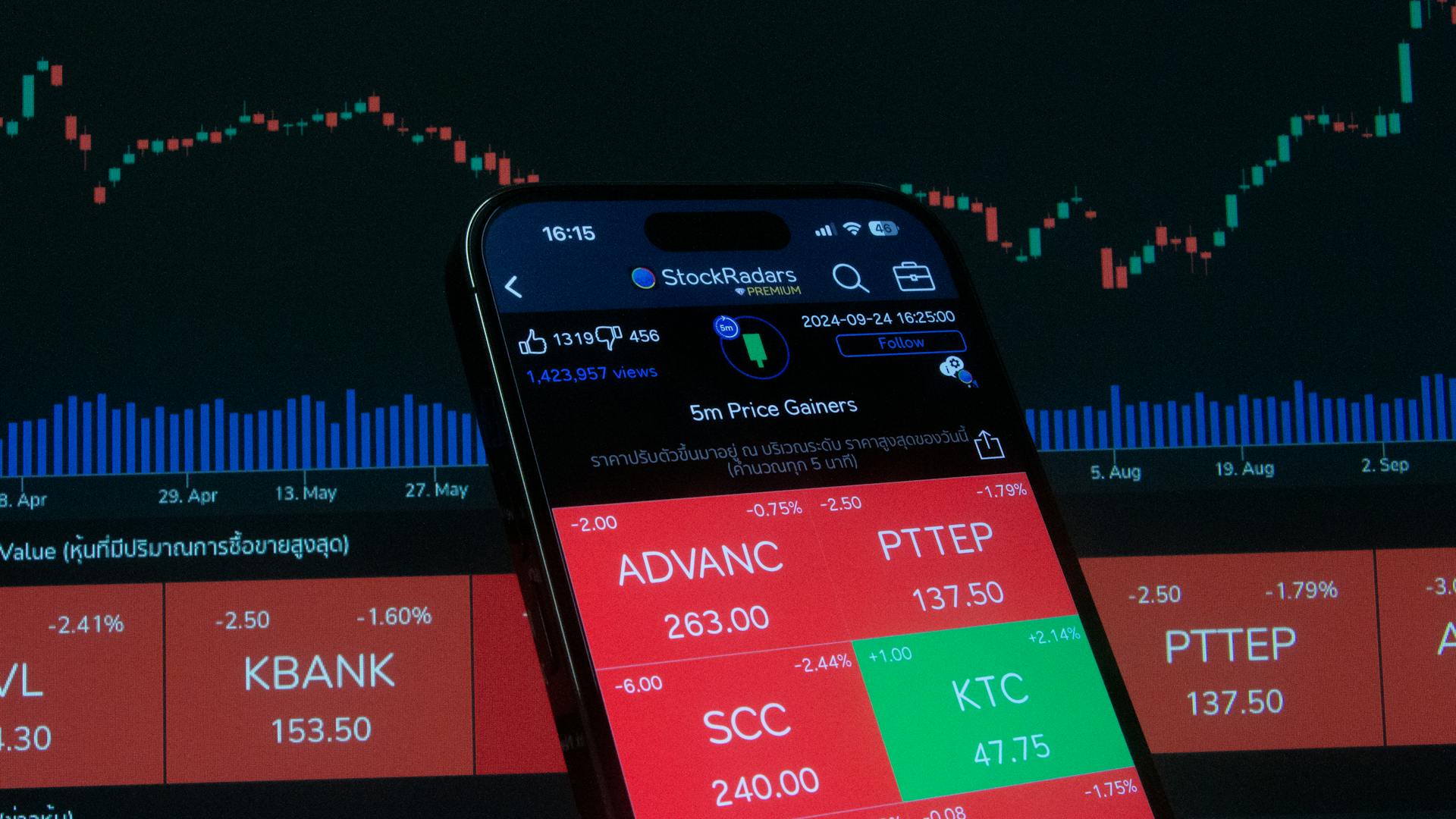
A short squeeze can happen when bullish news pushes a stock price higher, prompting short sellers to simultaneously head for the exits.
The GameStop trade in 2021 is a classic example of a short squeeze, where lots of buying by individual investors and large firms sent the share price higher, forcing some people with large short positions to buy shares to cover their short positions.
Short sellers are faced with losses to their short position as the underlying asset prices rise, and maintaining a short position can become more difficult because the amount of margin required as collateral increases.
The potential for a short squeeze is one of the most dangerous aspects of being short, as it can result in a surge in demand for shares and an extremely sharp rise in the underlying asset's price.
The stock price can jump sharply higher as short sellers scramble to buy back and cover losses, building upon itself and creating a self-reinforcing upward momentum.
For another approach, see: Large Cap Value Stocks
In October 2008, a famous short squeeze occurred in Volkswagen, where the shares surged from about €200 to €1,000 in just over a month as short sellers scrambled to cover their shares.
The risks involved in shorting are significant, and losses can escalate quickly and are theoretically unlimited since there's no upper limit on price.
Selling Risk vs Options Strategies
Selling risk is a major concern for traders, and it's essential to understand the differences between short selling and short options strategies. Short selling involves borrowing a stock and selling it, but this can lead to unlimited risk if the stock price rallies.
A naked short call, for example, involves selling a call option outright on a stock you don't own, and this type of transaction also carries unlimited risk. Margin requirements are typically high for naked call selling, and many accounts aren't approved for this strategy.
On the other hand, selling options can be a more controlled way to gain short exposure to a stock. A short call vertical spread, for instance, involves selling a call and buying another call with a higher strike price, limiting the risk to the difference between the strikes.
The most you could lose with a long put is the premium you paid for the option, plus transaction costs. This is a relatively low-risk strategy compared to short selling.
Expand your knowledge: Able Account Investment Options
Measuring Sales and Float

Most stocks have a small amount of short interest, usually in the single digits.
The higher that percentage goes, the greater the bearish sentiment might be surrounding that stock.
If the float reaches 10% or higher, some market pros consider it a red flag.
Market professionals follow key metrics, including "shorts as a percentage of float", which reflects the number of short-sold shares in proportion to the float.
If this caught your attention, see: Higher Expected Returns on Investment Will
Getting Started with Short Selling
To get started with short selling, you'll need to understand the basics. Short selling stocks can quickly get complicated and risky.
You can't sell a stock until you have it, so to sell short, you need to borrow the shares from someone else and then sell those shares in the open market.
Typically, an investor will work with a broker to facilitate this process.
At some point, you'll need to close the short position by buying back the same number of shares in the open market and returning the borrowed shares to the owner.
Readers also liked: Dollar Cost Average Selling
If the price drops, you can buy back the stock at the lower price and pocket the difference, minus transaction costs.
For example, if a stock shorted at $50 is bought back at $40, you'd realize a $10 per-share profit.
However, if the price increases, you could lose money, as seen in the example where the stock shorted at $50 is bought back at $60, resulting in a $10 per-share loss.
Even if you think your position will work out eventually, your broker may force you to close the positions to comply with margin requirements.
Related reading: Trailing Stop Limit Buy Order Example
Example and Overview
A short position is a trading strategy where you sell a security with the aim to buy it back later at a lower price. This is often done by borrowing shares of stock from a broker and selling them to another investor.
To illustrate this, let's consider an example from Amazon's quarterly results. A trader thinks the stock is poised to fall and borrows 1,000 shares to sell short. The trader sells the shares for $1,500 and later buys them back at $1,300, resulting in a gain of $200 per share.
A short position is essentially selling high and buying low. This is achieved by borrowing shares of stock that you think will fall in value, selling them to another investor, and then buying them back at a lower price to cover the position.
Here are some key takeaways from the mechanics of a short position:
- A short position involves selling a security with the aim to buy it back later at a lower price.
- Short selling can lead to potentially unlimited losses if the security price rises instead of falls.
- Traders must use a margin account with appropriate permissions to initiate a short position.
- The practice of naked short selling is illegal for equities in the U.S. and banned in some countries.
- A short squeeze can occur when short sellers are forced to buy back shares at rising prices, sharply increasing the stock's value.
Taking a short position on a stock can be a complex and high-risk strategy. For example, an average investor might borrow 100 shares of The Widget Company and sell them to another investor for $100 a share. If the company misses its target, the stock price drops, and the investor buys back the shares at a lower price, resulting in a net gain.
It's essential to understand the risks involved in taking a short position, including the potential for unlimited losses.
On a similar theme: Large Company Growth Index Fund
Conclusion and Final Thoughts
A short position in stocks can be a complex and high-risk strategy, but it's essential to understand the basics before making any investment decisions.
As we've learned, a short position involves selling a stock you don't own, with the expectation of buying it back later at a lower price to realize a profit.
The main goal of short selling is to profit from a decline in the stock's price, but it requires a significant amount of research and analysis to identify potential candidates.
In our example of XYZ Inc., we saw how the company's struggling sales and declining market share created a potential opportunity for short sellers to profit from a price drop.
Short selling can be a powerful tool for investors, but it's not a get-rich-quick scheme and should be approached with caution and a solid understanding of the risks involved.
The key to successful short selling is to identify companies with weak fundamentals and a high likelihood of price decline, as we saw with XYZ Inc.'s declining revenue and poor management decisions.
Ultimately, short selling requires a deep understanding of the stock market, a keen eye for detail, and a willingness to take calculated risks.
Featured Images: pexels.com