
To file Corporate Tax Form 1120, you'll need to provide detailed information about your company's financial transactions and operations. This form is used by corporations to report their income, expenses, and tax liability.
The IRS requires corporations to file Form 1120 annually, with the due date typically being the 15th day of the 4th month following the end of the tax year.
Take a look at this: Why Are Corporations so Greedy
What Is Corporate Tax Form 1120
Form 1120 is primarily used by C corporations to report their income, gains, losses, deductions, credits, and calculate their tax liability. This form is a must for most large, publicly-traded companies, as well as many small and medium-sized businesses that choose the C corporation structure.
Any corporation that hasn't elected to be taxed as an S corporation is considered a C corporation and must file Form 1120, regardless of the size of the business. This includes businesses like tech giants, manufacturing companies, and professional services firms organized as C corporations.
For another approach, see: Scalable Creative Solutions Large Businesses
Some examples of businesses that typically file Form 1120 include:
- Large public companies like tech giants or multinational corporations
- Privately-held manufacturing companies
- Local retail stores structured as corporations
- Professional services firms (like law or accounting firms) organized as C corporations
- Tech startups planning for future public offerings
Businesses structured as C corporations choose this form for various reasons, including the ability to retain earnings for future growth and easier access to capital markets. However, it also means facing potential "double taxation" on profits.
Form 1120 serves as more than just a tax reporting document, it's a comprehensive financial statement that the IRS uses to assess a corporation's tax liability and overall financial health.
Filing Requirements
You'll need to file Form 1120 by the fifteenth day of the fourth month after the end of your tax year. This is the standard deadline for corporations.
If your tax year ends on June 30, you'll need to file by the fifteenth day of the third month after the end of your tax year. Due dates that fall on weekends or holidays are extended to the next business day.
To file correctly, stay informed about IRS filing requirements for your business size and type. You can find this information on the IRS website or consult a tax professional if you're unsure.
Suggestion: Fifteenth Finance Commission
Who Uses It
Filing requirements are a crucial part of tax season for small business owners, who must file Form 1065, a partnership return, by March 15th of each year.
Most small business owners are sole proprietors, which means they file Schedule C, a form that reports business income and expenses, along with their personal tax return.
Individuals who earn income from self-employment, such as freelancers and consultants, must also file Schedule C and pay self-employment taxes.
Small business owners who have employees must file Schedule H, a form that reports household employment taxes, and pay employment taxes by the due date of their tax return.
Many small business owners also file Form 8829, which calculates the business use percentage of their home, and Form 4562, which reports depreciation and amortization.
A fresh viewpoint: False Self-employment
Who Is Required
Corporations must file their income tax return, including Form 1120, by the fifteenth day of the fourth month after the end of their tax year.
If a corporation has a fiscal tax year that ends on June 30, they must file by the fifteenth day of the third month after the end of their tax year.
Due dates that fall on Saturdays, Sundays, or legal holidays are extended to the next business day.
C corporations are required to file Form 1120 to compute the corporate tax due on their taxable income.
Filing Deadline
The Form 1120 filing deadline is on the 15th day of the 4th month after the end of the tax year. This means you need to be aware of the deadline, especially if your corporation uses a fiscal year.
If your corporation operates on a calendar year basis, the deadline is typically April 15th, as this is the fourth month following December. However, if your corporation uses a fiscal year, you need to make sure you are aware of the deadline.
For corporations with a fiscal tax year that ends on June 30, the filing deadline is the 15th day of the third month after the end of the tax year.
Related reading: Merger Filing Fee Modernization Act of 2021
If your corporation's tax year ends on December 31, 2022, you must file and pay your corporate income taxes by April 18, 2023. The due date must always occur on a business day.
Here's a summary of the filing deadline timeline:
Complete Header
To complete the header of Form 1120, you'll need to enter the corporation's name and address. This information is crucial for the IRS to identify the corporation.
You'll also need to include the employer identification number (EIN), which is a unique nine-digit number assigned to the corporation. This number is required for tax purposes.
To indicate the tax year, you'll need to specify the period for which the return is being filed. You'll also need to indicate the type of return, such as an initial return or a final return.
Here are the basic pieces of information you'll need to enter in the header:
- Corporation's name
- Address
- Employer identification number (EIN)
- Tax year
- Type of return (e.g., initial return, final return)
Records to Support Filing
To ensure you have the necessary records to support your Form 1120 filing, keep all financial records for at least three years from the date you filed your return or two years from the date you paid the tax, whichever is later.
For your interest: 5 Years
You'll need to keep track of income statements, balance sheets, receipts for expenses, payroll records, and previous tax returns.
Keep receipts for expenses, as they can be used to support your Form 1120 filing and help you accurately report your business income and expenses.
It's also a good idea to keep payroll records, including information about employee salaries, benefits, and taxes withheld.
You can use the IRS instructions for Form 1120 as a guide for completing the filing, and they will also help you understand what records you need to keep.
To make things easier, here's a list of the types of records you should keep:
- Income statements
- Balance sheets
- Receipts for expenses
- Payroll records
- Previous tax returns
Remember, keeping accurate and detailed records will help you avoid errors and ensure you're taking advantage of all the tax savings available to your business.
How to Complete
To complete Form 1120, start by gathering the necessary information, including your corporation's EIN, date of incorporation, total assets, shareholder information, income statement, and balance sheet. You can find the IRS instructions on their website for each tax year, which will serve as a guide for completing the form.
You'll need to compile these financial statements and detailed information about your corporation's activity during the tax year. The IRS instructions will walk you through the main sections, using a hypothetical company, "TechInnovate Inc.", as an example.
Begin by entering the corporation's name, address, employer identification number (EIN), and other identifying information in the header section. You'll also need to indicate the tax year and type of return, such as an initial return or final return.
To complete the header information, you'll need to enter the following details:
- Corporation's name
- Address
- Employer identification number (EIN)
- Other identifying information
- Tax year
- Type of return (e.g., initial return, final return)
Make sure to carefully review the IRS instructions and gather all the necessary information before starting to fill out the form. This will help ensure that you complete Form 1120 accurately and efficiently.
Income and Deductions
When you're filling out Form 1120, you'll need to report your corporation's income and deductions accurately. This will help determine your taxable income and ultimately, your tax liability.
The income section of the form requires you to report all sources of income, including gross receipts or sales from your primary business activities, returns and allowances, and other income such as interest, rents, or royalties.
Here's a breakdown of the types of income you'll need to report:
- Gross receipts or sales: Report total revenue from the company's primary business activities
- Returns and allowances: Subtract any refunds or adjustments to customers
- Cost of goods sold: Report direct costs associated with producing goods or services
- Other income: Include income from investments, rents, royalties, etc.
In addition to reporting income, you'll also need to claim deductions to reduce your taxable income. These can include operational expenses, salaries, equipment purchases, and other costs directly related to running the business. Some common deductions include compensation of officers, salaries and wages, repairs and maintenance, bad debts, rents, taxes and licenses, interest, charitable contributions, and depreciation.
Expand your knowledge: Does a Background Check Include a Credit Check
Income (Part I)
Income (Part I) is where you report all the sources of your corporation's income. This includes revenue from your primary business activities, as well as other income like interest, rents, or royalties.
You'll need to report gross receipts or sales from your company's primary business activities, which is the total revenue from your main business operations.
Returns and allowances should be subtracted from gross receipts, which means any refunds or adjustments to customers are taken into account.
Other income, such as interest, rents, or royalties, is also reported in this section.
Here's a breakdown of what you'll need to report in Income (Part I):
- Gross receipts or sales: Report total revenue from the company's primary business activities
- Returns and allowances: Subtract any refunds or adjustments to customers
- Other income: Include income from investments, rents, royalties, etc.
Remember to keep accurate records of all your income sources to ensure you're reporting everything correctly.
Report Officer Compensation
Reporting officer compensation is a crucial part of filing Form 1120.
Officer compensation is reported on Line 12 of Form 1120. Be sure to include all forms of compensation, including salaries, bonuses, and benefits. Remember that excessive officer compensation can be scrutinized by the IRS, so ensure it's reasonable for the services provided.
You'll want to make sure to report all forms of compensation accurately to avoid any issues with the IRS.
Payments and Credits
Payments and Credits are a crucial part of Form 1120, allowing corporations to reduce their tax liability.
You can claim various tax credits, such as credits for research and development, hiring from certain groups, or investing in specific types of equipment. These credits can directly reduce your tax liability.
Estimated tax payments are due on specific dates, which are the 15th day of the 4th, 6th, 9th, and 12th months of the tax year. For calendar year corporations in 2023, these dates are April 18, June 15, September 15, and December 15.
You can report payments already made towards your tax liability, including estimated tax payments, amount applied from previous year's tax return, and refundable credits.
Payments
Payments can be a complex but crucial part of tax season. Estimated tax payments are due on the 15th day of the 4th, 6th, 9th, and 12th months of the tax year.
For calendar year corporations in 2023, these dates are April 18, June 15, September 15, and December 15. Payments already made towards the tax liability include estimated tax payments, amount applied from previous year's tax return, and refundable credits.
Refundable credits can directly reduce a corporation's tax liability. Payments and refundable credits are reported in the "Payments and Refundable Credits" section.
Here are the types of payments and credits reported in this section:
- Estimated tax payments
- Amount applied from previous year's tax return
- Refundable credits
Interest Charges
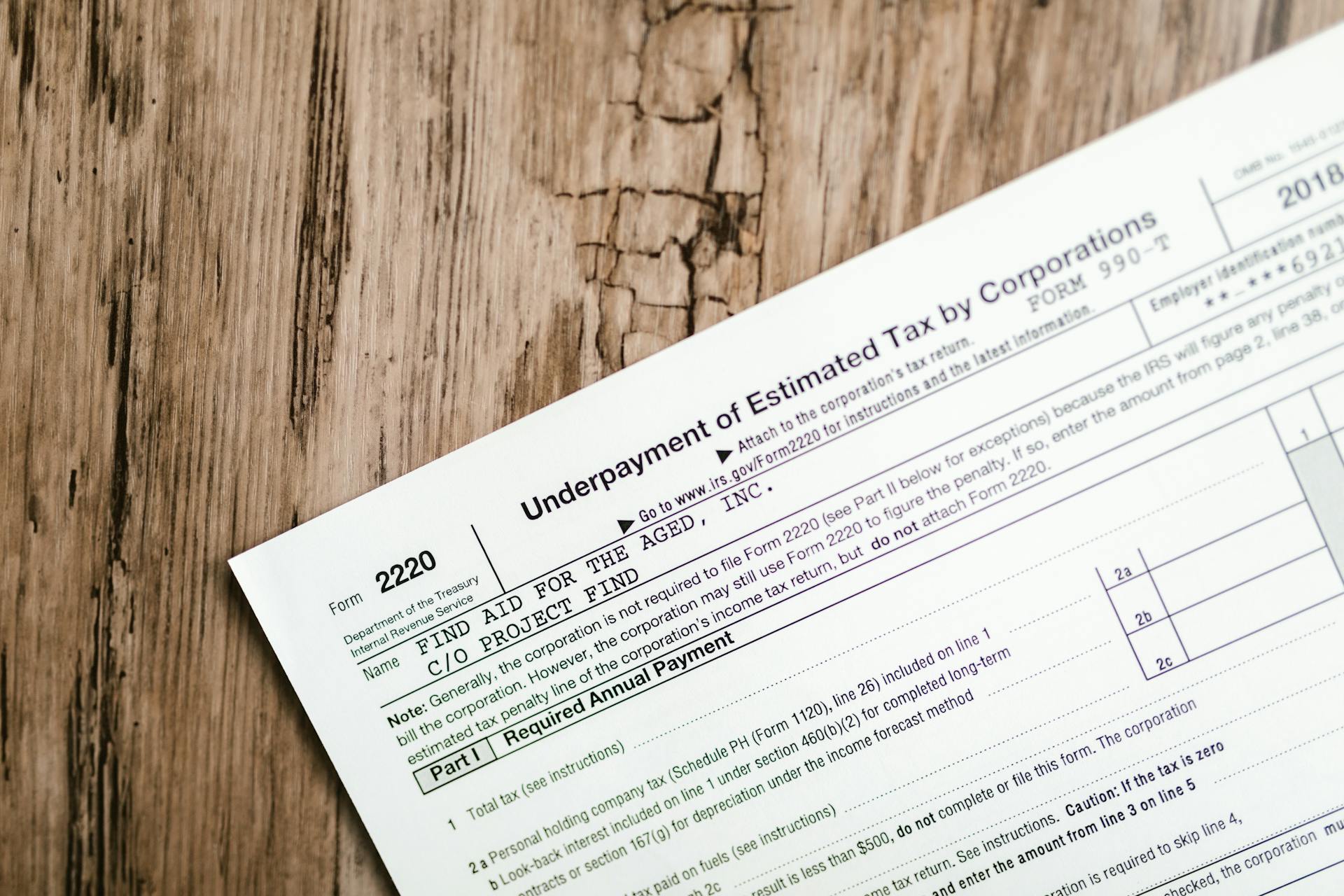
If you're unable to pay your corporate tax balance by the original due date of Form 1120, the IRS will charge a tax payment penalty and interest for each month the tax remains unpaid. This is in addition to late filing penalties.
Interest is charged on unpaid tax from the due date until the date of payment, and the interest rate is the federal short-term rate plus 3%. The interest compounds daily, which means it increases rapidly if you don't pay your tax balance promptly.
There is no maximum limit on the interest charged, so it's essential to pay your corporate tax balance as soon as possible to avoid accumulating unnecessary interest charges. This can help you avoid financial strain and keep your business running smoothly.
On a similar theme: Can My License Be Suspended for Unpaid Insurance Claim
Forms and Schedules
The corporate tax form 1120 requires a Schedule B, which is used to report interest, dividends, and capital gains.
You'll also need to file a Schedule C, which is used to report business income and expenses.
Form 1120 requires a Schedule D, which is used to report capital gains and losses.
Taxpayers must also file a Schedule M-1, which is used to reconcile the income and expenses reported on the corporation's books with the income and expenses reported on the tax return.
Form 1120 requires a Schedule M-3, which is used to reconcile the income and expenses reported on the corporation's books with the income and expenses reported on the tax return.
Taxpayers must also file a Form 4626, which is used to calculate the alternative minimum tax (AMT) for the corporation.
Form 1120 requires a Form 5471, which is used to report the corporation's foreign operations and transactions.
You'll also need to file a Form 8938, which is used to report the corporation's foreign assets.
If this caught your attention, see: A Unilateral Contract Requires Action
Submission and Compliance
The IRS encourages electronic filing of Form 1120, especially for corporations with $10 million or more in total assets, as it's typically faster and reduces the risk of errors.
To avoid penalties, adhering to filing deadlines is crucial. The filing deadline for Form 1120 is the 15th day of the 4th month after the tax year ends.
Here's a simple way to calculate the filing deadline: if your corporation operates on a calendar year basis, Form 1120 is due April 15th. However, if your corporation uses a fiscal year, you need to be aware of the deadline.
Using the wrong filing method, such as paper filing when e-filing is required, can result in rejected returns and potential penalties. Stay informed about IRS filing requirements for your business size and type, and consult the IRS website or a tax professional when in doubt.
You might enjoy: Flex Spending Account Deadline
Electronic Submission
The IRS encourages electronic filing of Form 1120, especially for corporations with $10 million or more in total assets. E-filing is typically faster and reduces the risk of errors.
The Form 1120 filing is due by the 15th day of the 4th month after the end of the tax year. This means if your corporation operates on a calendar year basis, Form 1120 is due April 15th.
Using the wrong filing method, such as paper filing when e-filing is required, can result in rejected returns and potential penalties.
Suggestion: Coreweave S-1 Filing
Consequences of Late or Incorrect Filing
Failing to file Form 1120 on time can lead to severe repercussions.
The repercussions of non-compliance with Form 1120 filing requirements can be severe.
Incorrect filing of Form 1120 can result in missed savings due to errors in tax credit calculations.
Mistakes in tax credit calculations can lead to missed savings or, if claimed incorrectly, potential penalties.
Businesses often encounter several pitfalls when filing Form 1120, including errors that can lead to increased scrutiny from the IRS.
These errors can also result in missed opportunities for tax savings.
Curious to learn more? Check out: Missed 15-day Deadline Fmla
Frequently Asked Questions
What's the difference between an 1120 and 1120-S?
C corporations use Form 1120, while S corporations use Form 1120-S, with the key difference being the tax treatment and ownership structure. Understanding the distinction between these two forms is crucial for businesses to file correctly and avoid potential penalties.
What goes into 1120?
What goes into Form 1120? C corporations report income, gains, losses, deductions, credits, and calculate income tax liability on Form 1120.
Featured Images: pexels.com