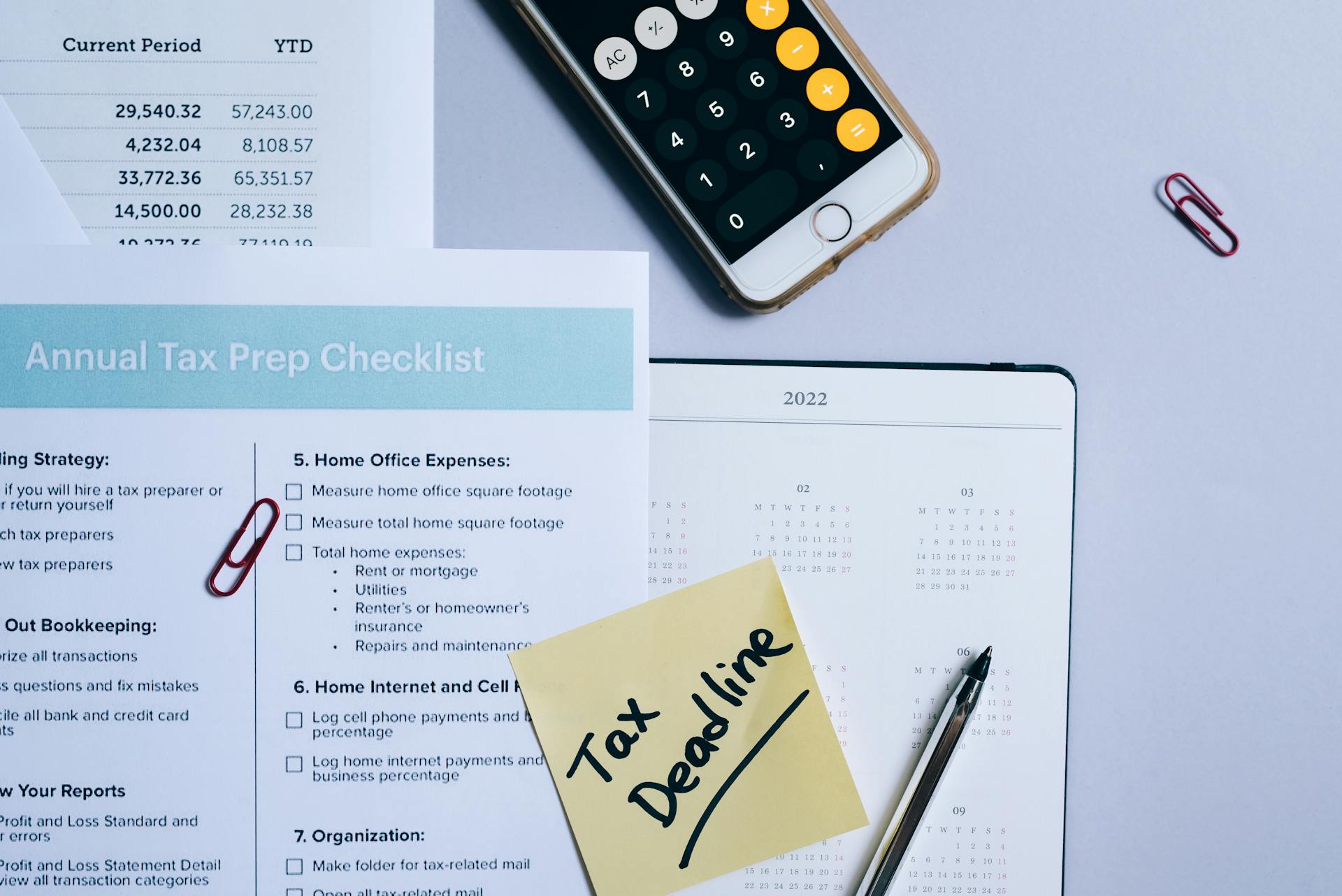
Consumption tax is a type of tax levied on goods and services purchased by consumers. It's a way for governments to generate revenue and encourage economic growth.
There are two main types of consumption tax: value-added tax (VAT) and sales tax. VAT is a tax on the value added to a product at each stage of production and distribution, while sales tax is a tax on the final sale of a product.
Consumption tax can have a significant impact on businesses and individuals. For example, in countries with high consumption taxes, people may be less likely to purchase luxury items or travel abroad.
In some countries, consumption tax is used to fund public services and infrastructure.
You might like: What Is Sales Tax
Types of Consumption Tax
Consumption tax can take many forms, but it's primarily a tax on goods and services. Sales tax is a well-known type of consumption tax, typically levied at the state and local level, and applied to purchases.
There are three main types of consumption taxes: sales tax, value-added tax (VAT), and excise tax. Sales tax is usually charged as a percentage of the purchase price, while VAT is applied at each step in the supply chain of a good or service.
Excise tax, on the other hand, is a sales tax that applies to a specific class of goods, such as alcohol, tobacco, gasoline, or tourism. Sin taxes, a type of excise tax, are imposed on items considered harmful to society, like cigarettes, in an effort to decrease their consumption.
Here are the three main types of consumption taxes:
- Sales tax: applied to purchases, usually charged as a percentage of the purchase price
- Value-added tax (VAT): applied at each step in the supply chain of a good or service
- Excise tax: a sales tax that applies to a specific class of goods, such as alcohol, tobacco, gasoline, or tourism
Excise
Excise taxes are a type of consumption tax that applies to specific goods, like alcohol, tobacco, and gasoline. They're often used to discourage certain behaviors, like smoking or excessive drinking.
Excise taxes are usually charged as a percentage of the purchase price, just like sales taxes. However, the tax rate varies depending on the type of good and the quantity purchased.
Expand your knowledge: What Type of Business Is Doordash for Taxes
Some excise taxes are known as sin taxes because they target products or services that are considered harmful to society. These taxes aim to reduce consumption by making these goods more expensive.
Here are some examples of goods that are often subject to excise taxes:
- Alcohol
- Tobacco
- Gasoline (petrol)
- Tourism
The tax rate for excise taxes varies depending on the type of good and the quantity purchased. This means that the more you buy, the more you'll pay in taxes.
Sales
Sales tax is a type of consumption tax that applies to purchases, usually levied at the state and local level. It's a percentage of the purchase price, so if you buy something for $100, you might pay an extra 8% in sales tax, bringing the total to $108.
There are 45 states and the District of Columbia that collect sales taxes. The states that don't collect sales tax are Alaska, Delaware, Montana, New Hampshire, and Oregon. However, Alaska does permit localities to charge local sales taxes.
Additional reading: Legal History of Income Tax in the United States
Sales tax is typically applied at the point of sale, and the amount is usually calculated by applying a percentage rate to the price of the sale. This means that the tax amount will vary depending on the price of the item you're buying.
Here are some examples of sales tax rates in different states:
Note that these rates are subject to change and may not reflect local sales taxes. It's always a good idea to check with the seller or local authorities for the most up-to-date information.
Some states exempt certain goods or services from sales tax, such as food, health, and housing. However, most states do apply sales tax to a wide range of goods and services, including clothing, electronics, and home appliances.
Sales tax is an important source of revenue for state and local governments, and it's used to fund a wide range of public services and infrastructure projects.
Here's an interesting read: Gift Tax in the United States
Economic Impact
A consumption tax can have a significant impact on the economy, particularly in terms of economic growth. Many economists and tax experts favor consumption taxes over income taxes because they believe they can stimulate economic growth.
Consumption taxes don't favor or disfavor investment, unlike income taxes, which can sometimes discourage investment. This means a consumption tax can increase the capital stock and productivity, leading to a larger economy.
The sale of a home, a one-time job bonus, or other events can temporarily push a person into a higher tax bracket, making income taxes less accurate.
For another approach, see: What Is Tax Deferred Growth
Economic Impact
A consumption tax can actually boost economic growth, as many economists and tax experts favor it over income taxes. This is because a consumption tax doesn't penalize investment, unlike income taxes, which can discourage people from investing.
This lack of penalty on investment can lead to an increase in the capital stock and productivity, ultimately growing the size of the economy. In contrast, income taxes can sometimes disfavor investment, as seen in the American system.
The income of individuals or families can vary greatly from year to year, often due to one-time events like the sale of a home or a job bonus. This can lead to temporary high income that pushes people into higher tax brackets.
A consumption tax, on the other hand, taxes consumption rather than income, making it a more stable and neutral approach. It's also worth noting that a consumption tax can increase savings, as it discourages consumption and encourages people to save instead.
Here's an interesting read: Why Are Tax Returns so Low This Year
Impact on Work
Consumption taxes can have a significant impact on individual work decisions. Two possible impacts are the income effect and substitution effect.
The income effect occurs when an individual's purchasing power decreases due to increased prices or decreased wages, causing them to work more hours to compensate for the loss of consumption power. For example, if an individual's monthly expenses increase from $1,000 to $1,100 due to a 10% consumption tax, they would have to work 10 more hours to cover the expenditures.
For more insights, see: When Are Quarterly Business Taxes Due
Taxes can also decrease the relative value of work in relation to leisure time, known as the substitution effect. This causes individuals to value leisure time more and decrease the amount of working time. In fact, the substitution effect works opposite to the income effect, making it a crucial consideration in evaluating the impact of consumption taxes.
A higher tax rate is likely to result in an increased substitution effect, but the consumption tax on past savings is an example of a lump-sum tax that does not distort behavior. This means that the consumption tax rate does not have to be as high as the income tax rate to preserve revenue neutrality.
Recommended read: Land Value Tax
Burden and Distribution
Consumption taxes are often criticized for being regressive, meaning the average tax rate decreases with increasing income.
This is because higher-income individuals can afford to save more, thus reducing the tax base for consumption tax more significantly than lower-income individuals.
However, if lifetime income is used to measure the ability to pay, the burden tends to be more equitable.
This is because over a lifetime, lifetime consumption is a good approximation of lifetime income.
The way income is measured can greatly affect the perceived fairness of consumption taxes.
For example, if income is measured annually or monthly, consumption taxes are truly regressive.
In contrast, if income is measured over a lifetime, the burden tends to be more equitable.
The difference in tax burden between income and consumption taxes is significant.
For instance, a person making $100,000 and a person making $25,000 both pay the same dollar amount of sales tax on a $100 item, but that tax eats up a greater percentage of income for the person earning $25,000.
This highlights the regressive nature of consumption taxes.
In the US, federal income taxes are progressive, meaning not everyone pays the same rate.
In contrast, consumption taxes are usually regressive taxes, meaning the percentage of your income that you pay decreases as your income increases.
This can have a disproportionate impact on lower-income households.
Overall, the burden and distribution of consumption taxes are complex issues that depend on various factors.
Country-Specific Information
In Japan, the consumption tax rate is 10% and is typically collected by retailers at the point of sale. This tax is usually included in the final price of goods and services.
For example, if you buy a product in Japan for 100 yen, the consumption tax would be 10 yen, making the total price 110 yen.
In the European Union, the standard VAT (Value-Added Tax) rate is 20% and ranges from 15% to 27% across different countries.
United States
The United States has a unique approach to consumption taxes. The country's early history shows that taxes were initially levied on consumption, with Alexander Hamilton favoring this approach in The Federalist Papers (No. 21) because they contain a natural limitation against excess.
Today, consumption taxes continue to be a primary source of income for state and local governments, despite personal and corporate income taxes providing the bulk of revenue to the federal government. In fact, 45 states and the District of Columbia collect sales taxes, with only Alaska, Delaware, Montana, New Hampshire, and Oregon not imposing a sales tax.
Intriguing read: States with Highest Business Taxes
These states, however, may allow localities to charge local sales taxes, so it's essential to check the specific laws in each state. The tax rates vary significantly across states, with California boasting the country's highest state sales tax rate at 7.25%.
Some states exempt certain goods or services from sales taxes, such as food, health, and housing, which is not the case in countries that have implemented a federal consumption tax. The U.S. does not have a federal consumption tax, but it does impose a federal excise tax on certain goods and services, like gas, airline tickets, and cigarettes.
Here's a breakdown of the states that do not collect sales tax:
As you can see, the U.S. has a complex system of consumption taxes, with different states and localities having their own rules and rates.
Which Countries Have
Japan has a consumption tax, which was first introduced in 1989 at a rate of 3%. In April 1997, the rate increased to 5%.

The tax is split between the national and local governments, with the national government receiving 4% and the local government receiving 1%. This split has been in place since the tax rate increase in 1997.
The consumption tax in Japan has been a topic of debate for many years, with some politicians promising not to raise it during their term in office. For example, Prime Minister Junichiro Koizumi said he had no intention of raising the tax during his government.
However, his successor, Prime Minister Yoshihiko Noda, "staked his political life" on raising the tax, and it was eventually increased to 10% in October 2019.
Curious to learn more? Check out: Government Budget Balance
Frequently Asked Questions
What is another word for consumption tax?
Another term for consumption tax is Value-Added Tax (VAT). VAT is also known as Goods and Services Tax (GST) in some countries.
Featured Images: pexels.com