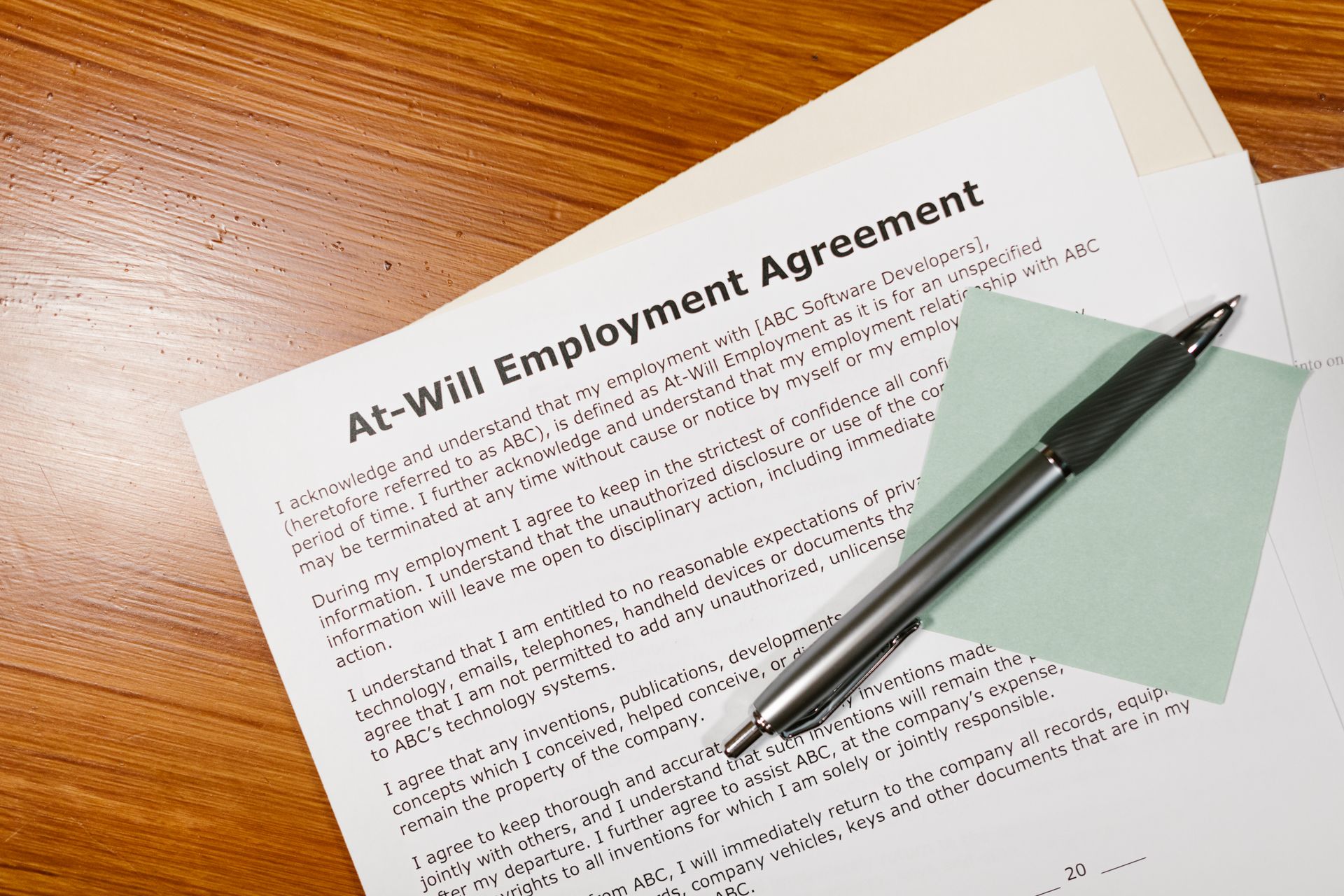
At-will employment laws can be complex, but understanding the basics can help you navigate your workplace rights.
In the United States, most employees are considered "at-will", meaning their employers can terminate their employment at any time, with or without cause.
Exceptions to at-will employment exist, such as in contracts or collective bargaining agreements.
Employees in these situations typically have more job security and protections.
What is At-Will Employment
At-will employment is a fundamental concept in the employment relationship. It's a presumption that employers and employees are free to end their employment relationship at any time, for any reason, or no reason at all.
This means that employers can fire employees for good cause, bad cause, or no cause at all, without providing prior warning or fair procedures. In fact, the Supreme Court of California has explained that the employment relationship is "fundamentally contractual", and limitations on employer prerogatives are only a matter of the parties' specific agreement.
Expand your knowledge: Just Cause (employment Law)
Employers are free to act peremptorily, arbitrarily, or inconsistently, without providing specific protections such as objective evaluation or preferential reassignment. However, this doesn't mean that employers can fire employees for unlawful reasons, such as retaliation or discrimination.
There are important exceptions to the at-will employment doctrine, including federal laws that prohibit employers from firing employees for discriminatory reasons. These reasons include:
- Age
- Color
- Country of origin
- Disability
- Sex, including gender
- Race
- Religion
- Genetic information
Many states have also created their own exceptions to the general rule of at-will employment, providing additional protections for employees.
History and Exceptions
At-will employment has a complex history, with various states and courts interpreting the concept in different ways. In 2006, the Supreme Court of Texas held that an employee handbook provision stating dismissal may be for cause did not modify an employee's at-will employment.
Thirty-six U.S. states recognize an implied contract as an exception to at-will employment, while fourteen states do not. These states include Arizona, Delaware, Florida, Georgia, Indiana, Louisiana, Massachusetts, Missouri, Montana, North Carolina, Pennsylvania, Rhode Island, Texas, and Virginia.
An implied contract can be formed when an employer's personnel policies or handbooks indicate that an employee will not be fired except for good cause or specify a process for firing. However, proving the terms of an implied contract can be difficult, and the burden of proof is on the fired employee.
History
The history of exceptions is a long and fascinating one. The concept of exceptions dates back to ancient Greece, where philosophers like Aristotle used them to explain natural phenomena.
Exceptions have played a crucial role in the development of mathematics, particularly in the field of geometry. Euclid's famous book "The Elements" contains many examples of exceptions to geometric rules.
In law, exceptions have been used to clarify and refine the rules of justice. The concept of "necessity" as an exception to the rule of law has been debated by jurists for centuries.
The concept of exceptions has also been applied in medicine, where certain conditions are considered exceptions to the general rule of health. For example, some people are born with a condition that makes them resistant to certain diseases.
Exceptions have been used in science to describe unusual phenomena that don't fit into established categories. The concept of "dark matter" is an example of an exception to the standard model of the universe.
Related reading: Accounting Period Concept
Implied Contract Exceptions
Thirty-six U.S. states recognize an implied contract as an exception to at-will employment, meaning an employer may not fire an employee without a valid reason.
An implied contract can be formed when an employer's personnel policies or handbooks indicate that an employee will not be fired except for good cause or specify a process for firing. If the employer fires the employee in violation of an implied employment contract, the employer may be found liable for breach of contract.
Proving the terms of an implied contract can be difficult, and the burden of proof is on the fired employee. This exception is not available in 14 states, including Arizona, Delaware, and Florida.
Here are the 36 states that recognize an implied contract exception:
- Alabama
- Alaska
- Arkansas
- Colorado
- Connecticut
- Georgia
- Idaho
- Illinois
- Indiana
- Iowa
- Kansas
- Kentucky
- Michigan
- Minnesota
- Mississippi
- Missouri
- New Hampshire
- New Jersey
- New York
- North Dakota
- Oklahoma
- Oregon
- Pennsylvania
- Rhode Island
- South Carolina
- South Dakota
- Tennessee
- Utah
- Washington
- West Virginia
- Wisconsin
- District of Columbia
However, it's essential to note that the implied-contract theory to circumvent at-will employment must be treated with caution, as the Supreme Court of Texas and the New York Court of Appeals have rejected this theory in certain cases.
Exceptions and Exclusions
There are several exceptions and exclusions to at-will employment, which can protect employees from unfair termination. Under the public policy exception, an employer may not fire an employee if the termination would violate the state's public policy doctrine or a state or federal statute.
Forty-two U.S. states and the District of Columbia recognize public policy as an exception to the at-will rule. This means that employees in these states have some level of protection against termination that would violate public policy.
Some states, however, do not have this exception. These states include Alabama, Florida (except in three limited conditions), Georgia, Louisiana, Maine, Nebraska, New York, and Rhode Island.
In addition to public policy, there is also an implied contract exception, which recognizes that an implied contract can form between an employer and employee, even if no express, written instrument exists. Thirty-six U.S. states and the District of Columbia recognize this exception, but 14 states do not, including Arizona, Delaware, Florida, Georgia, Indiana, Louisiana, Massachusetts, Missouri, Montana, North Carolina, Pennsylvania, Rhode Island, Texas, and Virginia.
The existence of an express or implied contract removes employment from the at-will realm. An express contract creates a contractual employment relationship, while an implied contract is created by oral or written statements or actions that imply the existence of an employment term.
Consider reading: Economy of Georgia (country)
Public Policy Exceptions
Public policy exceptions are a crucial aspect of employment law, and it's essential to understand how they work. As of October 2000, 42 U.S. states and the District of Columbia recognize public policy as an exception to the at-will rule.
The public policy exception protects employees from termination if it would violate state or federal statutes. This includes refusing to perform an action that would violate public policy. For instance, if an employee repeatedly warns that the employer is shipping defective airplane parts in violation of safety regulations, they cannot be fired for doing so.
In some states, the public policy exception is not recognized. Currently, there are 8 states that do not have this exception: Alabama, Florida (with three limited conditions that can override an at-will agreement), Georgia, Louisiana, Maine, Nebraska, New York, and Rhode Island.
Here's a list of states that recognize the public policy exception:
- 42 U.S. states and the District of Columbia (as of October 2000)
Implied-in-Law Contracts
Eleven US states have recognized a breach of an implied covenant of good faith and fair dealing as an exception to at-will employment. This exception is often referred to as an "implied-in-law" contract.
In these states, an employer may be liable for breach of contract if they terminate an employee in a way that's deemed unfair or malicious. For example, terminating a long-tenured employee solely to avoid paying their accrued retirement benefits could be considered a breach of good faith and fair dealing.
The states that recognize this exception are: Alabama, Alaska, Arizona, California, Delaware, Idaho, Massachusetts, Montana, Nevada, Utah, and Wyoming.
Some court rulings have required a clear at-will relationship to be communicated to employees, as seen in Highstone v. Westin Engineering, Inc. This means that employers must clearly inform employees that they can be terminated at any time, without cause.
Other court rulings have denied this exception, holding that it's too burdensome to determine an employer's true motivation for terminating an employee.
Related reading: Terminating Deposit
Exclusions
At-will employment doesn't apply in certain situations, and it's essential to understand these exclusions to navigate the complexities of employment law.
In 42 U.S. states and the District of Columbia, the public policy exception protects employees from termination if it would violate state or federal statutes. This includes situations where an employee is fired for performing an action that complies with public policy, such as warning about defective airplane parts.
The 8 states without the public policy exception are Alabama, Florida (with three limited conditions), Georgia, Louisiana, Maine, Nebraska, New York, and Rhode Island.
Thirty-six U.S. states recognize an implied contract as an exception to at-will employment, which means an employer can't fire an employee without a valid reason.
The 14 states without the implied-contract exception are Arizona, Delaware, Florida, Georgia, Indiana, Louisiana, Massachusetts, Missouri, Montana, North Carolina, Pennsylvania, Rhode Island, Texas, and Virginia.
Every state has statutory protections for employees, including federal anti-discrimination statutes that prohibit firing or refusing to hire based on certain characteristics.
Some examples of federal statutes that protect employees include the Equal Pay Act of 1963, Title VII of the Civil Rights Act of 1964, and the Americans with Disabilities Act of 1990.
The existence of an express or implied contract removes employment from the at-will realm, and an implied contract can be created by oral or written statements or actions that imply the existence of an employment term.
A fresh viewpoint: List of Banks in Georgia (country)
Eleven US states have recognized a breach of an implied covenant of good faith and fair dealing as an exception to at-will employment, including Alabama, Alaska, Arizona, California, Delaware, Idaho, Massachusetts, Montana, Nevada, Utah, and Wyoming.
Here are the 8 states without the public policy exception:
- Alabama
- Florida (with three limited conditions)
- Georgia
- Louisiana
- Maine
- Nebraska
- New York
- Rhode Island
And here are the 14 states without the implied-contract exception:
- Arizona
- Delaware
- Florida
- Georgia
- Indiana
- Louisiana
- Massachusetts
- Missouri
- Montana
- North Carolina
- Pennsylvania
- Rhode Island
- Texas
- Virginia
Controversy
Controversy can arise in at-will employment relationships, but there are ways to navigate these situations. Employers should seek legal advice from their company's attorneys when making controversial hiring and firing decisions.
Certain behaviors, such as workplace intoxication, theft, or violence, warrant immediate termination. This is a clear exception to the general rule that employees should never be surprised by termination.
Managers should document everything leading up to an employee's termination, including warnings and chances to improve their performance.
Pros and Cons
At-will employment is a complex topic, and it's essential to understand both its pros and cons.
At-will employment protects both employees and employers by providing no-fault freedom to part ways, giving employers autonomy and legal cover.
This arrangement reduces the number of costly legal battles, as employers can terminate employees without violating any exceptions to the at-will doctrine.
Employers also benefit from not having to renegotiate employment contracts annually, which can be an arduous process.
At-will employment helps attract high-caliber talent who would not want to be trapped in a contract if a better opportunity arose.
It also supports economic growth and competition by allowing employees to bring their fresh ideas to other corporations.
Companies can quickly fire superfluous employees, a bad fit, or those contributing to an unpleasant working environment.
However, some people are concerned about losing their jobs for any random reason, which can create anxiety and make them feel on edge.
Employee turnover is also increased due to the ability to leave a job at any given moment, making business planning challenging.
Employee stress due to lack of job protection can affect productivity and morale.
Here are some key pros and cons of at-will employment:
Featured Images: pexels.com