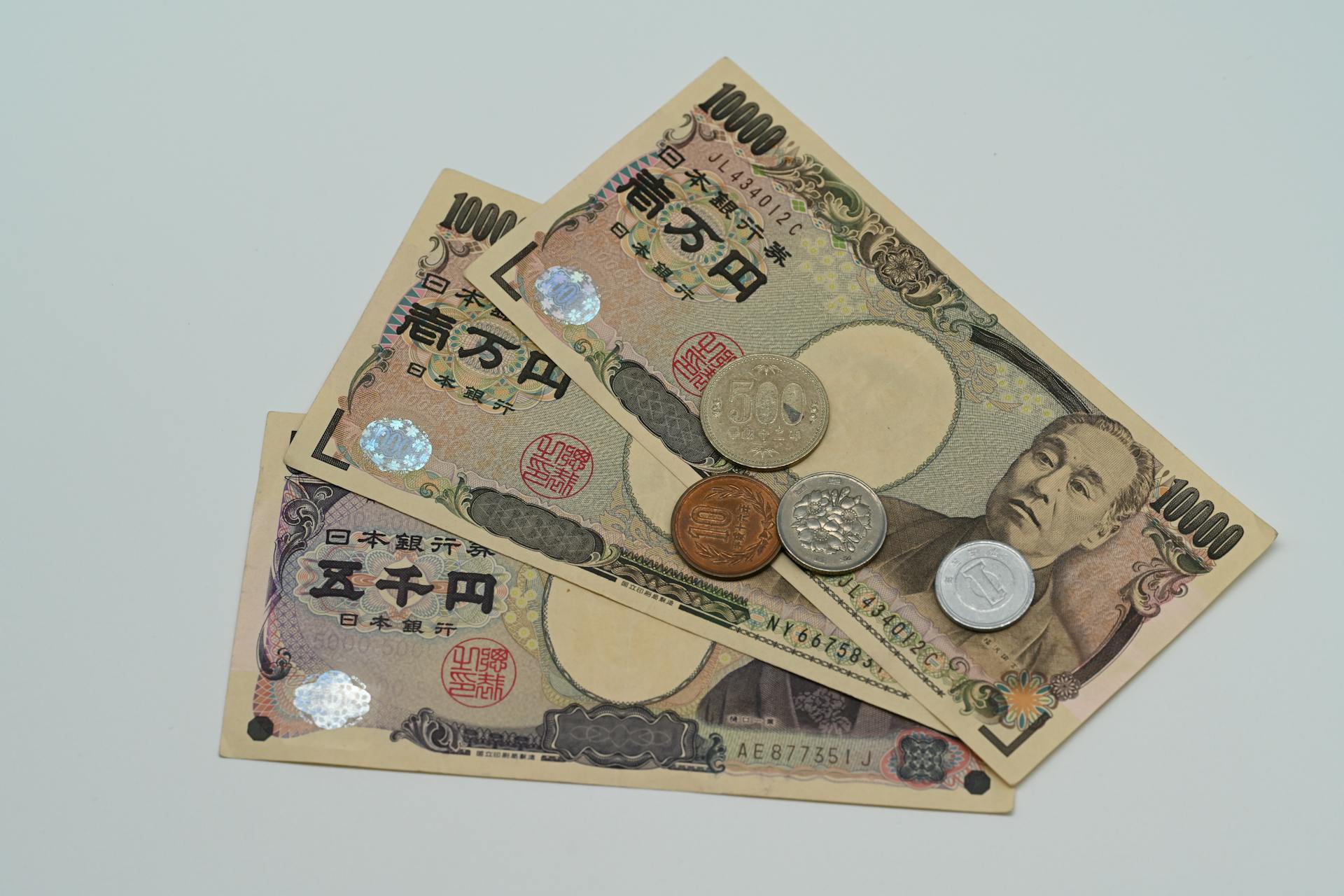
The yen has been experiencing a significant decline in value, and understanding the reasons behind this trend is crucial for investors, businesses, and individuals alike.
The Bank of Japan's (BOJ) prolonged monetary policy of quantitative easing, which began in 2013, has been a major contributor to the yen's weakness.
This policy has led to a surge in the money supply, causing the yen to lose value against other major currencies. The BOJ's actions have also led to a decrease in interest rates, making the yen less attractive to investors seeking higher returns.
The yen's weakness has significant implications for the Japanese economy, including higher import prices and a potential increase in inflation.
Worth a look: What Is a Weakness in the It Infrastructure?
Causes of Weak Yen
The yen's weakness can be attributed to a significant gap in interest rates between Japan and the US. This gap is a major draw for investors, favoring investments in the US and, consequently, the dollar.
The interest rate gap is substantial, with Japan's policy rate ranging from 0 to 0.1 per cent, while the US benchmark federal funds rate is between 5.25 and 5.5 per cent. This disparity is likely to persist due to the US economy's stronger-than-expected performance and sticky inflation.
You might like: Currency Exchange Rate Forecast
A key factor in the yen's weakness is the Bank of Japan's (BOJ) decision to end its negative rate policy, which was the last of its kind in the world. This move has left Japan with the lowest policy rate in the developed world.
The BOJ's policy rate hike has not been enough to close the interest rate gap with the US, and investors continue to favor the dollar. As a result, the yen's value has taken a hit, falling about 10 per cent against the dollar this year.
Explore further: World Weak Currency
What's the significance?
The weak yen has a mixed impact on the economy. Japan's weakening currency has helped boost exporters' profits by making their products cheaper to buyers overseas.
Exporters are seeing a significant advantage from the falling yen, with many large Japanese companies carrying out a significant portion of their operations overseas, which has helped increase the value of repatriated overseas profits.
A record number of tourists visited Japan in March, with 3.1 million visitors, thanks to the weak yen, which has boosted the buying power of incoming travelers.
However, the weak yen also makes imports of energy and food more expensive, hitting consumers and putting a strain on household budgets.
The largest umbrella group of unions in Japan has announced the largest wage hikes in three decades for the current fiscal year, which may give consumers more confidence about spending.
Japan's Options
Japanese authorities are considering various options to address the yen's weakness. They can buy up the yen or raise interest rates, but the latter might not be feasible given the BOJ's ultra-loose policy.
Japanese officials have expressed concern about the yen's excessive depreciation and are prepared to intervene if necessary. However, their previous intervention in 2022, where they spent over $60 billion of their foreign exchange reserves, only led to the yen continuing its slide.
The BOJ's decision to hold interest rates steady on Friday bolstered expectations that its ultra-love policy is here to stay. This means that the yen's weakness is likely to persist, with ING's Kang expecting it to continue over the coming months.
The BOJ's hesitation to raise interest rates despite inflationary pressures has contributed to the yen's decline. In contrast, major central banks like the U.S. Federal Reserve and the European Central Bank have implemented aggressive interest rate hikes to combat rising inflation.
The BOJ's short-term policy rate was raised from 0.25% to 0.5% in January 2025, but this increase remains significantly lower than interest rates in the U.S. and Europe. The U.S. Federal Reserve, for example, maintained interest rates between 4.25% and 4.50% in early 2025.
Japan's trade balance has historically affected the strength of the yen, with a persistent trade deficit contributing to the yen's weakness. The rising cost of energy imports and stagnant wage growth in Japan have made it difficult for the BOJ to tighten monetary policy.
Investors and economists are split over whether the BOJ is finished with raising interest rates in 2024 or will make another move. BOJ Governor Kazuo Ueda said if inflation runs hotter than expected, another rate hike would be on the table.
For your interest: How Big Is the Yen Carry Trade
Economic Factors

The yen's weakness can be attributed to Japan's ultra-loose monetary policy, which has kept interest rates near zero or even negative for decades.
This policy, maintained by the Bank of Japan (BOJ), has resulted in a significant interest rate differential between Japan and other economies.
In January 2025, the BOJ raised its short-term policy rate from 0.25% to 0.5%, but this increase remains lower than interest rates in the U.S. and Europe.
Major central banks like the U.S. Federal Reserve and the European Central Bank (ECB) have implemented aggressive interest rate hikes to combat rising inflation, making the U.S. dollar a far more attractive investment option than the yen.
A different take: Deutsche WertpapierService Bank
Japan's Interest Rates vs. Other Economies
Japan's interest rates have been a topic of discussion among economists and investors, and for good reason. In early 2025, Switzerland took over Japan's title of having the lowest interest rates in the world, with a rate of 0.25% compared to Japan's 0.5%.
Suggestion: Fed Interest Rate Decision Forex
The yen remains under pressure due to Japan's economic challenges and ongoing capital outflows. Despite the BOJ's recent rate hike, it's still far from reversing the long-standing trend of yen depreciation.
The divergence between Japan's low interest rates and the higher rates in the U.S. and Europe continues to make the yen an unattractive investment. Investors are seeking higher returns elsewhere, which has led to a decline in the yen's value.
One common trading strategy known as the "carry trade" has exacerbated the yen's decline. Investors borrow yen at low interest rates and invest in higher-yielding assets in other countries, increasing the supply of yen in global markets and driving its value down.
The widening interest rate gap has been a key driver of the yen's depreciation, making it one of the weakest-performing major currencies in recent years. The yen's value has been affected by the interest rate differentials between Japan and other economies.
In January 2025, the BOJ raised its short-term policy rate from 0.25% to 0.5%, but this increase remains significantly lower than interest rates in the U.S. and Europe. The U.S. Federal Reserve, for example, maintained interest rates between 4.25% and 4.50% in early 2025, making the U.S. dollar a far more attractive investment option than the yen.
Related reading: How Much Has Twisters Made so Far
Japanese officials have repeatedly expressed concern about the yen's excessive depreciation and indicated they are prepared to intervene if necessary. They can pull on two main levers: buying up the yen or raising interest rates.
However, the large gap between Japanese interest rates and those elsewhere is likely to persist for some time. The BOJ held interest rates steady in recent months, bolstering expectations that its ultra-loose policy is here to stay.
Japan's Trade, Inflation, and Wages
Japan's trade balance has historically affected the strength of the yen. For decades, Japan was known for running trade surpluses due to its strong export-driven economy, particularly in automobiles, electronics, and machinery.
A weaker yen makes energy imports more expensive for Japan, which relies heavily on imported oil and natural gas. This is a major factor affecting Japan's trade balance.
Despite inflation exceeding the BOJ's 2% target for 35 consecutive months, real wage growth in Japan has remained stagnant. In December 2024, core consumer inflation in Japan accelerated to 3.0%, marking the fastest annual pace in 16 months.
Explore further: Global Markets React to the Japanese Yen Carry Trade Unwind
Stagnant wages limit domestic spending and make it difficult for inflation to become self-sustaining, further complicating the BOJ's efforts to tighten monetary policy. This is in contrast to other major economies, where rising inflation and increased wage growth have prompted central banks to implement aggressive rate hikes.
The yen's decline has been further exacerbated by investors favouring currencies tied to economies with stronger inflation-adjusted returns. This has resulted in the yen continuing to weaken.
Consider reading: Inflation Japanese Yen
Government Intervention and Future
The government's role in propping up the yen is a topic of interest. Japan's Finance Minister Shunichi Suzuki has issued verbal warnings to put a floor under the yen, but the authorities have not taken direct action in the market since 2022.
The last time Japan intervened in the market was in 2022, when they supported the local currency multiple times. US Treasury Secretary Janet Yellen has said that any intervention by Japan would be understandable if it were aimed at smoothing out volatility, not affecting the absolute level of the exchange rate.
The possibility of Japan stepping in to support the yen again is a topic of speculation, with some analysts suggesting that an intervention took place after the yen hit 160 against the dollar in 2023.
Discover more: Japan Intervention Yen
Government Intervention
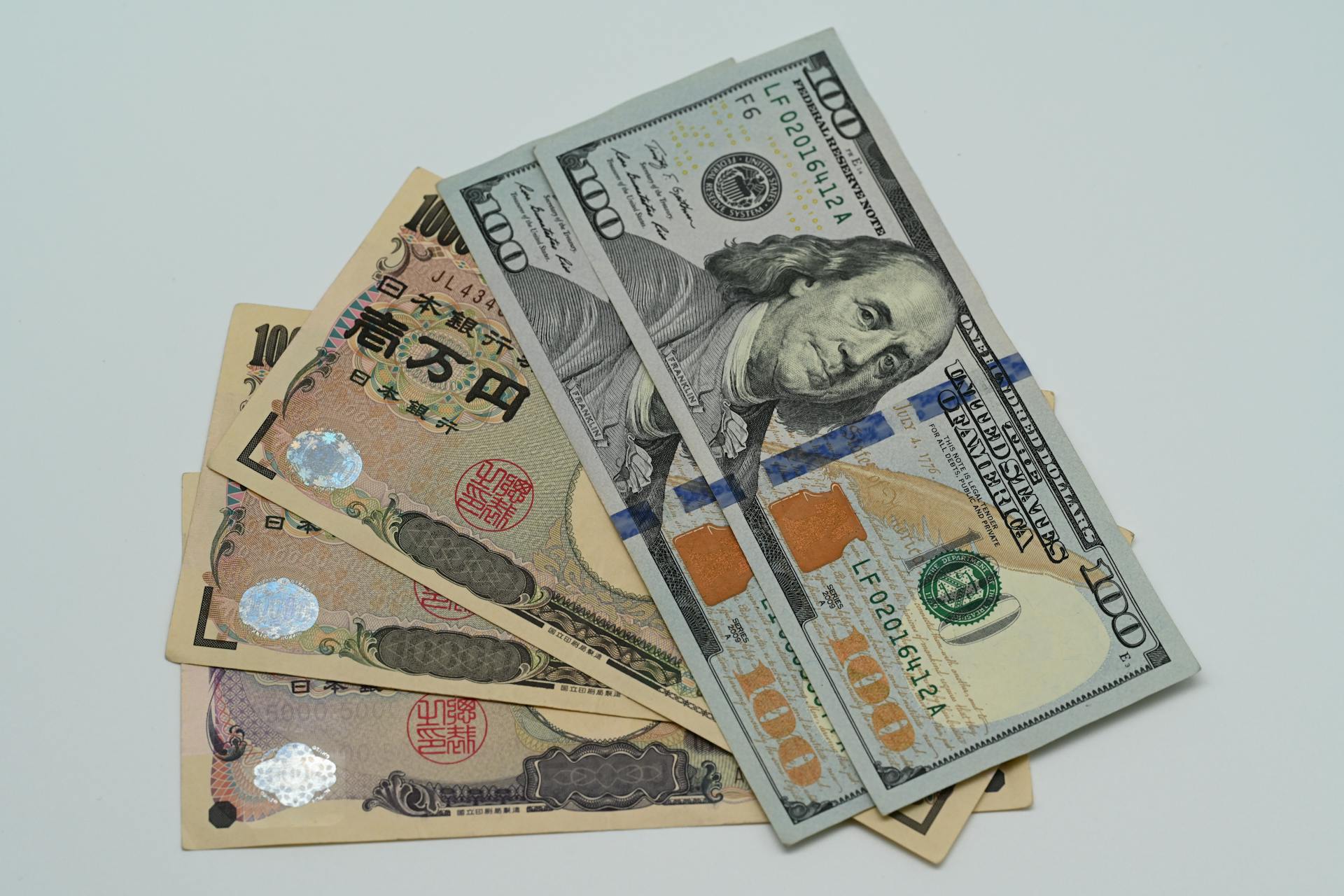
The Japanese government has a history of intervening in the currency market to support the yen, with the last instance being in 2022 when they intervened multiple times to prop up the local currency.
Japanese Finance Minister Shunichi Suzuki has issued verbal warnings to put a floor under the yen, but the authorities have not taken direct action in the market.
A sharp rebound in the yen occurred after it hit 160 against the dollar for the first time since 1990, sparking speculation that Japan had stepped back into markets to support its currency.
US Treasury Secretary Janet Yellen said in 2023 that any intervention by Japan to prop up the yen would be understandable if it were aimed at smoothing out volatility – not at affecting the absolute level of the exchange rate.
The yen fell close to the 152 threshold against the dollar in the wake of the BOJ’s rate hike, within a whisker of its historic low reached in 2022.
The Ministry of Finance has refrained from confirming any intervention, but a Bloomberg analysis of Bank of Japan accounts released the following day suggests that an intervention may have taken place.
Curious to learn more? Check out: Japan Currency vs Dollar
Where Is It Headed?

The yen's future is uncertain, but one thing is clear: its value is heavily influenced by monetary policies. The US is headed towards interest rate cuts, while Japan is expected to see interest rate rises, which could reduce the rate disparity and lead to a stronger yen.
Nakashima predicts a mild approach to reducing the interest rate disparity, with another rate rise expected within the year and another next year, before it settles down. This would likely keep the yen hovering around the same level it's at today.
The yen's value could be affected by the US economy growing more than expected, weakening the yen further. On the other hand, a global risk event could send the yen in the opposite direction.
A significant factor to consider is Japan's reliance on trade, with 99.7% of its crude oil being imported. This drives down the value of the yen, so even if it goes up in the short term, Nakashima believes the 25-year cycle of weakening has already begun.
Expand your knowledge: Why Are so Many Ceos Stepping down
Value and Meaning
The weak yen has significant implications for Japan's economy. A weaker yen makes imports of energy and food more expensive, hitting consumers.
Large Japanese companies with global operations benefit from a weaker yen, as it increases the value of repatriated overseas profits. This is because the yen's value is lower compared to other currencies, making it easier for them to bring in foreign revenue.
The yen's decline is not a new phenomenon, but rather part of a longstanding trend. Over the last three years, the yen has lost more than one-third of its value.
Is it a new phenomenon?
The yen's decline is actually part of a long-standing trend. It's been on a continual slide since early 2021, losing over a third of its value in just three years.
This decline is significant, bringing the currency back to where it was following the collapse of a huge asset bubble in the early 1990s.
Japan's economy has been struggling with prolonged stagnation, known as "the lost decades", which has led to the country maintaining rock-bottom borrowing costs.
The Bank of Japan's recent decision to hike the benchmark rate for the first time in 17 years is a step in the right direction, but it's still a rare move globally.
Has the Value?
The value of the yen has been a topic of interest lately. A weak yen can have both positive and negative effects on the economy.
Large Japanese companies with global operations benefit from a weaker yen as it increases the value of their repatriated overseas profits.
Imports of energy and food become more expensive for consumers when the yen is weak.
The yen's value is influenced by the economic growth rates of Japan and the US. Japan's slower growth rate compared to the US has contributed to the yen's decline.
The US has had stronger long-term interest rates than Japan, which has also contributed to the yen's weakening.
The Bank of Japan's decision to raise interest rates in July 2023 helped narrow the gap between the two countries' interest rates, causing a rally in the yen.
Japan has been experiencing a trade deficit since 2022, with imports outpacing exports, which has led to a decrease in the yen's value.
Featured Images: pexels.com