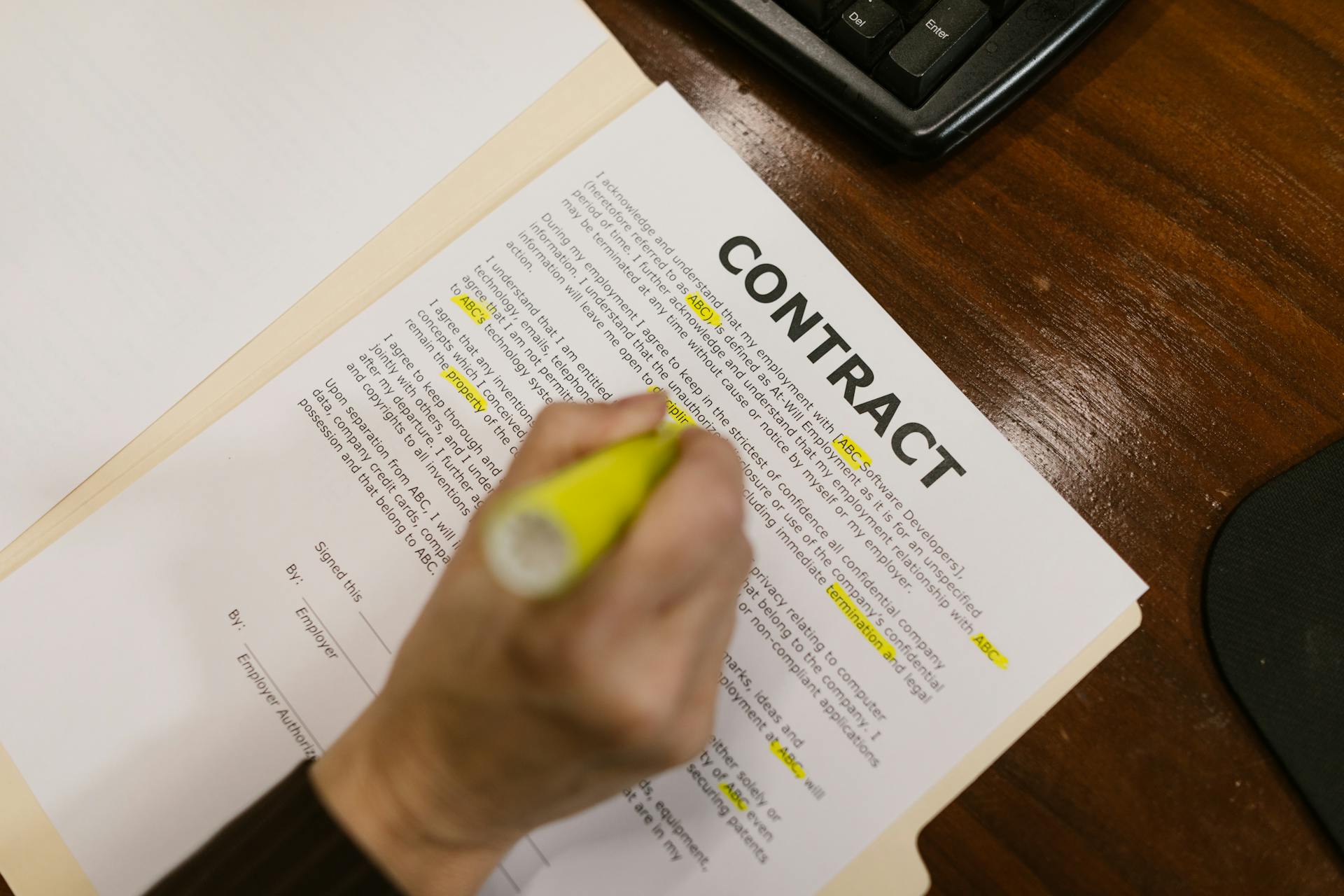
Whistleblower laws in the private sector are designed to protect employees who report wrongdoing or misconduct. These laws vary by state, but most provide some level of protection for whistleblowers.
In the United States, the Sarbanes-Oxley Act of 2002 requires publicly traded companies to have a whistleblower policy in place. This policy must include procedures for reporting and investigating allegations of wrongdoing.
Employees who report misconduct in good faith are generally protected from retaliation. This means employers cannot fire, demote, or otherwise punish employees for reporting wrongdoing.
Broaden your view: Whistleblowing Policy
Whistleblower Laws in the Private Sector
Whistleblower laws in the private sector are designed to protect employees who come forward to report wrongdoing within their companies. These laws vary by state, but they generally provide similar protections.
In Florida, the Private Sector Whistleblower Act prohibits employers from taking retaliatory personnel actions against employees who engage in protected activity, such as disclosing information about a law or regulation violation. Employees who work in the private sector in Florida are protected from retaliation.
Check this out: Hipaa Laws Oregon

Under Florida law, employees who disclose or threaten to disclose information about a law or regulation violation, or who refuse to participate in a violation, are protected from retaliation. This includes disclosing information to a state agency or refusing to participate in a violation.
Here are some examples of protected activity under the Florida Private Sector Whistleblower Act:
- Disclosing or threatening to disclose information pertaining to the violation of a law, rule or regulation
- Providing information pertaining to the violation of a law, rule or regulation to a state agency, body or agent during an investigation, hearing or inquiry.
- Refusing to participate in the violation of a law, rule or regulation.
These protections are essential for employees who want to report wrongdoing within their companies without fear of retaliation. If you're a private sector employee in Florida, it's essential to understand your rights and the legal protections available to you.
Types of Whistleblowers
Whistleblowers can be found in various industries, including manufacturing, healthcare, and finance. Private sector whistleblowers are often the first to expose problems within their companies.
Private sector whistleblowers can be found in companies of all sizes, from small startups to large corporations. They may work in a variety of roles, such as quality control, accounting, or human resources.
Expand your knowledge: Ecoa and Reg B Apply to

Private whistleblowers can expose a range of issues, including product defects, financial fraud, and unethical business practices. These issues can have serious consequences for both the company and its customers.
Private sector whistleblowers may face challenges and risks when reporting wrongdoing. However, many states have laws in place to protect these whistleblowers from retaliation.
Importance of Whistleblowers in Preventing Corporate Fraud
Whistleblowers are the single most important corporate resource for preventing fraud, exposing 43% of corporate frauds compared to professional auditors who only detect 19%. They save shareholders billions of dollars.
According to a 2007 study by PricewaterhouseCoopers, whistleblowers are the most effective source of information in detecting corporate fraud. This is why laws like the Dodd-Frank Act have been enacted to protect and incentivize whistleblowers.
The Dodd-Frank Act has been instrumental in protecting whistleblowers, allowing them to come forward with information confidentially and receiving a percentage of government recoveries from successful prosecutions. Whistleblowers are also protected from retaliation by employers.
If this caught your attention, see: Corporate Investigations Lawyers

In fact, a May 2020 decision in the case of Erhaft v. Bofi Holdings concluded that employer confidentiality agreements do not supersede federal whistleblower rights. This means that whistleblowers can take company documents to disclose fraud to the government in certain cases.
Whistleblowers can receive awards between 10% to 30% of the monetary sanctions collected from successful enforcement actions and prosecutions under the SEC and CFTC whistleblower programs. These programs also provide confidentiality protections for whistleblowers and prohibit retaliation by employers.
Here are some key benefits of whistleblower protections:
- Confidentiality protections for whistleblowers
- Protection from retaliation by employers
- Award of 10% to 30% of monetary sanctions collected from successful enforcement actions and prosecutions
Overall, whistleblowers play a crucial role in preventing corporate fraud and protecting shareholders.
Legal Rights and Protections
Whistleblowers in the private sector are protected by laws designed to prevent retaliation and termination for doing the right thing. The Sarbanes-Oxley Act was enacted after the Enron scandal to outlaw certain unethical accounting practices and to enhance protections for private sector whistleblowers.
Navigating the legal landscape of whistleblowing can be complex and daunting, but having experienced legal guidance is essential to ensure your rights are protected and that you can make your disclosures safely.
Whistleblowers are entitled to compensation for their bravery, and the protections in place are designed to support those who come forward to expose wrongdoing while safeguarding them from retaliation.
For more insights, see: Legal Fees Contract
Florida Whistleblower Laws

Florida has two primary whistleblower laws: the Private Sector Whistleblower Act and the Public Sector Whistleblower Act. These laws protect employees from retaliation for engaging in statutorily protected activity.
The Private Sector Whistleblower Act covers employees who work in the private sector, while the Public Sector Whistleblower Act covers employees who work for a Florida governmental agency. A Florida governmental agency includes any state, county, local, or municipal government entity, as well as public schools, community colleges, and state universities.
Employees who provide or disclose information regarding illegal policies or actions not in the public interest are protected from retaliation under the Public Sector Whistleblower Act. However, this protection does not apply to employees who disclose false information or confidential information.
To file a complaint under the Public Sector Whistleblower Act, employees must do so in writing within 30 days of the incident of retaliation. If the complaint is denied, employees may file a lawsuit.
If this caught your attention, see: Etfs Sectors

The Private Sector Whistleblower Act also protects employees from retaliation for engaging in statutorily protected activity. However, employees must make an effort to provide the information directly to their supervisor or other internal authority before disclosing it to an outside source.
Here are some examples of retaliatory personnel actions that are prohibited under the Private Sector Whistleblower Act:
- Blacklisting
- Demoting
- Firing
- Making threats
- Reducing pay
- Reassignment to a less desirable position
The Florida False Claims Act also provides anti-retaliation relief for employees who are discharged, demoted, suspended, threatened, harassed, or discriminated against in the terms and conditions of employment because of lawful acts done by the employee in furtherance of an action under the Act.
Colorado Whistleblower Laws
Colorado has two main statutes that protect whistleblowers in the private sector: Colorado Revised Statutes Section 24-114-102. This law prevents retaliation against employees who report illegal policies or actions not in the public interest.
To qualify for protection, private employees must make an effort to report the issue directly to their supervisor or internal authority before disclosing it to an outside source. This is not required for public employees.
You might enjoy: Hipaa and Covid Positive Employees

Private employees who are retaliated against may bring a civil lawsuit for wrongful termination or termination in violation of public policy without going through a formal complaint process. This is a key difference from the public sector statute.
Retaliation can take many forms, including blacklisting, demoting, firing, making threats, reducing pay, or reassigning an employee to a less desirable position. These actions are not tolerated under Colorado's whistleblower laws.
Here are some key exceptions to the protection offered by Colorado's whistleblower laws:
- Employees who disclose information they know to be false or who disclose information with reckless disregard for its truth;
- Employees who disclose information from public records which are closed to public inspection; or
- Employees who disclose other confidential information.
It's essential for private employees in Colorado to understand their rights and the requirements for reporting wrongdoing to ensure they receive the protection they deserve.
Retaliation and Legal Guidance
Whistleblowers are protected by laws designed to prevent retaliation and termination for doing the right thing. These laws ensure that whistleblowers can report misconduct without fear of losing their jobs and may even be entitled to compensation for their bravery.
Navigating the legal landscape of whistleblowing can be complex and daunting, but having experienced legal guidance is essential to ensure your rights are protected and that you can make your disclosures safely. Whether you are a public or private whistleblower, it's crucial to understand your rights and the legal protections available to you.
If you or someone you know may be a potential whistleblower, it's essential to contact an experienced retaliation attorney as soon as possible. Many of the laws discussed above have specific procedures and deadlines that must be followed, so don't wait – contact an attorney to find out how whistleblower retaliation law can help you.
Take a look at this: Legal Governance, Risk Management, and Compliance
What is an Adverse Employment Action?

An adverse employment action is a retaliatory action taken by an employer against an employee who engages in whistleblower activity. It's not just any negative action, but rather one that has a significant impact on the employee's job.
Courts define an adverse employment action as one that materially affects the compensation, terms, conditions, or privileges of an employee's employment. This can include actions that negatively affect an employee's pay.
Failure to hire, demotion, and reduction in pay are all examples of adverse employment actions. These actions can have a significant impact on an employee's livelihood and are considered serious infractions.
Denial of job benefits, suspension without pay, and termination are also considered adverse employment actions. These actions can be devastating to an employee's career and well-being.
Actions such as disciplinary action, undeserved negative performance evaluations, and increased workload can also constitute an adverse employment action. These actions can be just as damaging as more severe consequences.
Eliminating supervisory responsibilities and transfer to a different position can also be considered adverse employment actions. These actions can affect an employee's job satisfaction and overall career trajectory.
Broaden your view: Adverse Action Notice
Hire a Retaliation Attorney

If you've been retaliated against for exposing your employer's wrongdoing, it's essential to contact an experienced retaliation attorney. Many laws have specific procedures and deadlines that must be followed, so it's crucial to act quickly.
At HKM Employment Attorneys LLP, you can find experienced help bringing retaliation claims and lawsuits. They're available for a private consultation, either online or by calling 303-991-3075.
Navigating the legal landscape of retaliation can be complex, but having the right guidance can make all the difference. Experienced attorneys can help you understand your rights and the legal protections available to you.
Whistleblowers are vital to maintaining ethical standards and transparency in both government and corporate environments. If you're a victim of workplace retaliation, don't wait to seek help – contact an experienced retaliation attorney today.
A unique perspective: Legal Help on a Contract
Notable Whistleblowers
Sherron Watkins, an executive at Enron, reported various accounting irregularities before the company's collapse.
Her concerns were initially ignored, but the subsequent downfall of Enron became one of the biggest accounting frauds in history.
Private whistleblowers, like Watkins, often expose product defects, financial fraud, or unethical business practices.
These brave individuals work within the private sector, in industries such as manufacturing, healthcare, and finance.
Their reports can prevent corporate disasters, like Enron's collapse, and lead to significant financial losses being prevented.
A different take: Financial Law
Privacy and Security

The dilemma of balancing privacy and security is a complex one. Edward Snowden's case highlights the importance of this balance.
The line between privacy and security can be blurry, and it's up to us to strive for a balance that protects individuals while upholding ethical standards. This is exactly what public and private whistleblowers force us to confront.
The case of Sherron Watkins shows that even in the private sector, there are situations where ethical business practices must be weighed against profitability. This is a fundamental question that we must answer in order to create a fair and just society.
Ultimately, finding this balance is crucial in protecting individuals and upholding ethical standards. It's a challenge that we must continue to face head-on.
A unique perspective: Hipaa Cybersecurity Framework
Frequently Asked Questions
Is the whistleblower Act only for federal employees?
No, the whistleblower protection law also covers non-federal employees, such as contractors and subcontractors, who report waste, fraud, and abuse in federal contracts and grants. These employees are protected from retaliation under federal law.
What is the Private Sector whistleblower protection Streamlining Act of 2012?
The Private Sector Whistleblower Protection Streamlining Act of 2012 provides protections for private sector employees who report public safety threats or federal law violations. This law safeguards workers from retaliation and discrimination for speaking out against wrongdoing.
Featured Images: pexels.com