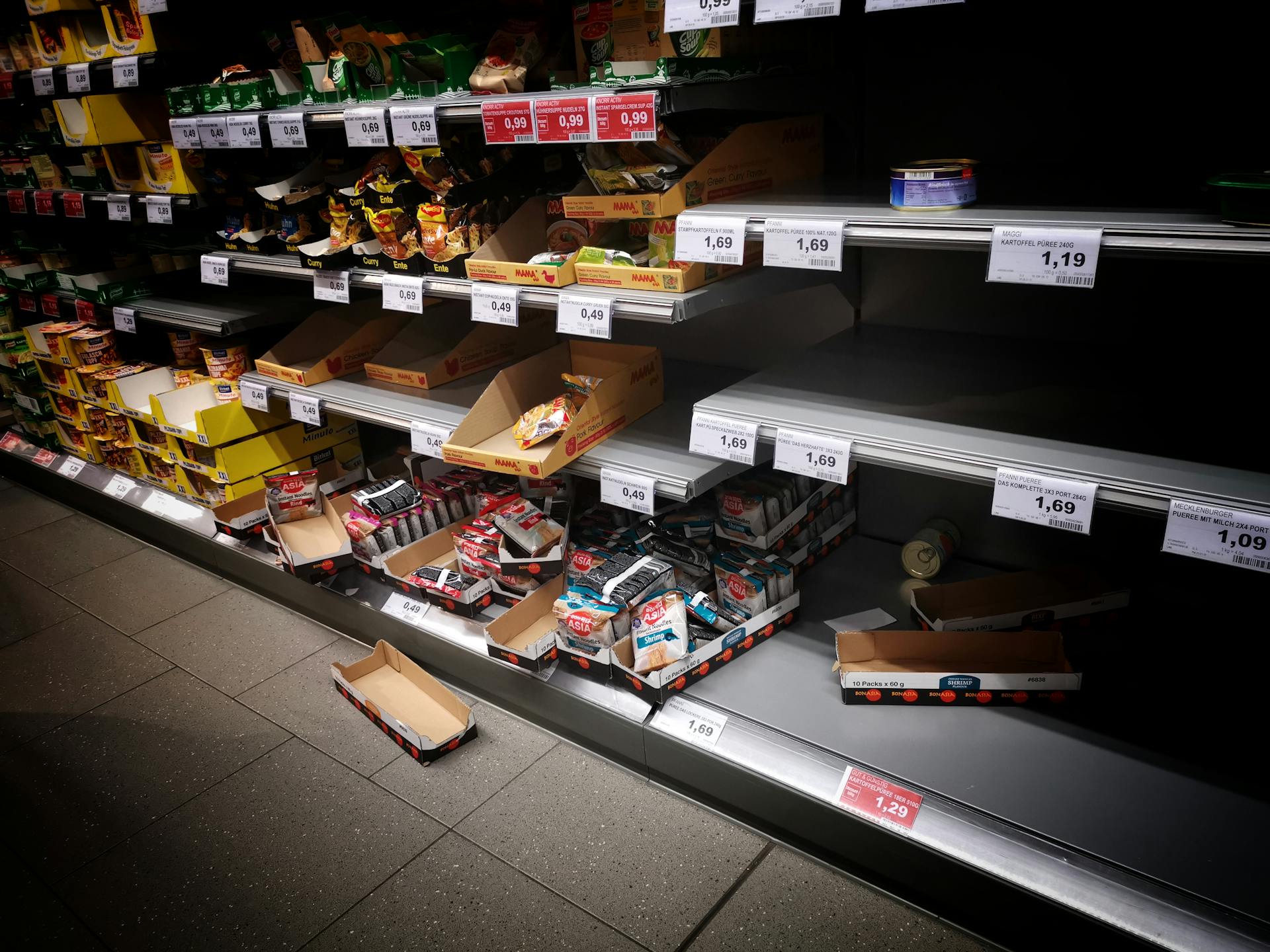
A world recession is a global economic downturn that affects many countries at the same time. It's a big deal, and can have severe effects on people's lives.
The main cause of a world recession is a decline in international trade, which can lead to a decrease in economic activity. This can happen when countries experience a sharp decline in their exports, making it harder for businesses to operate.
During a world recession, people may struggle to find jobs or keep their current ones, leading to increased unemployment rates. In fact, the unemployment rate can rise by as much as 10% in some countries.
As a result, people may have to cut back on their spending, which can further weaken the economy. This can create a vicious cycle of economic decline.
Additional reading: Consists of Giving or Loaning Money to Other Countries
What is a Recession
A recession is a slowdown in general economic activity, and it's officially recognized after two consecutive quarters of negative GDP growth rates. This is the definition used by the National Bureau of Economic Research (NBER) in the U.S.
Recessions are a normal part of the business cycle, with an economy expanding after reaching its trough and then receding after reaching its peak. This is a natural cycle that's been observed throughout history.
The International Monetary Fund defines a global recession as a decline in annual per-capita real World GDP, backed up by a decline or worsening in other global macroeconomic indicators. This definition is used to identify global recessions, which are events with large economic and financial disruptions occurring simultaneously in many countries.
A global recession can have severe effects, including financial disruptions, business confidence decline, and policy uncertainty. It's a sign of extreme stress in global financial markets, affecting not only the banking system but also the housing system.
There is no fixed definition of "global recession", but its effects are clear: synchronized financial disruption, economic damage in many countries, and a period of extreme stress in global financial markets.
On a similar theme: 2010 European Union Bank Stress Test
Causes of Recession
Wars and other disasters put immense pressure on the global economy, causing fuel and food shortages that can lead to permanent fragmentation of finances and affect the world's economy. This is why economists hold war-like disasters responsible for global recession.
The decline of per capita GDP is a serious concern that can be a warning sign of a global recession, as stated by the International Monetary Fund (IMF). Extreme risk aversion can make the condition worse.
A nation slipping into recession can quickly turn into a global problem, with unemployment rates spiking and reduced productivity resulting in slowed progress. This can eventually lead to a global-scale recession.
See what others are reading: Lead Product Manager Salary
Real Factors
A sudden change in external economic conditions can trigger a recession, which is explained by the Real Business Cycle Theory. This theory states that a recession is how a rational participant in the market responds to unanticipated or negative shocks.
For instance, a sudden rise in oil prices due to growing geopolitical tensions can harm crude oil-importing economies. This is because they rely heavily on imported oil to meet their energy needs.
A revolutionary technology that causes automation in factories can disproportionately impact economies with a huge pool of unskilled labor. This is because automation replaces jobs that require manual labor, leading to unemployment and reduced productivity.
Global recessions have coincided with US recessions, but some large emerging economies like China and India did not register declines in their real GDP per capita during the 2009 global financial crisis.
Explore further: Ecommerce Automation System
Psychological Factors
Psychological factors can play a significant role in the development of a recession. Excessive euphoria during an economic expansion period can lead to overexposure to risky capital.
This was evident in the 2008 Global Financial Crisis, which was partly caused by irresponsible speculation in the US housing market. The formation of a housing market bubble was a direct result of this speculation.
Widespread market pessimism can also contribute to a recession, even if it's unfounded in the real economy. A curtailed investment can occur when investors become too cautious and hesitant to invest, fearing a downturn.
Discover more: Xrp Digital Asset Reserve Speculation
Effects of Recession
Recessions can have a significant impact on the economy and individuals. Credit availability tightens, and short-term interest rates tend to fall. As businesses seek to cut costs, unemployment rates increase.
Unemployment rates reduce consumption rates, causing inflation rates to go down. Lower prices reduce corporate profits, which triggers more job cuts. This creates a vicious cycle of economic slowdown.
National governments often intervene to bail out key businesses and financial institutions. Some companies are able to take advantage of the lower cost of capital during a recessionary period.
Worth a look: Unemployment Insurance Claim California
Effects
Recessions cause standard monetary and fiscal effects – credit availability tightens, and short-term interest rates tend to fall. As businesses seek to cut costs, unemployment rates increase. Lower prices reduce corporate profits, which triggers more job cuts and creates a vicious cycle of an economic slowdown.
The government often intervenes to bail out key businesses that face potential failure or structurally important financial institutions such as large banks. This intervention helps stabilize the economy.
Take a look at this: Scalable Creative Solutions Large Businesses
A recession typically causes economic output, employment, and consumer spending to drop. Interest rates are likely to decline as central banks cut rates to support the economy.
A high rate of unemployment is a lagging indicator, confirming an economy's pivot into a recession stage rather than predicting a recession in the future. Unemployment rates nearing 6% of the total workforce are considered problematic.
Declines in economic output and employment can become self-perpetuating, with declining consumer demand prompting companies to lay off staff, affecting consumer spending power. This can further weaken consumer demand.
Governments have adopted fiscal and monetary policies to prevent a run-of-the-mill recession from becoming far worse. Unemployment insurance is an automatic stabilizing factor that puts money into the pockets of employees who lose their jobs.
You might like: List of Canadian Provinces by Unemployment Rate
How Long Do They Last?
Recessions can be a challenging and unpredictable time for many people. The average U.S. recession since 1857 lasted 17 months.
In recent history, recessions have been relatively short-lived. The six recessions since 1980 averaged less than 10 months.
This means that while a recession can be a difficult period, it's often a temporary setback.
A unique perspective: Amazon Pay Raise 6 Months
GDP
GDP is a crucial indicator of an economy's health, and a negative real GDP is a clear sign of a sharp drop in productivity.
The total value generated by an economy, as measured by real GDP, indicates a significant decline in economic activity.
A sharp drop in productivity can have far-reaching consequences, including job losses and reduced consumer spending.
Real GDP is adjusted for inflation, which means that it takes into account the rising cost of living and the decreased purchasing power of consumers.
Negative real GDP is a warning sign that an economy is experiencing a recession, and it's essential to take swift action to mitigate its effects.
Check this out: A Sign
Indicators of Recession
Recession can be a challenging and complex topic, but understanding its indicators can help you prepare for the worst. A recession is typically defined as a decline in gross domestic product (GDP) for two or more consecutive quarters.
High unemployment rates are often a sign of a recession. In a recession, people lose their jobs, and businesses struggle to stay afloat. The unemployment rate can rise significantly, making it harder for people to find new employment.
Curious to learn more? Check out: Natural Rate of Unemployment
Economic indicators such as the GDP, inflation rate, and consumer spending can also signal a recession. A decline in GDP, a rise in inflation rate, and a decrease in consumer spending can all contribute to a recession. These indicators can provide a warning sign that a recession is on the horizon.
Interest rates can also indicate a recession. As the economy slows down, interest rates tend to rise, making it more expensive for people and businesses to borrow money. This can have a ripple effect throughout the economy, making it harder for businesses to operate and for people to afford essential goods and services.
Businesses often cut back on investments and production during a recession, leading to a decline in economic activity. This can create a vicious cycle where reduced economic activity leads to further job losses, reduced consumer spending, and a deeper recession.
Explore further: Ngpf Activity Bank Taxes Answer Key
History of Recession
Since the Second World War, the global economy has witnessed five global recessions, with the 2020 recession being the deepest and most internationally synchronized after the Global Financial Crisis of 2008-2009.
Global recessions have become increasingly more synchronized since the 1950s, with the experience of individual economies showing more variation during global downturns compared to recessions.
Routine recessions can cause GDP to decline 2%, while severe ones might set an economy back 5%, according to the IMF.
Broaden your view: History of Recessions after Inverted Yield Curve
Since WWII
Since WWII, the global economy has witnessed five global recessions, in 1975, 1982, 1991, 2009, and 2020, and four global downturns, in 1958, 1998, 2001, and 2012.
Global recessions have become increasingly more synchronized since the 1950s, with the 2020 recession being the deepest and most internationally synchronized after the Global Financial Crisis of 2008-2009.
Global real GDP per capita figures for 1991 differ among sources, with the Conference Board Total Economy Database showing growth of 0.1 percent and the World Bank showing a minor contraction of 0.1 percent.
The experience of individual economies may show more variation during global downturns compared to recessions, highlighting the complexity of economic trends.
For another approach, see: 2009 Supervisory Capital Assessment Program
Depressions
Depressions are particularly deep and long-lasting recessions. There is no commonly accepted formula to define one.
Routine recessions can cause GDP to decline 2%, but a depression can set an economy back 5%.
During the Great Depression, U.S. economic output fell 33% and unemployment hit 25%. Stocks also plunged 80% during this time.
The 1937-38 recession was another severe downturn, with real GDP falling 10% and unemployment jumping to 20%.
Broaden your view: Ge Aerospace Has Risen during the Recent Market Slide.
Will We See a Global?
Will We See a Global Recession?
A global recession is not currently our base case forecast, but we do anticipate recessions in several large economies, including the US, UK, Germany, and Brazil.
The World Bank Policy Research Working Paper 9172, Global Recessions, suggests that a combination of several smaller unfavorable events could thrust the world back into recession.
Growth slowdowns or recessions are already foreseen in the three major economic blocs: China, the US, and Europe.
The war in Ukraine could escalate and worsen global food and energy shortages, potentially leading to a global recession.
Our forecast is more akin to a global downturn, but the possibility of a global recession cannot be ruled out.
Predicting and Preventing Recession
A recession is a decline in economic activity, typically defined as a decline in GDP for two or more consecutive quarters.
Many experts agree that predicting a recession is a complex task due to the numerous factors that can contribute to it, such as a decline in consumer spending or a rise in interest rates.
One way to predict a recession is to look at the yield curve, which is a graph that shows the relationship between interest rates and bond maturities. A flat or inverted yield curve can be a sign of a potential recession.
The yield curve has been a reliable predictor of recessions in the past, as seen in the 2008 financial crisis when the curve inverted before the recession began.
However, it's worth noting that not all recessions can be predicted, and some may be triggered by unexpected events such as a natural disaster or a global pandemic.
Introduction and Overview
A global recession is a severe financial crisis that affects the entire world, with devastating consequences. It's a reality that we're all too familiar with, especially in today's interconnected economy.
The National Bureau of Economic Research (NBER) is the authority that identifies a recession in the United States, considering several measures in addition to GDP growth. This includes two successive quarterly declines in GDP, a measure of the nation's output.
A unique perspective: Third Quarter Gdp Us
A global recession is harder to define, but it's characterized by a decline in the world's economic output. The International Monetary Fund (IMF) estimates that global recessions occur over a cycle lasting between eight and ten years.
The IMF also notes that global per capita output growth was zero or negative in the past three global recessions of the last three decades. This means that the average person's standard of living has actually decreased during these periods.
According to the IMF, the real GDP growth of emerging and developing countries is on an uptrend, while that of advanced economies is on a downtrend since the late 1980s. This trend is expected to continue, with the world growth projected to slow down in the coming years.
Here's a rough timeline of the economic history of the United States and Commonwealth of Nations countries, highlighting the major periods of growth and decline:
Featured Images: pexels.com