Sharia banking is a unique approach to finance that adheres to Islamic principles. It prohibits the collection and payment of interest, known as riba, which is considered usury in Islamic law.
Sharia banking operates on the basis of profit-sharing and risk-sharing between the bank and its customers. This approach is rooted in the concept of mudarabah, where the bank provides capital and the customer provides expertise and effort.
One of the key features of Sharia banking is the prohibition on speculative trading and gambling. This is in line with Islamic principles that discourage excessive risk-taking and speculation.
For more insights, see: Equity Market Risk Premium
What is Sharia Banking
Sharia banking is a financial system that operates according to Islamic principles, which prohibit the collection and payment of interest. This means that sharia banks use alternative methods to generate revenue, such as profit-sharing agreements.
Sharia banking has its roots in Islamic history, dating back to the 7th century when the Prophet Muhammad prohibited the collection of interest on loans. This prohibition is based on the Quranic verse that states "those who devour usury will not stand except as one whom the devil has confounded by his touch." (2:275)
If this caught your attention, see: Sharia Banking in the Us

Sharia banks offer a range of financial products and services, including savings accounts, loans, and investments. These products are designed to comply with Islamic principles, such as the prohibition on interest and the requirement that all financial transactions be based on mutual benefit.
One of the key features of sharia banking is the use of profit-sharing agreements, which allow depositors to share in the profits of the bank's investments. This approach is based on the Islamic concept of "mudarabah", which requires that all financial transactions be based on mutual benefit and risk-sharing.
Sharia banks also offer a range of investment products, including sukuk, which are Islamic bonds that comply with sharia principles. Sukuk are issued by companies or governments to raise capital for specific projects or purposes, and they offer a higher return than traditional bonds.
The use of sharia banking has become increasingly popular in recent years, particularly in countries with large Muslim populations. In countries such as Malaysia and Saudi Arabia, sharia banking has become a major player in the financial sector, offering a range of financial products and services that comply with Islamic principles.
Consider reading: Islamic Sharia Banking
Types of Lending

Islamic banking offers a range of lending options that are compliant with Sharia law. One such option is the mudarabah model, which was pioneered by Mohammad Najatuallah Siddiqui and involves the bank acting as the capital partner in a profit-sharing arrangement with the depositor and entrepreneur.
In practice, fixed-return models like murabaha have become more common, often mimicking traditional interest-based finance. Assets managed under these products far exceed those in profit-loss-sharing modes like mudarabah and musharakah.
The Qard mode is another popular Islamic finance structure for demand deposits, where customer deposits are considered "loans" and the Islamic bank a "borrower" who guarantees full return of the "lenders" deposits.
Diminishing Musharaka
Diminishing Musharaka is a type of Islamic financing that allows individuals to purchase an asset with the bank's financing, but with a twist - the ownership of the asset is gradually transferred to the individual over time.
This model is often used in combination with other Islamic financing methods, but it's not as widely used as some of the other models, such as murabaha.
Consider reading: What Is Creative Financing in Real Estate
One of the pioneers of Islamic banking, Mohammad Najatuallah Siddiqui, suggested a two-tier mudarabah model as the basis of a riba-free banking, but unfortunately, the fixed-return models like murabaha became the industry staples.
Diminishing Musharaka is a more complex model that requires regular payments from the individual, which are used to purchase more shares of the asset, gradually increasing ownership.
In practice, the fixed-return models, in particular murabaha model, became the industry staples, not supplements, as they bear results most similar to the interest-based finance models.
Readers also liked: Agency Banking Model
Musawamah
Musawamah is a type of contract used in Islamic commerce where the exact cost of the item(s) sold to the bank/financier cannot be or is not ascertained. This type of contract is literally "bargaining" and is the most common type of trading negotiation in Islamic commerce.
The seller is not under the obligation to reveal their cost or purchase price, which makes Musawamah different from Murabahah. This type of contract allows for more flexibility in pricing and is often used in situations where the cost of the item(s) is uncertain.
See what others are reading: Dubai Islamic Bank Online Banking

A key characteristic of Musawamah is that it does not involve the exchange of one unit of money for another of the same denomination, which is prohibited in Sharia law. This makes it a Sharia-compliant way of doing business.
Here are some key features of Musawamah:
- No obligation to reveal cost or purchase price
- More flexibility in pricing
- Does not involve exchange of money for money
- Sharia-compliant
Qard
Qard is a popular Islamic finance structure for demand deposits, where customer deposits are considered "loans" and the Islamic bank is the "borrower" that guarantees the full return of the "lender's" deposits.
The Qard mode is often used by Islamic banks to compete with conventional banks that pay interest on their demand/savings deposits. However, critics argue that this conflicts with traditional Islamic jurisprudence, which views Qard al-hasana loans as acts of charity to the needy.
Islamic banks may use Hibah, or "gift", as a way to offer rewards or prizes to their customers, which is different from conventional banks' interest payments. However, some scholars have criticized this as "entry of riba through the back door".
Discover more: What Is a Demand Deposit
Here are some of the arrangements that Islamic banks use for Qard-based lending:
- Qard (The client acts as the borrower and the bank as a lender)
- Ujra (The client simply pays an annual service fee for using the card)
- Ijara (Card is used as a leased asset)
- Kafala (The bank acts as a kafil for the transactions of the card holder)
- Bai al-ina/wadiah (The bank sells the customer an item/commodity and then repurchases it at a lower price)
- Cards that act like debit cards, with transactions directly debited from the holder's bank account
Financial Instruments
In Islamic finance, asset-backed financing is a key concept that allows for the transfer of one commodity for another, or for money. Asset-backed instruments include Murabaha, Musawamah, Salam, Istisna’a, and Tawarruq.
These instruments are based on sales contracts that transfer one commodity for another, or for money, and are considered ethical by those who use them. Islamic finance works differently to conventional banking, and is regarded as ethical by its users.
Murabaha, a type of asset-backed financing, has been criticized for ignoring shariah regulations, particularly when it comes to buying and selling commodities. Sometimes, no commodities are involved at all, just cash-flows between banks, brokers, and borrowers.
Expand your knowledge: Most Ethical Bank
Financial Instruments
Financial instruments are a crucial part of Islamic finance, allowing individuals and institutions to invest and manage their money in a way that is compliant with Sharia law.

Islamic finance offers a range of financial instruments, including Mudarabah, Musharakah, and Sukuk. These instruments are designed to promote risk-sharing and fairness in financial transactions.
Mudarabah is a profit-sharing partnership where one partner provides the capital and the other partner provides the expertise and management. The profits are shared according to a pre-agreed ratio, and the losses are borne by the capital provider.
Musharakah is another type of profit-sharing partnership, where all partners share in the profits and losses according to their investment ratio. This instrument is often used in investment projects and real estate financing.
Sukuk is a type of Islamic bond that represents ownership in an underlying asset. Sukuk holders receive a share of the profits generated by the asset, rather than fixed interest payments.
Here are some key features of Sukuk:
Islamic finance also offers other financial instruments, such as Murabaha, Ijarah, and Wadiah. These instruments are designed to promote fairness and transparency in financial transactions.
Here's an interesting read: Financial Market Authority (Austria)

Murabaha is a type of financing where the bank sells an asset to the customer at a markup, rather than charging interest. Ijarah is a type of leasing contract where the customer leases an asset from the bank and has the option to purchase it at the end of the lease.
Wadiah is a type of safekeeping contract where the bank holds the customer's assets and returns them on demand.
Recommended read: What Is Financial Asset Management Systems
Istisna and Bai Salam
Istisna and Bai Salam are two types of forward contracts that are commonly used in Islamic finance. They're essentially customized contracts where immediate payment is made for goods in the future.
Istisna contracts are limited to manufacturing, processing, or construction and can be applied within the sphere of supply chain management. Salam contracts, on the other hand, can be effected on anything, except gold, silver, or currencies based on these metals.
Salam contracts predate istisna and were designed to fulfill the needs of small farmers and traders. They carry a higher order of Shariah compliance than contracts like Murabahah or Musawamah.

The Kuwait Finance House and the Barzan gas project in Qatar have used istisna contracts in the past. ADCB Islamic Banking and Dubai Islamic Bank have also used salam contracts.
In a salam contract, the full price must be paid in advance, and the time of delivery must be specified. This is in contrast to istisna contracts, where payments can be made in stages.
Bia salam and istisna contracts should be as detailed as possible to avoid uncertainty.
Takaful (Insurance)
Takaful, also known as Islamic insurance, operates on a mutuality principle where the risk is shared among all the insured, not just the insurance company.
The insured contribute to a pooled fund, which is overseen by a manager, and receive any profits from the fund's investments.
Funds in takaful are not invested in haram activities, such as interest-bearing instruments or enterprises involved in alcohol or pork.
Any surplus in the common pool of accumulated premiums is redistributed to the insured.
The takaful industry has been praised for providing superior alternatives to conventional insurance, but also criticized for using conventional corporate management practices.
Related reading: Are Bank Safety Deposit Boxes Insured
Derivatives
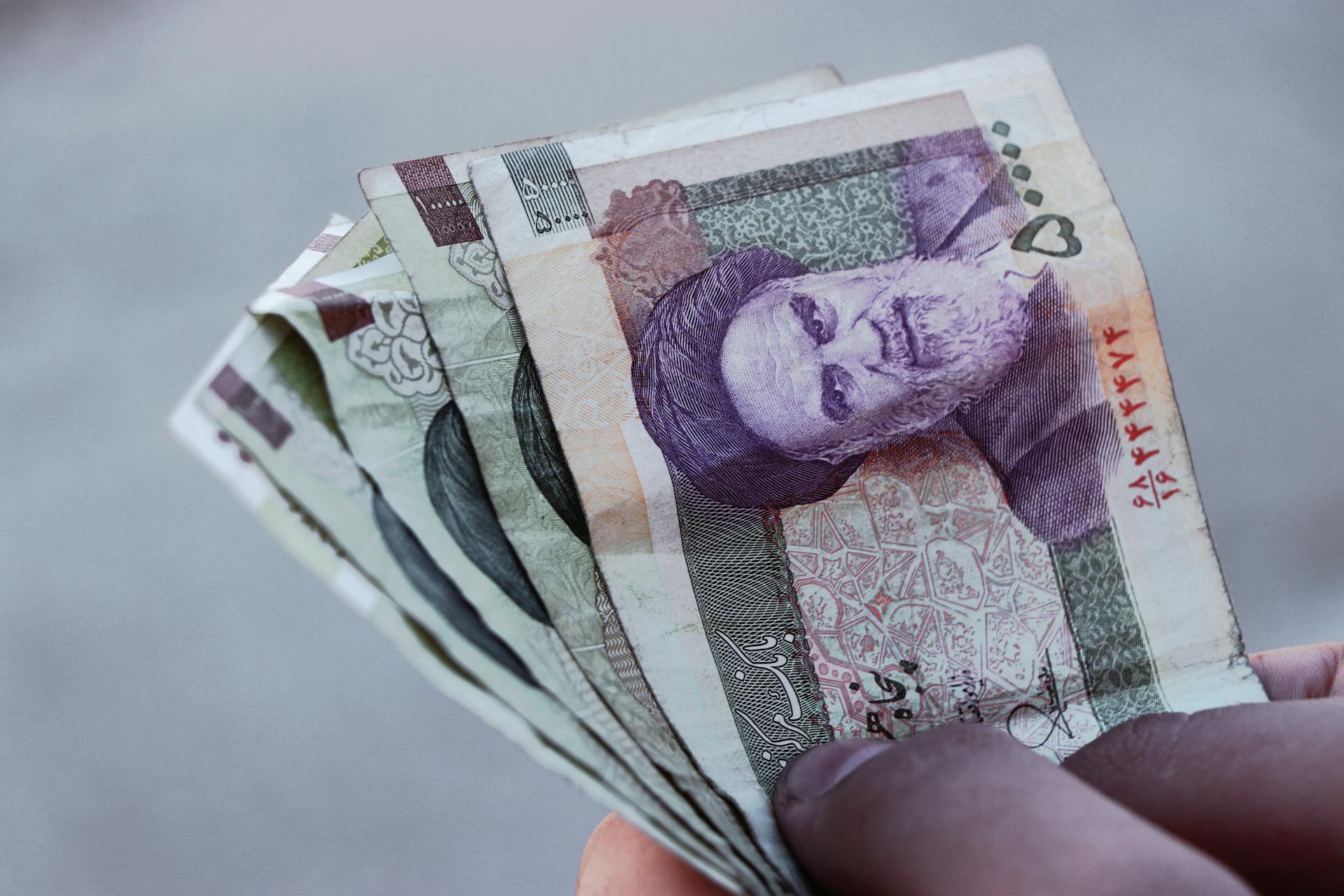
Derivatives are a type of financial instrument that can be quite complex, but let's break it down simply. In the context of Islamic finance, derivatives are a subject of heated debate among scholars.
Almost all conservative Sharia scholars believe that derivatives are in violation of Islamic prohibitions on gharar. This means that the use of derivatives in Islamic finance is not universally accepted.
The Islamic derivatives market was in its infancy as of 2013, and its size was not known. This lack of clarity has led to a range of opinions on the permissibility of derivatives in Islam.
There are two main types of swaps used in Islamic finance: profit rate swaps and cross-currency swaps. Profit rate swaps involve exchanging fixed for floating rate profits, similar to interest rate swaps in conventional finance.
In Malaysia, the Islamic Profit Rate Swap (IPRS) hedging tool is popular among investors. This tool helps to transfer currency fluctuation risk among investors.
Check this out: Why Is My Online Banking Not Working

Here are the two types of swaps used in Islamic finance:
These swaps are used by investors to manage risk and optimize their investments. The global standard for profit rate swaps has been developed by the IIFM and International Swaps and Derivatives Association.
Deposit Side
Islamic banking offers deposit accounts that are similar to conventional bank accounts.
Investment accounts in Islamic banks, based on profit and loss sharing and asset-backed finance, play a similar role to time deposits in conventional banks.
Depositors agree to hold their deposits at the bank for a fixed amount of time, and returns are measured as expected profit rates rather than interest.
Fixed Term deposits or savings accounts, like those offered by Al Rayan Bank in the UK, are examples of investment accounts in Islamic banking.
Islamic banks also offer demand deposits, which provide no return and are structured with qard al-hasana contracts or wadiah or amanah contracts.
Expand your knowledge: Emirates Nbd Al Barsha Branch

Demand deposits usually pay little if any return on investment and/or charge more fees.
Sharia-compliant savings accounts are protected in the same way as savings accounts offered by other regulated banks in the UK.
Deposits into savings accounts from UK Sharia-compliant banks are protected by the FSCS up to £85,000 per person, per bank.
Sharia savings accounts grow savings by earning profit through investments made into Sharia-compliant companies chosen by the bank.
The expected profit rate (EPR) for Sharia savings accounts is advertised, but it's not guaranteed, and it's highly unusual to receive less than the advertised EPR.
Sharia savings account rates are often highly competitive compared to other savings accounts, featuring among the top savings account deals.
Expand your knowledge: Fdic Insurance Limit for Business Accounts
Other Financial Instruments
Asset-backed financing is a key concept in Sharia banking, and it includes instruments like Murabaha, Musawamah, Salam, Istisna’a, and Tawarruq.
These instruments allow for the transfer of one commodity for another commodity, the transfer of a commodity for money, or the transfer of money for money. They are sales contracts that enable the exchange of goods or services.
The Accounting and Auditing Organization for Islamic Financial Institutions (AAOIFI) has issued standards for these instruments, which are mandatory for Islamic financial institutions in Bahrain, Sudan, Jordan, and Saudi Arabia.
In contrast to conventional banking, Sharia banking prohibits the use of interest, or riba, and instead focuses on legitimate trade and investment in assets. Money must be used in a productive way to generate wealth.
The Institute of Chartered Accountants of Pakistan issues Islamic Financial Accounting Standards (IFAS) to help account for these instruments.
You might enjoy: RMIT School of Accounting
Challenges and Issues
Sharia banking, also known as Islamic banking, has its own set of challenges and issues. Most Islamic banks have their own Shariah boards that rule on their bank's policies, but this can lead to differences in interpretation and application of Sharia principles.
The lack of Sharia uniformity is a significant challenge, with the four schools of Sunni fiqh applying Islamic teachings to business and finance in different ways. This can raise doubts in the minds of clients about whether a given bank is truly Sharia-compliant.
Broaden your view: Can I Open My Own Bank Account at 17
Islamic banks also face issues with late payments and defaults, with some people taking advantage of legal and religious loopholes to delay or avoid payments. This can be a serious problem, especially in countries where penalties and late fees are considered unenforceable.
These challenges and issues highlight the complexities and nuances of Sharia banking, and the need for ongoing innovation and improvement to address these problems and ensure that Islamic banking lives up to its defining characteristics.
Discover more: Do Banks Process Payments on Weekends
Lack of Uniformity
The lack of uniformity in Sharia compliance is a significant challenge.
The four schools of Sunni fiqh apply Islamic teachings to business and finance in different ways.
This lack of agreement can lead to doubts in the minds of clients over whether a given bank is truly Sharia-compliant.
Shari'a boards sometimes change their minds, reversing earlier decisions.
This can create uncertainty and undermine trust in the financial system.
Recommended read: Sharia Compliant Banking
Late Payments/Defaults
Late payments and defaults are a significant issue in Islamic finance, as some people take advantage of legal and religious loopholes to delay payments without incurring any costs.
A fresh viewpoint: Quickbooks Online Payments Bank to Bank

In many Islamic countries, penalties and late fees have been established, but they're often considered unenforceable due to their resemblance to riba, which is prohibited in Islamic finance.
This creates a problem for Islamic banks, as debtors know they can pay them last without facing any consequences.
As a result, Islamic banks face a serious problem with late payments and defaults, which can have a significant impact on their financial stability.
Inflation
Inflation is a problem for Islamic finance, particularly when it comes to lending without interest or charges.
Islamic banks have not imitated conventional banking and are truly lending without interest or any other charges. This can lead to a problem where lenders lose money due to inflation.
The Ihlas Finance House in Turkey closed in 2001 due to liquidity problems and financial distress.
Suggestions to compensate lenders for inflation include indexing loans, but this is opposed by many scholars as a type of riba and encouraging inflation.
Dubai's debt crisis in 2009 showed that sukuk can help to inflate debt to unsustainable levels.
See what others are reading: Lenders Commercial Mortgage
Stability/Risk

Islamic banking and finance has been criticized for having "higher costs, bigger risks" compared to conventional banking, a situation that hasn't improved over the decades.
The challenge of inflation is a significant issue in Islamic banking, as it can erode the value of deposits and investments.
Late payments are another problem that Islamic banks face, which can disrupt the cash flow and stability of the system.
There's a lack of sharia-compliant places to park short-term funds for liquidity, which can make it difficult for Islamic banks to manage their cash flow.
The non-Muslim ownership of much of Islamic banking is also a concern, as it can lead to a lack of understanding and commitment to Islamic principles.
Regulations and Compliance
Regulations and Compliance is a top priority in Sharia banking. Islamic financial products and services are regulated by Islamic Banking principles, and are periodically reviewed and approved by a Shariah Advisory Board.
These boards ensure that investments are made only in Shariah-compliant companies, and yearly Shariah audits are carried out. Sharia Supervisory Committees (SSCs) are also appointed to ensure Sharia compliance, and they issue legal opinions (fatwas) to certify that products are compliant.
Sharia compliance is at the heart of Sharia banking operations, and it's not just about following rules – it's about ensuring that financial transactions align with Islamic values and principles.
Discover more: The Principles of Banking
Compliance with Goals
Compliance with Islamic goals and sharia is a top priority in Islamic banking and finance. These issues are discussed within the Islamic community for the compliance of Islamic banking and finance with sharia and the desired Islamic objectives.
Compliance with sharia is the core of Islamic banking and finance. It's essential to understand the emic (from within) issues discussed within the Islamic community for this compliance.
Islamic banking and finance aim to achieve several Islamic objectives, including the prohibition of interest and the promotion of fairness and justice.
Intriguing read: Bank of America Issues Warning to Customers
Supervisory Committee

Our bank takes Sharia compliance very seriously, and we have a dedicated team to ensure our products and services meet the highest standards. We have a Sharia Supervisory Committee (SSC) that reviews and approves all our financial products and services.
The SSC is a committee of experienced scholars in Islamic finance and Sharia, who ensure our bank remains Sharia compliant. They issue a legal opinion, known as a fatwa, to certify our products and services.
Meet the members of our Sharia Supervisory Committee, who bring a wealth of knowledge and expertise to the table. Our Chairman, Sheikh Dr. Waleed Bin Hadi, has a strong background in Islamic finance and has served on the Sharia Supervisory Boards of several institutions.
Our other members, Sheikh Nizam Muhammed Saleh Yaqoobi and Mufti Abdul Qadir Barkatulla, are also highly respected scholars in the field of Islamic finance.
Here are the members of our Sharia Supervisory Committee:
We also pay tribute to our previous members, who have made significant contributions to our bank's Sharia compliance. Sheikh Dr. Abdul Sattar Abu Ghuddah served as Chair of the SSC from 2005 until his passing in 2020, and Sheikh Muhammad Taqi Usmani was a valuable member of the committee.
Unique Features
Sharia banking offers a unique approach to finance, with some features that set it apart from traditional banking.

Money invested in a Sharia bank cannot be used to fund businesses forbidden under Islamic law, such as alcohol, tobacco, or gambling.
A key feature of Sharia banking is the concept of Murabaha, where a property price above market value is agreed at the outset, and the profit earned by the bank is deemed a reward for the risk taken on by the bank.
This makes Sharia bank accounts a good choice if you're looking for an ethical savings account, as your money won't be used to support industries that go against your values.
Featured Images: pexels.com