
A savings account is a type of bank account that allows you to store your money safely and earn interest on it over time.
The main purpose of a savings account is to help you save money for short-term goals, such as a vacation or a down payment on a house.
You can open a savings account with a minimum deposit, which can vary depending on the bank or financial institution. For example, some banks may require a minimum deposit of $100.
A savings account is a liquid account, meaning you can access your money whenever you need it, making it a great option for emergency funds or short-term savings goals.
For your interest: Minimum Finance Charge
What is a Savings Account
A savings account is designed for saving and growing your money. It's a great way to set aside cash for short-term goals or emergencies.
Savings accounts typically don't have a debit card or checkbook, so you can't use them for everyday spending like you would a checking account. This helps you avoid dipping into your savings for non-essential purchases.
For another approach, see: Consumer Health and Savings Accounts - Transit
The interest rate on a savings account is higher than on a checking account, which means your money can grow over time. For example, you could earn interest on your balance.
Savings accounts are flexible and protected by FDIC insurance, which safeguards your deposits up to $250,000. This gives you peace of mind knowing your money is safe.
It's common for people to hold both a checking and savings account, as each serves a distinct purpose. This way, you can manage your everyday spending and savings goals separately.
Benefits and Features
Savings accounts offer many benefits and features that make them a great way to manage your finances. You can earn interest on your deposits, making your savings grow over time.
With a savings account, you have flexibility to take out your money when you need it, unlike other types of savings vehicles that may charge a penalty for early withdrawal. This makes it a great option for emergency funds or short-term savings goals.
Here are some key benefits of savings accounts at a glance:
- Earn interest on your deposits
- Flexibility to take out your money when needed
- Save risk-free with FDIC insurance
- Great for emergency funds or short-term savings goals
One of the best things about savings accounts is that you can link them to your checking account, making it easy to transfer excess cash and earn interest. This can be a huge advantage for people who want to make the most of their money.
Account Types
Regular savings accounts can be a safe place to put your cash or save for a goal, with interest rates varying based on the bank and the market.
Online savings accounts operate like regular savings accounts, but with the primary way of accessing them being online or with a mobile app. Online savings accounts often offer slightly higher interest rates than regular savings accounts.
There are also savings accounts designed for younger people, such as child or teen savings accounts, which may have features like educational programs or interactive features to make saving fun. These accounts often don't have account fees but usually pay a lower interest rate than regular savings accounts.
IRA savings accounts can be used for retirement, giving you the tax advantages of either a traditional or Roth IRA, minus the investment risk. Your retirement savings may not grow as much in a savings account as they would in an investment account.
Some savings accounts, like online savings accounts, may not have physical locations to go to when you have a question or want to deposit money into the account.
A fresh viewpoint: Ira Saving Account
Pros and Cons
Savings accounts are a great way to stash your cash, but like anything, they have their pros and cons.
One of the biggest pros is how easy they are to use - you can deposit, withdraw, and transfer money with ease.
Linking your savings account to your checking account can also make life easier, allowing you to transfer excess cash and earn interest on it.
You can also withdraw your balance at any time, making it a great option for short-term savings goals.
You might enjoy: Can I Withdraw Money from Saving Account

And, as an added layer of security, up to $250,000 is federally insured, which means your money is protected in case of a bank failure.
However, one of the downsides is that savings accounts typically pay less interest than other options, so you might not earn as much as you could elsewhere.
Easy access to your savings can also be a double-edged sword - it can be tempting to dip into your savings for non-essential purchases.
Some savings accounts may also require a minimum balance, which can be a hassle if you're not able to meet that requirement.
Here are some of the key pros and cons of savings accounts:
- Easy to use
- Can be linked to checking account
- Withdraw balance at any time
- Up to $250,000 is federally insured
- Pays less interest than other options
- Easy access can make withdrawals tempting
- May require minimum balance
Risk-Free Growth
A savings account is a great way to grow your money risk-free. Savings account deposits are typically insured by the Federal Deposit Insurance Corporation (FDIC), so if anything happens to the bank, you'll get your money back.
Unlike investing in the stock market, a savings account offers a set interest rate on all your deposits. This means you can earn interest without having to deal with market volatility or unpredictable annual returns.

With a savings account, you can earn interest without lifting a finger. Just make your deposits and watch your savings grow over time.
Savings accounts are designed to be safe for parking cash that you want available for short-term needs. This makes them ideal for building an emergency fund or saving for a short-term goal.
Most savings accounts pay a modest interest rate, but it's better than nothing. And with the flexibility to cash out the funds anytime, you can access your money when you need it.
Intriguing read: Loan Short Term
How to Open and Use
Opening a savings account is easy, and you may not even need to visit a bank in person to do it. To get started, you'll need to gather your documents, such as a driver's license, passport, Social Security number, basic contact information, and birthday.
You'll want to shop around for the best option, considering factors like interest rates, fees, and minimum balance requirements. Look for a savings account that offers a good interest rate and has minimal or no fees.
Curious to learn more? Check out: Chase Bank Saving Account Fees
To apply for the new account, most banks require you to fill out an application with your information. If you're opening an account online, you may get approved within a few minutes.
Once your bank account is open, you'll need to transfer the funds into it. You can do this by transferring money from another account at the same bank, depositing a check or cash, or transferring money from another bank.
You can link your savings account to your checking account, making it easy to deposit money and withdraw cash. Note that some banks or credit unions may limit you to six withdrawals or transfers per monthly cycle from your savings account.
Readers also liked: What Banks Offer Health Savings Accounts
How to Open an Account
To open an account, you'll need to gather some essential documents. Typically, a bank will want to see a form of ID, such as a driver's license or passport, along with your Social Security number, basic contact information, and birthday.
Shopping around for the best option is a great idea. Look for a savings account that offers a good interest rate and has minimal or no fees. You may also want to pick an account that doesn't require a minimum balance.
To apply for the new account, most banks require you to fill out an application with your information. If you're opening an account online, you may get approved within a few minutes.
Finally, you'll need to transfer the funds into your new account. You can do this by transferring funds from another account at the same bank, depositing a check or cash, or transferring money from another bank.
Here's a quick rundown of the steps to open an account:
- Gather your documents
- Shop around for the best option
- Apply for the new account
- Transfer the funds
Deposits and Withdrawals
Deposits and withdrawals are a breeze with a savings account. You can deposit money into your savings account through your bank's mobile app or online.
To deposit money, you can link your savings account to your checking account. This allows you to transfer funds from your checking account to your savings account.
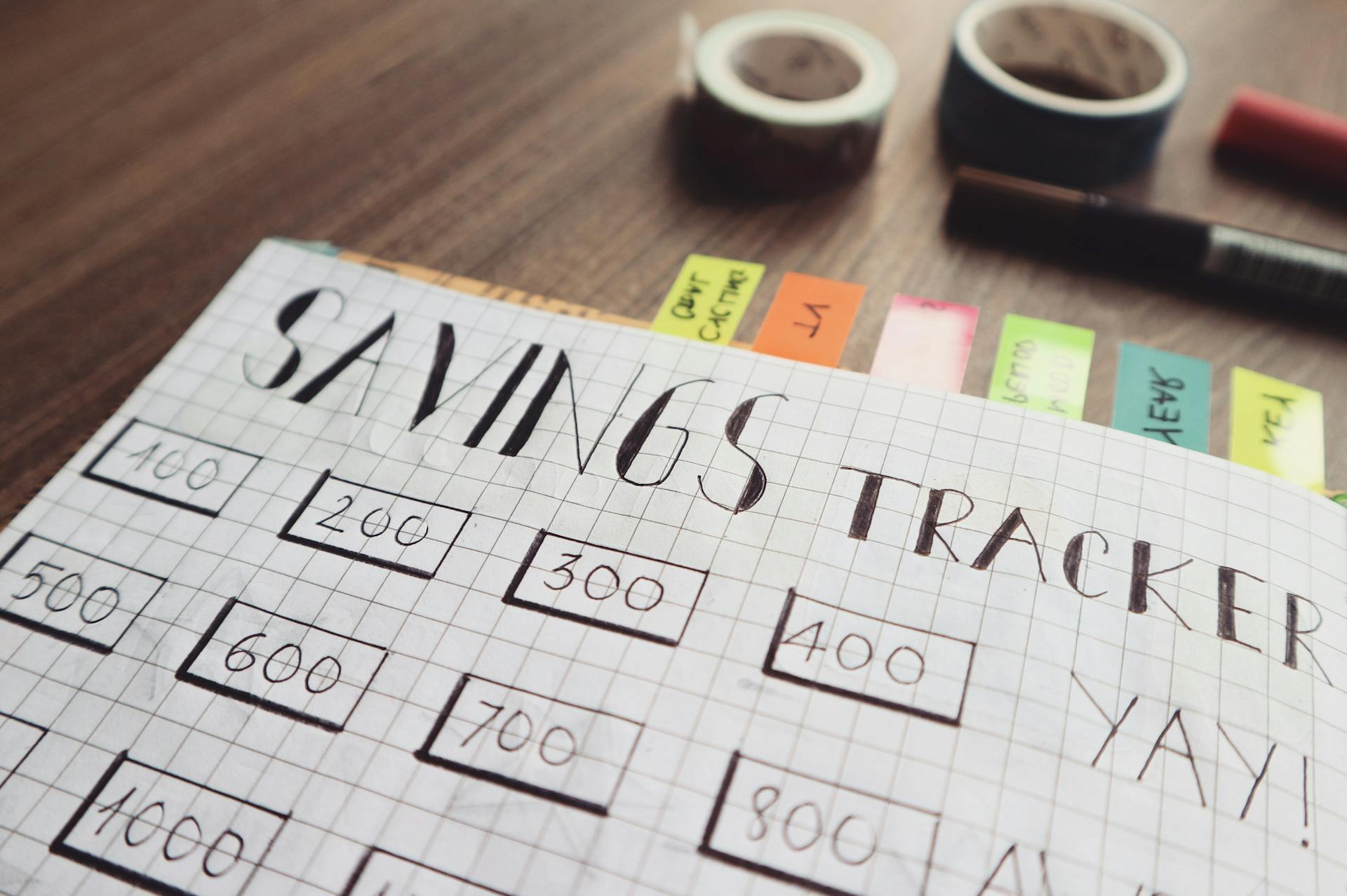
Money can be transferred in or out of your savings account online, at a branch, or ATM, by electronic transfer, or by direct deposit. Transfers can usually be arranged by phone, as well.
Some banks limit withdrawals to six per month, while others have no such restrictions. If you exceed the limit, the bank may charge a fee, close your account, or convert it to a checking account.
You can withdraw up to the amount in your account, but be aware of any potential fees. It's a good idea to check with your bank to understand their specific policies.
Tapping into your savings account is simple: just transfer the money to your linked checking account or withdraw cash through an ATM. Note that some banks or credit unions may limit you to six withdrawals or transfers per monthly cycle from your savings account.
Explore further: Dubai Personal Loan without Salary Transfer
Fees and Rates
The interest rate on a savings account is known as the annual percentage yield (APY), and it's the amount of interest you may earn in a year when compounding interest is considered. Some savings accounts, like high interest savings accounts, offer a higher APY than standard savings accounts.
For another approach, see: Highest Apy Saving Accounts
Synchrony Bank offers a competitive interest rate, compounded daily and credited monthly, on their High Yield Savings Account. The APY can change at any time, so it's essential to keep an eye on it.
Some banks charge a monthly account fee to maintain your savings account, which may be waived if you meet certain conditions, like maintaining a certain balance. Others, like Synchrony Bank, don't charge a monthly fee.
Here's a summary of the fees you might encounter:
Account Rules
To avoid diluting your earnings with fees, know the rules of your particular savings account, including any minimum balance requirements.
Some savings accounts have no balance requirement, but others may charge you if you don't meet the minimum.
Transfers can usually be arranged by phone, and you can transfer money in or out of your savings account online, at a branch, or ATM, by electronic transfer, or by direct deposit.
Banks often limit withdrawals to six per month, and exceeding that may result in a fee, account closure, or conversion to a checking account.
The interest earned on your savings account is taxable income, and you'll receive a 1099-INT form from your financial institution at tax time if you earn more than $10 in interest income.
You might like: Average American Saving Account Balance
Interest Rates
Interest rates on savings accounts can vary greatly depending on the financial institution and type of account. The Synchrony Bank High Yield Savings Account offers a competitive interest rate, with interest compounded daily and credited monthly.
The interest rate on savings accounts is variable and can change at any time. This means you should check the rate regularly to ensure you're getting the best deal.
A higher interest rate doesn't necessarily mean a savings account is the best option for you. Checking accounts are designed for everyday spending and may be a better choice if you need to write checks or make frequent purchases.
Some savings accounts, like high-yield savings accounts, can earn 10 times more in interest than a normal savings account. These accounts are a good option for short-term investing.
To maximize earnings from a savings account, consider community and online-only banks, which often offer higher interest rates than big brick-and-mortar banks. You can also shop at credit unions, which may offer even better yields.
Broaden your view: Saving Accounts at Banks Are Protected by
Here are some tips to keep in mind when shopping for a savings account with a high interest rate:
- Look for online-only banks or credit unions, which often offer better rates than traditional banks.
- Consider a sign-up bonus, which can range in the hundreds of dollars.
- Watch out for fees that can eat into your interest rate.
- Rely on the power of compound interest to grow your savings over time.
Fees
Fees can be a real drag on your savings account earnings. Some banks charge a monthly account fee, which may be waived if you meet certain conditions, like maintaining a certain balance in your savings account each month.
Receiving paper statements may also cost extra. And, if you don't use your account for a prolonged period, you may incur an inactivity fee. This can add up over time, so it's essential to review your account's rules and fees before signing up.
Not all banks have the same withdrawal limits. Some may charge a fee for withdrawing more than the allowed amount per month. The Federal Reserve suspended withdrawal limits in 2020, but not all banks have changed their policies. This means you should check with your bank to see what their rules are.
Discover more: Loan Application Fee

Here are some common fees to watch out for:
By understanding the fees associated with your savings account, you can make informed decisions and avoid unnecessary charges.
Comparison and Tips
A savings account can be a great tool for managing your finances, but it's essential to understand the different types available. A high-yield savings account, for example, can earn you more interest than a traditional savings account.
To choose the right savings account for you, consider your financial goals and needs. If you're looking for easy access to your money, a liquid savings account might be the way to go.
Some savings accounts come with debit cards or checks, while others require you to withdraw cash or transfer funds online. Be sure to check the account's features before opening it.
Savings vs. Checking Account Differences
Savings accounts are designed for saving and growing your money, with higher interest rates compared to checking accounts.
You can earn very little (or no) interest on the balance in a checking account, making it less suitable for long-term savings.
Checking accounts are geared for daily transactions, with debit cards and checkbooks for easy spending.
Savings accounts, on the other hand, typically do not have debit cards or checkbooks, discouraging unnecessary spending.
Both checking and savings accounts are flexible and protected by FDIC insurance, giving you peace of mind.
It's common for people to hold both types of accounts, each serving a distinct purpose in managing your finances.
Check this out: Should I Get a Flex Spending Account
How Much to Keep
When deciding how much to keep, consider the 80/20 rule, which suggests that 80% of the time, you only use 20% of your belongings. This principle can help you identify which items bring the most value to your life.
In one study, it was found that people who kept fewer possessions reported feeling less stressed and more organized. This is likely due to the reduced mental clutter that comes with having fewer things to manage.
Keeping only what sparks joy can be a helpful approach, as Marie Kondo's KonMari method suggests. This means letting go of items that don't bring you joy or serve a purpose.
Other Deposit Products
Other deposit products can be a great alternative to savings accounts, offering higher rates or more flexibility. Savings accounts aren't the only game in town.
Money market accounts can provide higher rates than savings accounts, but they may come with higher minimum balance requirements. They're similar to savings accounts, with limited withdrawals and transactions allowed per billing cycle.
If you're willing to lock your money away for a set period, certificates of deposit (CDs) can offer a guaranteed fixed yield that's generally higher than savings or money market accounts. Just be aware that you'll face penalties for early withdrawals.
Here are some key differences between these products:
Frequently Asked Questions
Do you gain money in a savings account?
Yes, savings accounts can earn interest, which is considered taxable income. This means you can gain money in a savings account, but you'll need to report it to the IRS.
Can you withdraw money from a savings account?
Yes, you can withdraw money from a savings account, but be aware that frequent transactions may incur fees. Check with your bank for their specific rules on convenient transactions.
Featured Images: pexels.com