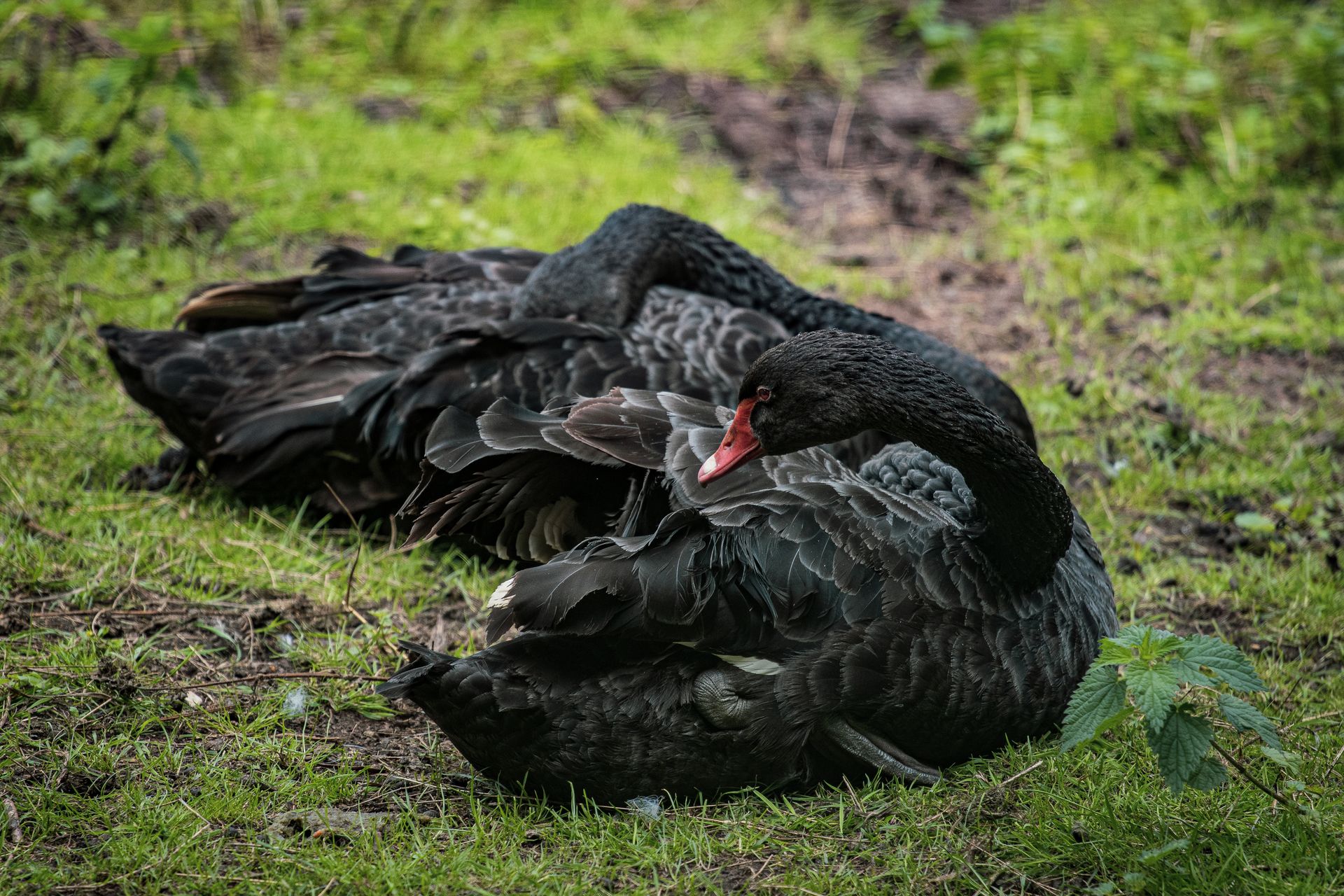
A black swan event is a rare and unexpected occurrence that has a significant impact on the world. These events are often characterized by their unpredictability and the fact that they are unforeseen by experts.
The concept of black swan events was first introduced by Nassim Nicholas Taleb in his book "The Black Swan", where he described them as events that are both rare and highly impactful. Taleb argued that these events are often caused by a combination of factors that are not fully understood.
Black swan events can have a significant impact on the world, causing widespread disruption and change. The 2008 financial crisis, for example, was a black swan event that was caused by a combination of factors, including excessive borrowing and a housing market bubble.
Definition
A Black Swan Event is a rare and unforeseen occurrence with massive consequences. It's often only explained after the fact, and people try to rationalize it in hindsight.
One key characteristic of a Black Swan Event is that it has potentially catastrophic effects, such as a major impact on the global economy. These events can be truly devastating.
According to Nassim Nicholas Taleb, a Black Swan Event has three main traits. Here are the key points:
- Rarity (Unpredictable Outlier)
- Results in Severe Consequences
- Rationalized Post-Occurrence (i.e. Retrospective Bias)
A Black Swan Event is unpredictable, which means it's impossible to foresee beforehand. This is what makes it so surprising and often leads to attempts to explain it after the fact.
Examples of Black Swan Events
Black swan events can be unexpected and have significant impacts on the stock market. The digital age, or "dot com" era, is a notable example of a black swan event.
The dot com era consisted of a recession once the bubble popped, but it also led to the development of the eCommerce sector, most notably Amazon, which is a prominent example of a "positive" black swan event.
Some of the most significant black swan events include the 2008 global financial crisis, the dot-com bubble burst, and Black Monday on October 19, 1987.
Here are some examples of notable black swan events:
- Digital Age (or “Dot Com” Era)
- Terrorist Attacks on September 11, 2001
- 2008 Global Financial Crisis (e.g. the “Great Recession”)
- Dot-com bubble burst between 2000 and 2002
- Black Monday on October 19, 1987
Event Examples
Black swan events can be unexpected and have significant impacts, but they're not all negative. The dot com era, for instance, led to a recession, but it also gave rise to companies like Amazon that emerged from the ashes.
The 2008 global financial crisis is often cited as one of the biggest black swan events. Triggered by the collapse of the U.S. housing market, it caused widespread economic turmoil.
The dot-com bubble burst between 2000 and 2002 is another example of a black swan event. Investors poured billions into internet startups with little to no sustainable business models, expecting endless growth.
Black Monday on October 19, 1987, was a day of stock market chaos, with the Dow Jones falling over 22% in a single day. This crash was unexpected and exposed vulnerabilities in automated trading systems and market psychology.
Curious to learn more? Check out: Pension Risk Transfer Market
Here are some notable black swan events:
- 2008 Global Financial Crisis
- Digital Age (or “Dot Com” Era)
- Terrorist Attacks on September 11, 2001
- Black Monday on October 19, 1987
In the case of the dot com era, the interpretation of the event as a black swan depends on one's perspective. Some saw it as a negative event, while others saw it as an opportunity for growth and innovation.
Was COVID-19 a Swan?
COVID-19 was a global pandemic that caused widespread devastation, but was it a true Black Swan event? According to Nassim Nicholas Taleb, the pioneer of the term "Black Swan", the COVID-19 pandemic was not a Black Swan event.
This might seem surprising, given the pandemic's unpredictable nature. However, Taleb has argued that the pandemic was actually predictable due to increased connectivity and nonlinearity. He co-wrote a paper on January 26, 2020, warning governments about the risks of the virus.
The COVID-19 pandemic was not a complete surprise, as some institutions had been preparing for a pandemic. For example, the All England Lawn Tennis Club had been paying into pandemic insurance since 2003 and received a payout of £157m in 2020.
Taleb believes that the pandemic's predictability can be attributed to the nonlinear nature of the virus and our worldwide connectivity. This combination created the perfect recipe for a global pandemic.
Explore further: The Biggest Risk Is Not Taking Any Risk
Markets and Investing
Black swan events can have a significant impact on stock and other investment markets, making it challenging to predict future outcomes. The 2008 Global Financial Crisis, for example, was a black swan event that triggered a sharp financial downturn.
The unpredictability of black swan events can create psychological and practical problems for investors. Nassim Nicholas Taleb, who popularized the concept of black swan events, argues that the standard tools of probability and prediction do not apply to rare events.
Investors often want to know the future, but black swan events make it impossible to predict with certainty. Even if we correctly predict some factors, such as election results or oil prices, other events like a natural disaster or war can override them.
Classic black swan events include the rise of the internet and personal computers, the September 11 attacks, and World War I. These events were so rare that even the possibility of their occurrence was unknown.
Broaden your view: Financial Risk and Non Financial Risk
Investors should be aware of the potential for black swan events to impact their investments. A list of notable black swan events includes:
- Digital Age (or “Dot Com” Era)
- Terrorist Attacks on September 11, 2001
- 2008 Global Financial Crisis (e.g. the “Great Recession”)
These events demonstrate the potential for black swan events to have a significant impact on markets and investments.
Notable Black Swan Events
The global financial crisis of 2008 was a massive Black Swan Event, triggered by the collapse of the U.S. housing market and leading to widespread economic turmoil.
Financial markets and major institutions like Lehman Brothers were severely affected, causing massive losses and government bailouts.
The 9/11 terrorist attacks in 2001 were a notable Black Swan Event, completely unexpected and having massive global consequences.
They reshaped international relations, triggered long-term changes in global policy and travel, and had a lasting impact on the world.
The Biggest Event
The global financial crisis of 2008 is widely regarded as one of the biggest Black Swan Events in history. It was triggered by the collapse of the U.S. housing market, which led to a chain reaction of bank failures, stock market crashes, and deep recession.
Additional reading: Currency Black Market
The crisis was largely unforeseen and caused massive losses, government bailouts, and a deep global recession. The U.S. government launched a bailout package worth over $1 trillion to stabilize banks and the economy, but many industrialized nations slipped into deep recession, costing millions of jobs.
This event is often cited as a classic example of a Black Swan Event, and it's easy to see why. The collapse of the housing market and the subsequent bank failures were completely unexpected and had a massive impact on the global economy.
Here are some key statistics that illustrate the severity of the crisis:
The global financial crisis of 2008 was a wake-up call for investors and policymakers alike, and it highlighted the importance of being prepared for unexpected events.
Middle East Conflict
The Middle East conflict is a prime example of a black swan event that can send currency markets into a frenzy. On October 7th, 2023, Hamas launched an attack on Israel, triggering a brutal war in Gaza.
This event sent shockwaves through global markets, causing investors to scramble to adjust. The Israeli shekel (ILS) was hit the hardest, plummeting to an eight-year low against the US dollar.
The Bank of Israel stepped in with a $30 billion intervention to stabilize the shekel, limiting further damage. The central bank's aggressive action was a crucial move in preventing a complete market meltdown.
The conflict also drove up shipping costs as Houthi rebel attacks on Red Sea shipping routes forced global trade to reroute around Africa's Cape of Good Hope. This added pressure on currencies of emerging market economies, making them more vulnerable to market fluctuations.
You might enjoy: Cargo Shipping Insurance
Understanding the Theory
A Black Swan Event is an unpredictable occurrence with catastrophic consequences. It's hard to believe that something so unexpected can have such a huge impact.
The three traits of a Black Swan Event, according to Nassim Nicholas Taleb, are rarity, severe consequences, and rationalization after the fact. This means that Black Swan Events are rare, have extreme effects, and are only explained in hindsight.
A Black Swan Event is marked by extreme rarity, a lack of clear warning signs, and significant economic consequences. This can trigger sudden market volatility and leave everyone wondering what happened.
Here are the three key traits of a Black Swan Event:
Origin of the Term
The term "Black Swan Event" originated from a fascinating story. Nassim Nicholas Taleb popularized the term in his 2007 book The Black Swan.
Taleb first explored the theory in response to financial events in 2001, which sparked his interest in unpredictable events. He was a former Wall Street trader and financial mathematician, giving him a unique perspective on the topic.
The metaphor of the Black Swan refers to the extremely rare black swan, also called the black-necked swan, which was considered unimaginable until its discovery in the 18th century. This bird was previously unknown, only known to exist in the form of white swans.
The Event Theory
The Black Swan Event Theory is all about identifying and understanding these rare and unpredictable events. It was popularized by Nassim Nicholas Taleb, who described the three key traits of a black swan event.
Rarity is the first trait, referring to an unpredictable outlier that doesn't fit into our usual expectations. This is what makes black swan events so hard to predict.
The second trait is the severe consequences that follow such an event. These consequences can be devastating and have a lasting impact.
Rationalized post-occurrence is the third trait, where we try to explain the event in hindsight, often using the benefit of hindsight to make it seem more predictable than it actually was.
A black swan event is often marked by extreme rarity, a lack of clear warning signs, and significant economic consequences. These events can trigger sudden market volatility and have a lasting impact on the economy.
Here are the three key traits of a black swan event, as identified by Nassim Nicholas Taleb:
- Rarity (Unpredictable Outlier)
- Results in Severe Consequences
- Rationalized Post-Occurrence (i.e. Retrospective Bias)
Meaning of the Theory

The Black Swan Theory is all about recognizing the unpredictable nature of catastrophic events. Nassim Nicholas Taleb popularized the term in his 2007 book, "The Black Swan: The Impact of the Highly Improbable".
A Black Swan Event is characterized by three main traits: rarity, severe consequences, and rationalized post-occurrence. This means that such events are extremely rare, have a significant impact, and are often only explained in hindsight.
Taleb's theory suggests that trying to predict Black Swan Events can do more harm than good. By assuming we can predict them, we leave ourselves more vulnerable to real Black Swan Events. This is because we commit too much attention, effort, and money to something we assume is predictable.
The Black Swan Theory encourages systems to cater for regular, small knocks to protect themselves from extreme damages. This is a method used by Taleb in his days as a trader, taking frequent, small losses on many of his investments.
The three traits of a Black Swan Event are:
- Rarity (Unpredictable Outlier)
- Results in Severe Consequences
- Rationalized Post-Occurrence (i.e. Retrospective Bias)
These traits are essential to understanding the unpredictability of Black Swan Events. By acknowledging these characteristics, we can better prepare ourselves for the unexpected.
Grey
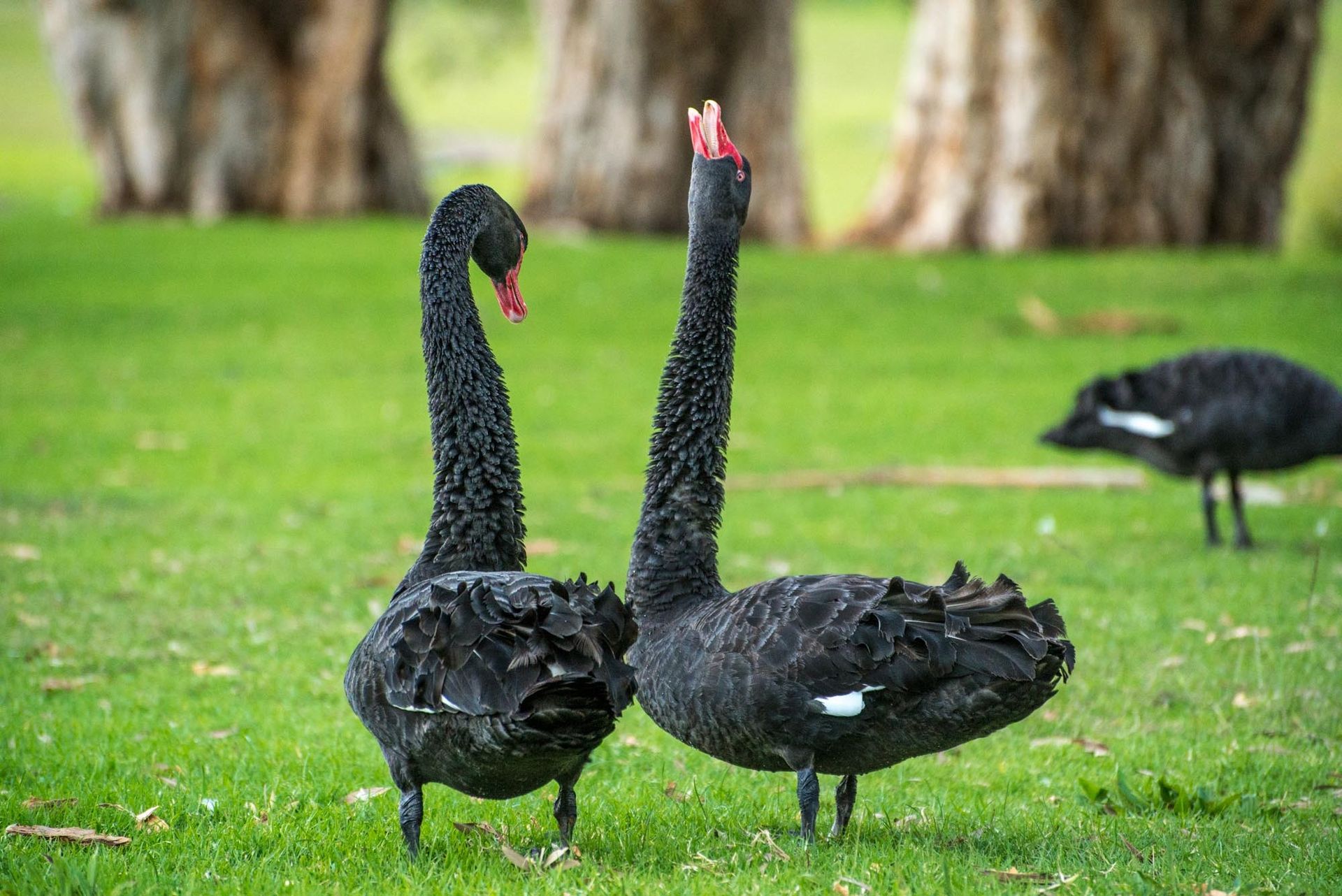
Grey Swan Events are scenarios that are possible but not necessarily likely. Unlike totally unforeseeable Black Swan Events, Grey Swans can be anticipated to some extent.
Grey Swans describe scenarios that are possible, but not necessarily guaranteed to happen. They require a certain set of circumstances to unfold.
Grey Swans can be thought of as a middle ground between Black and White Swans, where the outcome is uncertain but not entirely unforeseeable.
Explore further: Where Do Swans Go in the Winter?
Is an Event Positive?
A Black Swan Event can be positive, although they're often associated with negative events. These rare and unpredictable occurrences can sometimes lead to breakthroughs or innovations.
Despite their potential for disruption, most people tend to focus on the risks. This is due to their unexpected nature, making it hard to anticipate outcomes.
A positive Black Swan Event can be a game-changer, leading to new strategies and trends. It's essential to consider both the risks and potential benefits when evaluating such events.
While it's difficult to predict Black Swan Events, understanding their potential impact can help with crisis management. By being prepared, you can turn an unexpected event into an opportunity for growth.
Here are some key areas to consider when evaluating a potential Black Swan Event:
- Strategy
- Trends
- Prediction
- Future
- Crisis Management
Frequently Asked Questions
Can black swan events be positive?
While the term "black swan event" often implies a negative outcome, it's theoretically possible for such events to have positive impacts, such as a natural disaster that sparks innovation and growth. However, these instances are relatively rare and often overshadowed by more dramatic negative consequences.
Featured Images: pexels.com