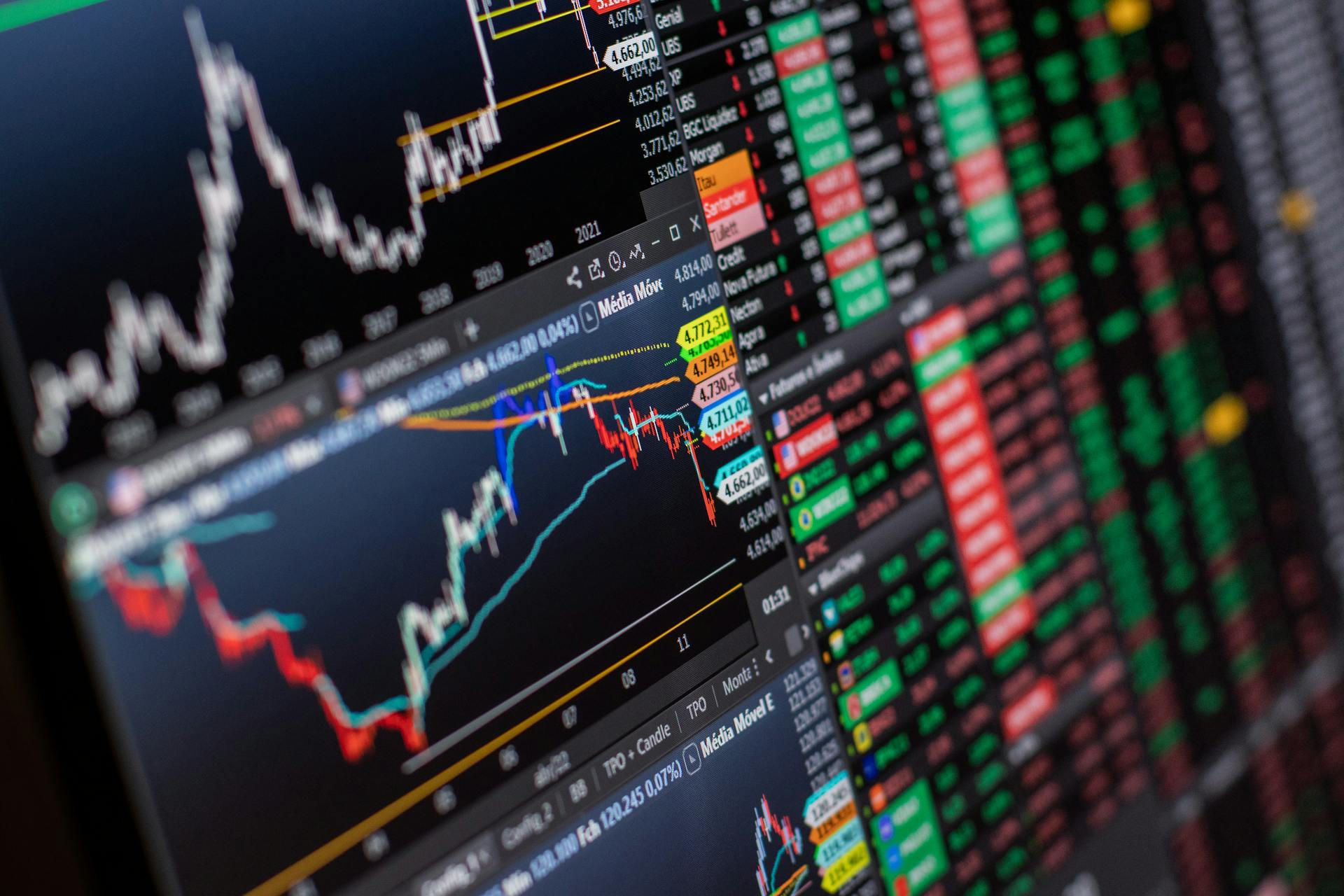
A bear market is a period of prolonged decline in the stock market, typically defined as a 20% drop in the value of a major stock market index over a period of time. This can have a significant impact on investors, causing them to lose money.
Investors who are not prepared for a bear market can suffer significant losses. A bear market can last for months or even years, making it essential to have a solid investment strategy in place.
To stay ahead, it's crucial to understand the warning signs of a bear market. According to the article, a bear market can be triggered by a variety of factors, including economic downturns, geopolitical tensions, and changes in interest rates.
Understanding Bear Markets
A bear market is a stock market decline that can be caused by a crisis of investor confidence, triggered by a weak or slowing economy, or the anticipation of an economic slowdown. This can lead to a selloff, where investors sell their shares, causing prices to fall.
The decline of a bear market can be gradual, taking a few months to a year to recover, or it can be a longer-term trend driven by market fundamentals. In some cases, a bear market can last longer and be driven more by long-term market trends than short-term consumer sentiment.
A bear market is typically declared when the market declines at least 20% from the most recent high, and is often associated with a loss of consumer, investor, and business confidence. Signs of a slowing economy, such as falling productivity, rising unemployment, and low consumer confidence, can contribute to the loss of confidence.
Here are some common signs of a slowing economy that can lead to a bear market:
- Falling productivity
- Rising unemployment
- Low consumer confidence
- Decreasing corporate profits
- Low disposable income
Causes of Decline
A bear market is essentially a crisis of investor confidence, triggered by a weak or slowing economy, or the anticipation of an economic slowdown. This can lead to a decline in the market as investors become pessimistic about future returns on investment.
Falling productivity, rising unemployment, low consumer confidence, decreasing corporate profits, and low disposable income are all signs of a slowing economy that can cause investors to become pessimistic.
Investors may feel that certain assets are overvalued, leading them to sell shares and cause prices to fall. This can create a self-reinforcing cycle of selling and price declines.
A loss of consumer, investor, and business confidence is often the underlying cause of a bear market. This can be triggered by various factors, including changes to interest rates, global events, falling housing prices, or changes in the economy.
The most common trigger of a bear market is a weak or slowing economy, or the anticipation of an economic slowdown. Here are some common signs of an economic slowdown:
- Falling productivity
- Rising unemployment
- Low consumer confidence
- Decreasing corporate profits
- Low disposable income
A bear market is not the same as a recession, although they often go hand in hand. A recession is a slowdown in economic output, typically defined as at least two consecutive quarters of decline in GDP.
Take a look at this: Lended a Helping Hand
Characteristics of a Bear Market
A bear market is a stock market decline that can be a result of negative investor sentiment. This decline is typically measured when the market falls at least 20% from its most recent high.
Bear markets can be categorized into two types: regular or cyclical bear markets, and secular bear markets. The former lasts for a few months to a year, while the latter lasts longer and is driven by long-term market trends.
A bear market is often preceded by a crisis of investor confidence, which can be triggered by a weak or slowing economy, or the anticipation of an economic slowdown. Signs of a slowing economy include falling productivity, rising unemployment, low consumer confidence, decreasing corporate profits, and low disposable income.
Here are some key characteristics of a bear market:
- Regular or cyclical bear market: lasts for a few months to a year
- Secular bear market: lasts longer and is driven by long-term market trends
- Decline of at least 20% from the most recent high
- Often preceded by a crisis of investor confidence
- Triggered by a weak or slowing economy, or the anticipation of an economic slowdown
These characteristics can help you understand what's happening in the market and make informed decisions about your investments.
Preparing for a Bear Market
Preparing for a bear market requires some planning and a solid understanding of market behavior. Understanding market volatility is key to not getting spooked by downturns.
Diversifying your portfolio is essential to avoid having everything crash at once. By spreading your investments across different market segments, you can reduce your risk and potentially protect your portfolio from significant losses.
Knowing your risk tolerance and capacity is crucial to making informed investment decisions. If you're risk-averse, it's better to invest more conservatively to avoid riding a bear market all the way to the bottom.
Having a complete financial plan in place will help you navigate both bull and bear markets. This plan should take into account your investment goals, risk tolerance, and time horizon.
To prepare for a bear market, consider reducing higher-risk investments such as growth stocks and speculative assets. Instead, move money into safer investments like cash, gold, bonds, or consumer staples and healthcare companies.
Intriguing read: Stock Investors Cannot Avoid Which Type of Risk
Here are some safe investments that tend to perform well during a bear market:
- Cash
- Gold
- Bonds
- Consumer staples companies
- Healthcare companies
During a bear market, it's often safer to shift from growing capital to saving it and reducing losses. Consider using a dollar-cost averaging strategy to invest small amounts of money over time, rather than trying to predict market highs and lows.
Investing Strategies
To prepare for a bear market, it's a good idea to reduce higher-risk investments such as growth stocks and speculative assets.
Moving money into cash, gold, bonds, or other less risky investments can help reduce the risk of losses if the market goes down. These safe investments tend to perform better than stocks during a bear market.
Consumer staples and healthcare companies are types of stocks that tend to weather bear markets well.
Be very careful with your allocations and avoid buying the dip until you run out of margin, as margin calls are a major factor in bear markets that can trigger forced liquidation.
Diversify
Diversify your investments to reduce risk. By spreading your money across different asset classes, you can minimize losses if one type of investment performs poorly.
Precious metals, bonds, crypto, real estate, and other types of investments can be included in a diversified portfolio. This way, if one asset declines in value, others may not follow suit.
In a diversified portfolio, it's hard to predict which asset will increase in value. But by spreading your investments across different types, you increase the chances of being exposed to an upward trend and seeing a gain.
Diversification can help you ride out a bear market. By having a mix of investments, you can reduce your reliance on any one asset class and minimize potential losses.
Worth a look: Diversified Technology
Play Both Sides
In a bull market, it's possible to play both sides of the trade, and the same applies to bear markets. Just as in bull markets, you can play both sides of the trade in bear markets as well.
Panic selling can lead to shares becoming extremely oversold, making it a good opportunity to play the reversion and reversals on the long side.
It's crucial to never use all your buying power in any single trade.
Check this out: What Is a Bull Market
Historical and Economic Context
Bear markets have occurred as close together as two years and as far apart as nearly 12 years, making it difficult to predict when the next one will happen. On average, bear markets tend to occur around every 56 months.
A bear market can last anywhere from a few months to over two years, with an average duration of about 355 days. The longest bear market on record lasted 630 days, from January 11, 1973, to October 3, 1974, with a decline of 48.20%.
Bear markets have a reputation for preceding economic downturns, with eight of 11 bear markets since 1948 followed by recessions. The time between a peak and the onset of recession is typically around seven to eight months, giving investors a relatively short window to adjust their strategies.
A unique perspective: 5 Years
History of Bear Markets
Bear markets have occurred as close together as two years and as far apart as nearly 12 years. On average, they occur around every 56 months.
If this caught your attention, see: Ohio E Check Years
A bear market can last anywhere from a few weeks to a few months, or even up to two years. The 2007 financial meltdown lasted nearly two years, requiring the U.S. Federal Reserve to implement the Troubled Asset Relief Program.
The average bear market lasts less than two years, with an average duration of 401 days. Some bear markets can be quite long, like the 1973-1974 bear market, which lasted 630 days.
Bear markets have resulted in significant losses, with the average decline being around 32.4%. The 2007-2008 bear market saw the S&P 500 drop by 51.93%, while the 2022 bear market resulted in a 25% decline.
Here are some notable bear markets, listed by peak and trough dates:
Economic Implications
Bear markets often signal recessions months ahead of time, as economic reports are typically a month late.
Since 1948, eight of 11 bear markets have been followed by recessions.
The average time between a peak and the onset of recession is seven to eight months, giving investors a relatively short window to adjust their strategies.
Worth a look: History of Recessions after Inverted Yield Curve
Market Trends and Cycles
A bear market can be a scary thing, but it's essential to understand that it's just a normal part of the market's natural cycle. Historically, the value of the stock market has always trended upward.
The average bear market lasts 349 days, which is a significant amount of time, but it's worth noting that the COVID-19 induced bear market of 2020 was actually the shortest bear market in history.
In fact, it's usually better to stay put and not sell during a bear market, as what often follows is a bull market where prices rise. You're effectively buying at a discount, since the value of your portfolio will likely rise during the next part of the cycle.
Curious to learn more? Check out: Ge Aerospace Has Risen during the Recent Market Slide.
Managing a Bear Market
The best defense against a downturn is to keep calm. Investor fear and worry are often contributors to bear markets, and it's usually in response to a sluggish economy or uncertainty around political events.
A good advisor can help you navigate through the noise and remain calm, especially when the best action to take with your investments is no action at all. This is because a solid plan is good, but it's often the emotional response that can lead to poor decision-making.
Diversification does not ensure against loss, but it can help spread out the risk. This means that even if one investment performs poorly, others can help offset the losses.
To stay calm during a bear market, it's essential to have a clear understanding of your investment goals and risk tolerance. This will help you make informed decisions and avoid emotional reactions to market volatility.
A financial advisor can provide valuable guidance and help you develop a plan to navigate through turbulent times. They can also help you identify opportunities to invest in stocks that tend to rise when the market falls.
Here are some key facts to keep in mind:
- Investor fear and worry are often contributors to bear markets.
- A good advisor can help you navigate through the noise and remain calm.
- Diversification does not ensure against loss, but it can help spread out the risk.
Featured Images: pexels.com