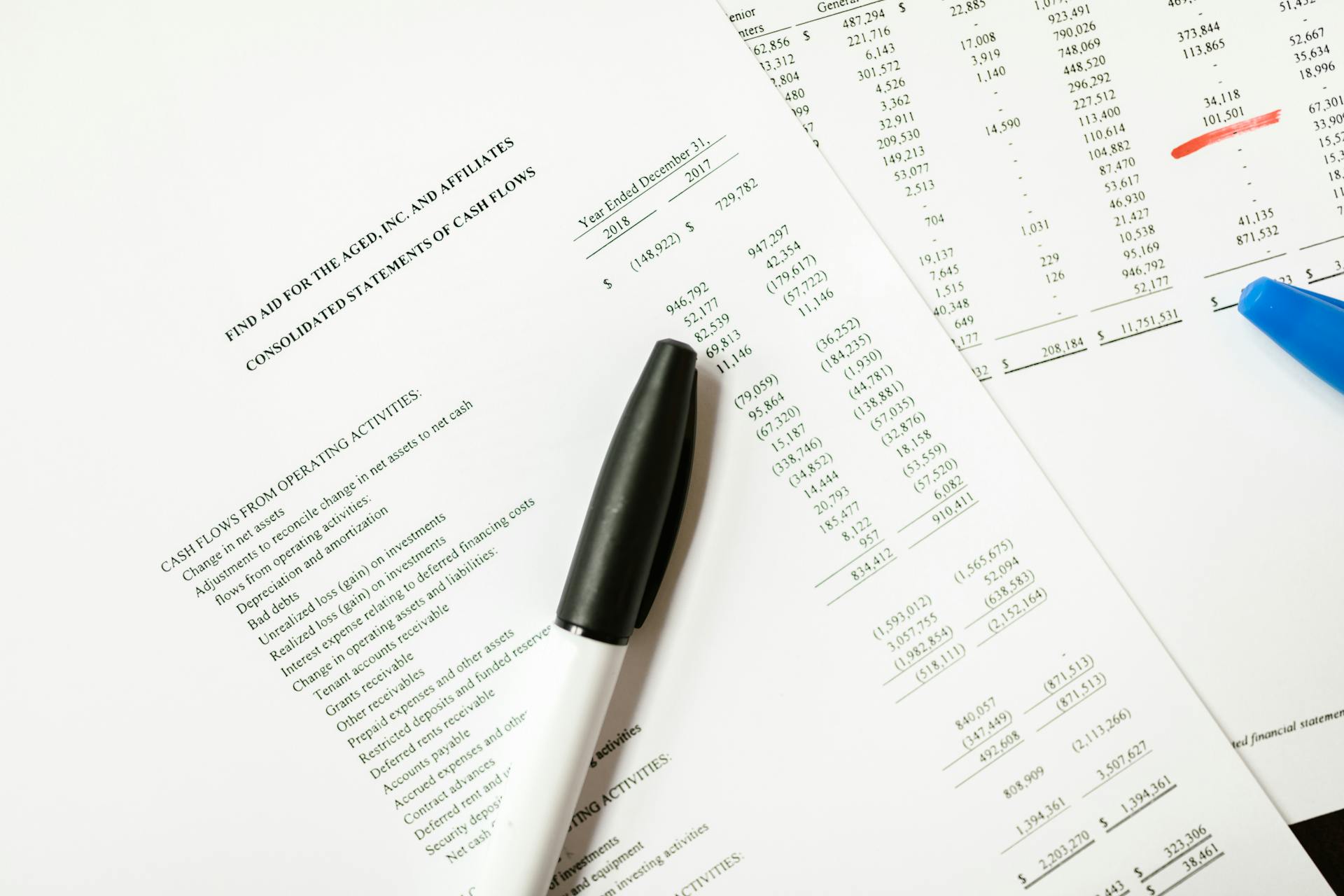
Cash flow is the lifeblood of any business, and managing it effectively is crucial for survival. A positive cash flow means you have enough money coming in to cover your expenses and invest in growth.
Cash flow can be affected by several factors, including the time it takes to receive payment from customers. For instance, if you offer a 30-day payment term, it can take up to a month for the cash to hit your account. This can put a strain on your business's liquidity.
To manage cash flow effectively, businesses need to monitor their accounts receivable and payable. This includes keeping track of when customers pay their bills and when suppliers are due to be paid. By doing so, you can identify any potential cash flow issues early on and take corrective action.
A good cash flow management system can help businesses avoid common pitfalls such as overdrafts and late payment fees.
Discover more: Do Businesses Prefer Cash or Credit
What Is Cash Flow
Cash flow is the lifeblood of any business, and it's essential to understand what it means. Cash flow is the movement of money into and out of a business over a specific period of time.
A business's cash flow is made up of two main components: cash inflows and cash outflows. Cash inflows are the money that comes into the business, such as sales revenue and loans. Cash outflows are the money that leaves the business, including expenses, taxes, and loan repayments.
A business can have a positive cash flow, where the inflows exceed the outflows, or a negative cash flow, where the outflows exceed the inflows. This can happen when a business has a slow sales period or when it's experiencing financial difficulties.
Types of Cash Flow
Cash flow is a crucial aspect of any business, and understanding its different types is essential for making informed financial decisions. Operating cash flow refers to the net cash generated from a company's normal business operations.
You might enjoy: Brk.b Shares Outstanding
There are three main types of cash flow: Operating Cash Flow, Investing Cash Flow, and Financing Cash Flow. Operating Cash Flow represents much of a company's revenue and expenses, including cash inflows from sales revenue and interest income, and cash outflows from employee salaries and payments to suppliers.
Here's a breakdown of each type of cash flow:
- Operating Cash Flow: The net cash generated from a company's normal business operations.
- Investing Cash Flow: The net cash generated from a company's investment-related activities, such as investments in securities or the purchase of physical assets.
- Financing Cash Flow: The net cash generated to finance the company, including debt, equity, and dividend payments.
Operating Activities
Operating activities are a crucial part of a company's cash flow. They involve the cash inflows and outflows from a company's core operations.
Net income is a key component of operating activities, and it can be found in the income statement. For example, in one company's income statement, the net income was $37,037.
Adjustments to reconcile net income to cash generated by operating activities are also important. These adjustments include depreciation and amortization, deferred income tax expense, and other items. For instance, one company had depreciation and amortization of $6,757 and deferred income tax expense of $1,141.
Curious to learn more? Check out: Adjustments to Net Income in Calculating Operating Cash Flows Include:
Changes in operating assets and liabilities can also impact operating activities. This can include changes in accounts receivable, inventories, and accounts payable. For example, one company had a decrease in accounts receivable of $2,172 and an increase in accounts payable of $2,340.
Here's a breakdown of the cash generated by operating activities:
Investing Activities
Investing Activities can be a crucial aspect of a company's cash flow. A company's investing activities can include the purchase or sale of physical assets and marketable securities.
Investing cash flow is the net cash generated from a company's investment-related activities. This can include investments in securities, the purchase of physical assets like equipment or property, or the sale of assets.
A company's investing activities can have a significant impact on its cash flow. For example, if a company purchases commercial real estate, it gains a tangible asset while also making a commitment to managing operational expenses.
Intriguing read: Operating Financing and Investing Cash Flows
Investing activities can be categorized into two main types: cash inflows and cash outflows. Cash inflows occur when a company sells property, equipment, or investments, while cash outflows occur when a company purchases fixed assets or investments.
Here is a breakdown of common investing activities:
A negative investing cash flow isn't necessarily a bad thing, as it could show investment in the company's future growth.
Calculating Cash Flow
Calculating cash flow is a crucial step in understanding a business's financial health. It's essential to calculate cash flow regularly to make informed decisions.
A business's cash flow is calculated by subtracting its total liabilities from its total assets, which can be done using the following formula: Cash Flow = Total Assets - Total Liabilities. This formula helps identify the amount of cash a business has available to meet its financial obligations.
Cash flow can be affected by the time it takes to collect payments from customers, which can be up to 30 days or more in some cases.
Check this out: How a Business Can Improve Its Cash Flow
Direct Method
The direct method is a straightforward way to calculate cash flow, where all cash receipts and payments are listed.
This method provides a clear picture of a company's inflows and outflows of cash during the reporting period.
It lists all the cash coming in, including sales, investments, and other sources of income.
The direct method also lists all the cash going out, such as payments to suppliers, employees, and taxes.
By using the direct method, companies can easily identify the sources and uses of cash, which is essential for making informed financial decisions.
Recommended read: The Direct Method of Reporting Operating Cash Flows
Indirect Method
The indirect method is a way to calculate cash flow that starts with net income from the income statement.
You add back non-cash items like depreciation and amortization to get a more accurate picture of your company's cash flow.
Changes to working capital, such as accounts receivable, accounts payable, and inventory, are also adjusted for.
This method helps you understand how your company's cash flow is affected by its financial activities.
By using the indirect method, you can get a clear picture of your company's cash flow and make informed decisions about its financial management.
Consider reading: Cash Flow Statement Indirect Method Solved Examples
Managing Cash Flow
Managing cash flow is crucial for any business, as it can make or break your financial stability. According to SCORE, 82% of business failures are due to cash flow problems.
Tracking all cash inflows and outflows is the first step to effectively managing your cash flow. This means recording every single transaction, big or small, to get a clear picture of your financial situation.
Performing a cash flow analysis on a regular basis will help you identify opportunities to improve your company finances before they become a problem. By analyzing your cash flow, you can spot areas where you can reduce expenses, increase revenue, or improve your cash flow management.
Offering electronic payment options, shortening your invoice payment terms, or providing early payment discounts can help you increase your speed of collection and improve your cash flow. This can be especially helpful during your slow season.
Waiting for the invoice due date to pay can help you have more working capital on-hand and avoid unnecessary cash constraints. However, this should be done strategically, taking into account your business's specific needs and cash flow cycles.
Here are some strategies to improve your cash flow:
- Improve your inventory-management system
- Negotiate better payment terms
- Review your business’s budget regularly
- Outsource non-core functions
- Leverage technology
- Consider leasing equipment instead of buying
By implementing these strategies, you can improve your business’s cash flow position and achieve financial stability.
Cash Flow and Profit
Cash flow and profit are often pitted against each other, but they have different indications of a company's financial health. A company can be both profitable and have a negative cash flow, hindering its ability to pay expenses and grow.
Profit and cash flow are not interchangeable terms, and understanding the difference between them is crucial. Net cash flow is the movement of cash into and out of a business, while profit is the amount of money left after all expenses have been paid. A company can have a positive cash flow but a negative profit, and vice versa.
Gates Little, President of the Southern Bank Company, emphasizes the importance of cash flow, saying that a company with positive cash flow can stay open, almost regardless of profit.
For your interest: Positive Cash Flows
Profit vs Profit
Profit and cash flow are often pitted against each other, but there isn't a simple answer to which is more important.
Both profit and cash flow are important in their own ways, and you need to understand both metrics to evaluate the financial health of a business.
It's possible for a company to be both profitable and have a negative cash flow, hindering its ability to pay its expenses and grow.
For example, a company might have a positive profit margin but struggle to pay its bills due to a lack of cash flow.
Profit and cash flow are just two of the dozens of financial terms and metrics that you should be fluent in to make informed business decisions.
Broaden your view: Corporate Bonds Most Often Pay Interest
Net vs. Profit
Net cash flow and profit are often confused with each other, but they have some key differences. Net cash flow is the movement of cash into and out of a business, while profit is the amount of money left after all expenses have been paid.
A company can be profitable while having a negative cash flow, and vice versa. This happens when noncash expenses, such as depreciation, are considered in the profit calculation.
The net cash flow formula is simple: Cash Inflows – Cash Outflows = Net Cash Flow. Using this formula, a bicycle shop with $100,000 in revenue, $50,000 in employee pay, and $40,000 in raw materials, has a positive cash flow of $10,000.
However, if we consider the shop's noncash expenses, such as depreciation, the profit calculation changes. Total Revenue – Total Expenses = Net Income. In this case, the shop's profit would be negative $5,000.
According to Gates Little, President of the Southern Bank Company, a company with positive cash flow can stay open, regardless of profit. This is because cash flow is essential for paying bills and employees.
For more insights, see: Revenue Center
Cash Flow and Business Loans
A small business loan can help improve your cash flow by smoothing out cash flow cycles and positioning your business to leverage opportunities while better managing expenses.
For example, financing can help you hire sales or service staff to build revenue, or use it for renovations and purchase equipment to reduce production costs and create process efficiencies.
With a small business loan, you can improve cash flow and boost your bottom line.
Understanding your business's cash flow rhythm through its operating, investing, and financing activities is essential for financial strength – and it will better position your business for financing if you need a loan or line of credit.
Cash inflows from financing activities include proceeds from issuing stock or borrowing from lenders.
Cash outflows include loan repayments, dividend payments, or stock buy-backs.
A positive financing cash flow usually demonstrates new investments or loans received, while a negative financing cash flow could represent debt repayment or distributions to owners.
Here are some common financing cash flow activities:
- Issuing stock to raise capital
- Borrowing from lenders to finance operations
- Repaying loans to creditors
- Paying out dividends to shareholders
- Buying back company stock
Cash Flow Analysis and Optimization
Cash flow is a crucial aspect of any business, and performing a cash flow analysis is essential to understand where your business stands financially.
Your working capital is one of the most important measurements, as it determines your business's liquidity and ability to pay off debts.
Cash flow analysis helps identify areas where your business can improve its financial performance.
If your business isn’t achieving its financial goals, the first step is to analyze your cash flow and identify the problem areas.
A cash flow analysis can help you determine whether your business is generating enough cash to cover its expenses and pay off debts.
Picture a situation in which you, a small business owner, are struggling to make ends meet because your business isn't generating enough cash.
By optimizing your cash flow, you can ensure that your business has enough liquidity to pay off debts, cover expenses, and achieve its financial goals.
Frequently Asked Questions
Does cash flow mean monthly or yearly?
The cash flow statement can report cash activity for a month, quarter, or year, depending on the company's needs. Typically, it's prepared on a yearly basis, but can be more frequently for certain businesses or financial analysis.
What is a good cash flow to sales?
A good operating cash flow to sales ratio is between 10% to 55%, indicating a strong ability to convert sales into cash. This range suggests a healthy financial position and potential for better credit terms.
How many times cash flow is a business worth?
For businesses with less than $5 million in annual revenue, a common valuation multiple is 1.5 to 3.0 times cash flow, depending on the industry. This means your business could be worth 1.5 to 3 times its annual cash flow.
Featured Images: pexels.com