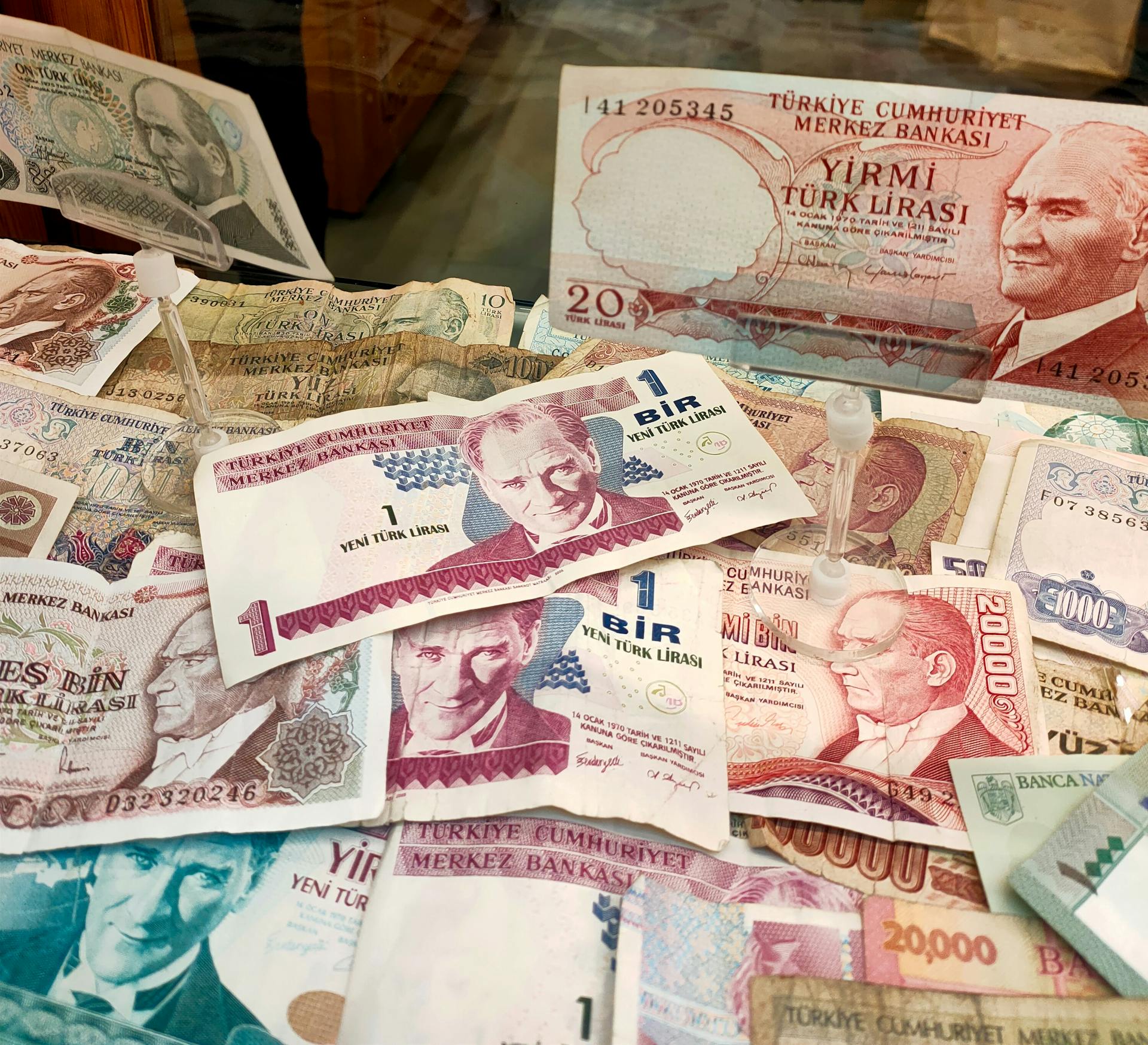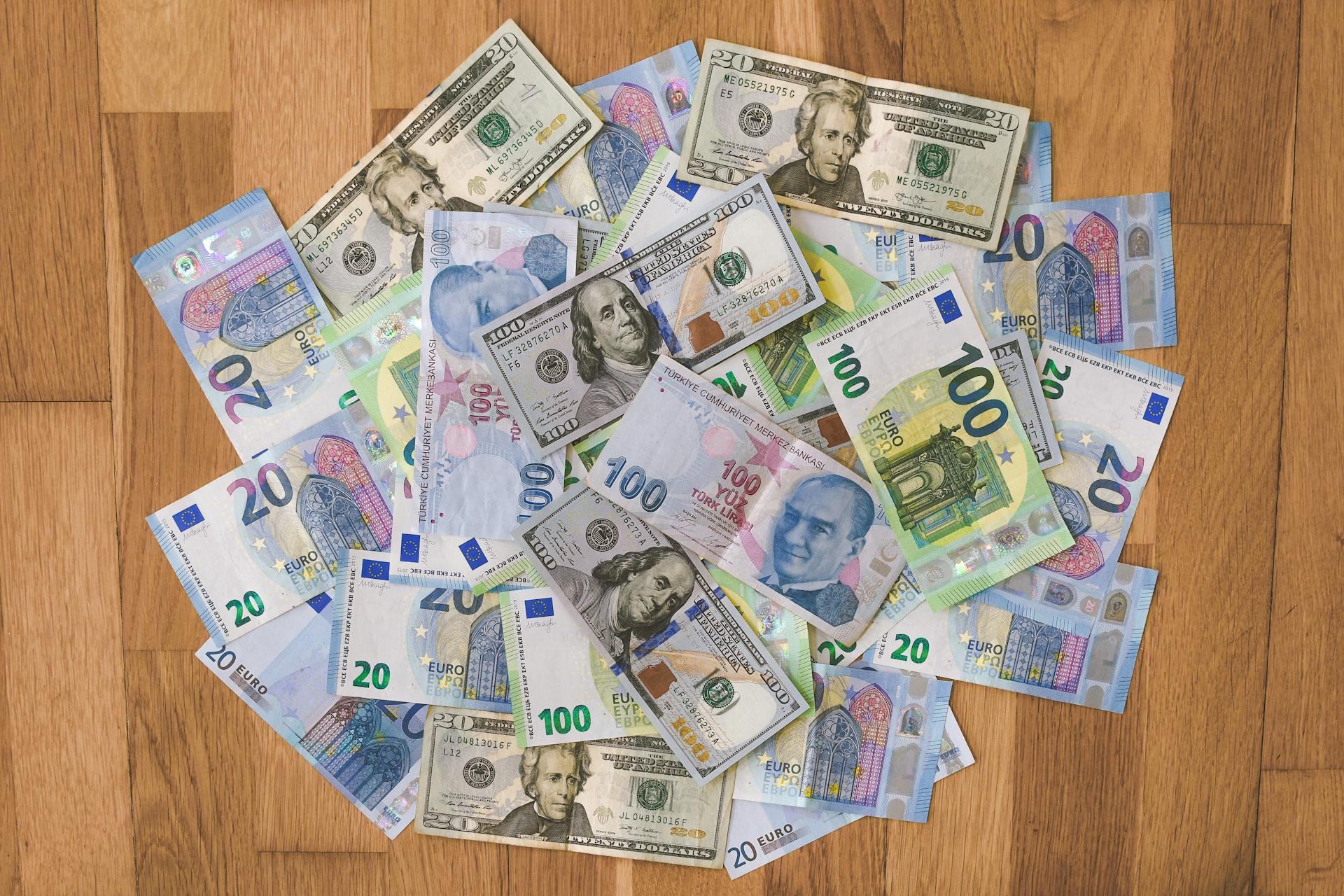
The Turkish New Lira is the official currency of Turkey, and it's been around since 2005. It replaced the old Turkish Lira, also known as the TL.
The New Lira is divided into 100 subunits called kuruş, although the use of kuruş is largely symbolic now.
You can exchange your money for Turkish New Lira at a bank or currency exchange office, or withdraw it from an ATM using your debit or credit card.
History of Turkish Lira
The Turkish lira has a long and complex history.
In the 1970s and 1990s, Turkey experienced chronic inflation, which led to the severe depreciation of the old lira.
Prime Minister Recep Tayyip Erdoğan called this problem a "national shame".
The old lira traded at approximately 1,650,000 lira per U.S. dollar in late 2001, representing an average inflation of about 38% per year.
In late December 2003, the Grand National Assembly of Turkey passed a law that allowed for the removal of six zeroes from the currency.
You might enjoy: Currency Converter Renminbi
The new lira was introduced on January 1, 2005, replacing the previous lira at a rate of 1 new lira = 1,000,000 old lira.
The old Turkish lira remained in circulation until the end of 2005, but is now no longer valid and thus worthless.
Make sure you don’t receive those as change!
Expand your knowledge: Old Us Dollar Bills Value
New Turkish Lira
The New Turkish Lira was introduced on January 1st 2005, replacing the previous lira at a rate of 1 new lira = 1.000.000 old lira.
The New Turkish Lira banknotes exist in denominations of 1, 5, 10, 20, 50, and 100 YTL, featuring portraits of Mustafa Kemal Atatürk and images of historical and important buildings in Turkey.
The New Turkish Lira coins were introduced in denominations of 1, 5, 10, 25 and 50 New Kuruş (Yeni Kuruş – YKR) and 1 New Turkish Lira, which are similar to Euro coins and require attention.
One kuruş is worth 1/100 of one lira, making it a crucial unit of currency in Turkey.
The New Turkish Lira was initially called YTL or TRY, but as of December 31, 2009, the 2005 series notes are no longer accepted for payment, and the currency is now simply called "TL".
Additional reading: 5 Kronur
Coins
Coins were introduced in 2005 in denominations of 1, 5, 10, 25 and 50 new (Yeni) kuruş and 1 new (Yeni) lira.
The 1 new (Yeni) kuruş was minted in brass, while the 5, 10 and 25 new kuruş were made of cupro-nickel.
All coins show portraits of Mustafa Kemal Atatürk.
The 50 new kuruş and 1 new lira coins are bimetallic, meaning they're made of two different metals.
Their sizes and compositions are quite similar to the €1 and €2 coins, which could cause confusion in the eurozone.
This similarity caused trouble for businesses using vending machines in the eurozone, particularly at airports, since some machines accepted the 1 new lira coin as a €2 coin.
Discover more: 5 Turkish Lira to Usd
Banknotes
The New Turkish Lira banknotes were introduced in 2005 in denominations of 1, 5, 10, 20, 50, and 100 new lira. They feature portraits of Mustafa Kemal Atatürk from different points of his life and images of various historical and important buildings and places in Turkey.
The lower four denominations of 1, 5, 10, and 20 new lira replaced older notes and used very similar designs.
The 50 and 100 new lira notes did not have equivalents in the old currency.
The New Turkish Lira banknotes have specific dimensions, with the 1, 5, 10, and 20 lira notes measuring 160 × 76 mm, and the 50 and 100 lira notes measuring 152 × 81 mm and 158 × 81 mm respectively.
Here's a breakdown of the New Turkish Lira banknotes:
New Turkish Lira
The New Turkish Lira was introduced on January 1st 2005, replacing the previous lira at a rate of 1 new lira = 1.000.000 old lira.
The old Turkish lira remained in circulation until the end of 2005, but is now no longer valid and thus worthless, so make sure you don't receive those as change!
New Turkish Lira banknotes exist in denominations of 1, 5, 10, 20, 50, and 100 YTL.
On a similar theme: How to Check the Value of Old Money
All notes show portraits of Mustafa Kemal Atatürk from different points of his life and images of various historical and/or important buildings and places in Turkey.
New coins were introduced in denominations of 1, 5, 10, 25 and 50 New Kuruş (Yeni Kuruş – YKR) and 1 New Turkish Lira.
These coins are Euro look-alikes, so be careful.
The current Turkish Lira is equivalent to one million (old, pre-2005) Turkish Liras (TL).
As of December 31, 2009, the 2005 New Turkish Lira (YTL) notes are no longer accepted for payment.
Currency Conversion
The Turkish New Lira has been experiencing some fluctuations in its value against the US Dollar.
In the last 30 days, the TRY to USD exchange rate saw a 30 day high of 0.0283 and a 30 day low of 0.0279, resulting in a 30 day average of 0.0281.
The change for TRY to USD in this period was -1.11.
This indicates a slight decline in the value of the Turkish New Lira compared to the US Dollar.
Over the last 90 days, the TRY to USD exchange rate saw a 90 day high of 0.0292 and a 90 day low of 0.0279, with an average of 0.0285.
The change for TRY to USD in this period was -3.96.
You might enjoy: Same Day Foreign Currency Exchange
Amendment to Lira References
The Turkish government implemented a law in December 2003 that allowed for the removal of six zeroes from the currency and the creation of the New Turkish Lira.
As a result, all references made to Turkish Lira or Lira in laws, other legislation, and documents producing legal effects were considered to have been made to New Turkish Lira at a conversion rate specified in Article 2.
If you're dealing with legal transactions or documents issued in Turkish Lira, it's essential to convert them into New Turkish Lira before December 31, 2005, to avoid any tax, duty, fee, or other liabilities.
The law also specified that persons who fail to comply with the conditions to be announced shall be charged with a heavy fine, ranging from one billion five hundred million Turkish Lira to five billion Turkish Lira.
The Central Bank of the Republic of Turkey and the Prime Ministry were responsible for determining the regulations on the concurrent circulation and conversion of banknotes and coins, respectively.
Curious to learn more? Check out: Currency Conversion Chart Euro Us Dollar
The Minister responsible for the Under secretariat of Treasury was entitled to remove doubts and make necessary regulations regarding the execution of the Law.
The New Turkish Lira banknotes and coins were introduced in denominations of 1, 5, 10, 20, 50, and 100 YTL, featuring portraits of Mustafa Kemal Atatürk and images of historical and important buildings in Turkey.
The new coins also included denominations of 1, 5, 10, 25, and 50 New Kuruş (Yeni Kuruş – YKR) and 1 New Turkish Lira, which are similar in design to Euro coins, so be careful when handling them.
Worth a look: 10 Kronur
Old Turkish Lira
Old pre-2005 Turkish Liras were withdrawn from circulation during 2005, and they're no longer legal for payment.
You should not accept pre-2005 Turkish Lira notes, the ones with lots of zeros, anymore. They're no longer official currency.
Old TL notes may be exchanged for 2009 TLs only at Turkish Central Bank offices or, in the absence of a Central Bank office, at a TC Ziraat Bankası office, until December 31, 2016.
After December 31, 2016, old TL notes and coins will be worthless, except for their curiosity or collectors' value.
The old 1 million TL note won't even buy you a cup of Turkish coffee.
On a similar theme: Old Mexican Pesos Value
Frequently Asked Questions
Is 7000 Turkish lira enough for a week?
7000 Turkish Lira may be sufficient for a week's trip for 2 people, but it depends on your spending habits and travel style. Consider visiting beyond September for a more budget-friendly experience
Featured Images: pexels.com