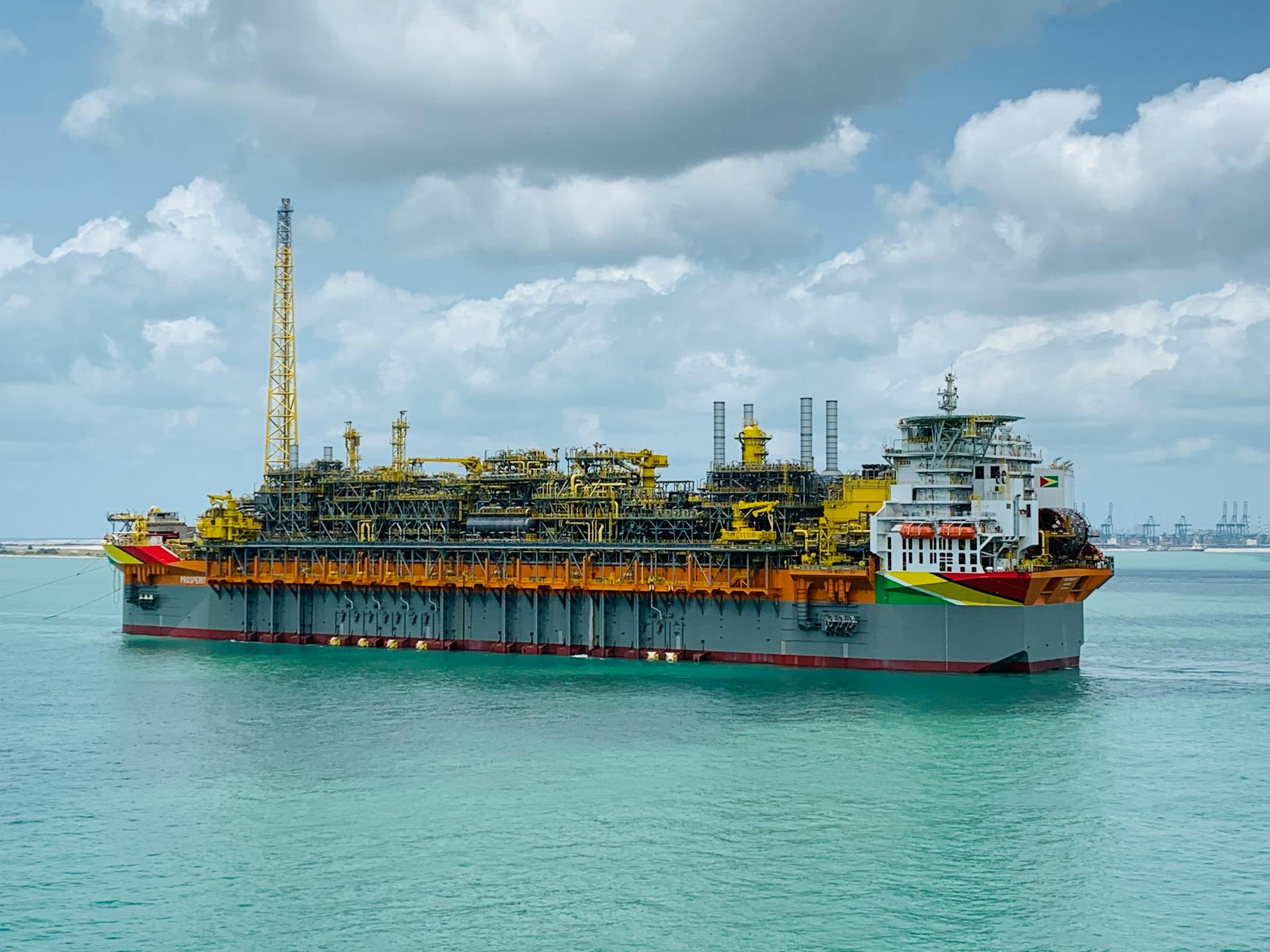
Transpetro has been expanding its fleet to meet the growing demand for oil and gas transportation in Brazil. The company has added several new tankers to its fleet, increasing its capacity to transport large volumes of petroleum products.
Transpetro's focus on sustainability is also evident in its efforts to reduce its environmental impact. The company has implemented measures to minimize its carbon footprint, such as using more efficient engines in its new tankers.
Transpetro's commitment to sustainability is not just about reducing its own environmental impact, but also about contributing to the country's overall sustainability goals. The company's efforts are in line with Brazil's national energy policy, which aims to increase the use of renewable energy sources.
Transpetro's expansion and focus on sustainability are key factors in the company's continued success and growth in the Brazilian oil and gas transportation market.
Curious to learn more? Check out: Shanxi Lu'an Environmental Energy
History
Transpetro was established by Law No. 9,478/1997 and officially constituted on June 12, 1998.

The company took over the operation of Petrobras' pipelines and terminals starting from the year 2000.
In 2009, Brazil's largest polyduct, the São Paulo-Brasília Oil Pipeline, was inaugurated.
The Urucu-Coari gas pipeline became operational in 2009 as well.
Transpetro was awarded the concession for the Belém do Pará Aquaviary Terminal in 2019 for a period of 20 years.
A subsidiary named Transbel was established under Transpetro in 2022 to manage the operations of the Belém Aquaviary Terminal.
Transpetro won the lease for the BEL09 area in 2022, also for a duration of 20 years.
Check this out: International Container Terminal Services
Operations
Transpetro operates nationwide, with facilities in 17 states of Brazil.
The company's operations are extensive, spanning 7,768 km of oil pipelines and 625 km of gas pipelines.
Transpetro has a significant presence in the country, with 21 land terminals and 27 waterway terminals.
In addition to its land-based operations, Transpetro also has a maritime fleet of 36 ships.
Transpetro operates in the areas of pipelines and terminals, and maritime transport, making it a major player in Brazil's energy industry.
Here's a breakdown of Transpetro's operations:
- 7,768 km of oil pipelines
- 625 km of gas pipelines
- 21 land terminals
- 27 waterway terminals
- 3 Liquefied Natural Gas (LNG) regasification terminals
- 36 ships in the fleet
Business Areas
We're a Brazilian company with a global role, operating terminals, oil pipelines, and gas pipelines in integrated mode, in addition to maritime and land transportation, generating value for our shareholders and other stakeholders.
Our company was created on June 12, 1998, and is currently structured in two business areas: Pipelines and Terminals and Maritime Transportation.
We operate in 17 out of 27 states of the union, covering all regions of Brazil, from the interior to the coast.
We have a strong presence in the country, with installations in almost every region.
Our company has a unique technical capability in logistics and transportation, undertaking the storage and handling of oil and its derivatives, natural gas, and biofuels, including import and export activities.
We have an impressive fleet of 33 ships, which is essential for operating in a country with over 7,000 kilometers of coastline and over 42,000 kilometers of navigable rivers.
We prioritize efficient management of our resources, without compromising on competitiveness and safety.
Our operational centers and partnerships with universities contribute to attaining increasingly better results.
We have a strong focus on safety, efficiency, and strategic vision, which is reflected in our daily operations.
Worth a look: Atlas Maritime
Sustainability
Transpetro is making a big move towards sustainability with its new gas tankers. These vessels will be up to 20% more fuel efficient.
The company's goal is to reduce greenhouse gas emissions by up to 30%. This is a significant step towards a more environmentally friendly maritime transport sector.
Transpetro's new ships will operate in ports with electrification, which is a key aspect of the international environmental goals guiding the maritime transport sector.
On a similar theme: Excel Maritime
Fleet Modernization Strengthens Strategic Role
Fleet modernization is a key focus for Transpetro, and it's not just about upgrading their equipment. The company has already signed its first contract in February 2025 for four Handy-class vessels.
This investment is part of the Petrobras System Fleet Renewal and Expansion Program, officially launched in July 2024. The goal is to reduce dependence on charters, improve logistical flexibility, and boost the national naval industry.
Transpetro's new investment cycle signals its commitment to modernizing its fleet with cutting-edge technology and environmental responsibility. This approach will not only improve efficiency but also help reduce greenhouse gas emissions.
The new ships will be up to 20% more fuel efficient, which is a significant improvement. Additionally, Transpetro aims to reduce greenhouse gas emissions by up to 30% and operate in ports with electrification.
By launching a new tender for medium-sized vessels in 2025, Transpetro is further expanding its operational capacity. This move will likely have a positive impact on the company's logistics chain and overall performance.
Company Information
Transpetro is a subsidiary of Petrobras, a Brazilian multinational energy corporation. It was established in 1998 to manage Petrobras' pipeline and transportation assets.
The company's main objective is to provide logistics and transportation services for Petrobras' oil and natural gas operations. Transpetro operates a vast network of pipelines and terminals across Brazil, covering over 7,000 kilometers.
Transpetro has a strong presence in the Brazilian oil and gas industry, with a fleet of tankers, barges, and pipelines that transport oil and natural gas products. This extensive infrastructure allows the company to efficiently transport large volumes of petroleum products.
Transpetro's headquarters is located in Rio de Janeiro, Brazil, and the company has a workforce of over 6,000 employees.
You might enjoy: Sui Northern Gas Pipelines Limited
Frequently Asked Questions
Who owns Transpetro?
Transpetro is a fully owned subsidiary of Petrobras, a leading Brazilian energy company. It was established in 1998 as part of a major oil sector restructuring in Brazil.
What is the revenue of Transpetro?
Transpetro's revenue exceeded R$13.88 billion in 2024, a 7.8% increase from the previous year.
Featured Images: pexels.com