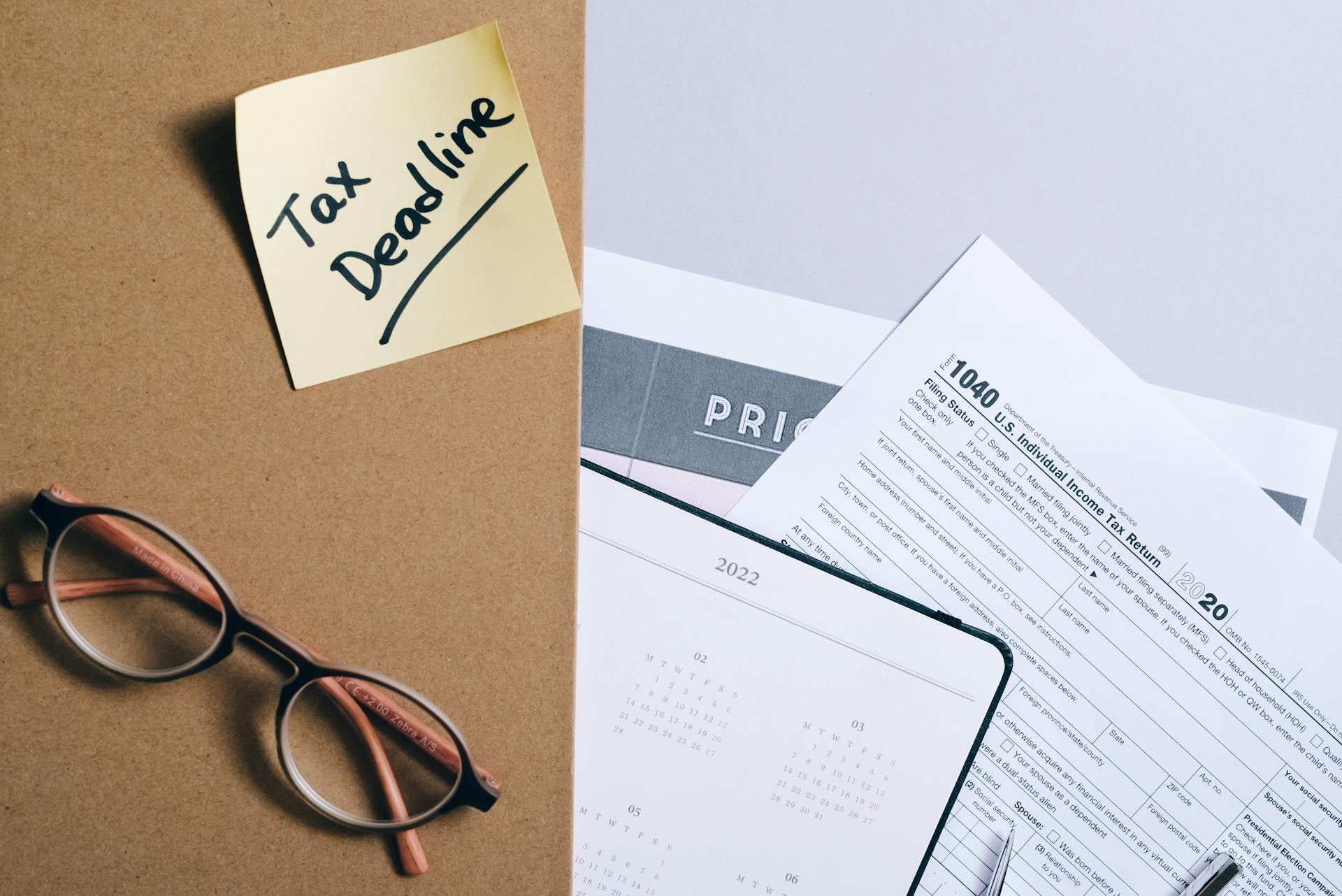
Corporate bonds can be a complex topic, but understanding how they're taxed can help you make informed investment decisions. Generally, corporate bonds are considered taxable as ordinary income.
When you purchase a corporate bond, you're essentially lending money to a company, and in return, you receive regular interest payments. These interest payments are typically considered taxable income.
To determine the tax treatment of corporate bonds, it's essential to consider the type of bond you own and the company's tax status. For example, bonds issued by foreign companies may be subject to withholding tax.
Related reading: Do S Corps Pay Corporate Taxes
Bond Issuance
Bond issuance is a complex process, but it's essential to understand the basics. The issuer of the bond typically pays a fee to the underwriter, which can range from 1% to 10% of the bond's face value.
For example, if a company issues a $100 million bond, the underwriter's fee could be between $1 million and $10 million.
Discover more: What Happens When a Stock Splits 3 to 1
The bond's interest rate, also known as the coupon rate, is determined by the issuer and the underwriter. This rate is usually set at a fixed percentage of the bond's face value.
The coupon rate for a $100 million bond might be 5%, which means the issuer pays $5 million in interest each year.
Bond issuance can be done through various channels, including public offerings, private placements, and exchange-traded funds (ETFs).
Explore further: In General a Corporate Bond's Coupon Rate
Tax Comparison
A corporate bond issued by a company like Amazon is a fully taxable bond, meaning the interest paid out is fully taxable at the federal and state levels.
You can compare the yield of different bonds using the taxable equivalent yield concept, which helps you understand the return you need to make up for the tax advantage of a tax-exempt bond.
To calculate the taxable equivalent yield, you'll need to know your state level marginal tax rate if you're comparing a US treasury bond or a municipal bond.
If this caught your attention, see: A Corporate Bonds Yield to Maturity:
For example, if a US treasury bond has a 4.50% yield and your state marginal tax rate is 5%, the taxable equivalent yield would be 4.74%.
If a municipal bond has a 4.00% yield and you live in the same state where the bond was issued, you'll need to know both your federal and state marginal tax rates to calculate the taxable equivalent yield.
Using the same example, if your federal marginal tax rate is 30% and state marginal tax rate is 5%, the taxable equivalent yield would be 6.15%.
However, if the municipal bond was issued in a different state than where you live, the calculation is slightly different, and you won't get the state tax exemption, so the taxable equivalent yield would be 5.71%.
Curious to learn more? Check out: Corporate Taxes as Percent of Federal Revenue
Taxation Rules
Corporate bonds are issued by companies to raise capital, and as such, they are fully taxable at the federal and state levels. This means the interest paid on these bonds is subject to taxes.
Taxable corporate bonds can be issued by any company, such as Amazon, to raise capital for various purposes. The interest paid on these bonds is fully taxable.
Tax-exempt municipal bonds, on the other hand, are issued for public purposes and are exempt from federal taxes. However, if the proceeds don't meet certain public purpose or public use tests under IRS requirements, they become taxable.
To compare the yield of different bonds, you need to consider the taxable equivalent yield. This is the return a taxable bond needs to have for its yield to equal the yield on a comparable tax-exempt municipal bond or US treasury.
The taxable equivalent yield can be computed by dividing the tax-advantaged yield by 1 minus the marginal tax rate.
Explore further: Authorized Issued and Outstanding Shares
Corporate Bonds
Corporate bonds are issued by companies to raise money for various business purposes. The interest earned on corporate bonds is taxable and added to your income for the year.
Discover more: Brk.b Outstanding Shares
The tax rate that applies to the interest income will depend on your income bracket. This means that corporate bond investors are subject to federal, state, and local taxes.
Corporate bonds carry more risk than government bonds, as they are not backed by the government. This is a key consideration for investors looking to minimize their risk.
Some states and cities impose their own income taxes, while others do not. This can impact the overall tax liability for corporate bond investors.
Here are the key tax implications of corporate bonds at a glance:
- Subject to federal, state, and local taxes
- Interest income added to your income for the year
- Tax rate depends on your income bracket
Capital Gains Taxation
Capital Gains Taxation is a key consideration for investors. Taxes owed on capital gains or losses are less traditional than taxes owed on interest. An investor can only receive capital gains from a corporate bond if they sell the bond prior to its maturity.
If you sell a bond for a gain prior to its maturity, the amount you receive above the original purchase price is considered a capital gain. This gain is taxed at your ordinary income tax rate.
Take a look at this: Do Capital Gains Taxes Change My Income Tax Rate
Selling a bond after one year, but before maturity, also triggers capital gains tax. However, if you hold the bond for more than 12 months, the net difference is called a long-term capital gain. This is taxed differently than a short-term capital gain.
A long-term capital gain is taxed at a lower rate than a short-term capital gain. For listed bonds, the holding period must be more than 12 months, while for unlisted bonds, it must be more than 36 months.
If you sell a bond for a loss, you may be able to claim a capital loss. This can help reduce your tax liability. However, if you sell a bond for a gain, you must pay capital gains tax on the amount received above the original purchase price.
Curious to learn more? Check out: Can a Private Company Sell Shares to the Public
Featured Images: pexels.com