Tax returns in Australia can be a daunting task, but understanding the basics will make the process much smoother. You'll need to lodge your tax return by the October deadline each year.
In Australia, tax returns are used to report your income and claim any deductions you're eligible for. This includes income from employment, investments, and any other sources.
The Australian Taxation Office (ATO) requires you to lodge a tax return if your income exceeds a certain threshold. This threshold varies depending on your age and residency status. For example, if you're under 18, you must lodge a tax return if your income exceeds $3,388.
Lodging a tax return is a straightforward process, and you can do it online or in person. You'll need to provide your personal and financial details, including your income, deductions, and any tax withheld.
A unique perspective: Does Instacart Withhold Taxes
Child Care and Family Benefits
If you're receiving Child Care Subsidy or Family Tax Benefit, it's essential to keep your income information up to date with Services Australia.
Services Australia uses your tax return information to balance your Child Care Subsidy, Family Tax Benefit, and child support, if applicable. This helps ensure you're receiving the correct amount of benefits.
If you don't need to lodge a tax return, you need to advise Services Australia, even if you had no income or have already told the ATO. You can do this through your Centrelink online account or the Express Plus Centrelink mobile app.
Services Australia will use your non-lodgment information from the ATO to balance your Family Tax Benefit. This ensures your benefit is adjusted accurately.
Take a look at this: Do You Need Tax Returns for Heloc
Tax Return Process
To lodge your tax return in Australia, you'll need to gather some essential documents. Your Tax File Number (TFN) is super important, as it's your unique ID with the ATO.
Income statements from your employer(s) are also crucial, so make sure to check your myGov account for statements marked 'Tax ready'. You'll also need dividend statements if you have shares. Government payments, like Centrelink, should be recorded as well.
To claim deductions, you'll need proof of expenses, such as receipts, invoices, and logbooks. The ATO app's 'myDeductions' tool can be a big help in tracking work expenses during the year.
Discover more: Do I Need to Submit 2 Bank Statements
Verify All Income Reported
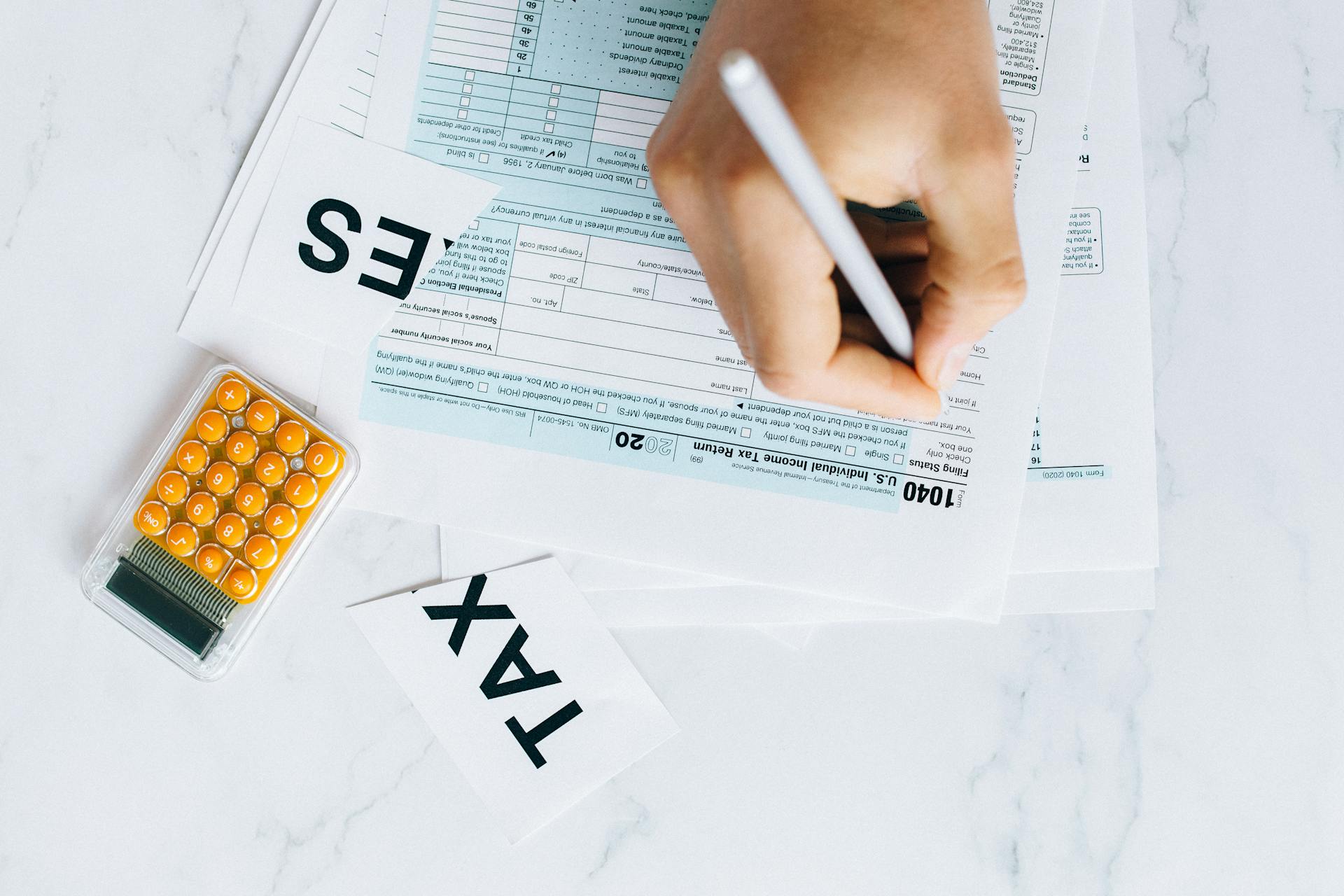
You may not have reported all your income, and that's okay! Some income and payments may not be on an income statement or payment summary.
Check the ATO website to find out what income you must declare.
Don't forget to check your Centrelink payment summary on the Services Australia website, as some payments don't show up there either.
Being organized is key to lodging your tax return quickly, so make sure to gather all the necessary documents.
Curious to learn more? Check out: Can You Go to Jail for Not Paying Business Taxes
Individual
If you're an individual, you'll likely need to lodge a tax return every year. Most individuals need to do this, unless your total income is less than the tax-free amount of $18,200.
You'll need to report all your sources of income, including employment income, government payments, super pensions and annuities, investment income, compensation and insurance payments, income from trusts, partnerships or businesses, and foreign income.
To lodge your tax return, you'll need to provide your Tax File Number (TFN) and income statements from your employer(s). Check your myGov account to ensure these are marked 'Tax ready' before you lodge.
You'll also need to keep records of government payments, dividend statements, and income from your work as a sole trader. For deductions, you'll need proof of expenses, such as receipts, invoices, and logbooks.
Here's a checklist of what you'll likely need to submit a tax return:
- Your Tax File Number (TFN)
- Income statements from your employer(s)
- Dividend statements (if you have shares)
- Records of government payments (like Centrelink)
- Income from your work as a sole trader (if applicable)
- Deduction Records: proof for any expenses you plan to claim
- Other Bits: your private health insurance statement and maybe your spouse's income details
Track Expenses
Tracking your expenses is a crucial part of preparing for tax returns in Australia. To claim a deduction, you must have a record to prove you incurred the expense and how you calculated your claim.
In most cases, you will need receipts. A bank or credit card statement on its own isn't enough evidence to support a deduction claim. You can also use the ATO app's MyDeductions tool to record expenses and deductions.
The ATO app makes it easier to do your tax return. You can record expenses and deductions, vehicle trips, income (if you're a sole trader), and even photos of your invoices and receipts. This is a convenient way to keep your records in one place.
Curious to learn more? Check out: Tax Deductions for Day Traders
To ensure you're keeping accurate records, remember that you can only claim a deduction for the work-related portion of an expense if it was for both work and private purposes. You'll need to have a record to prove the work-related portion.
Here are some common records you may need to keep:
- Receipts for expenses
- Bank or credit card statements (if accompanied by receipts)
- Photos of invoices and receipts
By keeping good records, you'll be able to accurately claim your deductions and avoid any issues with the ATO.
Deductions and Maximisation
To make the most of your tax return, it's essential to understand what deductions you're eligible for. You can claim expenses directly related to earning your income, but you must have spent the money yourself and not been reimbursed.
To claim a deduction, you'll need to keep records of your expenses, including receipts and invoices. The ATO has set methods for calculating working from home expenses, which can include phone, internet, and electricity bills, as well as stationery and computer supplies.
A fresh viewpoint: How Much Capital Lost Can Claim on Income Tax Reture
You can use the fixed rate method to claim 70 cents for each hour you worked from home, covering expenses such as data and internet, mobile and home phone usage, electricity and gas, and stationery and computer consumables.
Some common work-related expenses you may be able to claim include car and travel costs, self-education costs, tools and equipment, work uniforms, and union fees. You can also claim the cost of using a tax agent to prepare and lodge your tax return.
To maximise your deductions, consider both work-related and investment expenses. You may be able to claim the cost of earning interest, dividends, or other investment income, including interest charged on money borrowed to invest and investment property expenses.
Here are some examples of eligible expenses:
- Car and travel costs (e.g. driving between work sites)
- Working From Home expenses (e.g. phone, internet, electricity bills)
- Self-education costs (e.g. courses to improve skills for your current job)
- Tools and equipment (e.g. full cost or depreciation over time)
- Work uniforms (with employer's logo)
- Union fees
- Cost of using a tax agent
- Donations to eligible charities
Remember to keep good records, including receipts and invoices, to support your deduction claims. The ATO app can help you record expenses and deductions, making it easier to do your tax return.
Submission and Deadline
Lodging your tax return on time is crucial to avoid potential penalties from the ATO.
The deadline to lodge your tax return in Australia is between 30 June and 31 October.
Lodging your tax return online using the ATO's myTax system is a convenient option. You'll need to access myTax through your myGov account to complete and submit your return.
You'll receive a Notice of Assessment from the ATO after submitting your return, which will inform you if you owe any tax or if you'll get a refund.
Submit a Non-Lodgment Advice
If you don't need to lodge a tax return, you can submit a non-lodgment advice online through myGov.
To do this, sign in to myGov and select Australian Taxation Office from your linked services. Then, select Tax from the menu or tab, followed by Lodgments, and finally Non-lodgment advice.
You can also select Don't need to lodge a return on your ATO online account homepage. However, you'll need to link ATO to your myGov account if you haven't already.
If this caught your attention, see: Rrsp Non Resident Withholding Tax
You may not need to lodge a tax return if you didn't earn any income, your total income is below the tax-free threshold and no tax was withheld by your employer, or if all your income is exempt from tax.
Here are some scenarios where you may not need to lodge a tax return:
- If you didn't earn any income.
- If your total income is below the tax-free threshold and no tax was withheld by your employer.
- If all your income is exempt from tax (for example, some scholarships).
Why Meet the Deadline?
Meeting the tax return deadline is crucial because it helps you avoid any potential penalties from the ATO.
Lodging on time is a significant advantage, and you've got a few options to do it in Australia.
Missing the deadline can lead to financial consequences, so it's essential to stay on top of your tax return.
You can lodge your tax return through various channels, but it's always a good idea to review your options carefully.
The benefits of meeting the deadline far outweigh the costs of delaying, and it's worth taking the time to get it right.
On a similar theme: Deferred Tax Deadline
When and How
The Australian financial year runs from 1 July to 30 June, so mark your calendars accordingly. You need to lodge your tax return between 30 June and 31 October, or face a penalty from the ATO.
Gather your documents before lodging your tax return. You'll need your PAYG payment summary, which is usually found in your myGov account after 1 July. If not, ask your employer. You'll also need receipts for any work-related expenses.
Use myTax to lodge your tax return online through the ATO's myGov account. The system will guide you through the process, making it relatively easy to complete your return.
You can submit your return online once you've completed the details. You'll receive a Notice of Assessment from the ATO, which will tell you if you owe any tax or if you'll get a refund.
Here's a quick checklist to help you remember the key steps:
- Gather your documents, including your PAYG payment summary and receipts for work-related expenses.
- Use myTax to lodge your tax return online through your myGov account.
- Complete your return, following the prompts to enter your income, deductions, and other relevant information.
- Submit your return online, and wait for your Notice of Assessment from the ATO.
Online Submission
Online submission is a convenient and efficient way to lodge your tax return in Australia. Most information from employers, banks, government agencies, and health funds will be automatically included in your tax return by late July.
To lodge online, you'll need a myGov account linked to the ATO, which is free and easy to set up. You can then use the ATO's free online tax return, myTax, to lodge your return.
Returns lodged through myTax are usually processed within two weeks, and the ATO has 'how-to' videos to help you lodge online. Just remember to check the information is correct before submitting.
If you're unsure about the process, you can follow these steps to lodge online using myTax through myGov:
- Sign in to myGov.
- Select Australian Taxation Office from your linked services.
- Select Tax from the menu or tab, then Lodgments and then Income tax.
- You can now view the tax returns you need to lodge.
The ATO also offers a Super Health Check, which is 5 simple checks to stay in control of your super, and can be done while you prepare your tax return.
Book Accommodation via myGov
You can book accommodation through myGov, but it's not for lodging tax returns. To use myGov for lodging online, you need to sign in to your account.
First, make sure you have linked the Australian Taxation Office (ATO) to your myGov account. If you haven't, you'll need to do that first.
Here's a step-by-step guide to lodging online using myGov:
- Sign in to myGov.
- Select Australian Taxation Office from your linked services.
- Select Tax from the menu or tab, then Lodgments and then Income tax.
- You can now view the tax returns you need to lodge.
If you can't lodge online, you can find out more about lodgment options on the ATO website.
Online
You can submit a non-lodgment advice through myGov by following these steps: sign in to myGov, select Australian Taxation Office from your linked services, and then select Tax from the menu or tab, then Lodgments, and then Non-lodgment advice.
You may also be able to select Don't need to lodge a return on your ATO online account homepage, but you'll need to link ATO to your myGov account if you haven't already.
To lodge online with myTax, you need a myGov account linked to the ATO, and returns lodged this way are usually processed within two weeks.
Lodging with myTax is easy and free, and most information from employers, banks, government agencies, and health funds will be automatically included in your tax return by late July.
If this caught your attention, see: Uk Cgt Non Resident
The ATO has 'how-to' videos to help you lodge online using myTax, and it's also a great time to check your super with the ATO's Super Health Check.
You can lodge online using myTax through myGov by signing in to myGov, selecting Australian Taxation Office from your linked services, selecting Tax from the menu or tab, then Lodgments, and then Income tax.
You'll need to link the ATO to your myGov account, if you haven't already, and if you can't lodge online, you can find out more about lodgment options on the ATO website.
Here are the steps to lodge online using myTax through myGov:
- Sign in to myGov.
- Select Australian Taxation Office from your linked services.
- Select Tax from the menu or tab, then Lodgments and then Income tax.
- You can now view the tax returns you need to lodge.
Help Program
If you're struggling with your tax return, there's help available. You can get assistance through the ATO's free Tax Help program, which is run by volunteers and is suitable for people on lower incomes with simple tax affairs.
You might be eligible for Tax Help if your income is usually under $60,000. The Tax Help program is designed to support individuals with straightforward tax affairs.
Discover more: Does Having a Business Help with Taxes
You can find out more about Tax Help on the ATO website. To lodge your tax return, you can also use the services of a registered tax agent, who you'll need to pay for their services.
Here are some options for getting help with your tax return:
- the ATO’s free Tax Help program
- National Tax Clinics that help some people who can’t afford professional help
- a registered tax agent, who you pay to help with your tax return.
You can also submit a non-lodgement advice through the ATO, which can be done online or by post.
Registration and Agents
If you're planning to get a professional to do your tax return, make sure you use a registered tax agent. You can check if the accountant or agent is registered on the tax practitioner register.
A registered tax agent can help you find all the tax deductions Australia allows for your situation, check everything is accurate, and manage those later lodgement deadlines. They charge a fee for their service, but the good news is this fee is usually tax deductible on next year's tax return.
You might enjoy: What Is a Tax Levy Fee on My Bank Account
You generally need to sign up with a registered tax agent before 31 October to qualify for their later deadline, which is often until 15 May of the next year.
If you use a registered tax agent, you can lodge your return later than the 31 October deadline, but you need to engage them before the deadline. Most registered agents have special lodgement schedules for their clients.
You can find a registered tax agent on the Tax Practitioners Board website, and they usually get an extended deadline, often until 15 May of the next year.
You might enjoy: Why Are Tax Returns so Low This Year
Required Documents
To lodge your taxes in Australia, you'll need to gather a range of documents. The Australian Taxation Office (ATO) offers the convenience of downloading certain information directly into your tax return.
Your Tax File Number (TFN) is a unique number assigned to every person who works or receives benefits in Australia, and it's valid for life. You should never share your TFN with anyone else.
You'll also need your bank account details, including the BSB and account number, in case you're eligible for a tax refund. The ATO no longer sends refund cheques, so any refund will be deposited directly into your account.
If you have rental income or investments, you'll need to provide details of these as well. This includes any interest income from banks and building societies.
You may also need to provide details of your partner's income, as well as any tax offset information. Additionally, you'll need to gather details of any occupation-specific deductions you wish to claim.
If you plan to claim more than $300 in work-related expenses, you'll need to provide copies of invoices or receipts, credit card statements, a travel logbook, and a home office logbook.
Here's a summary of the documents you may need to gather:
- Your Tax File Number (TFN)
- Your bank account details (BSB and account number)
- Details of any additional income (rental, investments, interest income)
- Details of your partner's income and any tax offset information
- Details of any occupation-specific deductions
- Copies of invoices or receipts (if claiming work-related expenses over $300)
- Credit card statements (if claiming work-related expenses over $300)
- Travel logbook (if claiming work-related expenses over $300)
- Home office logbook (if claiming work-related expenses over $300)
Temporary and Other Situations
If you're studying in Australia for less than 6 months, you'll likely be considered a non-resident for tax purposes.
You'll still need to lodge a tax return, declaring any Australian income you earned.
Non-residents won't be entitled to the tax-free threshold, meaning you'll pay tax at a higher rate.
To find out if you're considered a non-resident, check this link.
Here are some steps to get you started:
- Lodge your tax return, even if you're not a resident.
- Be prepared to pay tax at a higher rate than residents.
- Check the link to see if you're considered a non-resident.
Understanding
If you're an Australian resident, you're in luck - you can earn up to $18,200 in a financial year and not pay tax.
Australia's tax system is progressive, meaning the more you earn, the higher your tax liability. This is managed by the Australian Taxation Office (ATO) on behalf of the government.
You'll need to declare various types of income when lodging your tax return, including employment income, Centrelink and government payments, investment income, superannuation pensions, and business income.
Here are some examples of income types you'll need to declare:
- Employment income (such as salary and wages, allowances, bonuses, tips, fringe benefits, lump sum payments and super contributions)
- Centrelink and other government payments (such as the age pension, Austudy, Abstudy, Jobseeker, youth allowance, carer payments and parenting payment)
- Investment income (such as interest, dividends, rental income or other capital gains)
- Superannuation pensions and annuities
- Business, partnership and trust income
- Compensation and insurance payments
- Foreign income
You can claim certain deductions that are subtracted from your assessable income, which can help reduce your tax liability.
Frequently Asked Questions
How much is the average tax return in Australia?
In Australia, the average tax return for self-preparers is around $2,576, while tax agent clients receive an average of $3,550. If you're due for a tax refund, learn more about the process and how to claim yours.
When to expect a tax return in Australia?
In Australia, tax returns are typically processed within 10 weeks (50 business days), but may take longer if manually reviewed. Check with the Australian Taxation Office for the most up-to-date processing times and information.
Featured Images: pexels.com