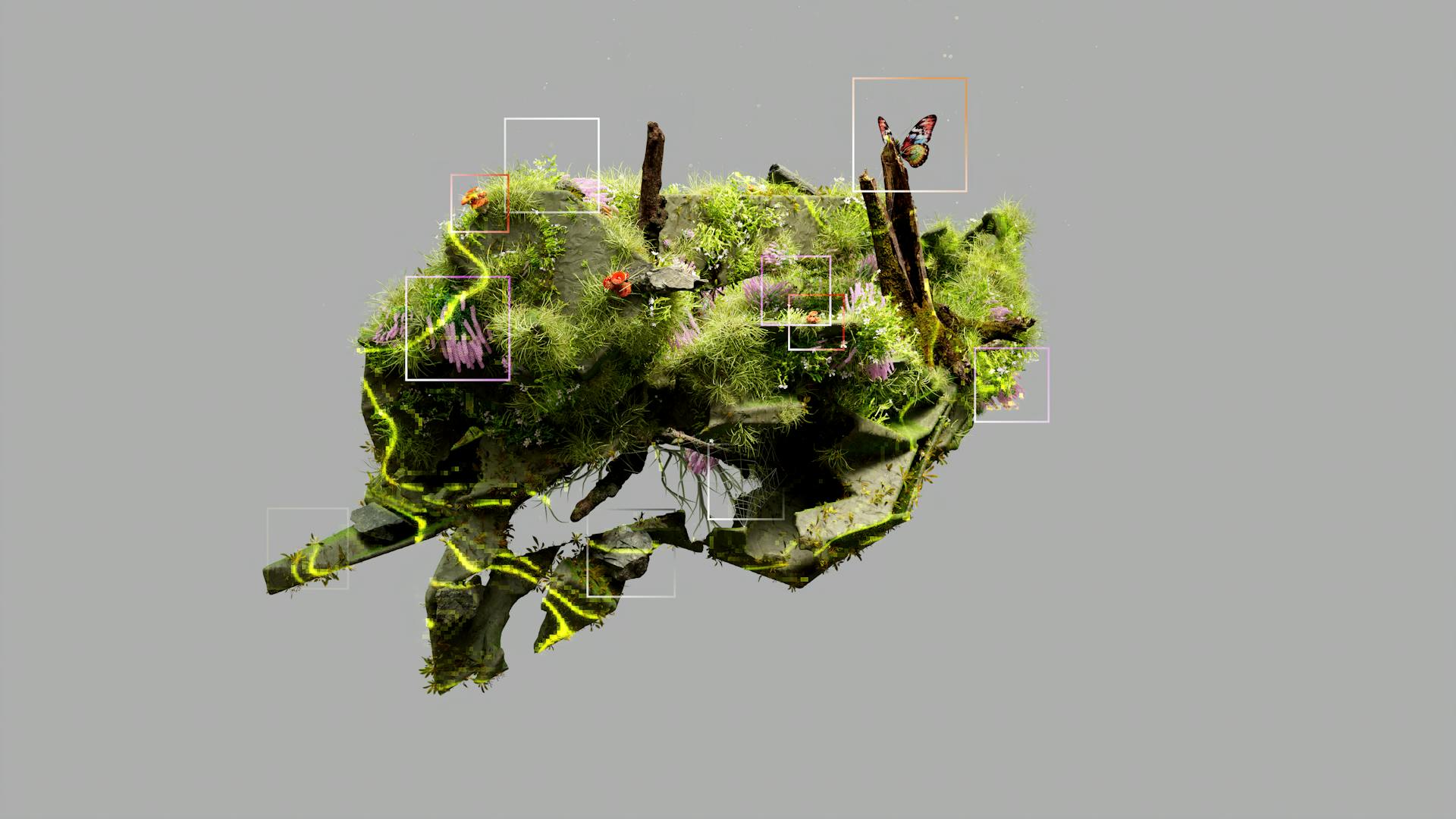
The Servicenow Knowledge Graph is a powerful tool that can help businesses make smarter decisions. It's essentially a massive database that stores and connects all the relevant information about an organization, its customers, and its operations.
This knowledge graph can be used to identify patterns and relationships that might not be immediately apparent, allowing businesses to anticipate and prepare for potential issues. By analyzing this data, organizations can make more informed decisions and improve their overall performance.
One of the key benefits of the Servicenow Knowledge Graph is its ability to provide a unified view of an organization's data, eliminating the need for multiple systems and silos. This makes it easier to access and analyze the information needed to make informed decisions.
Discover more: When Graphing Your Data It Is Important That You?
What is Knowledge Graph
A knowledge graph is a powerful tool that uses structured and unstructured data within the ServiceNow database.
It makes this data accessible through natural language queries, or NLQ, which is particularly important in the world of generative AI.
Customers can utilise the OOTB knowledge graphs or configure their own using the knowledge graph designer.
These graphs are the underpinning enabler of features that enhance the Virtual Agent.
They also have other uses, most notably as a source of data for Agentic Workflows.
Worth a look: Graphs Represent
Configuring and Activating
The Now_user_graph is used by default, which includes information about the user's Company, Department, Assets, Location, and Manager.
To activate the Q&A Search Enhancement, you can set the sn_vad_genai.now_assist.search.user_knowledge_graph.enabled sys property to true.
The location is especially useful for the knowledge graph, providing valuable context to the LLM.
Changing the knowledge graph requires changes to code, so proceed with caution.
You can configure the input given to the LLM and change the knowledge graph from the sn_kg_context_config table.
What Can This Feature Do?
The ServiceNow Knowledge Graph is a powerful feature that can do a lot for your organization. It can connect enterprise-wide data for real-time personalization.
This feature reduces the need for manual data mapping and complex integrations. It's expected to be introduced as a unified Knowledge Graph early next year.
With the Knowledge Graph, you can enhance decision-making and improve supply chain management, among other benefits. It's a game-changer for businesses looking to streamline their operations.
Related reading: Which Statement Is Supported by the Data in the Graph?
One of the most exciting things about the Knowledge Graph is its ability to retrieve user attributes and connect to external repositories. You can reference location and language fields from the user profile in ServiceNow, and even add custom attributes to the user table if needed.
The Knowledge Graph can also import article data from an external repository and convert it into the Knowledge Graph data model. This allows you to assign attributes like location and language to each article node.
You can then filter by attributes to search and extract only the relevant article nodes from the Knowledge Graph. This can be implemented using GraphQL queries, ServiceNow scripts, or search queries.
In addition to its data retrieval and filtering capabilities, the Knowledge Graph can also be used to answer employee questions directly from the ServiceNow database. This feature, known as Employee Q&A, uses the Now_user_graph_nlq Graph by default.
To activate Employee Q&A, you'll need to set the sn_ais_assist.enable_knowledge_graph_nlq sys property to true and define which knowledge graph you want the feature to utilize in the sn_ais_assist.kgnlq_schema_name sys property.
Here's an interesting read: Journal of Information & Knowledge Management
Harnessing the Power
With ServiceNow's Knowledge Graph, traditional search engines and chatbots are no longer the only game in town. Employees can finally get accurate answers to their questions, like "How much PTO can I take?" which returns the correct policy based on location and role.
The Knowledge Graph's no-code semantic layer organizes enterprise data into a graph of relationships, making AI and Virtual Agents truly context-aware. This means that field engineers can find the latest firmware without digging through outdated documents.
Schema Designer is a drag-and-drop interface that lets you define nodes, properties, and edges, making it easy to create a Knowledge Graph in minutes. This is a game-changer for organizations that need to connect people, data, and processes to deliver accurate answers.
With Virtual Agent and NLQ searches, procurement managers can instantly find compliant suppliers in a specific region, like Europe, without having to juggle multiple Excel sheets.
The Knowledge Graph scales effortlessly with RaptorDB and Workflow Data Fabric, ensuring enterprise-level speed and governance. This means that organizations can go live with their first Knowledge Graph use case in days, not months.
A different take: Knowledge-based Decision Making
Here are some real-world examples of the Power of the Knowledge Graph:
Frequently Asked Questions
How do I create a knowledge graph?
To create a knowledge graph, start by defining your use case and then follow a structured approach that includes choosing a database management system, modeling the graph, and preparing your data for ingestion. Follow these steps to build a robust and effective knowledge graph that meets your needs.
Featured Images: pexels.com