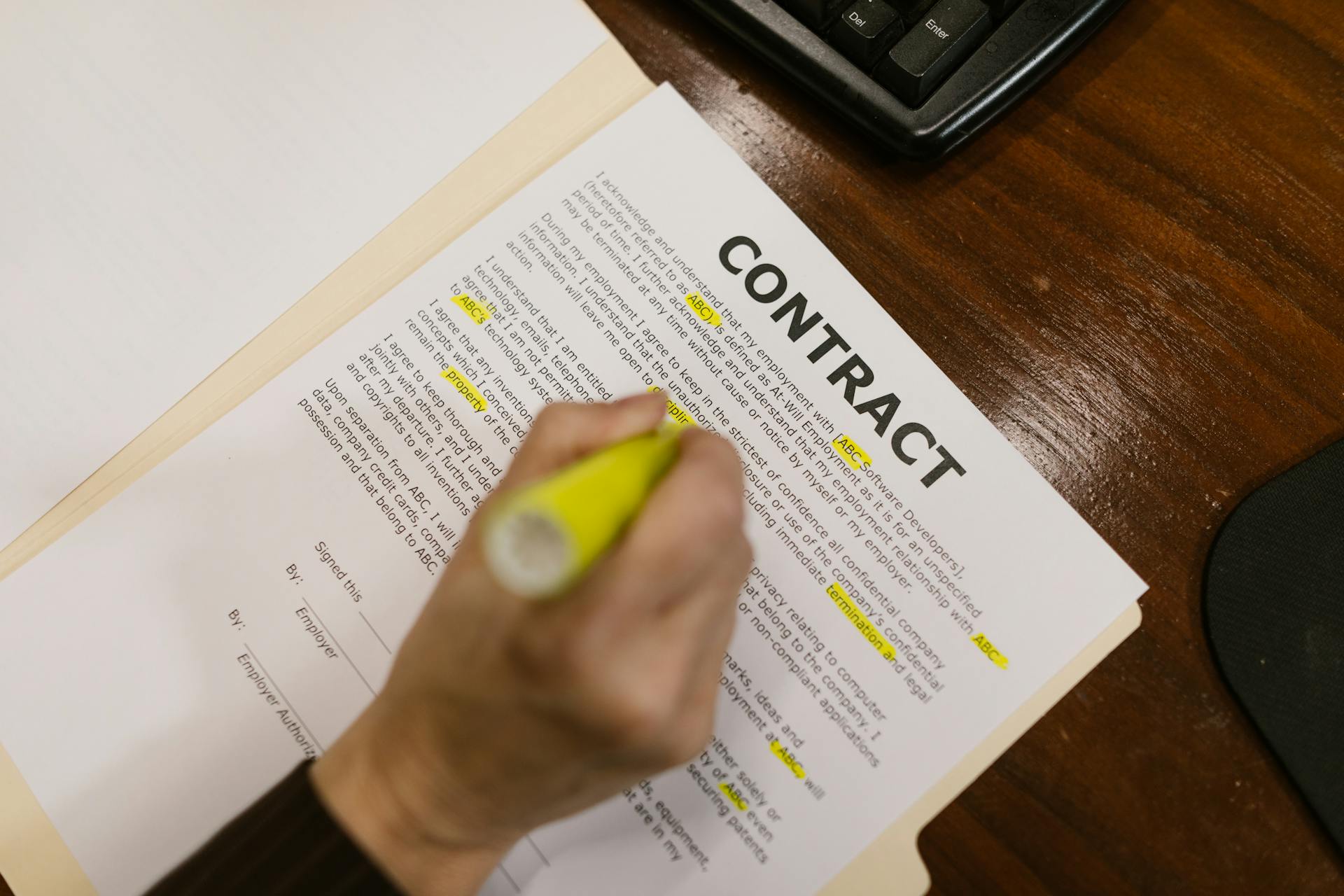
Contract rectification is a process that allows parties to a contract to correct mistakes or inaccuracies in the agreement. This can be a crucial step in ensuring the contract is enforced as intended.
A contract is considered a document that accurately reflects the parties' intentions, and rectification is used when the document does not accurately reflect those intentions. This can happen when a mistake is made during the drafting process.
To qualify for rectification, the mistake must be a genuine error and not a deliberate attempt to mislead the other party.
Worth a look: Mistake (contract Law)
What is Rectification?
Rectification is a crucial concept in law that helps prevent unjust outcomes from errors or miscommunications during contract formation. This can happen when parties don't clearly express their intentions, leading to disputes and misunderstandings.
It's essential to ensure that contracts are enforced in accordance with the parties' true intentions. This is where rectification comes in, providing a means to resolve disputes and correct mistakes.
Rectification involves adjusting documents or agreements to reflect the true intentions of the parties involved. This is crucial in ensuring that legal documents accurately represent the facts or agreements as intended.
Here are some key points that highlight the significance of rectification:
- Prevents unjust outcomes from errors or miscommunications during contract formation.
- Ensures contracts are enforced in accordance with the parties' true intentions.
- Provides a means of resolving disputes that may arise from contractual ambiguities or mistakes.
Nature of Mistakes
To determine if a mistake is rectifiable, we need to understand the nature of mistakes. A mistake must be one of expression, not intention, meaning the parties reached a clear agreement, but their written contract failed to reflect that agreement due to a clerical or drafting error.
The courts will scrutinize evidence such as emails, term sheets, and meeting notes to determine if a binding agreement predated the written document. This distinction is crucial: rectification does not rewrite deals – it corrects documentation errors where the deal was clearly made but misrepresented in writing.
There are two types of mistakes: common mistakes and unilateral mistakes. A common mistake occurs when all parties to the contract are mistaken regarding a fundamental element of the contract.
On a similar theme: Is a Text Agreement Legally Binding
A unilateral mistake, on the other hand, occurs when one party is mistaken about an aspect of a contract, and the other is not. To establish a claim for rectification where it is alleged that there is a unilateral mistake, there are four elements that must be proven.
Here are the four elements required to prove a unilateral mistake:
- One party had a mistaken belief that the document did or did not contain a particular term.
- The other party was aware, or should have been aware, of the other party being mistaken.
- Party B did nothing to correct the mistaken belief of Party A.
- The mistake was beneficial to Party B and/or detrimental to Party A.
In the case of a unilateral mistake, the party resisting rectification must have known or ought to have known about the mistake, and permitting the party to take advantage of the mistake would amount to fraud or the equivalent of fraud.
Steps Involved
Seeking rectification involves several key steps. To start, you need to identify the mistake or error in the written contract.
Gathering evidence is crucial to support your claim. This can include documentation of the parties' negotiations and correspondence.
Issuing proceedings in the relevant court or tribunal is the next step. This is where you formally seek rectification of the contract.
To succeed, you must prove that there was a common intention between the parties. This means showing that everyone involved agreed on the terms, but they were incorrectly written down.
Demonstrating continuity of intention is also essential. This means proving that the common intention continued right up until the contract was signed.
Here are the steps involved in seeking rectification in a concise format:
- Identify the mistake or error
- Gather evidence
- Issue proceedings
- Prove the common intention
- Demonstrate continuity of intention
Contract Law Basics
Rectification is a crucial concept in contract law that allows courts to correct errors in written contracts to reflect the true intentions of the parties involved.
In the United States, the remedy is commonly referred to as reformation, but the principle remains the same.
Rectification typically only takes place when there is no other option, and courts will only allow it in a restricted range of situations.
Before assessing whether a rectification is appropriate, the court will make sure the parties have thought about other possibilities.
A unique perspective: Will Paying off Debt in Collections Help My Credit Score
Rectification may be allowed in the case of a mutual error (when both parties make a mistake) or a unilateral error (a mistake one party makes).
A key factor in determining whether rectification is possible is whether the parties have considered other solutions the court may use.
The significance of rectification lies in its ability to prevent unjust outcomes that may arise from mistakes or miscommunications during the contract formation process.
In modern contractual disputes, rectification remains a vital remedy for resolving disputes arising from errors or miscommunications.
Here are some key benefits of rectification:
- Provides a means of correcting mistakes or ambiguities in contracts.
- Ensures that contracts are enforced in accordance with the parties' true intentions.
- Prevents unjust outcomes that may arise from contractual errors or miscommunications.
Requirements and Elements
To seek rectification, certain essential elements must be present. Understanding these elements is crucial in determining whether a contract can be rectified.
A common intention between the parties regarding the term or provision to be rectified is a must. This intention must be shared by both parties, and it's not just about one person's desire or expectation.
The written contract must contain a mistake or error that doesn't reflect the parties' common intention. This mistake can be a simple typo or a more complex misunderstanding.
Continuity of intention is also required, meaning the parties' intention must have continued up to the time of the contract's execution. This ensures that both parties were on the same page throughout the negotiation process.
To prove rectification, clear evidence of the true agreement between the parties is necessary. This evidence can come in many forms, such as drafts, communications, and witness testimony.
Here are the essential elements required for rectification:
- Common intention: A shared understanding between the parties.
- Mistake in the written contract: An error that doesn't reflect the parties' common intention.
- Continuity of intention: The parties' intention continued up to the contract's execution.
- Evidence of the true agreement: Clear proof of the parties' understanding.
When to Apply
Rectification is not a magic solution to fix contracts. If parties haven't fully considered the subject of the contract, rectification won't help.
The court's role is not to rewrite contracts or add extra terms for parties who haven't given it enough thought. This means the court won't intervene to help a party with a bad deal.
Recommended read: What Is a Smart Contract in Blockchain
Rectification can have a retroactive impact on the terms of the document. This means the updated contract will be read as though it had been initially written in its modified form.
Here are some key points to keep in mind:
- Rectification won't help parties who didn't incorporate a certain phrase because they hadn't fully considered the subject of the contract.
- The court's role is not to rewrite contracts or include extra terms on behalf of parties who haven't given it enough consideration.
- Rectification can affect parties in unforeseen ways, such as backdated tax accountability.
Comparison and Contrast
Rectification (law) involves correcting an error in a document or agreement, focusing on reflecting the true intent of the parties involved. This process is distinct from other legal concepts.
Rectification is not about making changes or additions to a document, that's what an amendment does. Amendments involve adding or modifying terms rather than correcting errors.
Rectification also differs from rescission, which involves canceling a contract and returning parties to their original positions. This means rescission voids an agreement rather than correcting it.
Here's a comparison of these concepts in a table:
In summary, rectification is a precise process that aims to correct errors in documents or agreements, setting it apart from other legal concepts.
Real World Examples and Challenges
Rectification can be a powerful remedy in law, but it's not without its challenges. One of the main difficulties is proving common intention between parties, which can be a tough nut to crack.
The lack of clear evidence can also make it hard to establish the parties' true intentions. This can lead to a lot of uncertainty and make it difficult to determine what the original agreement was.
In some cases, third-party interests may also come into play, which can limit the court's ability to grant rectification. This is because the court will not grant rectification if it would be unjust or inequitable to do so.
Here are some examples of real-world challenges that may arise when seeking rectification:
- Difficulty in proving common intention
- Lack of clear evidence
- Third-party interests
- Limitation periods
These challenges highlight the importance of carefully considering the potential obstacles before seeking rectification.
State Differences
State laws vary, and understanding these differences is crucial when dealing with rectification processes. California allows rectification through court orders if evidence of mutual mistake is presented.

In New York, you'll need clear evidence of the original intent and a formal application to the court. This can be a lengthy process, so it's essential to plan ahead.
Texas permits rectification if the error is evident in the document and agreed upon by all parties. This can be a more straightforward process, but it's still important to follow the proper procedures.
Here are some examples of state differences in rectification processes:
It's essential to consult local rules for specific guidance, as state laws and regulations can change over time.
Real World Examples
Mistakes in property deeds can be costly, but they can be corrected through rectification. In fact, a couple once signed a property deed with the wrong address listed, and they were able to seek rectification to fix the issue.
Typos in contracts can also have serious consequences, as seen in a hypothetical example where a business contract included a mistake in the payment terms.
Challenges and Limitations

Seeking rectification can be a complex process, and there are several challenges and limitations to consider.
Proving common intention between parties can be difficult, as it often relies on clear evidence.
The absence of clear evidence can make it challenging to establish the parties' true intentions, which is a crucial aspect of rectification.
Third-party interests can also come into play, as rectification may not be possible if it would prejudice their interests.
Limitation periods may also apply to claims for rectification, which can further complicate the process.
Rectification is a discretionary remedy, and courts will not grant it if it would be unjust or inequitable to do so.
Key Concepts and Procedures
Rectification in contract law is a complex process, but understanding the key concepts and procedures can make a big difference.
To seek rectification, you need clear evidence of a prior agreement that differs from the written contract due to a mistake. This is a crucial step in the process.
Courts consider pre-contractual documents, conduct, and credible witness testimony to assess intent. This means that the court will look at all the evidence available to determine what the parties actually agreed to.
Rectification is not available for poor drafting, failure to reach agreement, or regret over a bad bargain. These are common pitfalls that can lead to costly disputes.
Here are the key steps and considerations for seeking rectification:
- Seeking rectification involves a series of steps and considerations.
- Understanding these procedures is essential for parties seeking to rectify a contract.
- Clear evidence of a prior agreement is required.
- Courts consider pre-contractual documents, conduct, and credible witness testimony.
- Rectification is not available for poor drafting, failure to reach agreement, or regret over a bad bargain.
Rectification applies in cases of mutual mistake, and sometimes in cases of unilateral mistake with knowledge by the other party. This means that if both parties made a mistake, or if one party made a mistake and the other knew about it, rectification may be an option.
Types of Contracts
So you're wondering what types of contracts can be rectified? Well, it turns out that rectification is available for simple contracts.
Simple contracts, deeds, contracts for the sale of land, and partnership agreements are all types of contracts that can be rectified. This is according to the law, which allows for rectification in these specific cases.
On a similar theme: Cardano Smart Contracts
A simple contract is one that can be rectified, and it's not just a matter of paperwork. Deeds, which are formal documents used to transfer ownership, can also be rectified.
Contracts for the sale of land are another type of contract that can be rectified. This is crucial for property transactions, where a mistake in the contract can have serious consequences.
Partnership agreements can also be rectified, which is a relief for business partners who need to make changes to their agreement.
Here's a quick rundown of the types of contracts that can be rectified:
Intention and Agreement
Intention and agreement play a crucial role in rectification. The parties' common intention is a critical factor in determining whether a contract can be rectified.
The court's task is to identify the parties' true intentions and give effect to them. This requires an analysis of the evidence, including the parties' negotiations, correspondence, and other relevant documentation.
To demonstrate the common intention, the court will assess the surrounding evidence, such as emails, letters, and records of conversations. This assessment is conducted on an objective basis and the court does not have regard to either party's subjective thoughts or perspective.
In order to obtain an order for rectification, the party seeking the order must have "clear and convincing proof" of the common intention. This can be a challenging task, as the court expects a high standard of evidence.
Here are some key factors to consider when assessing intention and agreement in rectification:
- Common intention: Both parties must have shared the same understanding or goal when making the agreement.
- Objective basis: The court assesses the evidence on an objective basis, without considering either party's subjective thoughts or perspective.
- Clear and convincing proof: The party seeking rectification must provide clear and convincing proof of the common intention.
Unilateral Mistakes and Conduct
In unilateral mistake cases, rectification may be granted if one party made an error and the other party knew — or ought reasonably to have known — about the mistake.
Courts assess not only what was communicated but how each party acted throughout negotiations. Silence or failure to correct a known misunderstanding can support a claim for rectification.
The party alleging knowledge must prove the other party was aware that the written contract did not reflect the actual terms understood by both sides.
Courts are cautious here, as rectification in unilateral mistake claims effectively modifies a contract based on one party’s misapprehension, tempered by the other's conduct.
A unilateral mistake occurs when one party is mistaken about an aspect of a contract, and the other is not. To establish a claim for rectification, there are four elements that must be proven:
- One party (Party A) had a mistaken belief that the document did or did not contain a particular term.
- The other party (Party B) was aware, or should have been aware, of the other party being mistaken.
- Party B did nothing to correct the mistaken belief of Party A.
- The mistake was beneficial to Party B and/or detrimental to Party A.
In cases where a party is aware of the other's mistake, they may still be able to take advantage of it, but only if permitting them to do so would not amount to fraud or the equivalent of fraud.
A different take: Cryptocurrency Fraud Lawyer
Key Takeaways and Basics
Rectification in contract law is a remedy that allows courts to correct written agreements that don't reflect the true intentions of the parties involved. This can be a game-changer in situations where a mistake has led to an unfair contract.
To qualify for rectification, you need clear evidence of a prior agreement that differs from the written contract due to a mistake. This can come from pre-contractual documents, conduct, or credible witness testimony.
There are specific situations where rectification applies, including mutual mistakes and sometimes unilateral mistakes where the other party had knowledge of the mistake.
Here's a rundown of the situations where rectification may be allowed:
- A mutual error (when both parties make a mistake).
- A unilateral error (a mistake one party makes) with knowledge by the other party.
Rectification is not a solution for poor drafting, failure to reach agreement, or regret over a bad bargain.
Featured Images: pexels.com