
A real-estate bubble occurs when housing prices rise too quickly and become detached from their underlying value. This can be fueled by speculation and easy credit.
The housing market in the United States saw significant growth in the mid-2000s, with prices increasing by over 50% between 2000 and 2006. This rapid growth was largely driven by low interest rates and lax lending standards.
As prices continued to rise, more and more people bought homes, often with little or no down payment. This created a situation where many homeowners owed more on their mortgages than their homes were worth.
You might like: Japanese Yen Rising
What Is a Real-Estate Bubble?
A real-estate bubble is a steep run-up in home prices that's destined to "pop" when demand suddenly drops.
It's not just one thing that causes a real-estate bubble, but rather a combination of factors that move the market away from its fundamentals.
Subprime mortgages made up 20% of the market in 2006, and some banks made them their entire business, which ultimately led to their downfall.
Banks that heavily invested in subprime mortgages saw late payments and defaults in such high numbers that many collapsed.
The increased foreclosures brought down values of nearby homes, and the chain reaction spread across the country from 2008 to 2010.
A housing bubble is caused when the housing market moves away from its fundamentals, usually due to some temporary external pressure that boosts demand.
The collapse of a housing bubble can bring down entire institutions, such as insurance companies like AIG and investment firms like Lehman Brothers and Bear Sterns.
Causes and Indicators
Loosening lending standards can be a big red flag for a housing bubble. This was a major contributor to the housing bubble that crashed housing prices in the 2000s.
Looser lending standards allowed borrowers who wouldn't have been able to buy a house otherwise to get mortgages. This opened up homeownership to a whole section of the population, but many of these borrowers were unable to make their mortgage payments and lost their homes.
Intriguing read: Banking Codes and Standards Board of India
Loosening lending standards can lead to unsustainable demand for housing. This happened in the mid-2000s when lending standards were incredibly slack and it was easy to get a mortgage.
Sustainable demand for housing is driven by income growth. If housing prices are rapidly outpacing income, it's a concerning indicator that a housing bubble might be forming.
Rapidly rising home prices can be a sign of a housing bubble. If prices are disconnected from fundamentals and the demand is speculative, it's a warning sign.
Low interest rates can spur more investments in real estate and contribute to a housing bubble. The Federal Reserve kept interest rates low from 2001 to 2004, which helped prompt more people to enter into mortgages and bolster the growing bubble.
Rising mortgage interest rates can be a trigger that hurts demand and causes a housing bubble to burst. This can make buying a home more expensive and discourage buyers from entering the market.
Anything that hurts demand can trigger a housing bubble to burst. This can include general downturns in the economy, widespread layoffs in one industry or market, or other issues.
Here's an interesting read: Cyber Insurance Demand
Macroeconomic Factors
Macroeconomic factors play a significant role in the formation and bursting of real estate bubbles. Low interest rates, for instance, can spur more investments in real estate, contributing to the growth of a bubble.
The Federal Reserve's decision to keep interest rates low from 2001 to 2004 contributed to the upward trend in housing prices. Economists agree that low interest rates played a role in the housing bubble, but disagree on its extent.
A general downturn in the economy, widespread layoffs, or other issues can trigger a housing bubble to burst, making it more expensive for buyers to enter the market.
Expand your knowledge: Review of the Role and Effectiveness of Non-executive Directors
Macroeconomic Significance
Real estate bubbles can have a profound impact on the economy. They are considered a fundamental cause of financial crises and ensuing economic crises in some schools of heterodox economics.
Increases in housing prices can result in little or no wealth effect, meaning it doesn't affect the consumption behavior of households not looking to sell. House prices are often seen as compensation for the higher implicit rent costs of owning a home.
In some economic theories, real estate bubbles are seen as an example of credit bubbles, also known as speculative bubbles. Property owners often use borrowed money to purchase property, which can lead to financial and economic crises.
Numerous real estate bubbles have been followed by economic slumps, suggesting a cause-effect relationship between the two. The Post-Keynesian theory of debt deflation argues that property owners not only feel richer but also borrow to consume or speculate on property values.
The burden of repaying or defaulting on loans depresses aggregate demand, leading to economic slumps. This is a key point to consider when evaluating the macroeconomic significance of real estate bubbles.
Readers also liked: History of Financial Bubbles
Interest Rates
Interest rates play a significant role in the housing market, and low interest rates can actually contribute to a housing bubble. Low interest rates can spur more investments in real estate, which can lead to economic growth.
The Federal Reserve kept interest rates extremely low from 2001 to 2004, which helped prompt more people to enter into mortgages and bolster the growing bubble. Economists disagree on the extent to which low interest rates contributed to the housing bubble.
Rising mortgage interest rates can trigger a housing bubble to burst, as they make buying a home more expensive and may discourage buyers from entering the market. This can hurt demand and cause the bubble to pop.
Economists agree that low interest rates did play a role in the housing bubble, but they also acknowledge that raising interest rates to prevent a bubble can have unintended consequences, such as fostering a recession.
Credit Availability
The expansion of available credit played a significant role in the real estate bubble. The federal government encouraged home ownership for every income-level resident, targeting the low-income segment that was underachieving in this activity.
Many people in this category lived in debt or had poor credit, making it difficult for them to enter the real estate market. Lenders responded by offering "subprime" mortgages with relaxed standards, such as higher debt-to-income ratios, lower credit scores, and 100 percent financing.
The quality of these mortgages was steadily deteriorating for several years, going nearly unregulated by the federal government. Lenders were increasingly part of a "shadow banking system" that included investment banks, hedge funds, and structured investment vehicles.
These groups and their mortgages were securitized by Fannie Mae and Freddie Mac, enabling and encouraging more people to obtain such mortgages. The government's policy of encouraging low-income residents to purchase homes contributed heavily to the growing housing bubble.
Subprime lending practices represented a relaxed financing approach to mortgages, but they also increased the risk of default. The widespread use of subprime mortgages was a major contributor to the 2007-2010 recession.
A different take: Expert Systems for Mortgages
Prevention and Prevention Measures
Accurately forecasting future real estate bubbles is a significant challenge due to the complex nature of property valuation and the influence of various local and global factors.
Economists have developed models to estimate fundamental values, such as analyzing rental yields or comparing price-to-income ratios, but these models are not foolproof.
Real estate bubbles can be identified through housing market indicators, according to British magazine The Economist.
A land value tax can be introduced to prevent speculation on land, as it removes financial incentives to hold unused land solely for price appreciation.
Real estate bubbles direct savings towards rent-seeking activities rather than other investments, making it essential to implement measures that promote more productive uses of land.
At sufficiently high levels, a land value tax would cause real estate prices to fall by removing land rents that would otherwise become 'capitalized' into the price of real estate.
Effects and Consequences
Millions of Americans have been kept off the property ladder due to the U.S. housing market's affordability crisis.
Historically low inventory levels have kept prices rising since the pandemic, with a sudden surge of mortgage rates in 2022 further chipping away at Americans' purchasing power.
In parts of the country where inventory is growing, buyers are finally getting the upper hand, forcing sellers to slash prices or boost incentives.
A fresh viewpoint: Inventory
Foreclosures can have huge aftershocks, causing millions of Americans to lose their homes and leading to a six-trillion-dollar loss in wealth.
The economic impact of foreclosures can be felt throughout the economy, leading to less consumer spending and increased layoffs and unemployment.
A housing bubble popping can cause a sudden abundance of supply compared to demand, leading to a drop in home prices.
If you're able to hold onto your house during a housing market crash, it's best to wait to sell it until after the market has stabilized.
Additional reading: Midfirst Bank Foreclosures
Comparison and Analysis
Homebuilders are offering big incentives to buyers, a tactic eerily similar to the 2008 crisis. This desperation is evident in the fact that Lennar was offering 13 percent of revenue in sale incentives on home deliveries in the quarter leading up to February.
The situation is regional, with the South and Mountain West experiencing a surge in housing starts, while the Northeast and Midwest are struggling with inventory crises. Builders in the South and Mountain West are doing about 1.1 million housing starts, whereas in the Northeast and Midwest, they're doing only 270k.
Builders are still putting stakes in the ground and building new phases, despite being "desperate" to offload properties, as Gerli put it. Their lots are overflowing, and their margins are getting heavily compressed, but they're not cutting back on single-family starts – they're still at 1.1 million annualized.
For another approach, see: Hebrew Free Loan Association of Northeast Ohio
Similarities to the 2008 Crisis
Homebuilders are offering big incentives to potential buyers, similar to the 2007 housing bubble that led to the 2008 crisis. These incentives can range up to 13 percent of revenue in sale incentives, as seen with homebuilder Lennar.
Builders are desperate to offload their properties, which is a worrying sign. Their lots are overflowing, and their margins are getting heavily compressed.
Homebuilders are still building at a rate of 1.1 million annualized, which is below mid-2000s levels but still above pre-pandemic levels. This suggests that they're intent on continuing to build, unlike in the years leading up to the housing crash.
The distribution of homebuilders' activity across the country has changed significantly. In the mid-2000s, there was a more even distribution of homebuilding starts, but now they're almost exclusively in the South and certain Mountain States.
Builders in the South and Mountain West are experiencing a legitimate 2007-08 situation, with inventory, incentives, and desperate tactics like 0 percent down mortgages becoming more common.
See what others are reading: Sereboff V. Mid Atlantic Medical Services, Inc.
Is This a National or Florida Problem?
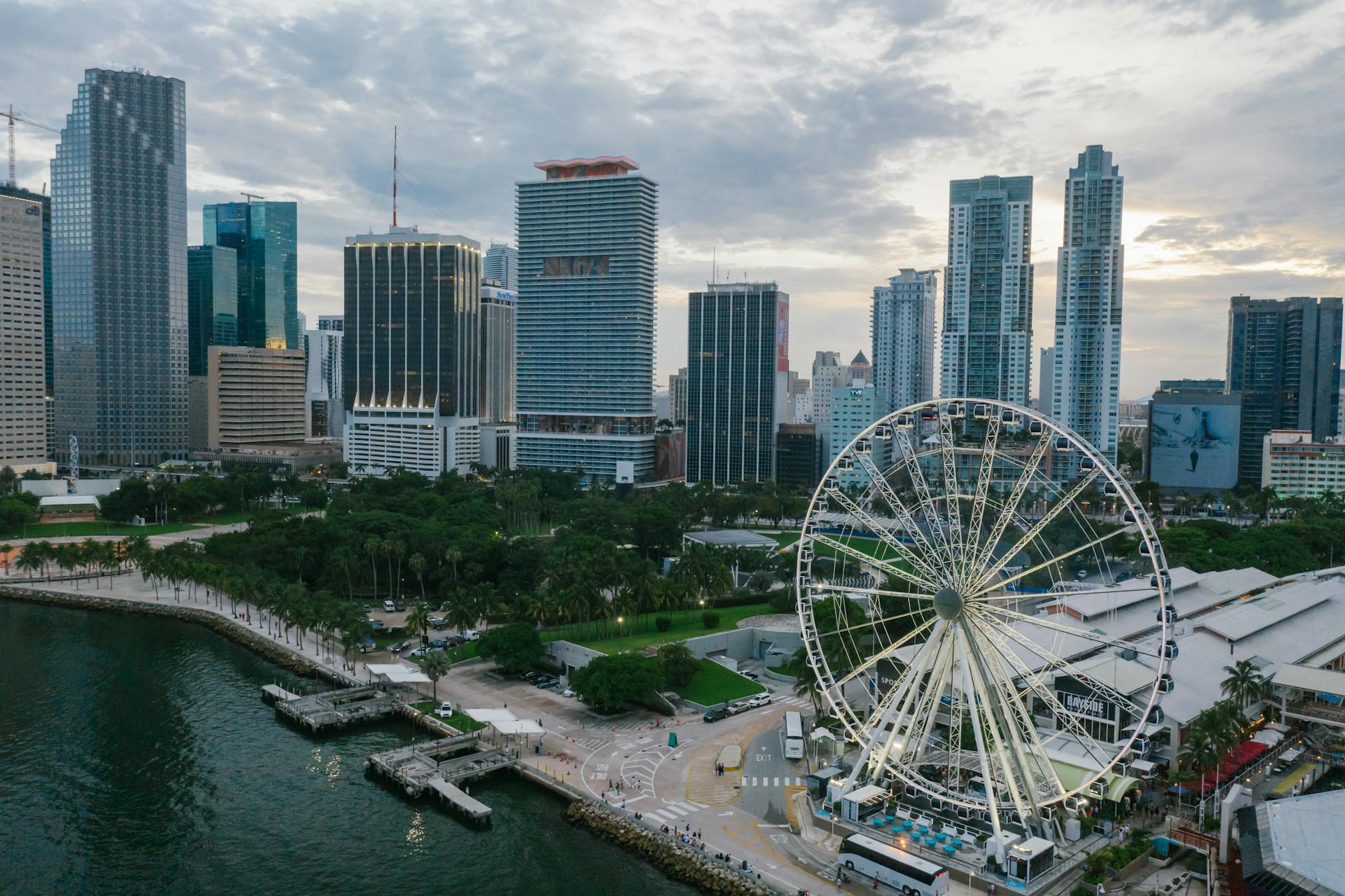
The situation in Florida is quite different from the rest of the country. The state has been building more than any other in the country, which is leading to unique challenges.
Florida's inventory is up 33.9 percent year-over-year as of February 2025, according to data available on Reventure App. This is largely due to surging insurance and HOA fees, which are making it harder for people to afford homes.
Home prices are dropping in most Florida counties, especially in once-overvalued markets like Punta Gorda. Home values in the city were down 8.3 percent year-over-year last month.
However, the situation in the Northeast and Midwest is quite different. There's very little builder inventory in these markets, and supply is still tight.
On a similar theme: What Do the Different Spfs Mean
Bursting the Bubble
A housing bubble bursting can have huge and far-reaching consequences.
The consequences can be huge and far-reaching.
As we've seen, housing bubbles can burst due to a combination of factors, including over-investment and speculation.
Over-investment and speculation can lead to a rapid increase in housing prices, making it difficult for people to afford homes.
Eventually, the bubble bursts, and housing prices plummet, leaving many people struggling to pay their mortgages.
The consequences of a bursting bubble can be devastating for consumers, causing financial losses and even homelessness.
A burst bubble can also lead to a decrease in consumer spending, as people become more cautious with their finances.
This can have a ripple effect on the entire economy, making it harder for businesses to operate and for people to find jobs.
Frequently Asked Questions
How long do real estate bubbles last?
A real estate bubble can last several years, but it's a temporary condition. The duration can vary, but understanding its lifespan is key to navigating the market.
Featured Images: pexels.com