Online banking fraud is a serious issue that can have devastating consequences for individuals and businesses alike. Phishing scams can be initiated through emails, text messages, or phone calls, with scammers posing as bank representatives to trick victims into revealing sensitive information.
Be cautious of unsolicited emails or messages that ask for your login credentials or financial information. Scammers often use fake emails that appear to be from a legitimate source, such as your bank.
In 2020, it's estimated that over $1 billion was lost to online banking fraud in the United States alone. This staggering figure highlights the need for vigilance when conducting online banking transactions.
To protect yourself, make sure to regularly review your bank statements and report any suspicious activity to your bank immediately.
Expand your knowledge: Creditone Bank Fraud
Types of Online Banking Threats
Online banking threats come in many forms, and it's essential to be aware of them to protect your financial information. Fake accounts are a type of digital bank account fraud, where scammers create fake accounts to steal sensitive information.
Account takeovers (ATO) are another common threat, where hackers gain access to your online banking account and make unauthorized transactions. Malware is also a significant threat, as it can capture login credentials, intercept banking transactions, or manipulate account details.
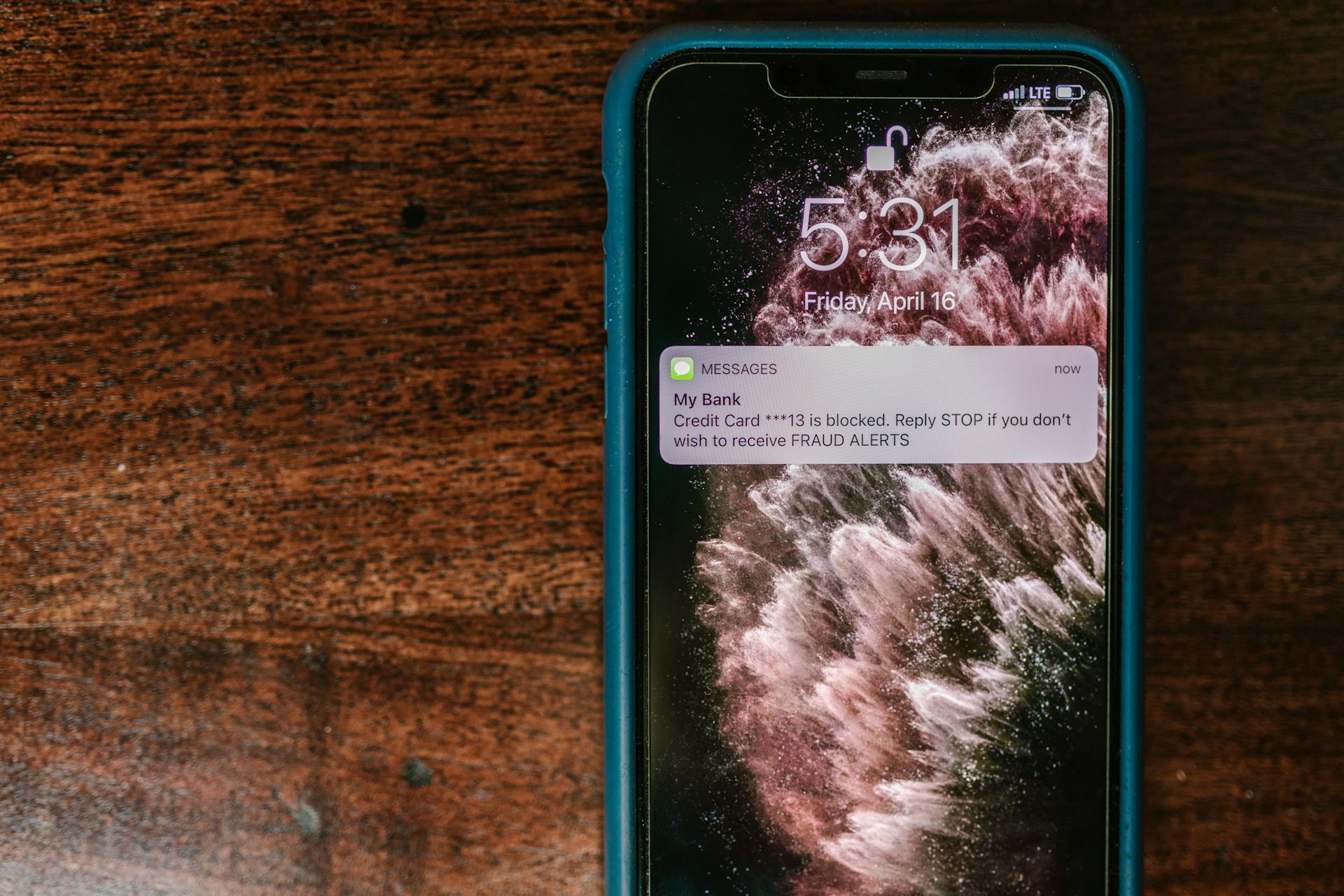
Fast cash-out techniques are used by scammers to quickly withdraw funds from your account. Phishing is a mode of online banking fraud where scammers send fake emails or SMS messages to trick you into providing sensitive information.
Malware can be installed on your device through malicious software, which can steal all your sensitive information. Data breaches can also expose your sensitive information, which scammers can use for fraudulent activities.
Logging in to your accounts via public networks or systems can expose your data to scammers. Cybersecurity measures are essential in combating these threats, as they help identify and close vulnerabilities that hackers exploit.
Here are some common modes of online banking fraud:
- Phishing: Scammers send fake emails or SMS messages to trick you into providing sensitive information.
- Malware: Malicious software can be installed on your device through links or downloads, stealing your sensitive information.
- Data breach: Large-scale data breaches expose sensitive information, which scammers can use for fraudulent activities.
- Public network or systems: Logging in to your accounts via public networks or systems can expose your data to scammers.
- Customer support: Scammers can call you as your bank's representative, asking for sensitive information to "recover" your account.
Digital Security Risks
Digital security risks are a major concern when it comes to online banking fraud. Malware is a significant threat, as cybercriminals and hackers exploit cybersecurity vulnerabilities to carry out fraudulent activities.
Malicious software, such as keyloggers, Trojans, and ransomware, can infiltrate banking systems or trick individuals into providing sensitive information. Once malware infects a device, it can capture login credentials, intercept banking transactions, or even manipulate account details, allowing cybercriminals to divert funds or steal personal information.
Data leaks are another goldmine for fraudsters, where lists of compromised credentials are passed around, giving them access to countless customers' accounts. This can be particularly damaging when combined with fake account smokescreens, allowing fraudsters to do serious damage to a good user without being noticed.
To spot a phishing attack, look out for three quick things: the message comes at an unusual time, creates a sense of urgency, or attempts to elicit an emotional response from you.
For more insights, see: When Did Online Banking Start
Money Mules
Money mules are a type of digital bank account fraud where an individual transfers illegally acquired funds on behalf of someone else. This can be done unknowingly by a victim of a romance scam or as a deliberate act by a fraudster.
A money mule can be a fraudster in on the scam, sharing the profit, or an unknowing victim. Romance scams, for example, fool an account holder into sending money to a fraudster disguised as a long-distance lover.
Fraudsters rely on money mules to add a layer of distance between their victims and themselves, making it harder for investigators to trace an online banking fraud scheme.
Implementing advanced technology is crucial in the fight against money mules, as it enhances the ability to detect and prevent fraudulent transactions. Anti-money laundering (AML) efforts rely on sophisticated algorithms, machine learning, and AI to identify suspicious patterns and anomalies.
By automating the monitoring of transactions and incorporating robust security measures, financial institutions can more effectively screen for red flags associated with money laundering schemes. These technologies allow for real-time analysis and response, enabling institutions to quickly identify and halt fraudulent activities before they escalate.
Curious to learn more? Check out: Regions Bank Fraud
Here are some common signs of money mules:
- Suspicious activity between seemingly unconnected accounts
- Unusual or frequent transactions
- Transfers to or from unfamiliar countries or regions
- Large or frequent deposits and withdrawals
Spotting a money mule requires a tool that detects suspicious activity between a network of seemingly unconnected accounts. Advanced AML solutions not only improve compliance with regulatory standards but also strengthen the overall security posture of financial systems, safeguarding them against the evolving tactics of financial criminals.
Malware
Malware is a significant threat in the world of digital security. It's a type of malicious software that can infect your device and steal sensitive information, including your login credentials and banking information.
Malware can capture login credentials, intercept banking transactions, and even manipulate account details, allowing cybercriminals to divert funds or steal personal information. This is exactly what happened in the case of corporate account takeover, where cyber thieves stole from a business by planting malware on their computer system.
To protect yourself from malware, it's essential to keep your software up to date and use strong passwords with at least 10 characters that include a combination of mixed case letters, numbers, and special characters. You should also clear your browser cache regularly to eliminate copies of web pages that have been stored on your hard drive.
A unique perspective: Atm Malware Card
Here are some ways to protect your business against malware:
- Reconcile all banking transactions on a daily basis
- Initiate ACH and wire transfer payments under dual control, with a transaction originator and a separate transaction authorizer
- Be suspicious of emails purporting to be from a financial institution, government department, or other agency requesting account information
- Use device intelligence to uniquely identify the background of an account and protect against emulator attacks, botnets, hijacked accounts, app cloners, and more.
What is ID Graphing
ID graphing is a powerful tool that aggregates information from millions of data points and relationships to provide insight into account behavior.
This graph-based visualization helps fraud fighters spot patterns of abuse, massive fake account networks, and compromised accounts, even in real-time.
Data is the best tool a fraud fighter has to stop bad actors, and ID graphing is a key part of that arsenal.
By analyzing relationships between accounts, fraud teams can identify and prevent fraudulent activity before it's too late.
ID graphing can help you decide which accounts appear to truly be fraudulent and which are good users, giving you a clearer picture of your digital security risks.
Check this out: Cit Bank Fraud
Protecting Your Account
You should report any lost or stolen cards, checks, or driver's license to your bank immediately. This is a crucial step in preventing identity theft and account fraud.
To stay on top of your accounts, sign up for online and mobile banking. This will allow you to monitor your transactions and detect any suspicious activity.
Regularly review your credit card statements to catch any unauthorized charges. This can help you identify potential scams and prevent further damage.
Shred any documents that contain personal identification information, such as charge receipts, credit card applications, or bank statements. This will help protect your sensitive information from falling into the wrong hands.
Use strong passwords for your online banking accounts and never share them with anyone. This is a simple yet effective way to prevent unauthorized access to your accounts.
Never use unsecured networks or shared computers to access your online banking accounts. This will help prevent hackers from intercepting your sensitive information.
Here are some key steps to protect yourself from online banking fraud:
- Report lost or stolen cards, checks, or driver's license
- Sign up for online and mobile banking
- Review credit card statements regularly
- Shred sensitive documents
- Use strong passwords and never share them
- Avoid unsecured networks and shared computers
Staying Safe Online
Citizens takes online safety seriously, with customizable security alerts and password-protected login to protect you from threats like phishing and malware.
To safeguard your identity and money, create a unique password for your Online Banking account that you don't use for any other web account.
Updating your anti-virus and anti-spyware software frequently is crucial, as is keeping your computer's operating system up to date.
Be cautious of emails or texts from senders you don't know, and don't open or respond to them.
If you suspect fraud on a debit transaction, you can file a claim in the mobile app or call 1-800-922-9999.
To check the status of a submitted debit or ATM card claim, go to the hamburger menu in the mobile app and click on "Dispute Status."
Have you received a suspicious email? Delete it from your mailbox immediately.
Here are some key tips to remember:
- Create a strong, unique password for your Online Banking account
- Update your anti-virus and anti-spyware software regularly
- Keep your computer's operating system up to date
- Be cautious of unknown emails and texts
- Report suspicious activity to Citizens immediately
Understanding Online Banking
Digital banking fraud is a growing concern, with fraudsters using new technology to put a spin on classic methods.
The banking industry adapted to serve modern customers, but fraudsters have also adapted, using technology to commit financial fraud in fintech.
Trust in digital banking has eroded due to these attacks, with some users being blocked from using digital bank cards by retailers.
Digital banking fraud shares similarities with other bank fraud types, with many common types falling under the scheme umbrella of account fraud.
Fraudsters use tactics such as malware, social engineering, and fast cash-out techniques to commit online banking fraud.
There are two main types of online banking fraud: Account Takeover (ATO) and Automatic Transfer System (ATS).
Banks and financial institutions should be aware of the different types of attacks included in these categories to manage risk in their systems.
To prevent threats, banks and financial institutions should set up appropriate security measures.
Reporting and Prevention
If you suspect online banking fraud, it's essential to report it to the relevant authorities. You can contact your bank's customer service center, such as Liberty Bank's, which is available weekdays from 8 a.m. to 7 p.m. (EST) and Saturdays from 8 a.m. to 3 p.m. (EST).
To report a lost or stolen debit or credit card, call (888) 570-0773 and select the relevant option. You can also follow the steps recommended by the Federal Trade Commission (FTC) at IdentityTheft.gov.
Here are the steps to follow:
By following these steps, you can help prevent further damage and protect yourself from online banking fraud.
Prevention Checklist
To stay safe online, it's essential to be aware of potential threats and take steps to prevent them. Be cautious with links and emails that urge you to act quickly. They might be phishing attempts.
Avoid giving out sensitive information like account numbers, social security numbers, or passwords. Never trust caller ID and always validate a person's organization by hanging up and calling them back through the official phone number.
To protect your passwords, create a strong, unique one for each online account. Update them regularly and follow the recommended password format. Don't share passwords with anyone.
When shopping online, only send money to trusted sources. Be wary of unfamiliar sellers or services. Keep your devices secure by installing the latest antivirus and spyware software and applying operating system and application updates regularly.
Here's a quick checklist to keep in mind:
- Avoid clicking suspicious links and/or responding to emails and texts urging you to act quickly.
- Never give out account numbers, social security numbers, credit card numbers, PINs, CVVs, passwords, or passphrases.
- Verify the requestor and the requestor’s right and need to know the information before releasing any sensitive information.
- Keep your passwords safe and up to date.
- Protect your devices by ensuring the latest antivirus and/or spyware software is installed and updated on your device(s).
By following these simple tips, you can significantly reduce the risk of falling victim to online scams and identity theft.
Liberty Bank Customer Service
Liberty Bank has a dedicated customer service center that's available to help you with any issues. You can reach them by phone from 8 a.m. to 7 p.m. EST on weekdays and 8 a.m. to 3 p.m. EST on Saturdays.
To report a lost or stolen debit card, call (888) 570-0773 and select option #3 when prompted. For credit card issues, call the same number and select option #4.
If you're a victim of identity theft, you can follow the steps recommended by the Federal Trade Commission. Start by calling the companies where you know fraud occurred and explain the situation.
Frequently Asked Questions
Do banks refund online scammed money?
Banks may refund money lost to online scams if your bank or provider is signed up to the CRM code and the scam occurred between 28 May 2019 and 7 October 2024
Featured Images: pexels.com