Traveling to Nigeria can be a thrilling experience, but navigating the local currency can be overwhelming. The official currency of Nigeria is the Naira, denoted by the symbol ₦.
You can exchange your money for Naira at a bank, currency exchange office, or a hotel. Be aware that the exchange rate may vary depending on the location and the service provider.
To make the most of your trip, it's essential to have a good understanding of the Naira's value and how to use it effectively. With a little preparation, you'll be able to handle your finances with ease and enjoy your time in Nigeria.
Discover more: South Africa Currency to Naira
Curious to learn more? Check out: What Is Japanese Yen Correlated with
History of Nigerian Currency
The naira was introduced on 1 January 1973, replacing the Nigerian pound at a rate of £1 = ₦2. This made Nigeria the last country in the world to abandon the £sd currency system in favour of a decimal currency system.
The name "Naira" was coined from the word "Nigeria" by Obafemi Awolowo. Shehu Shagari launched the currency as minister of finance in 1973.
For your interest: Parallel Market Exchange Rate in Nigeria Today
The naira was pegged at ₦197 to US$1 for several months before being allowed to float on 20 June 2016. Trade speculated the natural range of the naira would be between ₦280 and ₦350 to the dollar.
The eNaira, the digital version of the state currency, was officially launched in Nigeria by President Muhammadu Buhari in October 2021.
The 2023 Nigerian currency crisis was precipitated by a shortage of naira cash amid an attempt by the Nigerian government to force citizens to use newly-designed notes. This led to extensive street protests throughout January and February 2023.
The country's Supreme Court later invalidated the government's pronouncement that the previous notes had ceased to become legal tender.
A different take: Hong Kong Dollar Notes
Types of Nigerian Currency
The Nigerian currency is made up of banknotes and coins. The naira, denoted by the code "NGN" and symbol "₦", is Nigeria's official currency.
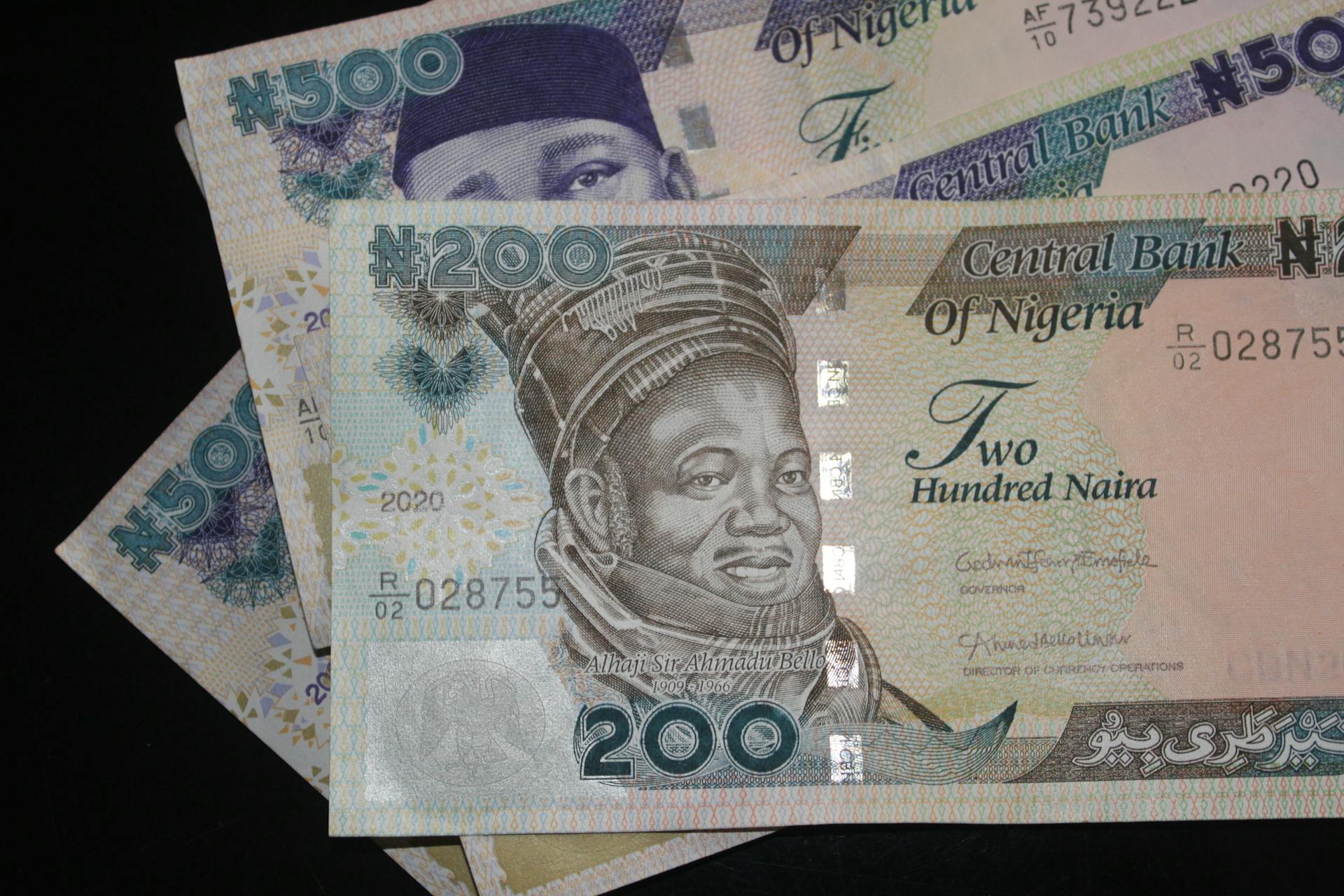
Banknotes come in various denominations, including ₦5, ₦10, ₦20, ₦50, ₦100, ₦200, ₦500, and ₦1000. The 50 kobo and 1 naira notes are no longer in use.
Suggestion: Norway Currency to Naira
Coins include the 50 kobo, 1 naira, and 2 naira pieces, which have been circulated since 2007. The 1⁄2 kobo coin was minted only in 1973, but it's no longer in circulation.
Here's a breakdown of the Nigerian currency denominations:
- Banknotes: ₦5, ₦10, ₦20, ₦50, ₦100, ₦200, ₦500, ₦1000
- Coin denominations: 50 kobo, ₦1, ₦2
Banknotes and Coins
Banknotes and Coins in Nigeria are issued by the Nigerian Security Printing and Minting Company, with some currency also produced by overseas printing companies. The company has been responsible for minting Nigerian currency since 1973.
Coins were first introduced in Nigeria in 1973, and the 1/2 kobo coin was minted only that year. The 1/2 kobo coin, along with the 1 kobo coin, was made of bronze, while the higher denominations of 5, 10, and 25 kobo were made of cupro-nickel.
In 1991, smaller coins were introduced in copper-plated-steel, including the 1, 10, and 25 kobo coins, as well as the nickel-plated-steel 50 kobo and ₦1 coins.
The central bank stated that the 1/2 to 25 kobo coins were withdrawn from circulation with effect from 28 February 2007.
Here are the denominations of Nigerian coins:
- 50 kobo
- 1 naira
- 2 naira
Banknotes in Nigeria are available in the following denominations:
- 5 naira (₦5)
- 10 naira (₦10)
- 20 naira (₦20)
- 50 naira (₦50)
- 100 naira (₦100)
- 200 naira (₦200)
- 500 naira (₦500)
- 1000 naira (₦1000)
Second
The naira has undergone some significant changes over the years. The second naira was scheduled for introduction in August 2008.
The plan was to redenominate the naira, with 100 old naira becoming 1 new naira. However, this was cancelled by then-President Umaru Musa Yar'Adua.
The Nigerian Central Bank stated that it would make the naira fully convertible against foreign currencies by 2009. The bank sets the exchange rate and regulates the amount of foreign currency through weekly auctions.
The naira appreciated against the dollar in 2007 due to high oil revenues. The then-Bank Governor, Professor Chukwuma Soludo, noted that the weekly central bank auctions of foreign currency would gradually be phased out.
Coins and banknotes have security features that can be found on the website of the Central Bank of Nigeria.
Curious to learn more? Check out: Central African CFA Franc
Exchange and Withdrawal
The official exchange rate set by the Central Bank of Nigeria is approximately ₦767.54 per 1 US dollar.
You can avoid exchanging money at airports, hotels, and tourist areas, as they often exploit tourists with less than stellar rates and may even try to defraud you.
Consider exchanging a small amount at your hotel or airport if you need naira immediately upon arrival, but wait to convert more cash somewhere with a better exchange rate.
ATMs are often available 24/7 and located throughout the country, making them a good option for exchanging currency in Nigeria.
By choosing to be charged in the Nigerian currency when withdrawing money from ATMs, your home bank will conduct the money exchange and save you on currency conversion fees.
Here are some approximate exchange rates for Nigerian naira to other currencies:
In major cities or tourist areas, you'll find plenty of places for currency exchange near you in Nigeria, including banks, ATMs, currency exchange services, airports, and hotels.
Tips for Travelers
As a traveler to Nigeria, it's essential to understand the local currency, the Naira. The Naira is divided into 100 kobo, which can be useful to know when making small purchases.
You'll find that many businesses in Nigeria still accept US dollars, especially in tourist areas. However, it's always best to have some local currency on hand.
Here's an interesting read: Functional Currency vs Local Currency
Be sure to exchange your money at a reputable bank or currency exchange office to avoid scams. The official exchange rate is set by the Central Bank of Nigeria, which is 1 USD = 410 NGN.
In Nigeria, you can withdraw Naira from ATMs using your debit or credit card. However, be aware that some ATMs may not accept international cards.
It's also a good idea to have some small bills on hand, as many vendors may not have change for larger denominations.
On a similar theme: The Bank United States One Thousand
Understanding Nigerian Currency
The Nigerian naira is the official currency of Nigeria, denoted by the code "NGN" and symbol "₦." One naira divides into 100 kobo, although kobo are rarely found in circulation due to their low value.
The naira has a floating exchange rate policy, which means its value can fluctuate freely on the foreign exchange market. This policy is managed by the Central Bank of Nigeria.
To give you an idea of the naira's value, as of December 2020, it took 380 NGN to buy one USD. This exchange rate has been pegged to the US dollar at various levels over the years.
Worth a look: Cbn Exchange Rate Dollar to Naira Today Black Market
The Central Bank of Nigeria is responsible for managing and distributing the naira, as well as ensuring the country's financial security and maintaining price stability.
Here are the key features of Nigerian banknotes:
- Abbreviation: NGN
- Symbol: ₦
- Banknote denominations: ₦5, ₦10, ₦20, ₦50, ₦100, ₦200, ₦500, ₦1,000
- Coin denominations: 50 kobo, ₦1, ₦2
- Security features: Watermarks, security threads, holographic strips, raised print, and polymer material
Nigeria Images
There are over 1,400 stock photos and images available of Nigerian currency.
These images can be browsed or searched for, with options including "naira" and "african currency" to find more great stock photos and pictures.
Nigerian currency is often depicted in close-up shots, such as hands holding the old and new Nigerian Naira notes or a macro image of miscellaneous Nigerain coins on a five Naira bank note.
The new Nigerian currency is often isolated on a white background, while some images feature the Nnamdi Azikiwe portrait from Nigerian money.
Here are some denominations of Nigerian currency that have been photographed:
- 10 naira bill
- 20 polymer
- 100 naira
- 500 polymer
- 1000 naira note
These images showcase various aspects of Nigerian currency, including point of sale machines and people counting money.
Featured Images: pexels.com