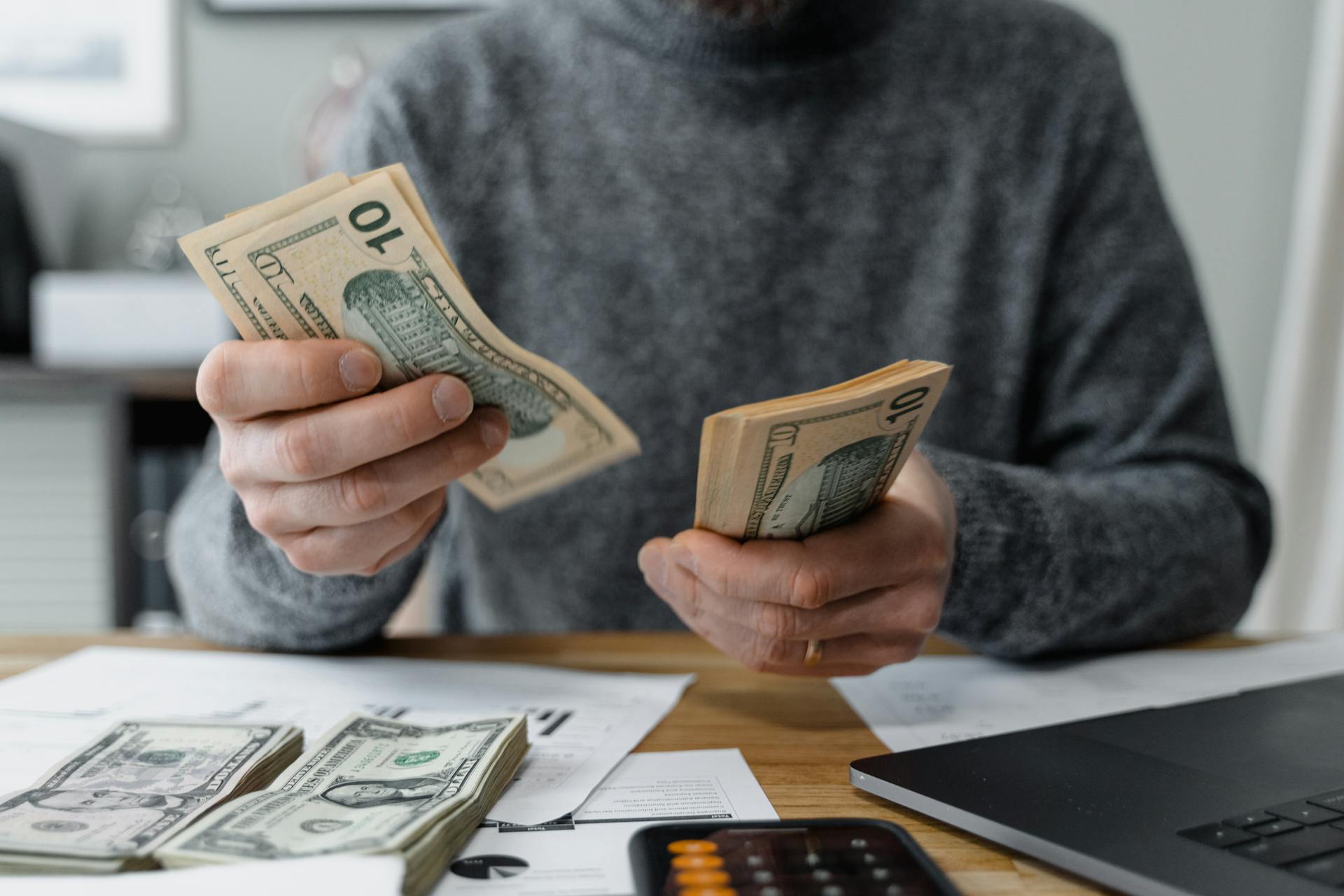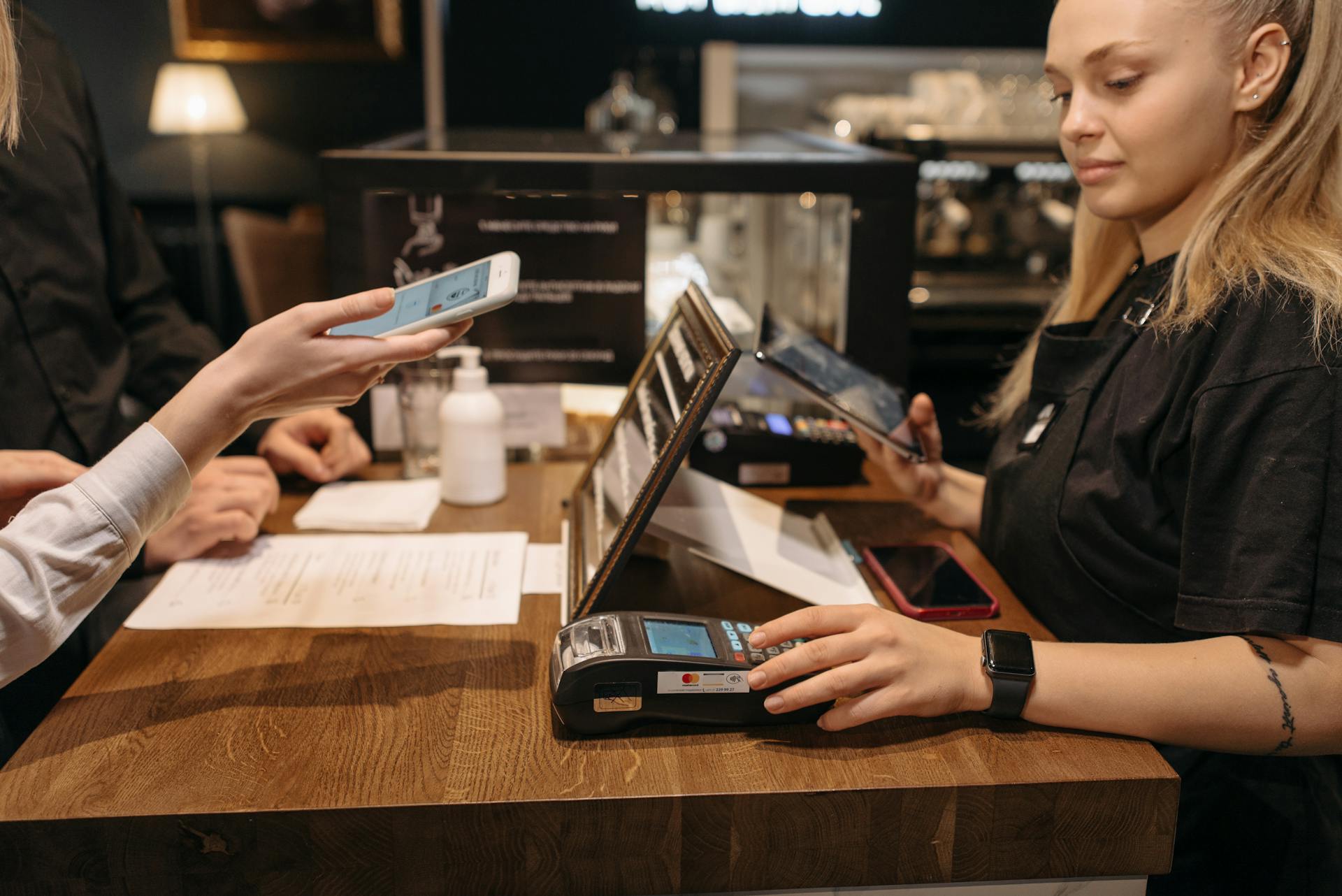
A money order is a type of payment that's similar to a check, but it's more secure and harder to counterfeit.
Money orders are usually available at post offices, banks, and other financial institutions.
They're a popular way to send money to someone, especially if you're not familiar with the recipient or if you're sending money to someone in another country.
Money orders are prepaid, which means you pay for them upfront, so you can't spend more than the amount you paid.
How to Buy a Money Order
You can buy a money order at various places, including banks, credit unions, drug stores, grocery stores, convenience stores, and stores that offer check cashing or money services like MoneyGram or Western Union.
The U.S. Postal Service also offers money orders. To order one, you'll need to bring enough money to pay for the money order, including fees, either in cash or with a debit card.
See what others are reading: Why Do Stores Have Credit Cards
For transactions above $3,000, you may be asked to present your ID and fill out a special form to prevent money laundering.
Here are some places where you can buy a money order:
- Banks
- Credit unions
- Drug stores
- Grocery stores
- Convenience stores
- Stores that offer check cashing or money services like MoneyGram or Western Union
- The U.S. Postal Service
How To Buy a?
To buy a money order, you can visit a bank or credit union, or even some stores like grocery stores, convenience stores, or those that offer check cashing services. Many of these places, like Western Union and MoneyGram, also sell money orders.
You'll need to bring the cash or a debit card to pay for the money order, including any fees. For transactions over $3,000, you might be asked to show your ID and fill out a special form to prevent money laundering.
You can pay with a credit card, but be aware that it may cost extra and show up as a later charge on your credit card bill. Some places might not accept credit cards at all.
Discover more: Western Union International Money Order
To fill out a money order, you'll need to know the payee's name and the amount you want to send. You'll also need to add your name and address, and sign the money order. Make sure everything is accurate, as you won't be able to change it later.
You'll receive a receipt with a tracking number, which you can use to verify that the money order reached the intended recipient. Keep this receipt handy in case you need to track your money order or contact the place where you bought it.
If you lose your money order or made a mistake on it, you can try to cancel it and get a replacement or refund. However, this process can take up to a month or longer, and you'll need to bring your receipt and the money order itself (if you have it) to the place where it was purchased.
Cash at Post Office
You can cash a money order at the Post Office for free. To do so, you'll need to take a primary photo ID with the money order to any Post Office location.
You'll also need to sign the money order at the counter in front of a retail associate. This is a crucial step, as you won't be able to sign the money order beforehand.
Domestic money orders never expire, and they don't accrue interest. This means you can cash them for the exact amount on the order at any time.
Here's a step-by-step guide to cashing a money order at the Post Office:
- Do not sign the money order.
- Take a primary photo ID with the money order to any Post Office location.
- Sign the money order at the counter in front of a retail associate.
Keep in mind that there may be additional requirements for money orders made out to organizations, more than one person, and minors. Be sure to check with the Post Office for specific details.
Fees and Costs
Fees and costs are an essential part of buying a money order. The fees are based on the money order dollar amount, and they vary depending on the issuer.
For money orders issued by the U.S. Postal Service, the fees are as follows: $2.35 for money orders up to $500, $3.40 for money orders from $500.01 to $1,000, and $0.79 for Postal Military Money Orders issued by military facilities.
Some commercial institutions, like banks, may have different prices for money orders. For example, Chase charges $5 for money orders up to $1,000, while Citibank charges $5, but offers it for free for premium checking customers.
Using a credit card to buy a money order can be costly, as it often counts as a cash advance, and the credit card company may charge a fee. For instance, if you use a credit card that charges a 5% cash advance fee, you'll end up paying more than if you paid with cash or a debit card.
Here's a summary of the fees for money orders issued by the U.S. Postal Service:
Security and Verification
To ensure the authenticity of a money order, examine the paper it's printed on. Real USPS money orders have specific marks and designs to prevent fraud.
When holding a money order up to the light, look for the following:
- Watermarks of Ben Franklin on the left side that repeat top to bottom.
- A vertical, multicolored thread with the letters “USPS” that weaves in and out of the paper.
Examine the Paper
Real money orders have specific marks and designs to prevent fraud.
You can spot these by holding the money order up to the light.
One key feature is the watermark of Ben Franklin on the left side.
This watermark repeats top to bottom and should be visible when you hold the money order up to the light.
Another feature is a vertical, multicolored thread with the letters "USPS" that weaves in and out of the paper.
This thread should be visible on the right side of the Franklin watermark.
To verify the authenticity of a USPS money order, check for these specific marks and designs.
A different take: Usps International Money Order
Sign the Front
To ensure the security of a money order, it's essential to sign the front. As the payer, you sign the front of the money order.

The person receiving the money will sign the back to cash it. This is a crucial step that needs to be completed accurately to avoid any issues.
Signing the front of the money order serves as a verification of the payment. It's a necessary step to complete the transaction securely.
Alternatives and Options
Money orders are a convenient way to send guaranteed funds, but they're not the only option. Other alternatives include traveler's checks, wire transfers, bank drafts, and cashier's checks. These options can be used in situations where the recipient isn't set up to receive cash.
In some cases, personal checks, debit cards, credit cards, or online payment apps might be acceptable for payment. However, money orders have some advantages. Unlike card or electronic payments, the recipient of a money order doesn't need any special technology to accept it. And, unlike personal checks, a money order can't bounce.
Some electronic alternatives to money orders have emerged, such as the konbini system in Japan, the PostePay system in Italy, and mobile banking services in Bangladesh. In the UK, pre-paid credit cards can be "topped-up" at various locations. These options use the Visa/MasterCard payment systems to settle transactions.
For more insights, see: In-Car Payment System
Alternatives to

If you're looking for alternatives to money orders, you've got plenty of options. In addition to checks and money orders, you can also use traveler's checks, wire transfers, bank drafts, and cashier's checks to send guaranteed funds.
A personal check, debit card, credit card, or online payment apps might also be acceptable for payment in some cases. However, money orders are slightly different from these alternatives because the recipient doesn't need special technology to accept a money order.
In some situations, a money order can't bounce, unlike a personal check. This makes it a more reliable option for certain transactions.
Here are some other common payment methods and how they stack up against money orders:
Many electronic alternatives to money orders have emerged in recent years, making them less popular in some areas. In Japan, the konbini system enables cash to cash transfers at convenience stores, while in Italy, the PostePay system is offered through the post office.
Broaden your view: Value Transfer System
Cashier's Checks
Cashier's checks are a secure payment method that can be more expensive than a money order, with fees ranging from $10 to $15. However, they have higher maximum amounts, making them a good option for large transactions.
A cashier's check is essentially a check written by a financial institution against its own assets, which makes it more reliable than a personal check. This means there's no risk of the check bouncing, and funds are usually available the next business day.
If you need to send thousands of dollars, it might be cheaper to send one cashier's check rather than several money orders, since there's a cap on money order transactions at $1,000.
Here's a quick comparison of cashier's checks and money orders:
Overall, cashier's checks are a good option for large, guaranteed payments from a bank account, but keep in mind the higher fees compared to other payment methods.
Usage
A money order is a convenient payment method, but it's essential to understand how it works. It's purchased for the amount desired, similar to a cashier's check.

The main difference between a money order and a cashier's check is the maximum face value. In the United States, for example, the United States Postal Service limits domestic postal money orders to $1,000.00 as of November 2023.
A money order typically consists of two portions: the negotiable check for remittance to the payee, and a receipt or stub that the customer retains for record. This documentation helps ensure that the payment is legitimate and can be verified.
The amount is printed by machine or checkwriter on both portions of the money order. This ensures accuracy and prevents errors.
Here are some key facts about money orders:
- Domestic postal money orders have a maximum face value of $1,000.00 as of November 2023.
- A money order typically consists of two portions: the negotiable check and a receipt or stub.
- The amount is printed by machine or checkwriter on both portions of the money order.
Domestic and International
Domestic money orders are a convenient way to send money within the United States. You can send up to $1,000 in a single order anywhere in the country.
To send a domestic money order, you'll need to go to a Post Office location with cash, a debit card, or a traveler's check. Credit cards cannot be used to pay for money orders. You'll also need to fill out the money order at the counter with a retail associate.
Domestic money orders never expire and don't accrue interest, so you can cash them for the exact amount on the order. You can cash a USPS money order at a Post Office for free, or at most banks and some stores.
International money orders are similar to domestic ones, but can be used to make payments abroad. They're often issued by a buyer's bank and bought in the currency the seller accepts. International money orders are considered safer than sending currency through the post because they require identification to cash.
Some countries have specific requirements for international money orders, such as being on pink and yellow paper and bearing the words "international postal money order." For example, Japan Post requires these features, so make sure to check the destination country's requirements.
Worth a look: Currency Money
Sending Domestic Mail
Sending domestic mail is a straightforward process that can be completed at any Post Office location. You can send money orders up to $1,000 in a single order anywhere in the United States.

To get started, you'll need to pay with cash, a debit card, or a traveler's check - credit cards aren't accepted. The money order amount you decide on will be the dollar value of the order plus the issuing fee.
You can fill out the money order at the counter with a retail associate, and it's a good idea to keep your receipt to track the money order. This will help you stay organized and ensure the order is processed smoothly.
Here are the steps to send a domestic money order in a quick reference format:
- Decide on the money order amount.
- Go to any Post Office location.
- Paying with cash, a debit card, or a traveler's check.
- Filling out the money order with a retail associate.
- Paying the dollar value of the money order plus the issuing fee.
- Keeping your receipt to track the money order.
Cashing Domestic
You can cash a domestic money order at a Post Office for free. This is a convenient option, especially if you have a Post Office nearby.
Domestic money orders never expire and they don't accrue interest, so you can take your time to cash them. This is a big plus, especially if you receive a money order and need to cash it at a later date.
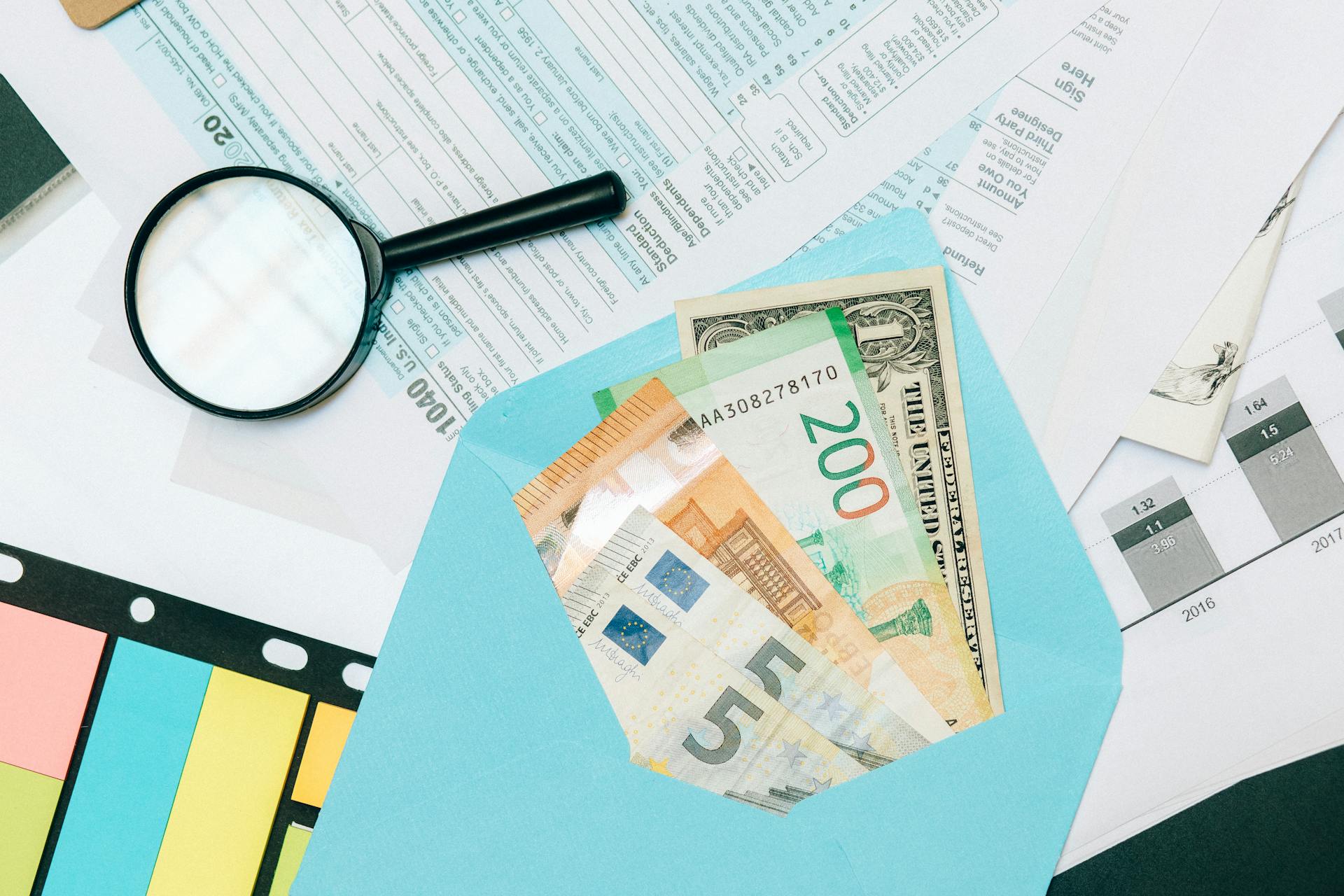
To cash a money order at the Post Office, you'll need to sign it in front of a retail associate. This is a standard procedure, and it's a good idea to have your primary photo ID ready.
You can also cash a domestic money order at most banks and some stores. However, be aware that some banks may charge a fee if you're not a customer of the bank.
Here are some common places where you can cash a domestic money order:
- Post Office
- Most banks
- Some stores
Keep in mind that not all Western Union locations that sell money orders are able to cash them. It's always a good idea to call ahead and confirm that the location you choose can cash a money order.
United States
In the United States, money orders are widely available and can be purchased at various locations, including post offices, grocery stores, convenience stores, and even some financial service companies.
You can buy a money order from the US Postal Service at any location, and they'll issue it for a small charge.

Many stores now offer money orders, such as 7-11, QuikTrip, Cumberland Farms, Safeway, Western Union, MoneyGram, CVS, Wal-Mart, and 3T Solutions.
The US Postal Service sells money orders as an alternative to sending currency through the postal system, which was initially implemented to reduce post office robberies.
Some financial service companies, like banks and credit unions, may not charge their clients for money orders.
The US Postal Service issues international money orders that are accepted in 29 countries.
Explore further: Us Postal Service Money Order Cashed
India
In India, a money order is a service provided by the Indian Postal Service, where a payer pays the amount and a small commission at a post office and receives a receipt for the same.
The amount is then delivered as cash to the payee after a few days by a postal employee, at the address specified by the payer.
A receipt from the payee is collected and delivered back to the payer at their address, making it a more reliable and safer option than sending cash in the mail.

Money orders are commonly used for transferring funds to a payee who is in a remote, rural area, where banks may not be conveniently accessible or where many people may not use a bank account at all.
This service is the most economical way of sending money in India for small amounts.
International
International money orders are a convenient way to make payments abroad. They're similar to regular money orders but can be used to pay for goods or services in another country.
To purchase an international money order, you'll need to ensure it's acceptable in the destination country. Some countries, like Japan Post, require a specific type of paper and wording, such as "international postal money order" on pink and yellow paper.
Foreign workers often rely on international money orders to send money back home, as they're considered safer than sending currency through the post. This is because international money orders require identification, like a signature and photo ID, to cash them.
If you're planning to use an international money order, make sure to check the specific requirements for the country you're sending to.
Tracking and Status
You can check the status of a money order you've purchased from the U.S. Postal Service at any time by visiting the Money Orders Application.
To do this, make sure you have the following information for the postal money order you want to check: the serial number, post office number, and dollar amount.
It's relatively simple to find out where a money order is, as long as you've kept your receipt. But the process varies slightly by issuer.
The U.S. Postal Service and MoneyGram allow you to track online with information such as the serial number found on your receipt and the purchase amount.
Your bank should be able to provide you with the same information for a money order purchased there. Without the receipt, you'll likely have to file a research request to find your money order's serial number, and that's expensive and time-consuming.
Here's a breakdown of the information you'll need to track a money order:
- Serial number
- Post Office number
- Dollar amount
Keep in mind that the money order should clearly show or state who the provider is, whether it's Western Union, MoneyGram, or the U.S. Postal Service.
Forms and Procedures
To fill out a money order, you'll need to add the payee's name, your name (and possibly your address), and sign it. Make sure everything is accurate, as you won't be able to change the information afterward.
You'll also need to keep the receipt, which is a carbon copy of the money order or a paper slip recording the information entered. This receipt will come in handy if you need to track your money order or contact the place where you got it.
The receipt will have a tracking number that you can use to verify that the money order reached the intended recipient. If any problems arise, contact the place where you bought the money order to get help.
You can buy a money order with cash or a debit card, but paying with a credit card might cost extra, with the charges appearing on your credit card bill later.
Take a look at this: Monzo Bank Contact Number
If you no longer have the money order or made a mistake on it, you may be able to cancel it and get a replacement or refund, but only if the money order hasn't been cashed.
Here are the steps to cancel a money order:
- Bring your receipt and the money order itself (if you have it) to the place where it was purchased.
- The issuer will likely have you fill out some paperwork using information from your receipt.
- You'll probably need to pay a fee.
- The issuer may take up to a month or longer to process your claim.
Advantages and Disadvantages
Money orders are a convenient way to make payments, but like any financial instrument, they have their advantages and disadvantages.
Money orders are a safer option than personal checks because they don't include sensitive information. You can cash a money order at a local bank or credit union, and it can also be deposited into a bank account for free.
Buying and cashing a money order can incur a fee, which can range from a few dollars to a small percentage of the order's value. You can usually avoid these fees by cashing the money order at the post office or your own bank.
Money orders can be issued in one country and cashed in another, making them a popular choice for international transactions. However, tracking a money order can be harder than tracking a personal check.
Here are some key points to keep in mind:
- Money orders don't include sensitive information, making them safer than personal checks.
- They can be cashed at a local bank or credit union, or deposited into a bank account for free.
- Buying and cashing a money order can incur a fee, which can range from a few dollars to a small percentage of the order's value.
- Money orders can be issued in one country and cashed in another, making them a popular choice for international transactions.
- They can be harder to track than personal checks, but the U.S. Postal Service offers an online money order inquiry service to help with this.
Replace lost, stolen, or damaged items
If you've lost or had a money order stolen, don't worry, it can be replaced. The process of confirming a money order's lost or stolen status may take up to 60 days, and investigating it may take up to 30 days.
You'll need to pay a $20.15 processing fee to get a replacement. This fee is non-negotiable, so be prepared to pay it when you go to the post office.
To replace a damaged money order, take the damaged item and your receipt to your local post office location. They'll exchange it for a new one, no questions asked.
A different take: Us Postal Money Order Lost
Frequently Asked Questions
What is the limit on a money order?
The maximum value for a single domestic money order is $1,000.00. You can purchase multiple money orders during the same visit with no daily limit.
Where is the easiest place to get a money order?
Get a money order at your local post office, where the process is straightforward and convenient
What is the difference between a postal order and a money order?
A postal order is a pre-printed order for a specific sum, whereas a money order is a custom-ordered payment that can be purchased with cash at a bank or Post Office. The key difference lies in their purchasing and customization options.
Is a money order good as cash?
A money order is a secure alternative to cash, widely accepted and providing proof of value. It's a reliable option for sending money, especially when cash or personal checks aren't recommended.
What is a money order vs. check?
A money order is a prepaid voucher that represents a specific amount of money, purchased with cash, whereas a check is a personal payment instrument that deducts funds from your account. Choose a money order for secure, anonymous transactions, and a check for more flexible payment options.
Featured Images: pexels.com