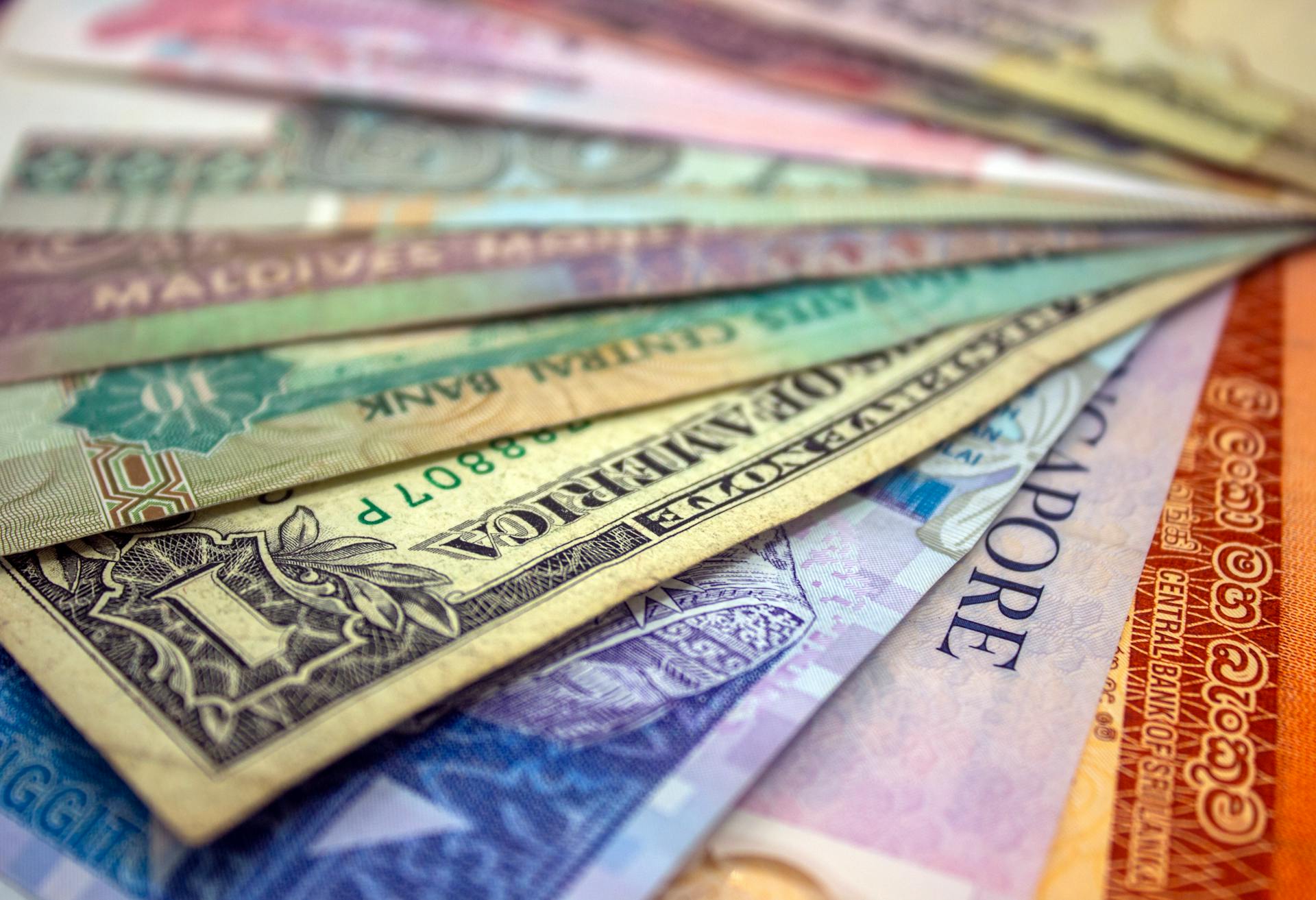
In a multipolar global economy, the concept of monetary hegemony takes on a new level of complexity. The US dollar's status as the global reserve currency has been a cornerstone of international trade and finance for decades.
The dollar's dominance has been largely due to the Bretton Woods agreement, which established the dollar as the global reserve currency in 1944. This agreement also pegged other currencies to the dollar, creating a system of fixed exchange rates.
Monetary hegemony is not just about the dollar's dominance, but also about the power dynamics that come with it. The US has used its economic influence to shape international trade and financial policies, often to its own advantage.
Discover more: International Status and Usage of the Euro
US Dollar Hegemony
The US dollar's influence is deeply embedded in the global financial system, with roughly 90% of all global foreign exchange transactions involving the dollar.
This pervasive presence means that the international financial system is configured to flow through the dollar's veins, with institutions like the IMF promoting sound macroeconomic policies and denominated in dollars.
For another approach, see: Global Monetary Reset
The Federal Reserve's monetary policy, designed to achieve domestic economic goals, inadvertently extends its reach globally due to the dollar's international role.
The foundation of this deep integration traces back to the Bretton Woods system established in 1944, which solidified the dollar's central role in the post-World War II global financial order.
No global currency leader has been able to sustain such a large lead over its closest competitor for such a prolonged period, with the dollar's dominance since WW2 contrasting markedly with the experience of the IMS over the preceding 150 years.
The dollar's strength can pose significant challenges for emerging markets and their citizens, with a strong dollar often leading to rising external debt costs and capital outflows.
The shift towards local currency trade offers a path to mitigate these risks, with trading in local currencies shielding economies from external shocks and dollar fluctuations.
However, the transition away from dollar dominance is not without its challenges for businesses and consumers, with de-dollarization bringing short-term instability and higher transaction costs.
Nations and businesses must mitigate the risks associated with dollar volatility while also pursuing opportunities in a more diversified currency landscape, requiring proactive adaptation and strategic foresight.
Suggestion: What Is the World Reserve Currency
American Advantage
The American Advantage is a unique position that allows the United States to borrow from the world in its currency, finance its deficits without immediate panic, and inflate its monetary base without severe repercussions. This privilege is often referred to as "exorbitant privilege" by former French finance minister Valéry Giscard d'Estaing.
It costs only a few cents for the Bureau of Engraving and Printing to produce a $100 bill, but other countries had to provide $100 of actual goods to obtain one. This is a stark contrast to the costs of producing other currencies.
The dollar's dominance grants the U.S. the ability to run larger trade deficits without facing a balance of payments crisis, as its imports are purchased in its currency. This is a significant advantage for the United States.
The dollar's supremacy is not solely a product of economic fundamentals, but is also reinforced by a broader geopolitical architecture, including the U.S. military presence in over 70 countries and its influence in Bretton Woods institutions. This intertwining of economic and military power means the dollar functions as a sovereign instrument masquerading as a neutral currency.
Additional reading: 1999–2002 Sale of United Kingdom Gold Reserves
The stability of any monetary system, ultimately, rests on trust in political, military, and economic power, and in the institutions that define and supervise the currency. The dollar's international role is significantly bolstered by U.S. security guarantees, which have been shown to boost a currency's share in foreign reserves by up to 30 percentage points.
Alternative to US Dollar
The BRICS bloc, comprising Brazil, Russia, India, China, and South Africa, is actively working towards creating an alternative to the US dollar. They've established the New Development Bank (NDB) in Shanghai, which provides settlement services and liquidity support for local currency transactions.
This approach is a significant challenge to the dollar's dominance, as it offers BRICS nations an alternative to traditional institutions like the World Bank and IMF. The NDB's creation is a pivotal step towards financial independence for the bloc.
Germany repatriated 674 tons of gold between 2013 and 2017, and other countries like Austria, the Netherlands, Turkey, Hungary, Poland, and Romania followed suit, converting their foreign exchange reserves into gold. This tangible move represents a direct challenge to the dollar's role as the primary store of value.
Additional reading: Gold Standard Monetary
Central banks globally have purchased more gold in recent years than at any time since 1950, signaling a fundamental shift in trust away from the dollar and towards a traditional hedge.
A growing number of countries are conducting bilateral and multilateral trade using their own national or regional currencies, thereby bypassing the US dollar as an intermediary. Argentina and Brazil, for instance, have agreed to use the yuan for Chinese imports.
Countries are signing bilateral and multilateral currency swap agreements, which allow for the direct exchange of local currencies without the need for dollar intermediation. China has been highly active in establishing such swap lines globally, including a significant agreement with Brazil covering a substantial portion of their bilateral trade.
China's Cross-Border Interbank Payment System (CIPS) and Russia's System for Transfer of Financial Messages (SPFS) are prominent examples of alternative financial messaging and payment systems to SWIFT. The BRICS bloc is also exploring a blockchain-based "BRICS Bridge" multisided payment platform, designed to connect member states' financial systems and facilitate settlements in central bank digital currencies.
Trading in local currencies can shield economies from external shocks and dollar fluctuations, leading to fewer exchange rate risks and greater certainty for investments. This approach also enhances regional economic integration, with intra-BRICS trade having the potential to double within a decade due to reduced transaction friction.
Discover more: China Foreign Exchange Trade System
Here are some key de-dollarization strategies being employed by countries:
Consequences of US Dollar Hegemony
The US dollar's dominance has far-reaching consequences that impact not only the global economy but also the daily lives of individuals. Roughly 90% of all global foreign exchange transactions involve the dollar, and over half of the world's trade is denominated in it.
This pervasive presence means that the international financial system is configured to flow through the dollar's veins, affecting borrowing costs, capital flows, and overall economic stability in other nations. The Federal Reserve's monetary policy, primarily designed to achieve domestic economic goals, inadvertently extends its reach globally due to the dollar's international role.
The severe outcomes of financial sanctions imposed by the US extend far beyond abstract economic figures, impacting the daily lives of countless individuals. Sanctions on Iran, Afghanistan, and Venezuela have led to widespread suffering, including malnutrition and prolonged suffering, particularly among the poor, patients, women, and children.
A strong dollar can pose significant challenges for emerging markets and their citizens, leading to rising external debt costs, capital outflows, and financial instability. This is because many developing countries' loans are denominated in dollars, making them vulnerable to dollar fluctuations.
For more insights, see: Why Is the Us Dollar the World Currency
Sanctions as a Double-Edged Sword: The Human Cost of Financial Exclusion
The dollar's influence extends far beyond economic matters, it's deeply embedded in the very infrastructure of global finance. Roughly 90% of all global foreign exchange transactions involve the dollar.
The IMF focuses on the functioning of the international monetary system and promotes sound macroeconomic policies, with its assistance often denominated in dollars, creating a reliance that can present challenges for developing countries. This reliance can have severe consequences.
Sanctions that restrict governments' access to foreign exchange can lead to widespread suffering, including malnutrition and prolonged suffering. The economic stranglehold imposed by such measures can severely limit a country's ability to provide essential public goods and services.
For example, sanctions on Iran caused a fall in national revenues, currency devaluation, and increased inflation and unemployment, resulting in a deterioration of people's overall welfare and their ability to access life's necessities. The impacts were particularly severe for the poor, patients, women, and children.
The U.S. tariff surge in 2025 led to a 2.3% rise in consumer prices, costing the average U.S. household thousands annually, with lower-income families being hit hardest. This vividly demonstrates how power wielded through financial means directly impacts people and places, leading to economic devastation and humanitarian crises.
The dollar's deeply embedded nature in global finance is not accidental; it's a legacy of a system designed to promote international economic cooperation and stability. However, this system can also be used as a tool for economic exclusion and punishment.
Currency Volatility and Its Impact
Currency volatility can have a significant impact on emerging markets, making it harder for them to pay off external debts due to rising dollar-denominated loan costs. This can trigger capital outflows, tighten financing conditions, and lead to financial instability.
A strong dollar can also increase funding costs and lower economic growth prospects for these countries. This is because abrupt swings in emerging market exchange rates are often linked to these capital outflows.
The shift towards local currency trade offers a way to mitigate these risks, shielding economies from external shocks and dollar fluctuations. This can lead to fewer exchange rate risks and greater certainty for investments.
However, transitioning away from dollar dominance can bring short-term instability, higher transaction costs, and complexities for businesses managing multiple currencies. For example, Canadian businesses engaged in international trade may need to adapt their currency risk management strategies.
Nations and businesses must be proactive in adapting to a more diversified currency landscape, moving beyond a reactive stance to a more deliberate shaping of their economic destinies. This requires strategic foresight and a willingness to navigate the challenges of currency volatility.
Readers also liked: Trade Coin
Global Economic Landscape
The dollar's influence on global finance is staggering, with roughly 90% of all foreign exchange transactions involving it, and over half of the world's trade denominated in it. This pervasive presence means the international financial system is configured to flow through the dollar's veins.
The dollar's dominance is a legacy of the Bretton Woods system established in 1944, which pegged other currencies to the dollar and ensured its central role in the post-World War II global financial order. This arrangement solidified the dollar's preeminence, making it the global operating system.
However, the dollar's share in global reserves has steadily eroded, declining from a peak of 72% in 2001 to 57% by the third quarter of 2024. This erosion signals a fundamental shift in the global monetary constellation.
New contenders are rising in visibility, with the Chinese yuan gradually increasing its share of global reserves and expected to grow further as China liberalizes its capital account.
You might like: Excess Reserves
Decline of US Dollar Hegemony
The decline of US dollar hegemony is a reality that's hard to ignore. Roughly 90% of all global foreign exchange transactions involve the dollar, making it a deeply embedded part of the global financial infrastructure.
The dollar's central role in the global financial system is a legacy of the Bretton Woods system established in 1944, which pegged other currencies to the dollar and solidified its preeminence in the post-World War II global financial order.
Take a look at this: Financial Services in Japan
As the global monetary system shifts towards a more diversified and less dollar-dominated structure, the dollar's role will change, and global actors will need to adapt. The crucial question is not if the dollar will endure, but how its role will change.
Over half of the world's trade is denominated in dollars, creating a reliance that can present challenges for developing countries. The IMF's assistance is often denominated in dollars, which can exacerbate these challenges.
The Federal Reserve's monetary policy, designed to achieve domestic economic goals, inadvertently extends its reach globally due to the dollar's international role. The Fed's actions ripple across continents, affecting borrowing costs, capital flows, and overall economic stability in other nations.
If this caught your attention, see: The Fed Can Change the Money Supply by Changing
Frequently Asked Questions
What is the simple meaning of hegemony?
Hegemony refers to the dominant influence or control one group has over others, often through social, cultural, or economic means. It's a powerful concept that shapes the dynamics of power and relationships within societies and communities.
Featured Images: pexels.com