Merchant services are an essential part of any business, allowing you to accept payments from customers and manage your finances efficiently.
A merchant account is a type of bank account that allows businesses to accept credit card payments, with the average merchant account fee ranging from 2.5% to 3.5% per transaction.
To get started with merchant services, businesses need to choose the right payment processor, considering factors such as transaction fees, payment processing speed, and customer support.
Many businesses choose to use a third-party payment processor like PayPal or Stripe, which can offer more competitive rates and features than traditional bank-issued merchant accounts.
Suggestion: Echeck Merchant Account
What Are Merchant Services?
Merchant services are constantly evolving to match the ever-expanding needs of merchants and the dynamic ways in which they do business. A payment gateway is an interface that allows customers to submit payment information online, including credit and debit card numbers, that is then routed to the merchant's payment processor.
Merchant service providers offer a range of services to help businesses accept payments, including online transaction processing, which involves everything that happens with a transaction after the customer enters payment information into the payment gateway. This includes communication between the merchant's bank and the customer's bank, and the merchant service provider moving the money where it needs to go.
Merchant services typically include point-of-sale (POS) systems, which consist of both hardware and software that allow merchants to accept payments and complete transactions in person. POS systems also provide functionality for tasks like updating inventory and tracking sales.
Here are some of the most common services included in merchant services:
- Payment gateways
- Online transaction processing
- Point-of-sale (POS) systems
- Credit card readers
- Ecommerce support
- Check processing
- Gift cards
- Loyalty programs and promotions
- Partner networks
What's Included
Merchant services are a vital part of running a business that accepts credit card payments. A payment gateway is a secure way for your business to accept online payments, and merchant service providers usually offer payment gateways integrated directly with your website or ecommerce store.
Worth a look: Insurance Cover on Business - Merchant Services
Online transaction processing is included in most merchant services, handling everything that happens with a transaction after the customer enters payment information into the payment gateway. Your bank and the customer's bank communicate with each other, and the merchant service provider moves the money where it needs to go.
Point-of-sale (POS) systems are another essential service, consisting of both hardware and software that allow merchants to accept payments and complete transactions in person. POS systems also provide functionality for tasks like updating inventory and tracking sales.
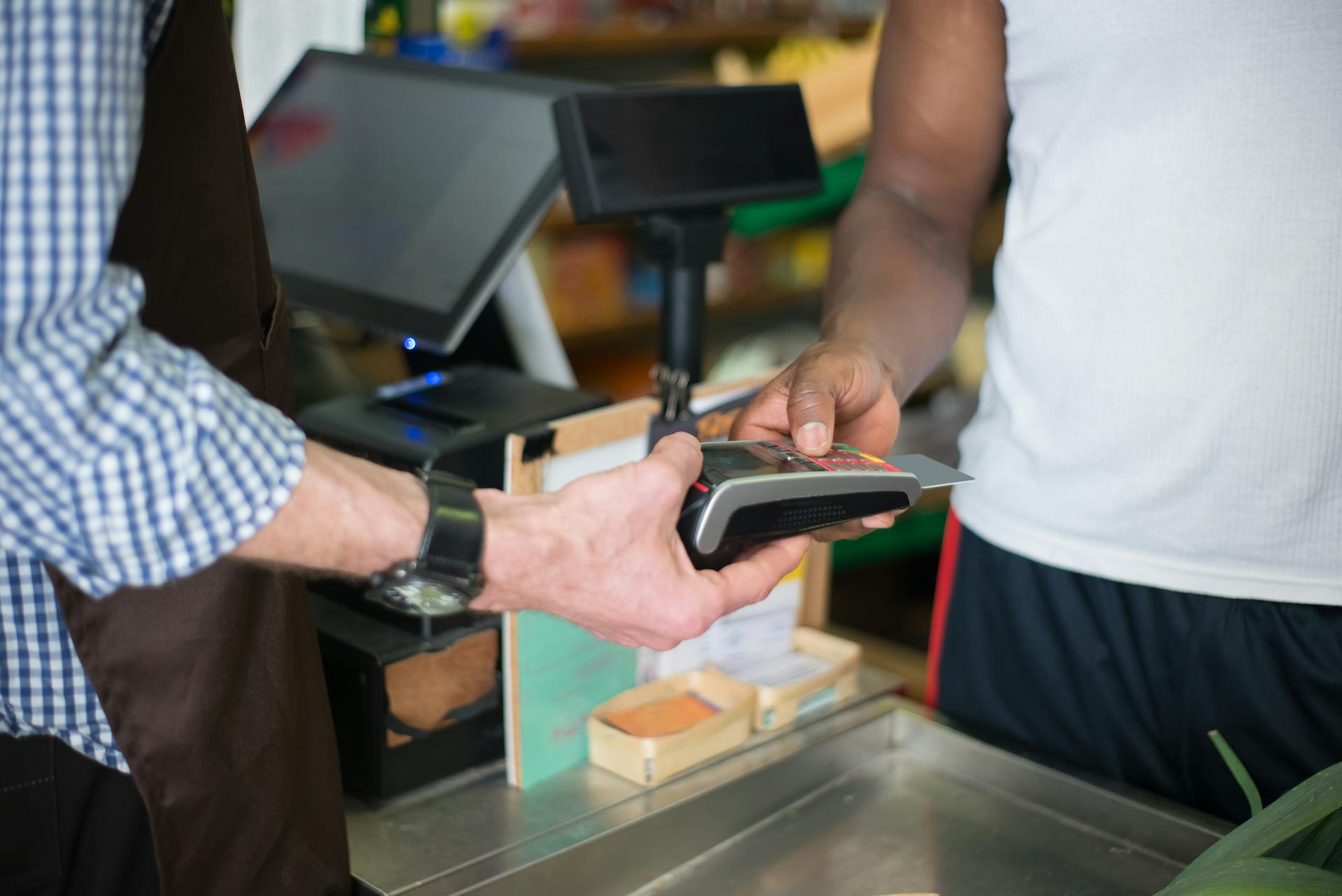
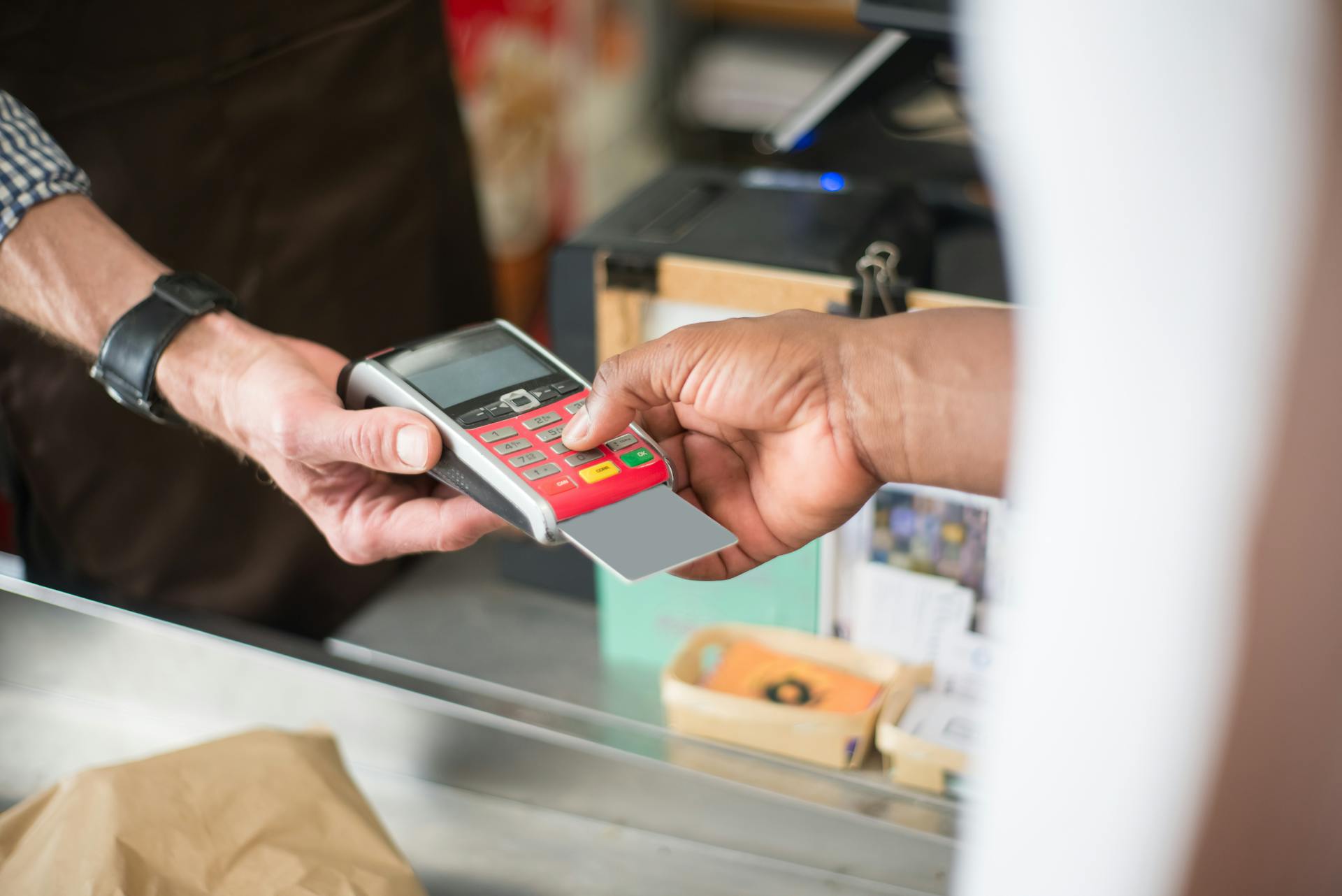
Credit card readers are used to process in-person transactions, transmitting payment information to the merchant's payment processor. Not all card readers look the same, and the hardware can vary based on how it's meant to be used.
Ecommerce support is also becoming more common, with merchant service providers offering tools to build and customize a website or marketplace for products, marketing tools, and sales analytics.
Check processing is typically included in merchant services, allowing businesses to process checks in addition to credit and debit card payments. Gift cards are another service, providing a flexible way to secure additional revenue for a business.
Loyalty programs and promotions are also supported by many merchant service providers, helping merchants generate better customer engagement, retention, and lifetime value. These initiatives can be complicated to deploy and execute, but merchant service providers are making the process easier.
Additional reading: First Merchants Corporation
Here are some common services included in most merchant services:
- Online and in-person credit card processing services
- Secure payment gateways for online payments
- Online transaction processing for managing customer orders and payments
- Point-of-sale (POS) systems for in-person transactions
- Check processing for businesses that accept checks
- Loyalty programs for rewarding customers
- Credit card terminals for in-person credit card payments
What Is A
Merchant services are a type of payment processing that allows businesses to accept credit and debit card payments from customers.
Merchant services provide a way for businesses to process transactions and receive payment from customers.
Types of Merchant Services
There are three main types of merchant services providers that cater to different business needs. These providers offer various payment services that can be tailored to suit your business type.
Merchant accounts are a type of merchant service that allows businesses to accept and issue payments, usually by credit card, debit card, or other electronic methods. It's essentially a separate bank account that holds transacted funds before they are sent to your regular business bank account.
Merchant services, on the other hand, involve more than just moving money in and out of merchant accounts. They also include additional services such as ecommerce support and loyalty programs.
Here are the three main types of merchant services providers:
Mobile Systems
Mobile Systems are a convenient way for customers to make payments.
They can use a mobile card reader that connects to their smartphone or tablet, turning it into a credit card terminal.
Mobile payment systems provide online transactions anywhere there's an internet connection.
This means businesses can accept payments in any location, not just at a physical store.
Mobile payment systems are a great option for businesses on-the-go, like food trucks or festival vendors.
On a similar theme: Card Association
Difference Between an Account?
When you're considering merchant services, it's essential to understand the difference between a merchant account and merchant services.
A merchant account is a separate bank account that holds transacted funds before they are sent to your regular business bank account.
Merchant services, on the other hand, involve moving money in and out of merchant accounts, but they also include other services such as ecommerce support and loyalty programs.
Here's a quick comparison of the two:
- Merchant Account: A separate bank account for businesses to accept and issue payments.
- Merchant Services: Involve moving money in and out of merchant accounts, plus additional services like ecommerce support.
In simple terms, a merchant account is just for holding payments, while merchant services are a broader range of services that help your business succeed.
Difference Between Service and Service

Merchant services providers and payment service providers may seem like interchangeable terms, but they have distinct differences. The key distinction lies in how they handle business accounts.
A merchant services provider establishes a separate account and identification number for each business they serve. This involves a verification and compliance process that can take weeks.
On the other hand, payment service providers consolidate multiple businesses under a single account, offering instant approval.
Here's a comparison of the two:
This table illustrates the main differences between merchant services providers and payment service providers.
Embedded Finance
Embedded finance is a type of merchant service that allows businesses to integrate financial services directly into their platforms.
A merchant account is a bank account specifically designed for businesses to accept and issue payments, usually by credit card, debit card, or other electronic method. Merchant services, on the other hand, involve moving money in and out of merchant accounts, as well as providing other services like ecommerce support and loyalty programs.
If this caught your attention, see: Merchant Account Fee
Embedded finance encompasses various services, including Connect Payments for platforms, Treasury Financial accounts, Capital Customer financing, and Issuing Physical and virtual cards. These services enable businesses to streamline their financial operations and provide a seamless experience for their customers.
Here's a breakdown of the services that fall under embedded finance:
By integrating these services, businesses can automate various financial tasks, such as revenue recognition, tax calculations, and invoicing. This can help reduce errors, save time, and improve overall financial efficiency.
If this caught your attention, see: Homebridge Financial Services
Choosing the Right Service
Choosing the right merchant services provider is crucial for your business. Consider the upfront costs and ongoing monthly services, including per-transaction fees.
You'll also want to factor in the level of customer support you'll receive. Look for providers with a good reputation for timely support, and check online reviews to see what existing customers say about their experiences.
Some payment processors may not be able to process payments as quickly as you need, so it's essential to research their average payment processing times. This can make a big difference in your business operations.
Here are some key questions to ask potential providers:
- Does the solution/product ensure the secure capture and transmission of cardholder data?
- Does the vendor/service provider carry insurance to cover data breaches related to their product/solution?
- Does the vendor/service provider assist with notification of my customers in the event of a data breach and your product solution is the root cause?
By asking these questions, you can narrow down your choice and find a provider that meets your needs.
Account
A merchant account is a bank account that can accept the proceeds from credit and debt card transactions.
Merchant account providers offer a merchant account specifically designed for businesses to accept credit and debit card payments, which is extremely helpful for companies that make a large number of transactions with credit and debit cards.
Merchant account providers issue a Merchant ID, exclusive to your business and no one else, and allow businesses to control payments and get benefits from quick access to funds and low transaction fees.
Here are some merchant payment services that merchant account providers can offer:
- Credit card terminals
- Mobile card readers
- POS systems
Merchant accounts can have various fees, including a monthly minimum, billing, authorization, transaction, customer service, and maintenance fees.
Choosing the Right Service for Your Business
Choosing the right service for your business can be a daunting task. You want to make sure you're getting the best value for your money, and that the service you choose will meet your needs.
First, consider the upfront costs and ongoing monthly services. Some providers may charge a flat rate, while others may have fluctuating payment processing fees. Don't forget to factor in the per-transaction fees that most companies build into their prices.
Customer support is crucial, so take a look at online reviews for each provider. Check what ongoing support you'll receive after you purchase the hardware or software. You don't want to lose business because your service provider didn't get back to you fast enough.
Some payment processors may not be able to process payments as quickly as you need, so look into this before choosing a provider. Check online reviews to see what existing customers say about average payment processing times.
Ideally, your service will seamlessly integrate with other pieces of business software or hardware. Choosing a familiar name, like Intuit, comes with the benefit of knowing it will integrate well with Intuit's bookkeeping software.
To narrow down your choice, ask yourself some key questions. Does the solution ensure the secure capture and transmission of cardholder data? Does the vendor carry insurance to cover data breaches? Does the vendor assist with notification of customers in the event of a data breach?
Here are some top-rated merchant services providers to consider:
- Dharma Merchant Services
- Helcim
- Payment Cloud
- Payment Depot
- Stax
- Square
- Stripe
Fees and Costs
Merchant fees can be complex and vary depending on the provider and services chosen. Some providers charge a flat monthly fee, while others have tiered pricing packages that change based on features and equipment needed.
Merchant service providers often charge a combination of fees, including monthly fees, processing fees, and flat rates per transaction. These fees can add up quickly, so it's essential to understand what you're paying for.
Credit card fees typically total around 2% of the transaction amount, while debit card fees are limited to $0.21 plus 0.05% multiplied by the transaction value, plus a $0.01 fraud-prevention adjustment.
Here's a breakdown of some common fees:
- Monthly fees: $135 to $145 per month, or a combination of a $1,799 upfront fee and a monthly rate of $49.95 to $59.95 (Clover)
- Processing fees: 2.65% plus 10 cents for card payments at a physical station (Bank of America), or 1.83% plus 8 cents for in-person transactions (Helcim)
- Flat rates: 10 cents per transaction, in addition to a processing fee or monthly fee
Fees Overview
Merchant services providers charge a variety of fees, including monthly fees, processing fees, tiered pricing packages, and flat rates.
Monthly fees can range from $99 to $145, depending on the provider and services chosen. For example, Helcim charges no monthly fee, while Stax offers plans starting at $99 per month for processing up to $150,000 a year.
Processing fees are typically a percentage of the transaction amount, with credit card fees averaging 2% and debit card fees limited to $0.21 plus 0.05% multiplied by the value of the transaction.
Tiered pricing packages change depending on the features and equipment needed, as well as the amount processed per year. Bank of America charges processing fees of 2.65% plus 10 cents for in-person transactions, 2.99% plus 30 cents for online purchases, and 3.5% plus 15 cents for keyed transactions.
Flat rates, usually around 10 cents per transaction, may be added on top of processing fees or monthly fees. For example, Clover charges a fee per transaction in addition to monthly fees.
Here's a breakdown of some common merchant service providers and their fees:
Keep in mind that these fees can vary depending on the specific services and equipment chosen, as well as the amount processed per year. It's essential to research and compare fees before selecting a merchant service provider.
Settlement and Fund Transfer
When you make a purchase, the settlement process begins. The issuing bank transfers funds for the transaction to the business' bank, which then deposits the funds in the business' merchant account. This process typically takes 24 to 48 hours.
The transaction amount is added to the customer's balance, which will be shown on their next billing statement. This is a standard practice in the payment industry.
In the case of a debit card, the issuing bank can simply withdraw the money from the cardholder's account.
Here's an interesting read: Your Card Was Declined by the Issuing Bank
Benefits
Merchant services can provide a significant boost to your business, and it's not just about accepting electronic payments. Merchant services cost money, but they offer worthwhile added benefits to businesses.
In fact, trends are moving in the direction of electronic and even digital payments, with many consumers preferring to use these methods over cash.
Nine out of 10 U.S. consumers engaged in some form of digital payment during 2024, according to a McKinsey & Company survey.
This shift towards digital payments is creating a huge opportunity for businesses to increase their sales.
Discover more: Electronic Banking Services
How it Works
Merchant services are a crucial part of modern commerce, and understanding how they work can help businesses and customers alike.
A merchant service provider acts as an intermediary between businesses and banks, facilitating transactions in a secure and seamless way.
The process typically takes only a few seconds, with the following steps involved: the customer enters payment information, the merchant service provider sends the information to the bank, the bank sends the transaction to the card company, the card company sends the confirmation to the merchant's bank, and the payment is approved.
Here's a breakdown of the key steps in the transaction process:
- The customer enters payment information, such as their card number and expiration date.
- The merchant service provider sends this information to the bank.
- The bank sends the transaction to the card company, such as Visa or Mastercard.
- The card company sends the confirmation to the merchant's bank.
- The merchant's bank then approves or declines the transaction.
Some of the key services offered by merchant service providers include customer onboarding, transactions management, online POS, payment initiation and acceptance, regular payouts, refunds initiation, and merchant's digital wallet.
In addition to these services, merchant service providers also play a crucial role in ensuring the security and efficiency of transactions, with most of the process happening behind the scenes and virtually instantaneously.
Components and Tools
Merchant services rely on a combination of hardware and software. Some common components include point-of-sale (POS) systems, which can process sales, manage daily operations, and monitor inventory.
A POS system usually consists of software and hardware that accept payments. This can be anything from a simple cash register to a complex system with multiple terminals.
Point-of-sale financing options for customers are also enabled through POS systems. This can be a valuable tool for businesses looking to increase sales and customer satisfaction.
Components
Components are the building blocks of a merchant's payment system, and they come in two main forms: hardware and software. Some common components include mobile card readers that connect to your mobile device and an application to communicate with your provider's processing network.
A point-of-sale (POS) system is a crucial component that usually consists of software and hardware that accept payments. It can also manage a company's daily operations and processes, such as processing sales, producing reports, and monitoring inventory.
Payment gateways are another essential component that provide a secure online connection between the merchant and the customer. This makes it difficult for hackers to infiltrate the system and steal sensitive information.
Merchants often use a combination of these components to create a seamless payment experience for their customers. By using a POS system, mobile payment systems, and secure payment gateways, merchants can ensure that their customers' information is protected and their transactions are processed efficiently.
Broaden your view: Merchant and Manufacturers Bank
OLTP
OLTP is a vital tool in ecommerce, where speed is key. It allows merchants to process large numbers of transactions in real time. This is especially important for businesses that need to record transactions for accounting and other purposes.
OLTP is used in conjunction with a payment gateway. This combination enables merchants to process transactions efficiently.
Additional reading: Discover Card Merchants
Finance Automation
Finance automation is a game-changer for businesses. It helps streamline financial processes, freeing up time and resources for more important tasks.
With finance automation, you can automate billing and revenue recognition, ensuring accurate and timely payments. This includes subscription-based billing and usage-based billing.
Tax automation is also a key component, with features like sales tax and VAT automation. This helps businesses stay compliant with tax regulations and avoid costly errors.
Invoicing is another area where finance automation excels, with online invoices that can be easily sent and tracked. Custom reports, such as those provided by Sigma, also help businesses gain valuable insights into their financial performance.
Here are some key features of finance automation:
- Billing: Subscription-based billing and usage-based billing
- Revenue Recognition: Accounting automation
- Tax: Sales tax & VAT automation
- Invoicing: Online invoices
- Sigma: Custom reports
- Data Pipeline: Data sync
Payment Processing
Payment processing is the backbone of merchant services, and it's essential to understand how it works. Customers encounter merchant services when they initiate a transaction using a credit card, debit card, or other electronic means.
The payment processing process typically starts with a POS device or online portal collecting the transaction amount, the cardholder account number, and other data identifying the cardholder. This information is then transmitted to the card-processing network associated with that card.
Most of the payment processing process happens behind the scenes and virtually instantaneously, making it largely invisible to the customer. In some cases, such as with American Express and Discover, the network is also the company that issued the card used (the issuing bank).
Streamlined payment processing not only provides greater security but also speeds up transactions both online and off, reducing time and labor costs. The less time customers have to wait in line and the less effort they need to expend in completing an online transaction, the more likely they are to return to a business.
Payment service providers (PSPs) enable businesses to accept digital payments both offline and online, without having a dedicated merchant account. This simplifies payment processing for small business owners, despite having longer processing times and higher overall costs.
Payment gateways are the virtual equivalent of a POS system, performing the same basic functions but for online transactions. They verify the legitimacy of the cardholder in other ways, such as asking for a validation code, also known as a CVV, CV2, or CVV2 code.
A payment gateway is software that enables businesses to accept and process safe credit card payments online through their website or e-commerce store. It gathers and encrypts customer credit card information for later processing.
Merchant service providers and payment gateways are two important components of the payment processing ecosystem. A merchant service provider acts as an intermediary between businesses and the various parties involved in the payment process, enabling businesses to accept electronic payments and handle the authorization, processing, and financing of transactions.
Intriguing read: Merchant Credit Cards
Getting Started
Merchant services are a must-have for any business that wants to accept payments from customers. To get started, you can explore prebuilt checkout options, which can be easily integrated into your website or app.
Libraries and SDKs provide a convenient way to add payment functionality to your business. These tools can be used to create a seamless payment experience for your customers.
App integrations are also a great way to get started with merchant services. By integrating payment functionality into your app, you can offer a convenient payment option to your customers.
If you're looking for a comprehensive payment solution, consider using a prebuilt checkout option. These solutions often come with libraries and SDKs that make it easy to integrate payment functionality into your business.
To get started with merchant services, you can explore the following options:
- Prebuilt checkout
- Libraries and SDKs
- App integrations
Understanding Merchant Services
Merchant services are a type of financial service that allows businesses to accept payments from customers.
These services are typically provided by banks, credit card companies, or specialized payment processors, and can include services such as credit card processing, check acceptance, and electronic funds transfer.
Merchant services can be a game-changer for small businesses, allowing them to accept credit card payments and expand their customer base.
A merchant account is a special type of bank account that is used to process credit card transactions, and it's required for businesses that want to accept credit card payments.
Merchant services can also help businesses to manage their cash flow, by providing them with a way to accept payments from customers and deposit them directly into their bank account.
See what others are reading: Credit Settlement Services
Popular Merchant Services
Merchant services providers offer a range of services, but some are more popular than others.
Credit and debit card payment processing is a fundamental service for most businesses, allowing them to accept transactions securely.
Check guarantee and check conversion services are also widely used, helping businesses to verify the authenticity of checks and convert them into electronic payments.
Automated clearing house check drafting and payment services are another popular option, enabling businesses to make payments directly from their bank accounts.
Gift card and loyalty programs are a great way for businesses to incentivize repeat customers and reward loyalty.
Payment gateway services provide a secure and efficient way for businesses to process online transactions.
Merchant cash advances are a convenient option for businesses that need access to funds quickly.
Online transaction processing and point of sale (POS) systems are essential for businesses that want to streamline their payment processes.
Here are some common types of merchant services:
- Credit and debit card payment processing
- Check guarantee and check conversion services
- Automated clearing house check drafting and payment services
- Gift card and loyalty programs
- Payment gateway
- Merchant cash advances
- Online transaction processing
- Point of sale (POS) systems
Frequently Asked Questions
Who is the largest merchant service provider?
The largest merchant service provider is Fiserv, which owns First Data and the popular Clover POS system. As of 2025, Fiserv handles the most merchant payments worldwide by volume.
Featured Images: pexels.com