Macy's has a rich history that spans over 160 years, with its first store opening in 1858 in New York City. It was founded by Rowland Hussey Macy, a sailor and entrepreneur who wanted to create a store that would sell quality goods at reasonable prices.
Macy's has undergone significant changes over the years, with its first department store opening in 1875. This store was a huge success, and it paved the way for the modern department store concept.
Despite its success, Macy's has faced numerous challenges, including the rise of online shopping, which has led to a decline in foot traffic and sales. In response, Macy's has been working to revamp its stores and improve its e-commerce capabilities.
One of the key strategies Macy's has employed is to focus on its core customers, the middle-class American family. By offering a wide range of products at affordable prices, Macy's has been able to maintain its loyal customer base and stay competitive in the market.
Take a look at this: Uniqlo Success Story
Macy's History
Macy's has a rich history that spans decades. The company was originally R. H. Macy & Co., which merged with Federated Department Stores in December 1994.
Federated promptly shut down the remainder of the I. Magnin chain, converting several to Macy's or Bullock's and selling four locations to Saks Fifth Avenue. This was a significant move that marked a new chapter in Macy's history.
The company continued to expand through strategic acquisitions, including the purchase of Broadway Stores, Inc. in 1996. This acquisition gave Macy's a leading position in Southern California and a dominant one in Northern California.
By 2007, Federated Department Stores had announced plans to change its corporate name to Macy's Group, Inc. and later revised its name change to Macy's, Inc. This change was approved by shareholders in May 2007 and took effect on June 1, 2007.
The company has continued to evolve, with the opening of new concept stores in the late 2000s. These stores, designed to fit open-air lifestyle malls, feature Starbucks Coffee Cafés and fitting rooms that feel like lounges.
Additional reading: Rowland Hussey Macy
1992 Bankruptcy
In 1992, R. H. Macy & Co., Inc. filed for Chapter 11 bankruptcy protection on January 27.
This was a result of the company's struggles after a leveraged buy-out led by Edward Finkelstein in 1986.
The company's banks brought in a new management team after the bankruptcy, which made some significant changes.
They shut several underperforming stores, jettisoned two-thirds of the luxury I. Magnin chain, and reduced Macy's to two divisions, Macy's East and Macy's West.
Macy's East, which operates the Macy's department stores in the northeast U.S. and Puerto Rico, was one of the two remaining divisions.
It's the operating successor to the original R.H. Macy & Co., Inc. and has been known by various names over the years, including Macy's New York and Macy's Northeast.
For your interest: Northeast Bank
Federated Acquisition 1994
In December 1994, R. H. Macy & Co. merged with Federated Department Stores.
Federated promptly shut down the remainder of the I. Magnin chain, converting several to Macy's or Bullock's and selling four in Carmel, Beverly Hills, San Diego, and Phoenix to Saks Fifth Avenue.
Worth a look: Macy Gray
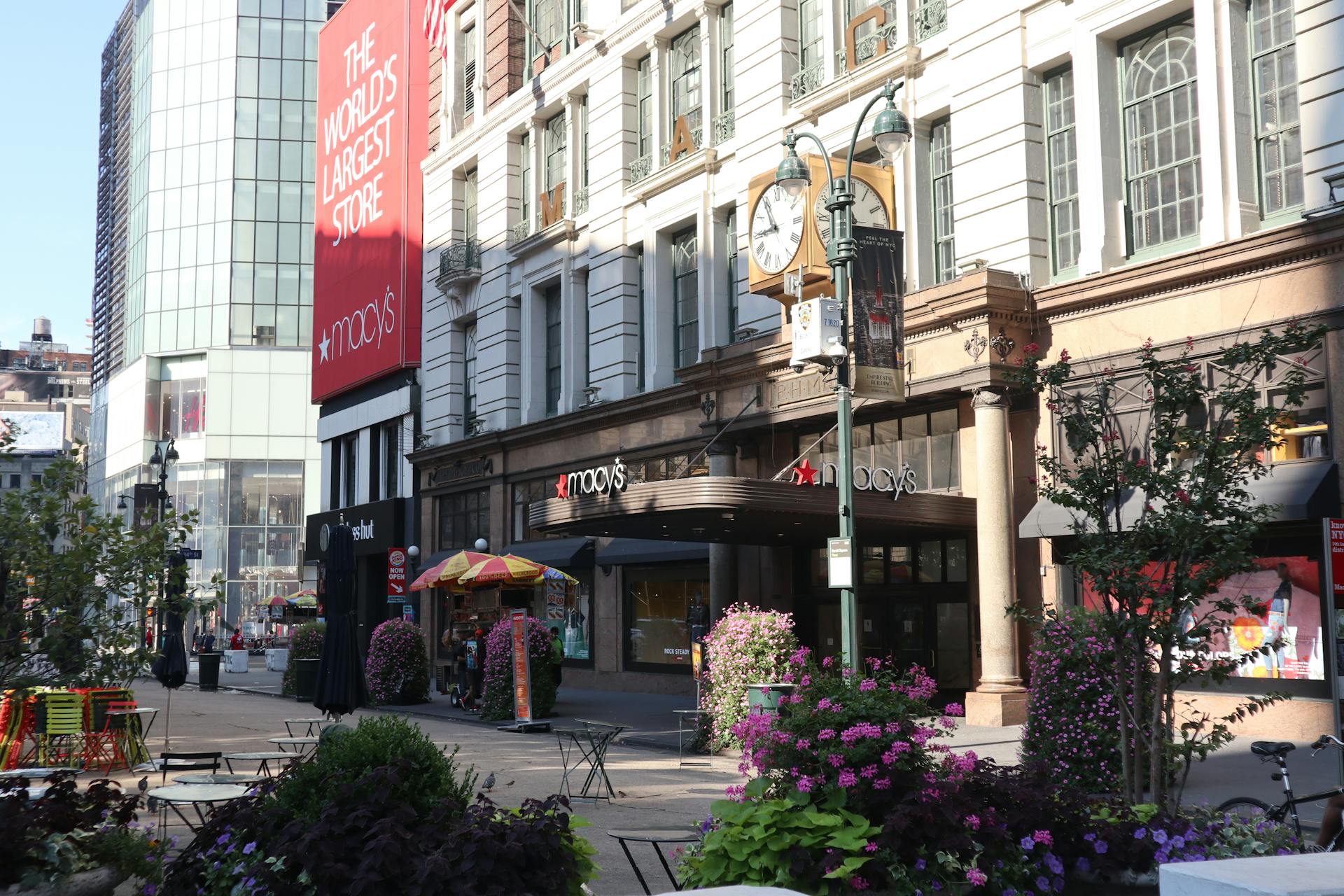
The merger marked a significant shift for Macy's, as it moved its headquarters to Cincinnati, Ohio.
Federated also merged its Abraham & Straus/Jordan Marsh division with the new "Macy's East" organization based in New York, renaming the Abraham & Straus stores in metropolitan New York with the Macy's nameplate in 1995.
The Jordan Marsh moniker was erased in New England in early 1996.
Federated's acquisition of Broadway Stores, Inc. in 1996 gave it a leading position in Southern California and a dominant one in the Northern California marketplace.
In early 1996, Federated dissolved Broadway Stores, incorporating the majority of its locations into Macy's West, rebadging them as Macy's and using the opportunity to retire the Bullock's name.
Additional reading: Carnegie Corporation of New York
Recent Developments
Macy's has been making waves in the retail industry with some exciting recent developments. The company has been working to revamp its e-commerce platform, investing in new technology to improve the online shopping experience.
Macy's has also been expanding its omnichannel capabilities, allowing customers to seamlessly transition between online and in-store shopping. This includes initiatives like buy online, pick up in store (BOPIS) and order online, return in store (BORIS).
One notable example of Macy's progress in this area is its partnership with Google to bring Google Express to its stores, enabling customers to pick up online orders at a designated location within the store.
You might enjoy: Online Retailers in Uae
Herald Square Construction
Macy's Herald Square construction began in 1902, when the flagship store moved uptown to its current location at 34th Street and Broadway.
The original building was designed by De Lemos & Cordes and built by the Fuller Company between 1901-02, featuring a Palladian facade.
Macy's expanded the store through new construction, eventually occupying almost the entire block bounded by Seventh Avenue on the west, Broadway on the east, 34th Street on the south, and 35th Street on the north.
A small pre-existing building on the corner of 35th Street and Seventh Avenue was purchased by Robert H. Smith in 1900 for $375,000, which is equivalent to $14.2 million in 2024, with the intention of blocking Macy's expansion.
However, Macy's simply built around the building, which now carries Macy's "shopping bag" sign by lease arrangement.
In 1912, Isidor Straus died in the sinking of the Titanic at the age of 67 with his wife, Ida.
For more insights, see: Scottish Building Society
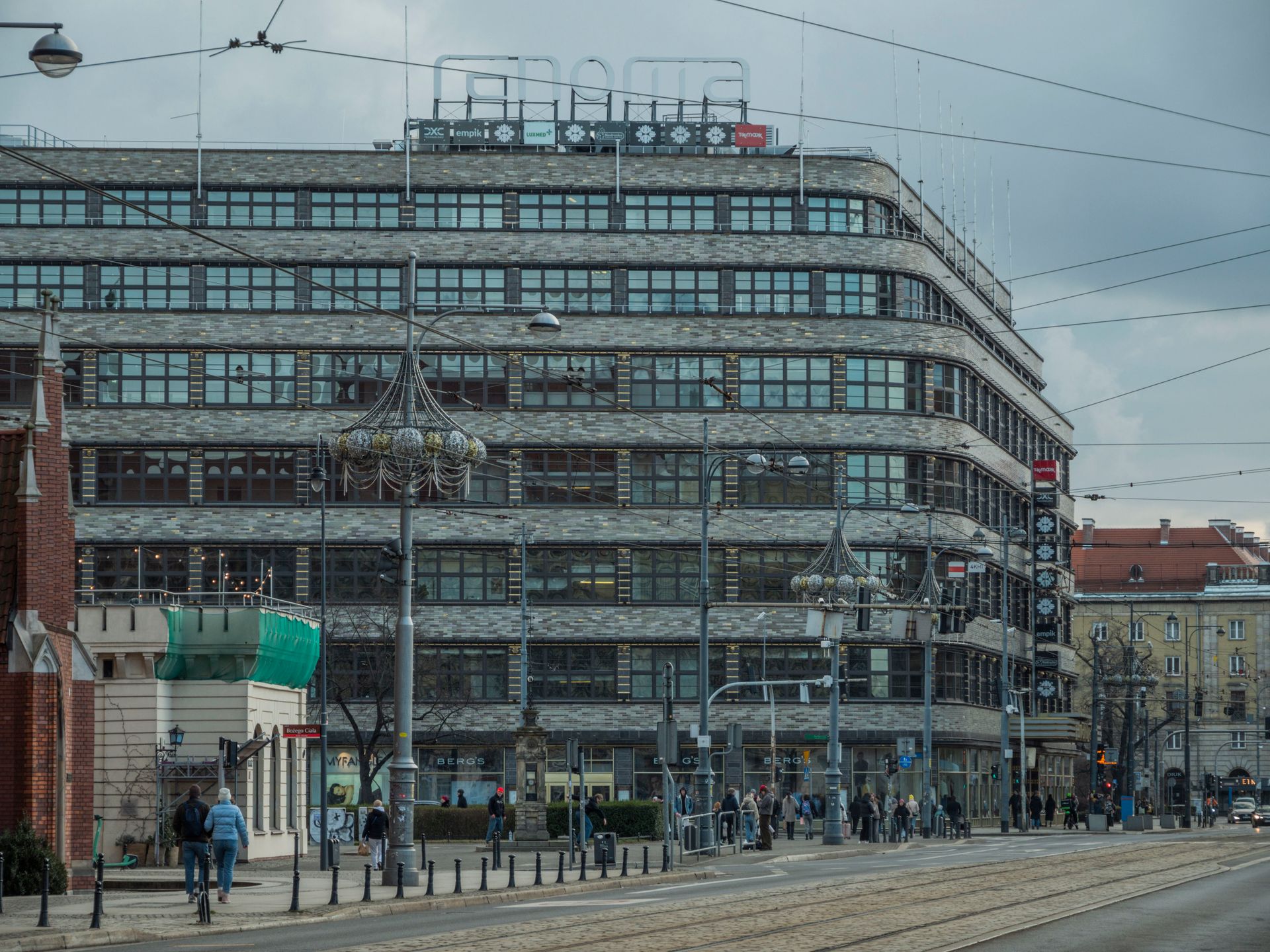
The building has undergone several additions, including further expansions to the west in 1924 and 1928, and the Seventh Avenue building in 1931, all designed by architect Robert D. Kohn.
The newer buildings were increasingly Art Deco in style, a departure from the original Palladian facade.
In 2012, Macy's began a $400 million renovation of the iconic Herald Square flagship store, with Studio V Architecture leading the design.
The building was listed on the National Register of Historic Places in 1978 and designated a National Historic Landmark in the same year.
A fresh viewpoint: Manufacturers Trust Company Building
What Happened?
Macy's shares got a boost after Kohl's reported strong earnings, causing a 3.4% jump in the morning session.
This was likely due to investors feeling more optimistic about the retail sector as a whole.
The positive results from Kohl's also sparked interest in Macy's upcoming second-quarter results, which are scheduled for release next week.
Analysts are keeping a close eye on how tariffs will affect Macy's performance, but some are also seeing encouraging signs of consumer demand.
Macy's has been working to improve its store offerings and product assortments, which may be paying off in areas like new product lines.
Intriguing read: Kohl's Charge Card Apply
First Major Retailer to Use Amazon's Retail Media Tech
Macy's has become the first major retailer to use Amazon's retail media tech through a partnership with Amazon Retail Ad Service. This move allows advertisers to buy sponsored product ads on Macy's ecommerce website through Amazon Ads' platform.
The goal of this partnership is to make it easier for brands to access Macy's ad inventory without going through the retailer's sales representatives or technology. This is a significant shift in the retail media adtech space.
Macy's vice president of retail media, Michael Krans, described the deal as "complementary" to the retailer's current adtech stack, which includes Criteo. This means that the partnership will work alongside Macy's existing advertising technology.
A pilot for the partnership will begin sometime this fall, though a start date has not yet been set. This will give advertisers a chance to test the new ad-buying process.
Business Strategies
Macy's is taking a bold step in the retail media adtech space by partnering with Amazon Retail Ad Service. This deal allows advertisers to buy sponsored product ads on Macy's ecommerce website through Amazon Ads' platform.
The goal is to simplify the ad-buying process for brands, making it easier for them to access Macy's ad inventory without needing to go through sales representatives or technology. This is a big shift in the way Macy's operates.
Macy's vice president of retail media, Michael Krans, wants the retailer to be where media buyers want to buy. He believes this partnership will help achieve that goal.
A pilot for the deal is set to begin sometime this fall, but no start date has been announced yet. This is a crucial step in testing the waters and making sure everything runs smoothly.
The pressure is on for Macy's to succeed in this partnership, as smaller players in the retail media adtech space are putting pressure on incumbents like Criteo.
Challenges and Controversy
Macy's has faced numerous challenges and controversies over the years. One major issue was the company's struggles to adapt to changing consumer behavior and technological advancements, which led to a decline in sales and market value.
In 2020, Macy's announced a major restructuring plan, including store closures and layoffs, in an effort to cut costs and focus on e-commerce. This move was a response to the growing trend of online shopping.
The company's decision to close underperforming stores was met with criticism from some employees and local communities, who argued that the closures would lead to job losses and economic disruption. This controversy highlighted the difficult balance between business needs and social responsibility.
Macy's has also faced criticism for its treatment of employees, including allegations of wage theft and poor working conditions. However, the company has taken steps to address these issues, including implementing new policies and procedures to protect workers' rights.
In recent years, Macy's has made efforts to revamp its brand image and appeal to a younger demographic. However, some critics have argued that these efforts have been superficial and do not address the underlying issues facing the company.
Frequently Asked Questions
How do I contact Macy's customer service?
Contact Macy's Customer Service by calling 1-800-BUY-MACY (1-800-289-6229) or reaching out to them through other available channels.
Featured Images: pexels.com