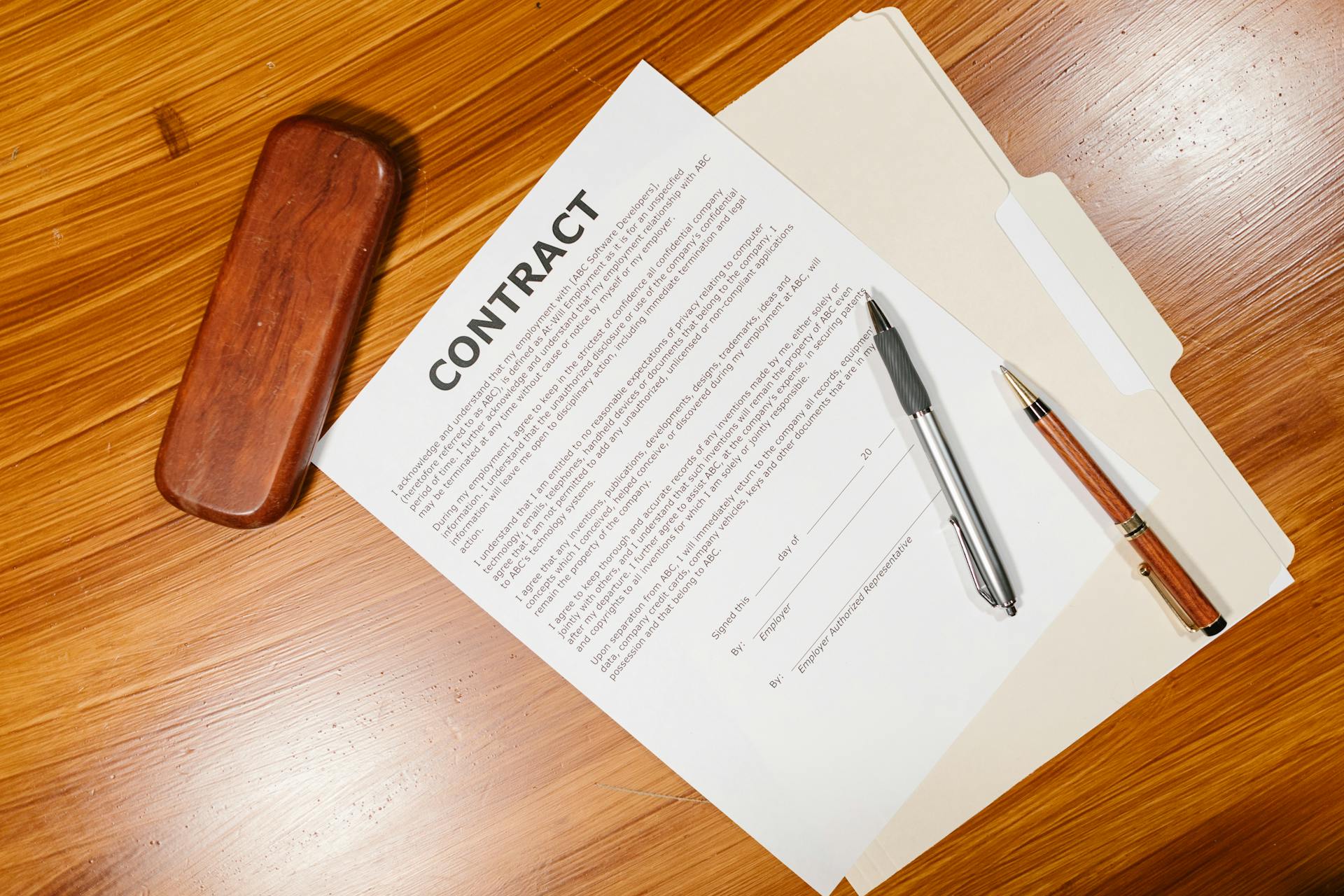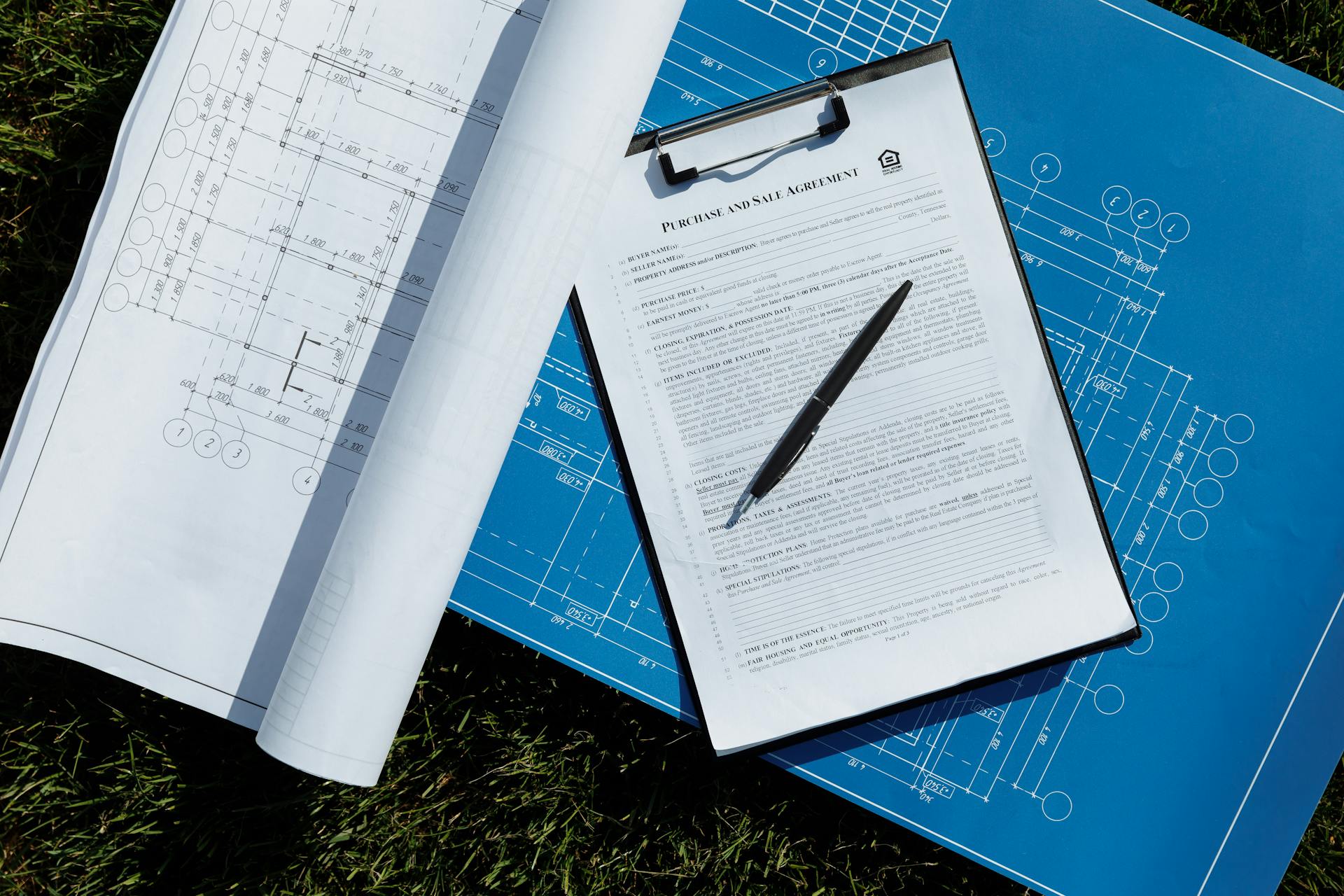
A land contract is a type of agreement where a seller allows a buyer to purchase their land without a bank loan. This can be a great option for buyers who can't qualify for a mortgage or want more control over the process.
The seller usually holds the title to the land until the buyer has made all the payments. This means the buyer gets to use the land and make improvements, but the seller still has ownership until the contract is fully paid.
In exchange for not using a bank loan, the buyer typically pays a higher interest rate on the contract or makes larger monthly payments. This is because the seller is taking on more risk by not having the security of a mortgage.
For your interest: Seller Financing Land Contract
What Is a Land Contract?
A land contract is a written legal contract used to purchase real estate, similar to a mortgage, but instead of borrowing money from a lender, the buyer makes payments directly to the seller.
The buyer does not get full ownership of the property, but rather "equitable title", which is the right to obtain full ownership once the total purchase price is paid.
In a land contract, the buyer is in charge of making all repairs and paying property taxes, and most contracts also require the buyer to get homeowners insurance.
The parties can negotiate the monthly payments, including whether there will be a balloon payment, an unusually large payment due at the end of the purchase period.
In Michigan, the interest rate cannot be above 11%, and it's possible for the interest rate to change over time, but the average interest rate has to be 11% or less.
A land contract can make property easier to sell because the seller decides the credit requirements and down payment amount.
How It Works
A land contract is typically between two parties: the buyer – sometimes referred to as the vendee – and the seller, also known as the vendor.
The seller agrees to finance the property for the buyer in exchange for the buyer meeting the terms agreed upon in the land contract.
The buyer and seller work out the terms of the contract together, including the price of the property, the interest rate, and the payment schedule.
The buyer makes regular payments to the seller, usually with interest, until the full purchase price is paid.
The seller retains ownership of the property until the buyer has met all the terms of the contract.
Worth a look: Seller Financing Agreement
Unique Features
A land contract is a unique way to purchase real estate, and it has some distinct features that set it apart from traditional financing. Unlike traditional financing, land contracts are completely between you and the owner of the house, so each one will likely look a bit different.
One key feature of a land contract is that it's a form of seller financing, meaning the buyer agrees to take ownership of the property and then make payments to the real estate owner or seller until the purchase price is paid in full. This can be beneficial for buyers who may not qualify for traditional financing or want to avoid the hassle of dealing with a bank.
A unique perspective: Seller Financing for Land
A land contract is a written legal contract, or agreement, used to purchase real estate, and it's similar to a mortgage but with a key difference: the buyer doesn't borrow money from an institutional lender or bank. Instead, the buyer agrees to make payments directly to the seller.
The terms of a land contract will cover agreed-upon terms and conditions of the sale, including the purchase price, payment schedule, and any other requirements. Upon satisfaction of all contract terms and conditions, including payment of the purchase price over a specified time period, the legal title of the property transfers from the seller to the buyer by way of a warranty deed or other deed used to convey title.
Here are some key takeaways about the unique features of a land contract:
- Land contracts are a form of seller financing.
- The buyer agrees to take ownership of the property and make payments to the seller.
- The terms of the land contract will cover agreed-upon terms and conditions of the sale.
- The legal title of the property transfers from the seller to the buyer upon satisfaction of all contract terms and conditions.
Pros and Cons
A land contract isn't for every buyer and situation. You should consider all financing options and types of home loans available to you when buying property.
The benefits of land contracts include that they can be a financing option for buyers who don't qualify for traditional mortgages. They also allow sellers to sell their property without having to go through the lengthy and costly process of foreclosure.
However, land contracts also come with risks, such as the buyer defaulting on payments and the seller losing their property. At the least, you need to be fully aware of the benefits and risks of using a land contract.
Readers also liked: Benefits of a Prenup in Californaia
Pros and Cons
A land contract isn't for all buyers and every situation, so it's essential to consider all financing options and types of home loans available to you.
Ideally, you should be fully aware of the benefits and risks of using a land contract to complete a real estate transaction.
A land contract can be a good option for buyers who want to purchase a property but can't get a traditional mortgage.
This is because land contracts allow buyers to pay for the property in installments, which can be more manageable than a large upfront payment.
Pro: More Purchase Opportunities

A land contract can provide more opportunities to purchase a property, especially for buyers who need a bigger space but can't qualify for it under traditional home loan guidelines.
This financing option allows buyers to obtain the property through seller financing, paying off the land contract down the line through a mortgage once the balance is smaller.
For example, a buyer who needs a bigger space but can't qualify for a traditional mortgage may be able to obtain the property through a land contract.
This can be a game-changer for buyers who are struggling to meet the requirements of traditional lenders.
By using a land contract, buyers can get into a property sooner, even if they don't qualify for a traditional mortgage.
This can be a great option for buyers who are willing to take on a little more risk in exchange for the opportunity to own a property.
Explore further: Grows Bigger
Con: Vagueness
A land contract can be a viable option, but it's essential to be aware of the potential drawbacks. Contract vagueness is a significant con, as it can lead to misunderstandings and disputes down the line.

You'll want to scrutinize the contract to ensure it's ironclad, with clear payment terms and no room for ambiguity. Legal advice may be necessary to negotiate clear terms, so consider hiring a real estate attorney.
A title search is crucial to reveal any encumbrances on the property or outstanding debt, and to ensure the seller has ownership rights. This will also give you peace of mind knowing you're getting a clear title to the property.
You'll also want to get in writing that you get legal title to the property no later than when the principal is paid off as defined by the sale price of the property. This will protect your interests and prevent any potential disputes.
A thorough title search at the county's Register of Deeds can reveal existing liens or other issues that limit your rights to the property. It's a simple step that can save you a lot of headaches down the line.
Additional reading: Know Your Rights with Debt Collectors
Higher Interest Rates
Higher Interest Rates can be a major drawback of land contracts. The seller will likely charge you a rate higher than current market interest rates for traditional financing because they're taking on the higher risk.
This is because land contracts are often used by buyers who can't qualify for a standard mortgage, which means the seller is assuming more risk by lending to you.
As a result, you can expect to pay a higher interest rate on your land contract, which can increase the overall cost of the property over time.
Worth a look: External Risk
Buyer Breach Consequences
If the buyer breaches the land contract, they could lose all the money they've paid so far. The seller can file a court action called "land contract forfeiture", which means the buyer forfeits all money paid and loses their equitable title to the property.
Missing or partial payments can cause problems for the buyer, and the seller can take action. The most common action the seller takes is to forfeit the contract.
Readers also liked: Class Action Lawsuit Credit Card Fees
A buyer who misses a payment or doesn't make the entire payment risks having the contract canceled. The seller can use forfeiture as a remedy for any breach of the contract.
Foreclosure is a less common remedy, but it's still an option for the seller. The seller can use either forfeiture or foreclosure if the buyer breaches the contract.
The seller takes a risk by selling through a land contract, but they have protection in case the buyer fails to pay. The buyer needs to be aware of these consequences to avoid losing their investment.
A fresh viewpoint: Texas the Contract Provides Express Remedy
Parties' Responsibilities
A land contract should clearly state the responsibilities of the parties involved, including the buyer's obligation to make mortgage payments.
The contract should also outline what happens if the buyer defaults on payments, including any timeline for paying back missed payments and conditions under which the buyer may become delinquent.
The seller's responsibilities should be clearly defined, including any maintenance or repair requirements for the property.
If a buyer misses a payment or doesn't make the entire payment, the seller can take action, such as forfeiting the contract or foreclosing on the property.
It's essential for buyers to carefully review the contract and understand their responsibilities before signing.
Consumer Protection Concerns
Consumer protection concerns are real, particularly when it comes to land contracts.
The Consumer Financial Protection Bureau (CFPB) is considering regulations on land contract sales due to concerns that they may violate truth in lending laws.
In Texas, a change to the law in 2015 automatically places the legal title to the property with the buyer, but the seller retains a vendor's lien for the outstanding balance of the contract.
Historically, contract-for-deed arrangements were popular in mid-20th-century Chicago, and buyers, often black families shunned from government-insured mortgage loans, didn't accumulate equity and faced a long and precarious path to ownership.
This highlights the potential risks and challenges associated with land contracts.
Curious to learn more? Check out: Regulation Z Mortgage
Alternative Mortgage Options
A land contract is a viable alternative to traditional mortgage financing, allowing buyers to purchase real estate without relying on institutional lenders. It's a form of seller financing, where the buyer agrees to make payments directly to the seller until the purchase price is paid in full.
Unlike traditional financing, land contracts are negotiated directly between the buyer and seller, so each one will likely look different. This means buyers need to be careful when negotiating to ensure the terms don't put them at a disadvantage.
A buyer can become the new owner of the land-contract property once they've satisfied all contract terms and conditions, including payment of the purchase price over a specified time period. This typically involves transferring the legal title of the property from the seller to the buyer with a warranty deed or other deed used to convey title.
Land contracts can be a good option for buyers who don't qualify for traditional financing, but it's also a good idea to explore other financing options and get quotes from multiple lenders.
Traditional vs. Wrap-Around
Traditional land contracts and wrap-around land contracts are two alternative mortgage options that can be used to structure a land deal. In a traditional land contract, the seller keeps the legal title to the property until the land contract is fully paid off.
The buyer, on the other hand, gets equitable title, which allows them to build up equity in the property and can be converted into a regular mortgage later on. This means the buyer can eventually own the property outright.
In a wrap-around land contract, the seller keeps paying on their existing mortgage while collecting payments from the buyer. The seller pockets the difference between their mortgage payment and what they receive from the buyer each month.
One key difference between traditional and wrap-around land contracts is that the seller's lender must agree to a wrap-around land contract. This is because the lender won't receive the full payoff amount.
Here's a comparison of the two options:
In both types of land contracts, installment payments are due at periodic intervals as agreed upon by the buyer and seller. At the end of the term, the buyer may need to make a balloon payment to satisfy the loan terms.
Alternative for Home Buyers
If you're struggling to get traditional financing for a home, don't worry, there are other options available.
A land contract is a viable alternative for home buyers. It's a form of seller financing where the buyer agrees to make payments to the seller until the purchase price is paid in full.
The buyer and seller both sign the land contract, which covers the agreed-upon terms and conditions of the sale. This includes the payment schedule, interest rate, and any other important details.
A land contract is similar to a mortgage, but the buyer doesn't borrow money from a lender. Instead, they make payments directly to the seller.
Here are some key facts to consider:
- Why Are Land Contracts Used?
- When Does the Buyer Become the New Owner of the Land-Contract Property?
- What Happens If the Buyer Fails to Make the Land Contract Payments Due?
- Does an Attorney Need to Review a Land Contract?
- Other Resources on Home Financing and Real Estate Contracts
The buyer becomes the new owner of the property when the final payment is made and all conditions of the land contract are met. The deed to the property is then filed with the government office, naming the buyer as the new owner.
Don't be discouraged if you're not approved for a traditional mortgage. There are other options available, and a land contract may be the perfect solution for you.
Take a look at this: Is Balance Billing Legal in New York
Alternative Mortgage Financing Options
Alternative mortgage financing options can be a great way to buy or sell a house without using traditional financing methods. A land contract, for example, is a written legal contract between a buyer and seller that allows the buyer to take ownership of the property and make payments to the seller until the purchase price is paid in full.
Unlike traditional financing, land contracts are completely between the buyer and seller, so each one will likely look a bit different. As a buyer, you really have to be careful when negotiating to ensure that the terms don’t put you at too much of a disadvantage.
A buyer and a seller both sign the land contract, which will cover agreed-upon terms and conditions of the sale. Upon satisfaction of all contract terms and conditions, including payment of the purchase price over a specified time period, the legal title of the property transfers from the seller to the buyer by way of a warranty deed or other deed used to convey title.
A unique perspective: Paying off a Collection Account and Credit Score
There are two main types of land contracts: traditional and wrap-around. In a traditional land contract, the seller keeps the legal title to the property until the land contract is fully paid off. Meanwhile, the buyer gets equitable title, which enables them to build up equity in the property and can allow them to pay off their land contract by converting it into a regular mortgage.
Here are some key differences between traditional and wrap-around land contracts:
A wrap-around land contract can be beneficial for buyers who want to own the property immediately, but it requires the seller's lender to agree to the arrangement. The lender takes a junior lien position, which means they can take the home back if the seller stops making payments.
Traditional Mortgage Conversion
Converting a land contract to a traditional mortgage can be a great option for buyers who are able to get their credit in shape and meet other qualifying standards.
You'll need to provide a copy of the fully executed land contract to the lender, which will help them determine the loan amount and ensure the title is clear.
A payment history of your land contract is also crucial, as it will be used to verify your qualifications.
To get started, gather as long a payment history as possible and be prepared to provide it to the lender.
The lender may also require an appraisal to verify the value of the property.
A different take: Do Prenuptials Hold up in Court
Late Payment Consequences
If the buyer fails to make land contract payments due, the seller can file a court action called "land contract forfeiture." This can result in the buyer forfeiting all money paid to the seller for the property.
The seller can keep all money received plus the real estate itself if the buyer defaults on the land contract. This is because the buyer's equitable title will be extinguished.
The buyer takes a risk by entering into a land contract because they may forfeit all payments made if they're unable to make future payments. The seller, on the other hand, gets to keep a periodic income stream throughout the term of the contract.
Intriguing read: Debt Collectors Keep Calling Me
If a buyer misses a payment or doesn't make the entire payment, the seller can take action by forfeiting the contract. This is the most common remedy a seller takes for a breach of the contract.
The seller can also use foreclosure as a remedy for a breach of the contract, although this is less common.
A unique perspective: Legal Remedies Breach of Contract
Parties' Responsibilities
In a land contract, the buyer and seller have specific responsibilities to each other.
The contract should clearly state the responsibilities of the parties, including whether the buyer will make the mortgage payment.
If the buyer defaults on payments, the contract should specify the timeline for paying them back and the conditions under which the buyer becomes delinquent.
The contract should explicitly state what happens if the buyer misses payments, including the possibility of the seller taking the property back.
The seller should not sell the property to a third party or subject it to a lien or encumbrance that would interfere with the buyer's interest in it.
The buyer should thoroughly inspect the property before signing the contract to identify any needed repairs.
The buyer should record their interest in the property at the Register of Deeds to protect their rights to the property.
Readers also liked: State Contractors Payment Terms Commonwealth of Mass
Why Are Land Contracts Used?
A land contract is a flexible way to buy and sell real estate. It allows the buyer to make monthly payments directly to the seller, which can be beneficial for buyers who can't get a mortgage from a traditional lender.
The seller benefits from a land contract too, as it gives them more options for potential buyers and allows them to negotiate a higher purchase price. The seller can also require and receive a large cash down payment.
The final payment in a land contract is often a large balloon payment, which can be made with the help of a conventional mortgage loan from a bank. This is especially helpful for buyers who don't qualify for conventional mortgage loans due to poor credit or an insufficient down payment.
Using a land contract can also save the seller from paying third-party lender fees, such as title service, appraisal, and termite inspection costs. These costs can add up and make the closing process more complicated.
A land contract is a unilateral contract, which means it can't be assigned to another buyer without the seller's consent. This gives the seller control over the sale and ensures they can negotiate the terms of the contract.
When Does Buyer Become Owner?
The buyer becomes the new owner of the land-contract property when they make the final payment and all conditions of the land contract are met. This is when the deed to the property is filed with the government office, naming the buyer as the new owner.
The buyer has an interest in the land contract property from the moment they start making payments to the seller, known as an "equitable title". This means the seller can't sell the property to anyone else or put a lien on it that would affect the buyer's interest.
The seller still holds the "legal title" to the property until the final payment is made, at which point the buyer's equitable title becomes the legal title.
A unique perspective: Buyer's Credit
Featured Images: pexels.com