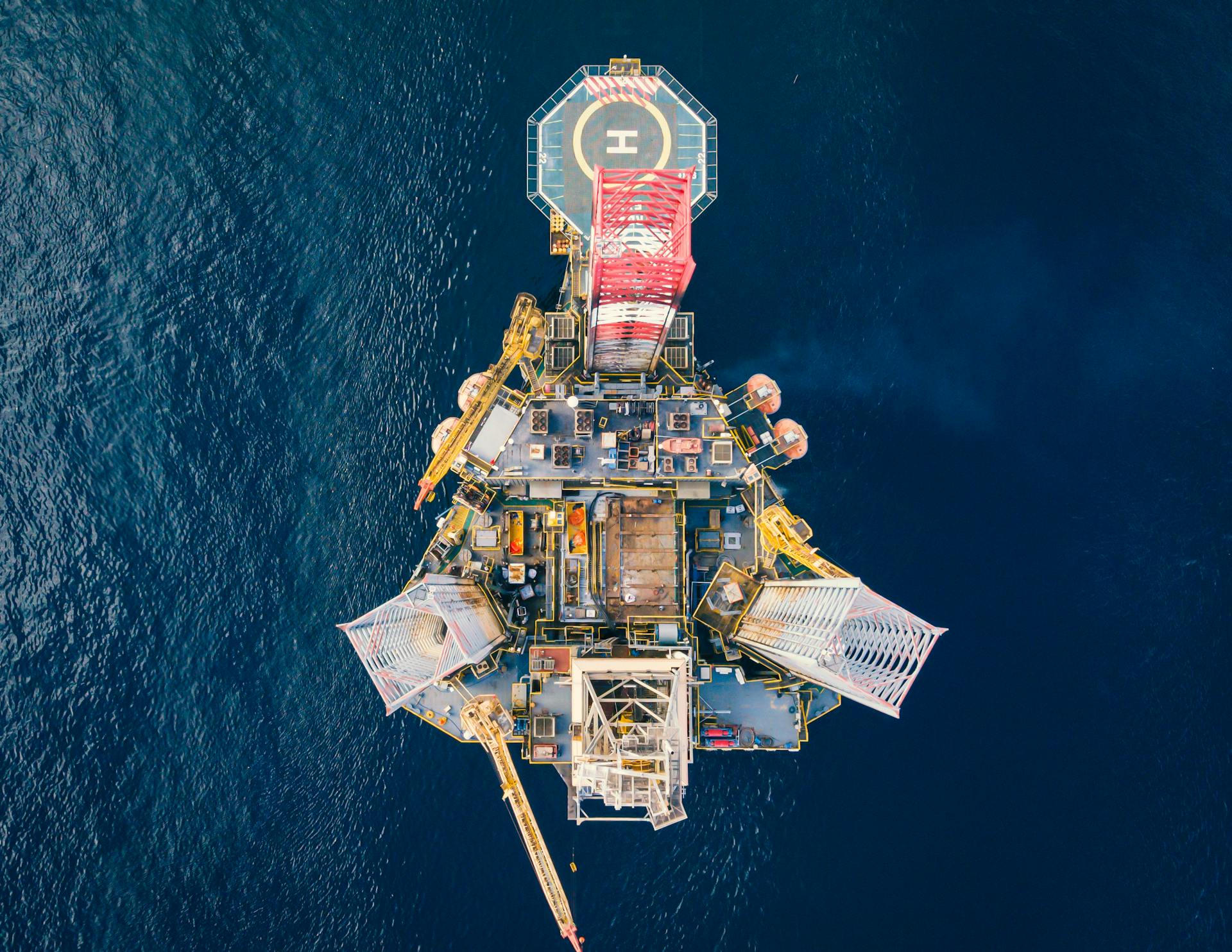
The Kashagan Field is a major offshore energy project located in Kazakhstan, on the Caspian Sea. It's a massive undertaking that requires careful planning and execution.
The Kashagan Field is estimated to hold approximately 9 billion barrels of oil, making it one of the largest oil fields in the world. This vast reserve has significant implications for the global energy market.
Located in a remote area, the Kashagan Field is a challenging project to develop, requiring specialized equipment and expertise to extract the oil. The harsh environment and complex geology add to the complexity of the project.
The Kashagan Field is operated by a consortium of companies, including Eni, ExxonMobil, and Royal Dutch Shell, among others. This collaboration is essential to bringing the project online and ensuring its successful operation.
Geology and Exploration
The Kashagan Field is a massive oil field located in the Caspian Sea, covering an area of over 5,500 square kilometres. It consists of five separate fields, including Kashagan, Kalamkas A, Kashagan Southwest, Aktote, and Kairan.
The Kashagan reservoir is a carbonate platform of Late Devonian to middle Carboniferous age, stretching 75 kilometres long and 35 kilometres wide. The reservoir is heavily pressurized, which presents a significant drilling challenge.
The field is in very shallow water, with depths ranging from 3 to 9 metres, and the oil column extends for over 1,000 metres. The oil is a light oil with 45 API gravity, and it has a high gas-oil ratio and hydrogen sulphide (H2S) content of 19%.
Geology
The Kashagan contract area is a massive 5,500 square kilometres, covering five separate fields in the Precaspian Basin.
These fields are all located in shallow water, with depths ranging from 3 to 9 metres.
The Kashagan field itself is a 75-kilometre-long and 35-kilometre-wide carbonate platform, stretching across the Caspian Sea.
It's a remarkable geological formation, with a narrow neck joining two broader platforms, Kashagan East and Kashagan West.
The reservoir is approximately 4,500 metres below sea level, with an oil column extending for over 1,000 metres.
The seal is middle Permian shale and late Permian salt, which helps to trap the oil.
The reservoir consists of limestones with low porosities and permeabilities, making it a challenging drilling environment.
The oil in the Kashagan field is a light oil with 45 API gravity and a high gas-oil ratio.
Unfortunately, the oil also contains a high concentration of hydrogen sulphide, which poses a significant environmental risk.
The estimated oil in place is between 30 and 50 billion barrels, with a commonly quoted figure of 38 billion barrels.
However, the recovery factor is relatively low, ranging from 15 to 25%, due to the reservoir's complexity.
This means that only between 4 and 13 billion barrels are estimated to be recoverable from the field.
Worth a look: Permian Basin Royalty Trust
Path to Discovery
The Kashagan oil field was discovered in June 2000 by the Kashagan East-1 discovery well, located in water depths between 3m and 4m.
The field's commercial status was declared in June 2002, following the drilling of the Kashagan West-1 exploration well and the Kashagan East-2 appraisal well in 2001.
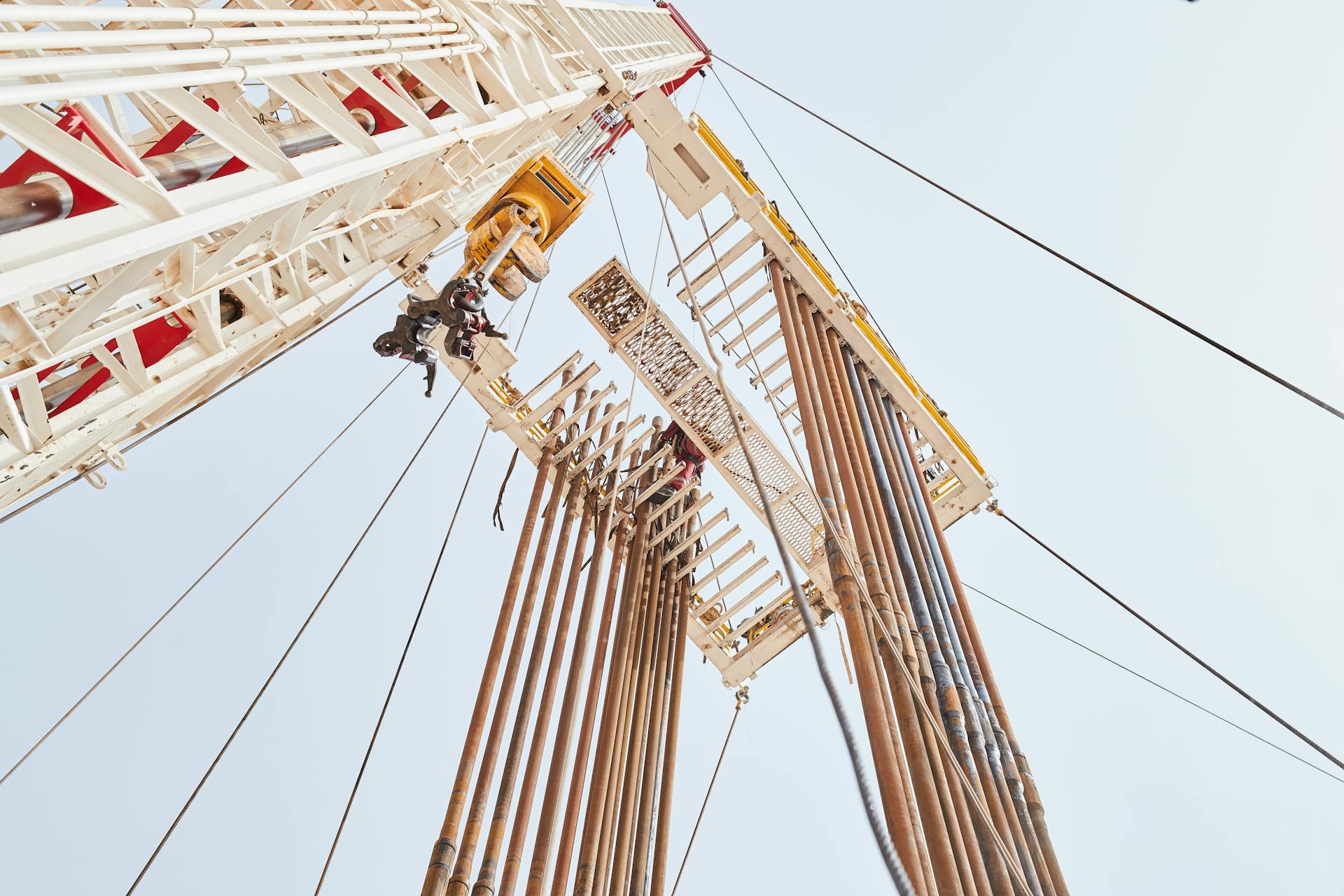
The Kashagan field covers 2,678km² in the Caspian Sea, measuring 75km-long and 45km-wide.
Kashagan is considered one of the world's biggest oil discoveries in 45 years.
The highly-pressurised Kashagan reservoir is estimated to contain more than 35 billion barrels of oil, with up to 13 billion barrels being recoverable.
The hydrocarbon fluids in the Kashagan reservoirs have a high concentration of hydrogen sulphide.
Project Development
Eni has been present in Kazakhstan since 1992 and is a co-operator of the Karachaganak field in production.
The company participates in the North Caspian Sea PSA consortium, which is responsible for operations at the Kashagan field.
The production of hydrocarbons and natural gas in Kashagan is constantly increasing through studies for further development phases implemented during Eni's activity.
Eni does not carry out exploration activities within the boundaries of Natural Sites included in the UNESCO World Heritage List to respect local biodiversity.
The Kashagan field development is planned to progress from the eastern and central parts of the field towards the western end.
For your interest: Eni Gas & Power France
The full field development plan includes a total of 35 drilling centres, two offshore processing hubs, three offshore gas plants, and a large-scale onshore processing facility with multiple oil trains and gas sweetening plants.
Approximately 1,000km of infield pipelines, umbilicals, and power cables, and 500km of trunk lines are part of the development plan.
Discovery and Reserves
The Kashagan Field is an incredible discovery, and I'm excited to share some of its remarkable facts with you.
Located in the Caspian Sea, the Kashagan Field was discovered in June 2000 by the Kashagan East-1 discovery well.
The field is situated in shallow water, with depths ranging from 3m to 4m.
The Kashagan Field was declared commercial in June 2002, after the drilling of the Kashagan West-1 exploration well and the Kashagan East-2 appraisal well in 2001.
This massive field covers an area of 2,678km², measuring 75km-long and 45km-wide.
The Kashagan reservoir is located 4.2km beneath the seabed and is estimated to contain more than 35 billion barrels of oil.
Of these, up to 13 billion barrels are considered recoverable.
The hydrocarbon fluids in the Kashagan reservoir have a high concentration of hydrogen sulphide.
For your interest: Warner Bros. Discovery New Zealand
Phase One Details
Construction of the D Island, the biggest artificial island built on the Kashagan field, started in November 2002.
Drilling activities from the D Island began in July 2006.
The onshore processing facility at Bolashak was started after the Republic of Kazakhstan Government approved the Kashagan development plan in 2004.
Most of the onshore and offshore installation works were performed between 2006 and 2008.
Offshore hook-up works took place in 2010.
Two raw gas injection modules were installed on the D Island in June 2012.
Initial production from the Kashagan field started in September 2013.
However, it had to be suspended due to gas leakage and defects in the onshore section of the gas pipeline originating from the field.
The Kashagan oil and gas field was officially declared operational in November 2016.
The Kashagan field has been developed with a total of 40 wells and five artificial islands.
Connected with all other offshore bases, the D Island serves as the offshore processing and production hub for the field.
For your interest: Employment Equality (Age) Regulations 2006
The produced hydrocarbon fluids are processed for oil and gas separation at the D Island.
Half of the gas produced is re-injected into the reservoir.
The remainder of the gas and crude oil are piped onshore to the Bolashak plant for final processing.
The pipeline network for Kashagan phase one involved a total of 510km.
The bulk of crude oil processed at the Bolashak facility is fed into the Caspian Pipeline Consortium (CPC) pipeline system.
Take a look at this: Plains All American Pipeline
Production and Management
The Kashagan Field has been a significant oil production site, with its first crude export happening in October 2016, totaling 26,500 metric tons. This marked the beginning of commercial oil production at the field.
By the end of 2017, North Caspian Operating Co. aimed to increase production capacity to 370,000 barrels a day. The field produced over 450,000 tonnes of raw materials as of November 2016.
In 2016, over 350,000 tonnes of oil from the Kashagan field was transported through the Caspian Pipeline Consortium (CPC) pipeline. The field produced 400,000 barrels of oil per day in 2019.
Expand your knowledge: North Baja Pipeline
Here's a summary of the field's production milestones:
- 2016: First crude export, 26,500 metric tons
- 2016: Produced over 450,000 tonnes of raw materials
- 2016: Transported over 350,000 tonnes of oil through the CPC pipeline
- 2019: Produced 400,000 barrels of oil per day
The field's production capacity has continued to increase, with the phase one development achieving 180,000bopd production capacity in early-2017 and 200,000bopd by mid-2017.
Intriguing read: Health Saving Account Contribution Limit 2017
Contractors and Development
The Kashagan field has seen a significant amount of development work, with multiple contractors involved in its construction. ERSAI Caspian Contractor, a subsidiary of Saipem, was awarded a £1.17bn contract for the construction of two 95km pipelines connecting the D island of the Kashagan field with the Karabatan onshore plant in February 2015.
Saipem was also engaged for the review and development of the Pre-FEED study, detailed design, and onshore survey for the project from 2005 to 2006. This extensive work was a crucial part of the Kashagan field's development.
North Caspian Constructors (NCC), a joint venture of Fluor, Tekfen Construction, and Gama Group, was contracted for the management of onshore construction works in October 2005. This joint venture played a vital role in the construction of the Kashagan field.
ENKA along with its Kazakh partner MSS was also engaged for offshore civil construction works for the project. The company was involved in the Pipeline Replacement Project that was implemented between 2015 and 2016.
KBR provided project management services for the Kashagan phase one as well as provided conceptual design for phases two and three. The company's expertise was instrumental in the development of the Kashagan field.
McDermont provided FEED for the Kashagan full field development plan, while WorleyParsons, in a joint venture with CB&I and Aker Solutions, was awarded an updated FEED services contract for phase two development of the field in April 2010. The Kashagan field's development plan is a complex one, requiring the expertise of multiple contractors.
The Boskalis-Archirodon joint venture was contracted for the construction of rock islands on the field in 2003. This work was a critical part of the Kashagan field's development.
GE Oil & Gas provided the sour gas reinjection trains for the project. The company's equipment has played a vital role in the Kashagan field's operations.
KazStroyService and Punj Lloyd were engaged for the construction of oil and gas export pipelines for the project. The construction of these pipelines was a significant undertaking.
ABB provided a self-contained power generation barge for the project under a contract awarded in September 2004. This power generation barge has been instrumental in the Kashagan field's operations.
Synectics Industrial Systems provided IP networked CCTV system for the project. The company's system has improved the Kashagan field's operational efficiency.
Prospects and Challenges
The Kashagan Field has the potential to be a game-changer for the energy industry. The field is estimated to hold up to 9-13 billion barrels of oil, making it one of the largest oil fields in the world.
The field's remote location and harsh climate pose significant logistical challenges. The field is located in the Caspian Sea, making it difficult to access and extract the oil.
Despite these challenges, the Kashagan Field is expected to become a major player in the global energy market. The field's oil reserves are estimated to meet 10% of the world's current demand.
Additional reading: Fx Market Making
However, the field's development has been plagued by delays and cost overruns. The project has been delayed multiple times, with the initial start-up date being pushed back from 2005 to 2013.
The field's production capacity is expected to reach 1.5 million barrels per day, making it one of the largest oil-producing fields in the world. This will not only meet the world's demand but also provide a significant boost to the local economy.
The Kashagan Field's development is a complex and ambitious project that requires significant investment and expertise. The project has already seen significant investment, with over $50 billion being spent on its development.
The field's oil will be transported to the Bautino terminal via a 76-kilometer pipeline, which will be the longest onshore pipeline in the world. This will not only reduce transportation costs but also minimize the environmental impact of the project.
Related reading: Rockies Express Pipeline
Frequently Asked Questions
Who owns the Kashagan field?
The Kashagan field is jointly owned by seven major oil companies: China National Petroleum, Eni, Exxon Mobil, Inpex, KazMunayGas, Shell, and TotalEnergies. This diverse ownership structure contributes to the field's complex operations and management.
Featured Images: pexels.com