Iridium Communications is a company that specializes in satellite-based voice and data communications. It offers a range of products and services that cater to various industries and applications.
Iridium's products include handheld satellite phones, satellite-based data services, and a constellation of low-Earth orbit satellites. These satellites provide global coverage and enable users to make voice and data calls from anywhere in the world.
The company's business model is based on a subscription-based service, where users pay a monthly fee for access to Iridium's network. This fee includes a certain number of minutes or data usage, depending on the plan chosen by the user.
A fresh viewpoint: Sell Iridium
Satellite Technology
Iridium Communications operates a unique constellation of 66 cross-linked Low Earth Orbit (LEO) satellites, providing truly global voice and data communication services, including coverage over the poles.
These satellites communicate with neighboring satellites via Ka band inter-satellite links, and each satellite can have four inter-satellite links to ensure excellent satellite visibility and service coverage.
For more insights, see: Sino Satellite Communications
The satellites orbit from pole to pole with an orbital period of roughly 100 minutes, and the constellation has six orbital planes spaced 30° apart, with 11 satellites in each plane.
Here are some key features of the Iridium satellite network:
- Global coverage, including over the poles
- Low Earth Orbit (LEO) satellites
- 66 cross-linked satellites
- Four inter-satellite links per satellite
- Six orbital planes spaced 30° apart
- 11 satellites in each plane
The Iridium network connects mobile devices anywhere on the planet through satellite links routed via ground stations, making it a reliable service for niche markets like journalists, explorers, and military units.
Satellite Constellation
The Iridium satellite constellation is a network of 66 active satellites in low Earth orbit, with 9 spare satellites kept in orbit to serve in case of failure. These satellites are arranged in six polar orbital planes, spaced 30° apart, with 11 satellites in each plane.
Each satellite weighs about 680 kilograms and can support up to 1,100 concurrent phone calls at 2,400 bit/s. The satellites communicate with neighboring satellites via Ka band inter-satellite links.
The Iridium system requires a high level of precision to ensure seamless global coverage, which is achieved through the use of orbital perturbation analysis to aid in the process of moving spare satellites to different planes. This process can take several weeks and consumes fuel, which shortens the satellite's expected service life.
Check this out: Philippine Communications Satellite Corporation
Orbital velocity of the satellites is approximately 27,000 km/h, which allows for excellent satellite visibility and service coverage, especially at the North and South poles. The satellites orbit from pole to pole with an orbital period of roughly 100 minutes.
The Iridium constellation has a unique design, with each satellite having four inter-satellite links, and cross-seam inter-satellite link hand-offs are not supported due to large Doppler shifts. The constellation continued operation following the bankruptcy of the original Iridium corporation.
The Iridium system operates within a dedicated band segment from 1,618.725 to 1,626.5 MHz and shares with Globalstar a band segment from 1,617.775 to 1,618.725 MHz. These segments are part of the wider L band, adjacent to the Radio Astronomy Service (RAS) band segment from 1,610.6 to 1,613.8 MHz.
Intriguing read: Spot Price of Iridium
Collision
Collision can be a serious issue for satellites in space. The first hypervelocity collision between two artificial satellites in low Earth orbit occurred on February 10, 2009.
The Russian satellite Kosmos 2251 collided with the Iridium 33 at a relative speed of roughly 35,000 km/h (22,000 miles per hour). This collision created over 2000 large space debris fragments.
These fragments can be hazardous to other satellites, making space debris a significant concern for satellite technology. The collision also highlighted the importance of responsible satellite operation and debris mitigation strategies.
The Iridium 33 was one of the oldest satellites in the constellation, having been launched in 1997, and was in active service at the time of the accident.
A unique perspective: Broadcasting Satellite System Corporation
Products and Services
Iridium Communications offers a range of products and services that cater to various markets. Their portfolio includes Satellite Voice & Data Services, which provide global coverage and reliable L-band connectivity.
They also offer Internet of Things (IoT) Services, which enable low-latency data transmission and global machine-to-machine (M2M) connectivity. In fact, they've achieved over 1.8 million IoT subscribers by early 2024.
You might like: Ashland Global
Iridium Certus Broadband is another service that provides L-band broadband speeds up to 704 kbps. It's scalable and suitable for various platforms, including maritime, aviation, and land mobile.
For government and scientific research, Iridium offers Hosted Payloads & Other Services. These services utilize space on satellites for specific customer missions, such as AireonSM for global aircraft surveillance.
Some popular devices that use Iridium's satellite network include Garmin's inReach SE+ and inReach Explorer+ satellite communicators. These devices can send and receive text messages, provide location sharing, and offer direct communication options to emergency services.
Here's a summary of Iridium's products and services:
Global Safety and Security
Iridium Communications plays a vital role in global safety and security, particularly in remote and hard-to-reach areas.
The Federal Aviation Administration (FAA) approved the use of Iridium for Future Air Navigation System (FANS) data links in July 2011, enabling satellite data links with air-traffic control for aircraft flying in areas not served by Inmarsat.
Suggestion: What Is Allegiant Airlines
This approval allows for more efficient and reliable communication between aircraft and air-traffic control, especially in polar routes.
In January 2020, the Iridium constellation was certified for use in the Global Maritime Distress and Safety System (GMDSS), ending a monopoly held by Inmarsat since 1999.
This certification ensures that ships can now use Iridium's satellite network to send distress signals in emergency situations.
Cellphone Solutions
Iridium has been working on adopting standard-based solutions for cellphones. In 2024, they introduced Project Stardust, a 3GPP standard-based satellite-to-cellphone service focusing on messaging, emergency communications, and IoT for devices like cars, smartphones, tablets, and related consumer applications.
This solution will be supported using a version of the NB-IoT standard for 5G non-terrestrial networks (NTN) and is scheduled for launch in 2026. It won't replace the company's proprietary solution for voice and high-speed data, but will co-exist with that offering on the Iridium's existing global low-earth orbit satellite network.
Iridium has shifted its focus to standards-based solutions, likely due to market demand. Smartphone manufacturers have indicated a preference towards standards-based solutions for satellite-to-phone connectivity, prompting Qualcomm to discontinue their proprietary solution.
Additional reading: Viavi Solutions
One-Way Pagers
Two types of pagers were made for the Iridium network: the Motorola 9501 and Kyocera SP-66K.
These pagers are one-way devices that can only receive messages sent in the form of SMS.
They can be assigned with telephone numbers in area code 480.
Pagers can also be contacted using email and SMS.
Messages are delivered to pre-selected "MDAs" which cover a certain geographic area.
Standard-Based Cellphone Solutions
Iridium has been working on standard-based solutions for cellphones, a shift from their proprietary solution. This move is in response to smartphone manufacturers preferring standards-based solutions for satellite-to-phone connectivity.
In 2024, Iridium introduced Project Stardust, a 3GPP standard-based satellite-to-cellphone service. This service focuses on messaging, emergency communications, and IoT for devices like cars, smartphones, tablets, and related consumer applications.
Qualcomm, a partner of Iridium, notified them of the end of their partnership due to a lack of interest in their proprietary solution. Smartphone makers have indicated a preference for standards-based solutions.
See what others are reading: Better Online Solutions
The new standard-based solution will be supported using a version of the NB-IoT standard for 5G non-terrestrial networks (NTN). It's scheduled for launch in 2026 and will co-exist with Iridium's existing proprietary solution.
Here's a brief comparison of the two solutions:
Short Burst Modems
Short Burst Modems are a type of device that support only SBD for IoT services and don't use a SIM card. They're perfect for applications that require only short bursts of data.
The Iridium 9601 is a popular example of a Short Burst Modem, designed as an OEM module for integration into various applications. It supports SBD and has an RS-232 interface for easy connectivity.
The Iridium 9602 is a smaller, cheaper version of the 9601, released in 2010. This made it even more accessible to developers and manufacturers.
The Iridium 9603 is a compact version of the 9602, with a one-fourth volume and half the footprint.
Here are some key specs of these Short Burst Modems:
Ground Infrastructure
Iridium's ground infrastructure plays a crucial role in connecting satellite phones to the rest of the world. Communication between satellites and ground stations is at 20 and 30 GHz.
Iridium has several ground stations located around the globe, which link to the network through the satellites visible to them. These ground stations are strategically placed in key locations to ensure maximum coverage.
Here are some of the key ground stations that make up Iridium's network:
- Tempe, Arizona (USA)
- Fairbanks, Alaska (USA)
- Svalbard, Norway (Europe)
- Izhevsk, Russia
- Punta Arenas, Chile (South America)
These ground stations interconnect the satellite network with land-based fixed or wireless infrastructures worldwide to improve availability.
Stl
Iridium is providing Satellite Time & Location (STL) service, which was developed by Satelles company and later acquired by Iridium Communications in April 2024.
This service is based on low Earth orbit (LEO) satellites and is the only commercial positioning, navigation, and timing (PNT) service available as of April 2024.
Iridium STL service offers a unique solution for those who need accurate time and location information, and it's a great example of how satellite technology can be used to provide essential services.
Worth a look: Paramount Communications, Inc. V. Time Inc.
Ground Stations
Ground stations are a crucial part of the Iridium network, allowing it to connect with land-based infrastructures worldwide. They're essentially the gateway between space and the ground.
There are several ground stations that link to the Iridium network through the satellites visible to them. These stations are strategically located around the world.
Some of the notable ground stations include:
- Tempe, Arizona (USA)
- Fairbanks, Alaska (USA)
- Svalbard, Norway (Europe)
- Izhevsk, Russia
- Punta Arenas, Chile (South America)
Communication between satellites and ground stations is done at 20 and 30 GHz frequencies.
Business and Finance
Iridium Communications operates a capital-intensive business due to the high cost of building, launching, and maintaining its Low Earth Orbit (LEO) satellite constellation. This creates significant operating leverage; once fixed costs are covered, additional subscribers contribute significantly to profitability.
The company's pricing involves recurring subscription fees for various service plans, such as voice, data, and IoT services, tailored to different market segments like maritime, aviation, government, and land mobile. One-time revenue is also generated from hardware sales.
Key economic drivers for Iridium Communications include growing the subscriber base, particularly in the high-growth IoT segment, and maintaining stable or increasing Average Revenue Per User (ARPU) to drive service revenue growth. Government contracts provide a stable, long-term revenue foundation.
Here's a breakdown of Iridium Communications' revenue streams, estimated for FY2024:
History
The history of Iridium Communications is a fascinating story. The company was launched on November 1, 1998, as Iridium SSC, with the first call being made by Vice President Al Gore to Gilbert Grosvenor, the great-grandson of Alexander Graham Bell.
The company's name comes from the chemical element iridium, which has an atomic number of 77, matching the initial number of satellites required for global coverage. However, only 66 satellites were ultimately needed.
The Iridium satellites were launched into orbit in 1998, but the company went into Chapter 11 bankruptcy just nine months later due to mismanagement and high costs. The initial commercial failure of Iridium had a damping effect on other proposed commercial satellite constellation projects.
For more insights, see: Telephone Number for Frontier Communications
In 1999, CNN writer David Rohde detailed the difficulties he experienced trying to get Iridium service, including a "run-around" from the company's representatives. This was just one of the many challenges that contributed to the company's downfall.
The US government stepped in to save Iridium in 2000, providing $72 million in exchange for a two-year contract. The company was eventually sold for $25 million in 2001, erasing over $4 billion in debt.
Here's a brief timeline of some key events in Iridium's history:
The company was restarted in 2001 by a new group of private investors, who have since worked to revitalize the business. In 2025, Iridium entered into a partnership with Deutsche Telekom to integrate its Iridium NTN Direct service with Deutsche Telekom's mobile network.
Recommended read: Telekom Malaysia
Business Economics
Iridium Communications Inc.'s business economics is a complex beast, but let's break it down. The company operates a capital-intensive business due to the high cost of building, launching, and maintaining its Low Earth Orbit (LEO) satellite constellation.
See what others are reading: How Does Business Communication Differ from Communication in General
This creates significant operating leverage; once fixed costs are covered, additional subscribers contribute significantly to profitability. This is a crucial point, as it means the company can scale its business quickly once it reaches a certain point.
Key economic drivers include growing the subscriber base, particularly in the high-growth IoT segment. This is a key area of focus for the company, as it has the potential to drive significant revenue growth.
Maintaining stable or increasing Average Revenue Per User (ARPU) is crucial for service revenue growth. This means that the company needs to ensure that its customers are paying a good price for its services, and that prices are increasing over time.
Government contracts provide a stable, long-term revenue foundation. This is a significant advantage for the company, as it provides a predictable source of revenue that can help offset the risks associated with the capital-intensive nature of its business.
Here are the key economic drivers for Iridium Communications Inc.:
- Growing the subscriber base, particularly in the high-growth IoT segment.
- Maintaining stable or increasing Average Revenue Per User (ARPU).
- Government contracts providing a stable, long-term revenue foundation.
Market Position and Outlook
Iridium Communications Inc. maintains a strong position in the Mobile Satellite Services (MSS) market, particularly for critical communications, safety services, and the rapidly expanding Internet of Things (IoT) sector.
Its LEO satellite constellation provides truly global coverage, a significant advantage over geostationary satellites with higher latency.
The company generated total operational revenue of $801.3 million in fiscal year 2024, primarily driven by recurring service revenue.
Iridium's niche focus on reliable, truly global L-band services, voice communications, and specialized data applications provides a defensible market space.
Its strategic initiatives, particularly around expanding IoT connections and entering the direct-to-device market, signal its intent to leverage its network infrastructure for future growth vectors.
The satellite communications market features several key players, each with distinct strengths.
Here's a snapshot of the competitive landscape as of early 2025:
Iridium's future outlook hinges on capitalizing on IoT growth, expanding government contracts, and successfully integrating new direct-to-device capabilities, balanced against increasing competition from established players and new LEO constellations.
Worth a look: New Brunswick Liquor Corporation
Leadership and Strategy
At the helm of Iridium Communications is an experienced executive team, led by Matthew J. Desch as Chief Executive Officer (CEO) and Director. Thomas J. Fitzpatrick serves as Chief Financial Officer (CFO), Chief Administrative Officer (CAO), and Senior Vice President.
This team is responsible for guiding the company's strategic direction and day-to-day operations. They oversee the company's mission to provide reliable global satellite communications services.
The company's leadership team is complemented by a strong, experienced team that drives Iridium's success.
Strategic Advantages
Iridium Communications Inc. has made a significant investment of $3 billion in a complete satellite constellation replacement, Iridium NEXT. This bold move has enabled the company to offer new, higher-bandwidth services and ensure service continuity for decades.
The company's commitment to universal connectivity is deeply rooted in its mission and values. Iridium Communications Inc. prioritizes strategic direction and operational priorities beyond simple financial metrics.
The unique global coverage offered by Iridium is a game-changer. The company is the only commercial satellite network providing real-time, pole-to-pole coverage.
On a similar theme: Gap Inc Leadership
Iridium's L-Band Spectrum Resilience is another key advantage. This spectrum is known for its reliability and lower susceptibility to weather interference compared to other bands used by competitors.
The cross-linked satellite architecture used by Iridium enables low-latency communication and reduces reliance on numerous ground stations. This innovative approach sets the company apart from its competitors.
Iridium has established a strong presence in the niche market for critical communications in maritime, aviation, government, and industrial IoT sectors. The company's long-standing relationships and tailored solutions have cemented its dominance in this space.
Here are some key strategic advantages of Iridium Communications Inc.:
- Unique Global Coverage: Real-time, pole-to-pole coverage
- L-Band Spectrum Resilience: Reliable and less susceptible to weather interference
- Cross-Linked Satellite Architecture: Enabling low-latency communication and reduced reliance on ground stations
- Established Niche Market Dominance: Strong relationships and tailored solutions in critical communications sectors
- Proven Infrastructure & Ecosystem: A fully deployed next-generation constellation (Iridium NEXT) and a mature ecosystem of hardware manufacturers and service partners
Leadership
At the helm of Iridium Communications Inc. is a seasoned executive team that steers the company's direction and daily operations. Matthew J. Desch serves as the Chief Executive Officer (CEO) and Director.
Thomas J. Fitzpatrick is a triple threat as the Chief Financial Officer (CFO), Chief Administrative Officer (CAO), and Senior Vice President.
This leadership team oversees the company's mission to provide reliable global satellite communications services.
Launch and Operations
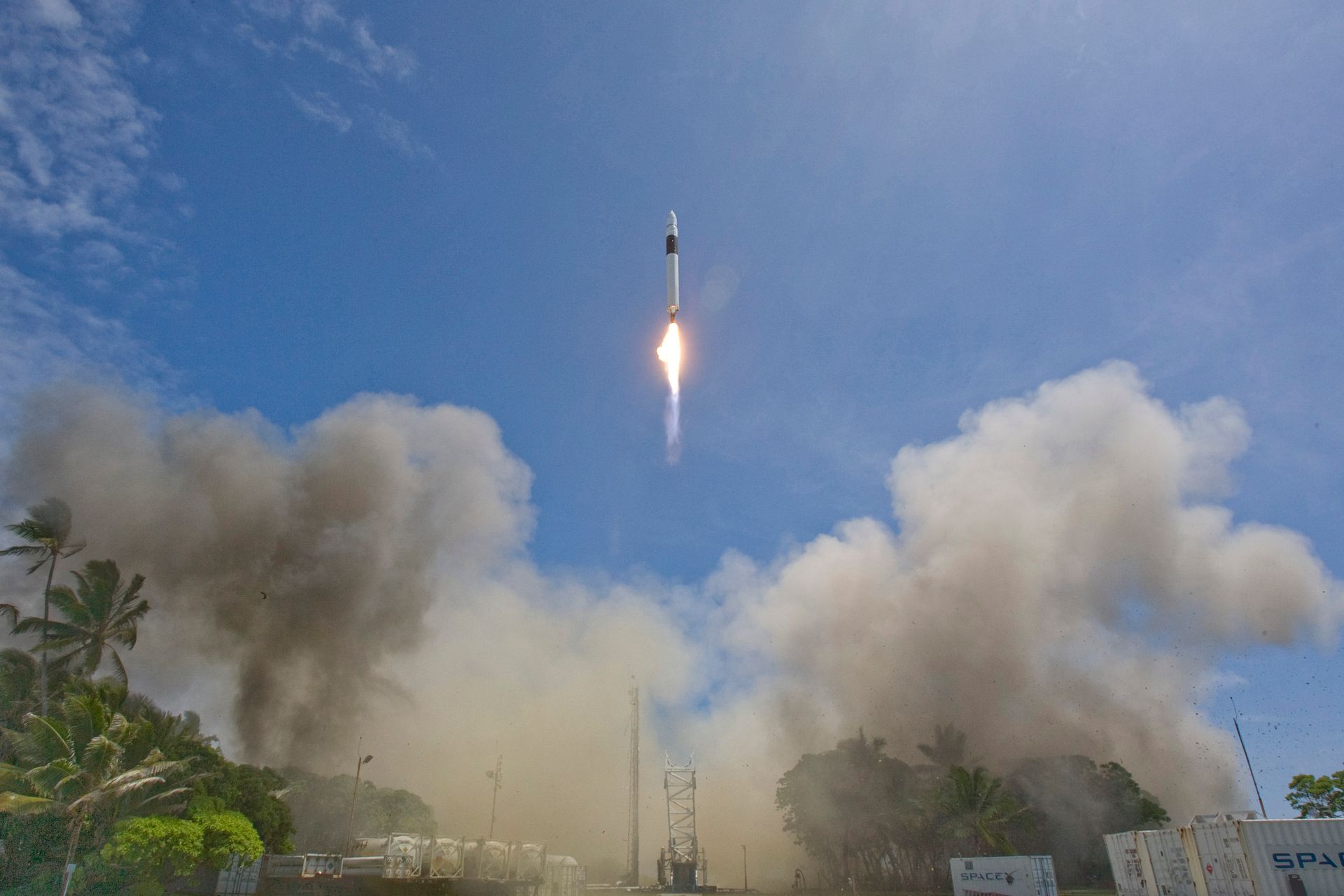
Iridium Communications has a robust launch and operations framework in place. The Iridium NEXT launch campaign was announced in 2007 and consisted of 8 launches using SpaceX Falcon 9 rockets.
The campaign involved upgrading Iridium's ground infrastructure and launching 75 new satellites into space. This was a significant undertaking, with the first launch taking place on January 14, 2017, and the final launch occurring on January 11, 2019.
The Iridium NEXT network covers the entire Earth, including poles, oceans, and airways, with 66 satellites and 9 active backups. This extensive network provides reliable connectivity to over 2.2 million billable subscribers as of late 2023/early 2024.
If this caught your attention, see: Goggo Network
Founding Timeline
Iridium Communications Inc. has a fascinating founding timeline that spans over two decades. The company was formed in 1998 with the commercial service launch of the world's first truly global satellite phone and paging service via a constellation of 66 low-Earth orbit satellites.
This ambitious endeavor was short-lived, as Iridium filed for Chapter 11 bankruptcy in 1999, just nine months after launch. The high operational costs, expensive handsets, and failure to achieve subscriber targets were major contributing factors.

In 2001, Iridium's assets were acquired by private investors for $25 million, forming Iridium Satellite LLC. This marked a significant shift in the company's focus towards government, military, maritime, aviation, and industrial markets.
Here's a brief overview of Iridium's major milestones:
Defunct Satellites
A defunct satellite is a satellite that has reached the end of its operational life and is no longer functioning. Many satellites are designed to have a limited lifespan, after which they are intentionally deorbited or left to decay in orbit.
The first satellite to be intentionally deorbited was the Russian satellite Kosmos 954, which re-entered Earth's atmosphere in 1978. It's a sobering reminder of the potential risks of space debris.
The European Space Agency (ESA) estimates that there are over 500,000 pieces of space debris in Earth's orbit, including defunct satellites and other human-made objects. This can pose a hazard to operational satellites and spacecraft.
Some defunct satellites, like the Iridium 33 satellite, have been known to collide with operational satellites, causing damage and potentially leading to catastrophic failures.
Operational Framework
Iridium Communications Inc.'s Operational Framework is built around its sophisticated Iridium NEXT satellite constellation, supported by a global network of ground stations and a central Network Operations Center (NOC) in Virginia.
The company's operations are focused on network reliability, cybersecurity, and expanding service capabilities like Certus, which is a key factor in driving its market position.
The operational core of the company is the management and maintenance of its satellite constellation, which is crucial for delivering voice and data services, IoT connectivity, and specialized broadband solutions to its customers.
As of late 2023/early 2024 reporting, the company has surpassed 2.2 million total billable subscribers, driving service revenues that consistently account for approximately 80% of its total revenue.
Equipment sales make up the remaining portion of the company's revenue, highlighting the importance of its operational framework in generating revenue through both services and equipment sales.
Iridium Communications Inc. sells airtime access for voice and data services, IoT connectivity, and specialized broadband solutions through a vast network of service providers and value-added resellers, further expanding its market reach.
A different take: Vehicle Communications Equipment Cautiously
Launch Campaign
The Iridium NEXT launch campaign was a series of 8 launches that replaced the original constellation with 75 new satellites.
Iridium started working on launching new satellites in 2010, after completing financing within three years of the campaign's announcement in 2007.
The campaign included upgrades to Iridium ground infrastructure.
In June 2010, Iridium announced a fixed-price contract with Thales Alenia Space for the design and construction of the next-generation satellites.
The contract for launch services was signed with SpaceX in June 2010, designating the Falcon 9 as a major provider of launch services for the Iridium NEXT campaign.
The contract was the largest single commercial launch deal ever signed at the time, with a value of $492 million.
The first Iridium NEXT launch took place on January 14, 2017, from Vandenberg Air Force Base in California.
Over the next two years, Iridium sent an additional 65 satellites into low Earth orbit to completely replace the original satellite constellation.
The final Iridium NEXT launch took place on January 11, 2019.
A total of 75 satellites were launched, with 66 in orbit and 9 acting as active backups, and 6 remaining on the ground as spares.
If this caught your attention, see: The New York Times Company
Patents and Manufacturing
The Iridium system's patents played a crucial role in its development, with two main patents, U.S. Patents 5,410,728 and 5,604,920, covering satellite communications.
These patents were just the beginning, as the manufacturer generated several hundred more patents to protect the technology in the system.
The company's manufacturing initiatives were also instrumental in the system's technical success.
Motorola made a key hire, bringing on the engineer who had set up the automated factory for Apple's Macintosh.
He created the technology necessary to mass-produce satellites on a gimbal, reducing production time from months or years to just weeks.
At its peak, Motorola produced a new satellite every 4.3 days, with a lead-time of just 21 days.
A fresh viewpoint: Motorola Mobility
Featured Images: pexels.com