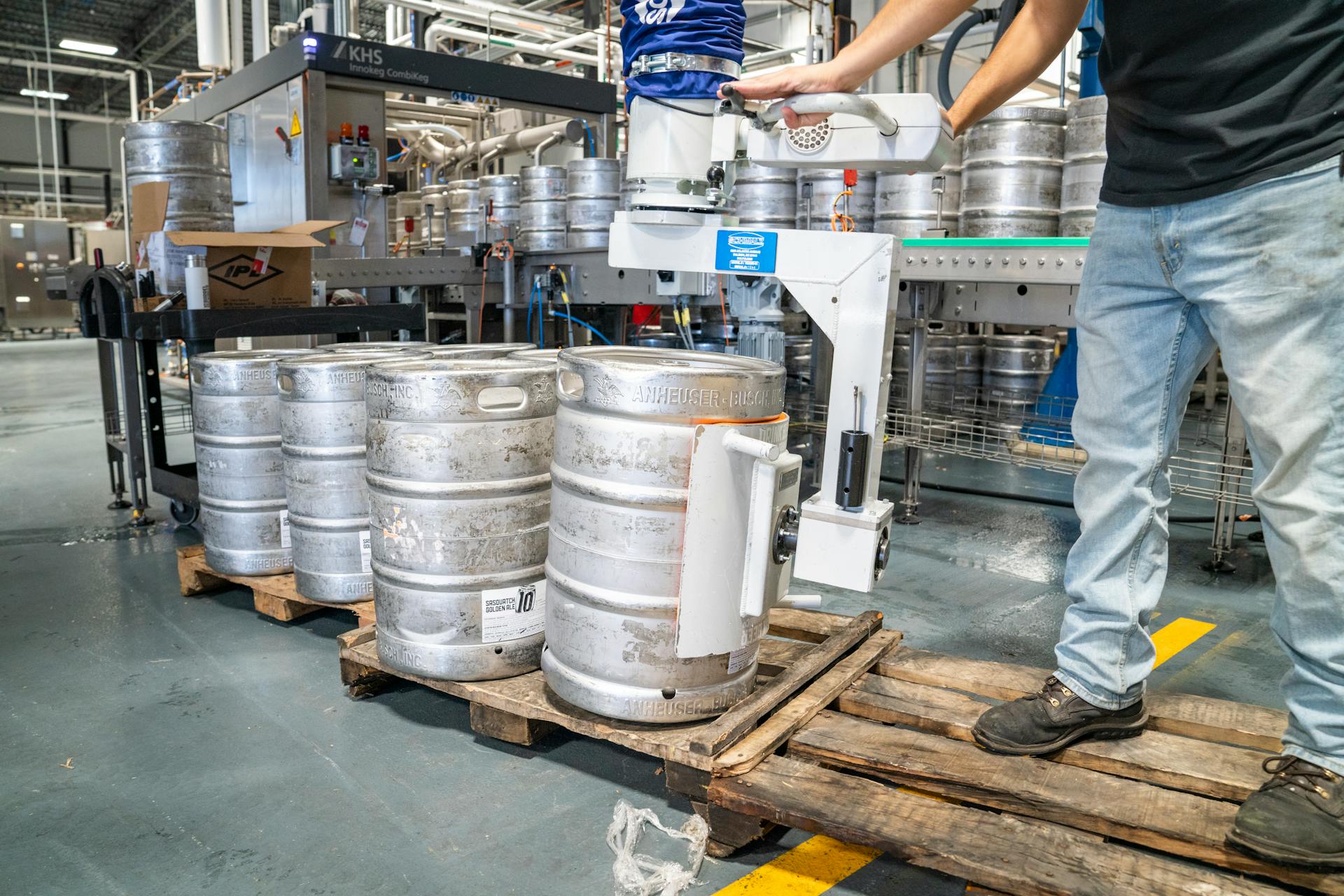
Industrial relations are the interactions between employers and employees in the workplace, and understanding them is crucial for maintaining a positive work environment.
Industrial relations involve the collective bargaining process, where employees or their representatives negotiate with management to reach a mutually beneficial agreement on wages, benefits, and working conditions.
Good industrial relations can lead to increased productivity, job satisfaction, and employee retention, while poor relations can result in strikes, decreased morale, and even lawsuits.
The collective bargaining process typically involves the negotiation of a labor contract, which outlines the terms and conditions of employment for a specific period.
Recommended read: NFL Collective Bargaining Agreement
History of Industrial Relations
The history of industrial relations dates back to the Industrial Revolution in the 18th century, where workers began to organize and demand better working conditions.
Industrialization led to the growth of factories and the emergence of a new class of industrial workers, who were often treated poorly and worked long hours for low wages.
The first trade unions were formed in the early 19th century, with the British Trades Union Congress (TUC) established in 1868, marking a significant milestone in the history of industrial relations.
The TUC played a crucial role in promoting workers' rights and improving working conditions, and its influence spread to other countries.
The late 19th and early 20th centuries saw a rise in labor movements and strikes, as workers continued to demand better treatment and working conditions.
The New Deal in the United States in the 1930s introduced significant reforms to labor laws, including the creation of the National Labor Relations Board (NLRB).
The NLRB was established to protect workers' rights to form unions and engage in collective bargaining, marking a major shift in the history of industrial relations.
The post-World War II period saw a significant increase in union membership and collective bargaining agreements, as workers continued to push for better wages and working conditions.
A unique perspective: Can You Change Medicare Supplement Plans with Pre Existing Conditions
Theoretical Perspectives
Industrial relations scholars have identified three major theoretical perspectives that shape our understanding of workplace relations. These perspectives are unitarism, pluralism, and the radical or critical school.
Unitarism views the organization as an integrated and harmonious whole, where management and employees share a common purpose and mutual cooperation is emphasized. This approach demands loyalty from employees and sees trade unions as unnecessary.
In contrast, pluralism sees the organization as made up of powerful and divergent sub-groups, each with its own interests and objectives. This perspective recognizes that conflict is inherent in workplaces and views trade unions as legitimate representatives of employees.
The radical or critical perspective, also known as the conflict model, looks at the nature of the capitalist society and sees workplace relations as a result of the fundamental division of interest between capital and labor. This view sees conflict as a natural outcome of capitalism and trade unions as a natural response of workers to their exploitation by capital.
Each of these perspectives offers a unique understanding of workplace relations and influences how we approach issues like conflict resolution, collective bargaining, and employee rights.
Consider reading: Workplace Safety and Insurance Board
Labor and HRM
Labor and HRM play a crucial role in maintaining good industrial relations. Labour relations is a multidisciplinary field that draws from economics, sociology, history, law, and political science, examining labour unions and labour movements.
Industrial relations in HRM emphasize fair treatment of workers, a free flow of information, and respect among team members. This approach helps reduce employee turnover, as workers feel appreciated and their working conditions are fair.
A good example of this is a healthcare provider that offers flexible schedules, competitive wages, ongoing training programs, and other benefits. This approach can lead to lower staff turnover rates, as workers feel valued and invested in their careers.
On a similar theme: Receivables Turnover Ratio
Labor
Labor is a vital aspect of Human Resource Management (HRM), and it's essential to understand its various components. Labour relations, also known as labour studies, is a multidisciplinary field that draws from economics, sociology, history, law, and political science.
It examines labour unions and labour movements, and in an interdisciplinary context, it's considered a subfield of labour history. Labour relations refer to the study and management of unionized employment settings, which include the employer, management, union(s), and the unionized employees.
Effective labour relations can lead to lower staff turnover rates. When workers feel appreciated and their working conditions are fair, they are less likely to quit their jobs. For example, a healthcare provider offering flexible schedules, competitive wages, ongoing training programs, and other benefits experiences low employee turnover rates.
Good industrial relations also promote job satisfaction among employees. Workers' concerns are addressed and fair practices are promoted through effective industrial relations. Employees' job satisfaction improves when they feel heard and their issues are resolved promptly.
Here are some key areas related to labour relations:
- Industrial relations
- Business law
- Employee relations
By understanding and managing labour relations effectively, organizations can create a positive working environment, improve employee satisfaction, and reduce turnover rates.
Diverse Workforce
A diverse workforce requires sensitivity to unique needs and concerns and tailored approaches.
Diversity training is essential to address cultural, gender, and generational differences. Implementing inclusive policies helps manage diversity-related challenges effectively.
Creating specific employee resource groups (ERGs) for various demographics fosters an inclusive environment. This helps manage diversity-related challenges effectively.
Tailored approaches can include adapting communication methods to suit different demographics, such as using visual aids for a younger workforce.
Discover more: What Are the Main Challenges Initial Stage Start Ups Face
Business Relevance and Impact
Businesses need to understand how industrial relations work in a given country before establishing operations there, as different systems can have significant repercussions on the working environment and production of goods and delivery of services.
Industrial relations play a crucial role in promoting workplace harmony, which is essential for enhancing productivity. Good industrial relations can create a motivated and engaged workforce, as seen in a manufacturing industry that adopted ethical labor practices alongside pay-for-performance incentives, leading to increased productivity.
A motivated workforce is more likely to work faster and produce more, as demonstrated by a factory that introduced a profit-sharing plan where employees receive a percentage of profits based on their performance. This approach stimulates workers to strive for excellence and contributes to increased production levels.
To navigate industrial relations effectively, businesses can study and understand the way collective bargaining occurs in a multi-employer context, or if collective agreements are extended to cover all workers and employers. This knowledge can help businesses develop strategies to broaden industrial relations at the international level, such as through International Framework Agreements (IFAs) between a global union and a multinational company.
IOE provides a platform for discussing industrial relations topics and brings together its members within the Industrial Relations Policy Working Group, where they debate topics such as industrial action, collective bargaining systems, and mediation.
If this caught your attention, see: NHL Collective Bargaining Agreement
Employer-Employee Relations
Protecting the rights of both employers and employees is crucial for maintaining a fair and just work environment. This can be achieved by complying with labor laws, such as observing minimum wage legislation regardless of race or gender.
Companies that prioritize diversity in their recruitment processes and regularly audit their payroll to ensure compliance with pay laws demonstrate a commitment to fairness and equality. This not only enhances a firm's reputation but also creates a positive work environment.
Frequent town hall meetings within a strong industrial framework allow employees to voice their concerns directly to top management, fostering trust among colleagues. For instance, a technology firm held monthly Q&A sessions attended by senior staff, where questions about corporate performance were asked and answered.
By creating an open and transparent communication channel, companies can avoid misunderstandings and promote workplace harmony. This approach demonstrates a genuine interest in the well-being and satisfaction of employees.
Curious to learn more? Check out: Knowledge Engineering Environment
Management and Compliance
Ensuring compliance with labor laws is crucial for companies to avoid expensive lawsuits and legal issues. Industrial relations management involves creating policies, bargaining labor contracts, handling grievances, and enforcing state labor laws.
Regular reviews of policies to ensure they align with new employment legislation and compliance training for supervisors can help avoid breaches of workers' rights. This proactive approach to compliance can make a big difference in maintaining a positive work environment.
Effective industrial relations management is crucial for maintaining a productive workforce and avoiding workplace conflicts. This involves creating policies, bargaining labor contracts, handling grievances, and enforcing state labor laws.
Companies can subscribe to legal updates to stay current with labor law compliance. A multinational corporation revising its employee handbook annually to align with new labor laws exemplifies proactive legal compliance management.
Here are some key areas of focus for management and compliance:
- Ensuring policies align with new employment legislation
- Conducting compliance training for supervisors
- Regularly reviewing and updating policies
- Staying current with labor law compliance through legal updates
By prioritizing these areas, companies can maintain a positive work environment, avoid workplace conflicts, and stay compliant with labor laws.
Challenges and Trends
Industrial relations can be a complex and challenging field to navigate. Maintaining a harmonious and productive work environment is crucial for organizations.
One of the key challenges in industrial relations is overcoming issues that hinder a smooth work environment. These challenges include managing conflicts, ensuring fair treatment of employees, and maintaining good communication between management and workers.
In order to address these challenges, organizations must be proactive and take steps to prevent problems from arising in the first place. This can involve implementing policies and procedures that promote fairness and respect in the workplace.
A fresh viewpoint: Challenges in Logistics Industry
Challenges in
Challenges in industrial relations can be a major obstacle for organizations. Maintaining a harmonious and productive work environment is crucial, but it's not always easy.
To overcome these challenges, organizations must address issues such as employee turnover, which can be costly and disrupt business operations. This can be caused by factors like low job satisfaction, poor communication, and lack of opportunities for growth.
Recommended read: United States V. Congress of Industrial Organizations
Poor communication is a significant challenge in industrial relations, and it can lead to misunderstandings and conflicts between management and employees. This can be resolved through open and transparent communication channels.
Employee turnover can also be caused by low job satisfaction, which can be a result of unfair compensation or poor working conditions. This can be addressed by providing competitive salaries, benefits, and a safe working environment.
Organizations must also navigate the challenges of collective bargaining, where employees may demand higher wages or better working conditions. This can be a complex process, requiring negotiation and compromise from both parties.
Ultimately, overcoming these challenges requires a commitment to creating a positive and productive work environment, where employees feel valued and supported.
You might enjoy: Royal Mail Group Ltd V Communication Workers Union
Technological Advancements
Technological advancements can be a double-edged sword for companies, disrupting jobs and requiring skills upgrades, which can cause uncertainty for employees.
Introducing new automation technologies, like a manufacturing company, can raise job security concerns.
Providing retraining programs and clear communication about technological benefits can help address these concerns, as seen in companies that offer training on new software and tools.
Support programs for transitioning employees, such as those offered by companies adapting to technological changes, can make a big difference in employee morale and retention.
A company that offers training on new software and tools and support programs for transitioning employees demonstrates effective management of technological advancements.
A different take: Does Pet Insurance Cover Training
Globalization
Globalization can be a complex beast to navigate, especially when it comes to labor markets and international labor standards. A company with branches in multiple countries must understand and adhere to each country's labor regulations.
Hiring local HR experts is essential for effective globalization management. Regularly reviewing international labor standards is also crucial to stay compliant.
A retail company operating efficiently across diverse markets through a global HR team and local compliance officers showcases effective globalization management. This approach helps to minimize risks and maximize opportunities in the global market.
A fresh viewpoint: Hr Outsourcing Companies
IOE's Position and Support
IOE believes that industrial relations systems should be tailored to each country's specific situation, without being forced to adopt a particular model.
IOE advocates for strong, responsible, independent, and representative social partners to effectively engage in social dialogue and play a role in the industrial relations system.
IOE provides a platform for discussing industrial relations topics and brings together its members within the Industrial Relations Policy Working Group.
This Group debates topics such as industrial action, collective bargaining systems, and mediation to find common ground and address issues of concern for employers.
IOE's work in Industrial Relations advances the agenda for business by providing a network for members to interact with each other on specific points of industrial relations policies.
By maintaining fair practices and addressing worker issues, industrial relations can promote overall stability and success in an organization.
A unique perspective: Issues in Retirement Security
What Is IOE's Position on
IOE believes that industrial relations systems cannot and should not be reduced to a single model. There is no one-size-fits-all approach, and countries need to develop their systems based on their specific situations.

IOE advocates for strong, responsible, independent, and representative social partners to effectively engage in social dialogue and play a role in the industrial relations system.
IOE provides the platform for discussing industrial relations topics and brings together its members within the Industrial Relations Policy Working Group. This group debates topics such as industrial action, collective bargaining systems, and mediation.
IOE drafts policy papers on topics like industrial action and provides a network for members to interact with each other on specific points of industrial relations policies.
A unique perspective: Can Family Members Be Held Responsible for Medical Bills
How IOE's Work Supports Business Agenda
IOE's work in Industrial Relations brings together its members to discuss topics such as industrial action, collective bargaining systems, and dispute resolution mechanisms to find common ground and address issues of concern for employers.
By facilitating these discussions, IOE drafts policy papers on industrial action, providing a framework for employers to navigate these complex issues.
IOE's Industrial Relations Policy Working Group is a platform for employers to share knowledge and best practices, ultimately leading to more effective management of industrial relations.
Broaden your view: Federal Employers Liability Act

This collaborative approach helps employers stay ahead of the curve and make informed decisions about their industrial relations strategies.
IOE's work supports business agenda by providing a network for members to interact with each other on specific points of industrial relations policies, ensuring that employers are equipped to handle the challenges of industrial relations.
A finance firm that maintains strong industrial relations through engagement with employee unions and negotiating equitable contracts enjoys a stable and productive workforce.
By prioritizing fair practices and addressing worker issues, employers can promote overall stability and success in their organization.
Worth a look: Workers Compensation Employers Liability Coverage
1st International Conference Highlights
The 1st International Conference on Industrial Relations was a groundbreaking event that set the stage for critical discussions on the present and future of work. IOE's position on industrial relations emphasizes the need for countries to develop their systems based on their specific situations, rather than adopting a one-size-fits-all approach.
IOE firmly advocates for strong, responsible, independent, and representative social partners to engage in social dialogue and play a role in the industrial relations system. This is crucial for promoting organizational stability and success.
A finance firm that maintains strong industrial relations through engagement with employee unions and negotiating equitable contracts enjoys a stable and productive workforce. This is evident in a bank that allows employee representatives to negotiate fair wage structures with top management, resulting in improved customer care and productivity.
The conference highlighted the importance of industrial relations in promoting fair practices and addressing worker issues. By doing so, organizations can ensure satisfaction with income, leading to sustained growth.
IOE Events and Initiatives
IOE and WEC have partnered on a new industrial relations and labour law newsletter, offering in-depth coverage of the latest developments.
The newsletter is launched on a monthly basis, providing timely information to those interested in the field.
IOE and WEC also conducted a survey on strike action in IOE member countries, with findings shared in a policy review from February 2023.
This survey aimed to gather insights into strike action in various countries, contributing to a better understanding of industrial relations.
The findings of the survey are summarized in an executive summary, highlighting key points from the research.
See what others are reading: Survey on Household Income and Wealth
Policy and Project Examples
The European Union is taking steps to encourage a digital and green transition through revitalised and inclusive union-employer negotiations.
These efforts aim to create sustainable and socially just transnational sectoral labour markets, which is a crucial aspect of industrial relations.
Some notable project examples include:
- Encouraging a Digital and Green Transition through Revitalised and Inclusive Union-Employer Negotiations
- Sustainable and socially just transnational sectoral labour markets
- Recovering workers’ data to negotiate and monitor collective agreements in the platform economy
These projects demonstrate the EU's commitment to promoting fair labour practices and protecting workers' rights in the digital age.
Policy on Essential Services
A new policy paper on essential services has been released, focusing on the right to strike during national emergencies.
The paper explores essential services from an industrial relations point of view. This is a significant topic, as it affects many workers and industries.
The B20, Business at OECD (BIAC), and IOE recently met to discuss the issue, following the B20-OECD-Business at OECD annual meeting last Friday, 16th July.
Readers also liked: Essential Health Benefits
Project Examples
The projects being implemented are quite fascinating. Encouraging a digital and green transition through revitalised and inclusive union-employer negotiations is one of the key initiatives.

This approach aims to promote sustainable and socially just transnational sectoral labour markets. By doing so, it can have a positive impact on the environment and society.
Recovering workers' data to negotiate and monitor collective agreements in the platform economy is another project example. This project recognizes the importance of workers' data in the digital age.
Here are some project examples:
- Encouraging a Digital and Green Transition through Revitalised and Inclusive Union-Employer Negotiations
- Sustainable and socially just transnational sectoral labour markets
- Recovering workers’ data to negotiate and monitor collective agreements in the platform economy
Frequently Asked Questions
What does someone in industrial relations do?
Industrial relations representatives build bridges between management, employees, and unions to create a positive and productive work environment. They help maintain harmonious relationships that drive workplace success.
Featured Images: pexels.com