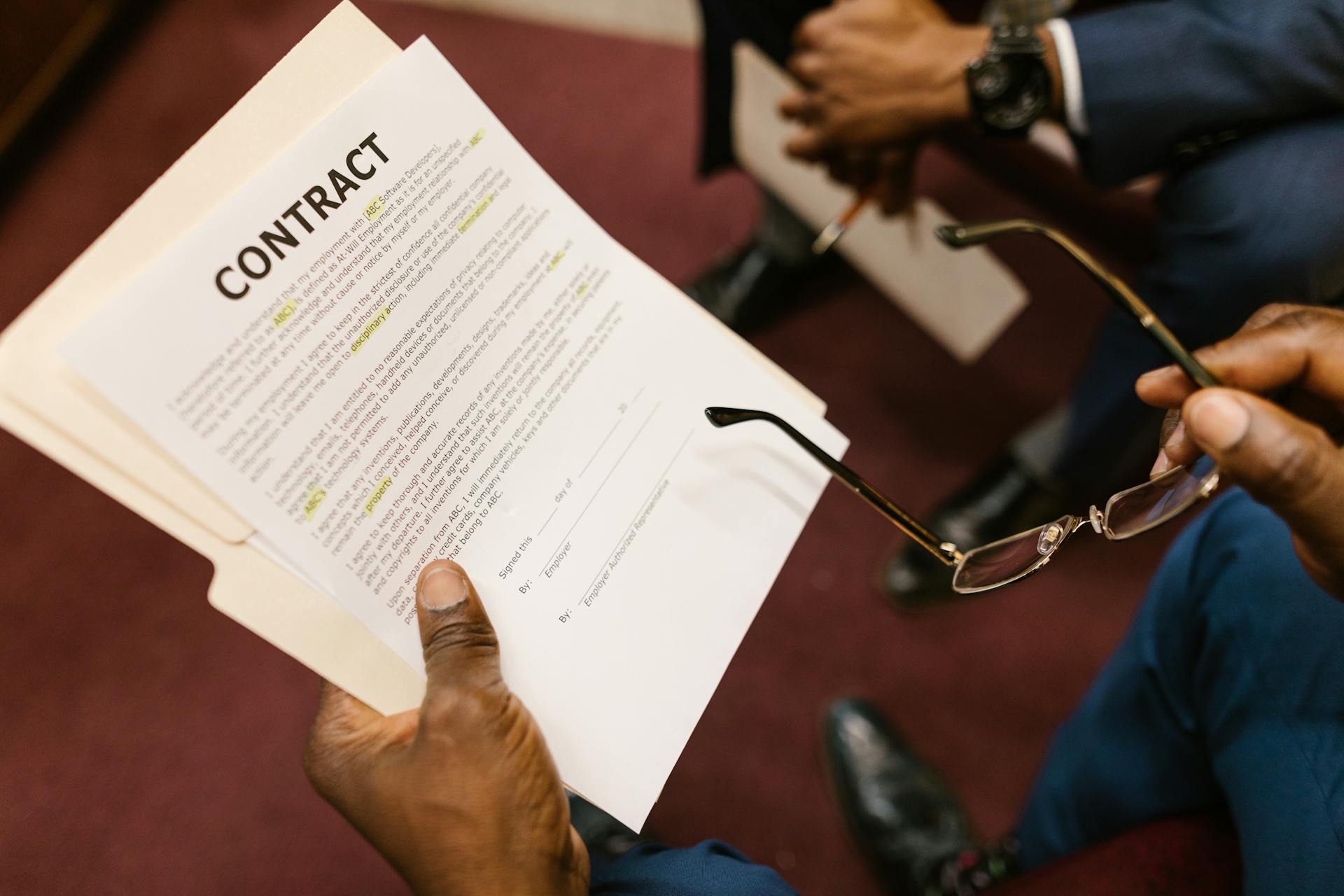
Creating a legal contract without a lawyer requires careful consideration of the essential elements. The contract should clearly state the terms and conditions, including the parties involved, the purpose of the contract, and the obligations of each party.
To avoid disputes, it's crucial to include a clear description of the goods or services being exchanged. This will help prevent misunderstandings and ensure that both parties are on the same page.
A well-written contract should also specify the payment terms, including the amount, method, and due date. This can help avoid financial disputes and ensure a smooth transaction.
It's also essential to include a clause for dispute resolution, such as mediation or arbitration, to resolve any issues that may arise.
Worth a look: How Legal Consultation Can Help with Contract Disputes
Understanding the Basics
Before you start drafting a contract, it's essential to understand the basics. A contract is a legally binding agreement between two or more parties, and it's crucial to have a clear understanding of what it entails.
To begin with, you need to determine whether you need a contract. This is crucial because a contract is necessary when exchanging something of significant value, such as your labor or services, intellectual property, or material goods.
A contract has three essential elements: an offer, an acceptance of that offer, and sufficient consideration. This means that all parties involved must clearly understand the contract without needing an attorney to interpret it.
To form a valid contract, all parties must be legally able to participate. This means that they must be adults with the legal ability, or capacity, to enter into a contract. Capacity is usually determined by a person's age and mental competence.
Here are the basic requirements of all contracts:
- An offer must be made and accepted.
- There must be sufficient consideration, or something of value, exchanged for something else of value.
- All parties must have the capacity to enter into a contract, meaning they must be adults with the legal ability to do so.
- There must be a meeting of the minds, or mutual agreement, between all parties.
- All parties must mutually assent to the terms of the contract, meaning they agree to the contract without being forced or coerced.
By understanding these basics, you'll be well on your way to drafting a solid contract that protects all parties involved.
Creating a Contract
Creating a contract can be a straightforward process if you know what to include. To start, you need to make sure your contract is enforceable, which means it needs to have a few basic requirements. These include an offer and acceptance, consideration, capacity, mutual intent, legality, and signatures from both parties.
To create a contract, you can use online tools like DocuSign, HelloSign, Paperbell, XodoSig, or ContractBook, which can help you draft a contract easily without the need to employ a lawyer. These tools are easily accessible and cover a wide range of business scenarios.
To ensure your contract is comprehensive, outline the who, what, when, where, and how of the transaction, including a detailed description of the goods or services being transacted, the deadline, and other conditions. Don't forget to include provisions for confidentiality and non-disclosure if the agreement involves sensitive information.
Can I Create?
You can create your own contract, but it's essential to have a clear understanding of what makes a contract legally binding. To do this, you need to include certain elements, such as an offer and acceptance, consideration, capacity, mutual intent, legality, and signatures.
In many jurisdictions, including the US and Canada, electronic signatures hold legal weight, making digital contracts just as enforceable as their paper counterpart. This means you can draft a contract that protects your interests and execute it remotely.
To create a contract, you'll need to follow the basic requirements, which include:
- Offer and acceptance: One party makes a clear offer while the other party agrees to the terms.
- Consideration: Something of value is being exchanged.
- Capacity: All parties must be legally capable of entering into the agreement.
- Mutual intent: All parties need to show a clear intention of entering a legally binding contract.
- Legality: All of the contract's subject matter must be legal.
- Signatures: Both parties should sign and date the document.
If you're not a lawyer, you can still create a contract, but it's crucial to be aware of the potential risks. Without access to the appropriate legal resources, things can go south without it being intended.
If this caught your attention, see: Can I Adopt My Grandchild without a Lawyer?
Record All Details
When creating a contract, it's essential to record all details to avoid miscommunication and disputes. Ensure that your contract includes the terms of the contract, such as the parties involved, payment terms, and the specific scope of the services.
A detailed description of the goods or services being transacted is also crucial. Outline the who, what, when, where, and how of the transaction, including the deadline and other conditions.
Assumptions can lead to miscommunication if left unaddressed, so be clear and don't hide anything in the fine print. This includes specifying the time frame of the agreement and any additional clauses that may be relevant.
Document all changes made to the contract and ensure all parties agree to the decisions in writing. Changes in payment terms, the time of work, the scope of work, and availability should be recorded and accepted by the parties involved.
Additional reading: Pisgah Legal Services
Ensure Agreement
To ensure all parties are on the same page, you need to document all changes made to the contract and have all parties agree to the decisions in writing. This can help prevent disputes down the line.
Changes in payment terms, the time of work, the scope of work, availability, and other key details should be recorded and accepted by the parties involved. This includes documenting all changes made to the contract.
It's essential to ensure that all parties are in agreement, especially when it comes to sensitive information. This can be achieved by including provisions for confidentiality to protect unauthorized disclosure of confidential information.
Here are the key elements to include when ensuring agreement:
- Document all changes made to the contract.
- Have all parties agree to the decisions in writing.
- Record changes in payment terms, the time of work, the scope of work, availability, and other key details.
- Include provisions for confidentiality to protect unauthorized disclosure of confidential information.
Define Terms
Defining key terms is crucial in a contract to ensure clarity and prevent misunderstandings. All parties may not understand specialized terminologies, so define those key terms within the contract itself.
This eliminates ambiguity and prevents disputes that could arise from differing interpretations of technical languages. It's essential to be precise and clear in your definitions to avoid confusion.
For more insights, see: Locksmith Make Car Key
To ensure clarity, define technical terms used in the contract. This will help all parties involved understand their responsibilities and obligations.
Defining key terms also helps to prevent disputes that could arise from differing interpretations of technical languages. It's a simple yet effective way to ensure that everyone is on the same page.
In drafting a contract, it's essential to include a clear definition of key terms. This will help to prevent misunderstandings and ensure that all parties are aware of their responsibilities and obligations.
By defining key terms, you can avoid costly disputes and ensure that your contract is clear and enforceable.
A fresh viewpoint: How to Contest a Will without a Lawyer?
Contract Structure and Content
Creating a solid contract structure is crucial to ensure your agreement is legally binding and protects both parties. A contract should include the essential elements that provide clarity and specificity.
The offer and acceptance are the foundation of a contract. An offer is a clear and specific proposal, while acceptance is the agreement to the terms of the offer.
Consideration is a crucial element that involves something of value being exchanged between the parties. This can be a service, a good, or even a promise.
The agreement is the final piece of the puzzle, outlining the terms and conditions of the contract. It's essential to ensure all parties understand and agree to the terms.
To ensure your contract is comprehensive, make sure to include the following essential elements:
- Offer
- Acceptance
- Consideration
- Agreement
Drafting a Legal Agreement
Drafting a legal agreement can be a daunting task, but with the right approach, you can create a solid contract without the help of a lawyer. Consider including a mechanism for dispute resolution, such as mediation, to resolve conflicts efficiently and preserve the relationship between parties.
To ensure the contract is legally valid, conduct a thorough review to ensure all terms and provisions accurately reflect the parties' involved intentions and expectations. Pay close attention to details such as names of associated parties, addresses, the contract duration, the scope of the service being provided, and financial terms, schedules, or agreements to avoid errors and holes in the contract.
In case of unforeseen circumstances such as pandemic outbreaks, natural disasters, or economic crises, consider including clauses for these scenarios where performance becomes impossible. This clause allocates responsibilities in the event of unforeseen circumstances beyond the parties' control.
To draft a contract without an attorney, you'll need to ensure all parties are in agreement and document all changes made. Record and accept all changes in writing to prevent disputes.
Here are the basic requirements for a contract to be legally binding:
- Offer and acceptance: One party makes a clear offer while the other party agrees to the terms.
- Consideration: Something of value (money, goods, services, etc.) is being exchanged.
- Capacity: All parties must be legally capable of entering into the agreement.
- Mutual intent: All parties need to show a clear intention of entering a legally binding contract.
- Legality: All of the contract's subject matter must be legal.
- Signatures: Both parties should sign and date the document.
Maintaining communication with the other party throughout the process of drafting the contract is crucial. Be sure to address concerns that you notice and seek clarification on ambiguous terms that you don't understand.
Contract Clauses and Terms
When drafting a contract, it's essential to include clear and concise language to avoid misunderstandings. Define technical terms used in the contract to ensure clarity, as not everyone may be familiar with specialized terminologies.
To avoid disputes, include an Alternative Dispute Resolution (ADR) clause, which can save time and money by avoiding court battles. Common ADR methods include mediation, arbitration, and negotiation.
Spelling out payment terms is also crucial, including details like total amount, deposit requirements, payment schedule, and late fees. This will help prevent confusion and ensure timely payment.
To protect your interests, include essential clauses like confidentiality, dispute resolution, and force majeure. These clauses will help safeguard sensitive information and outline how disputes will be resolved if they occur.
Here are some key clauses to consider including in your contract:
- Confidentiality: Protects sensitive information involved in the partnership.
- Dispute resolution: Outlines how disputes will be resolved, whether through mediation, arbitration, negotiation, etc.
- Force majeure: Covers unforeseen events that prevent either party from fulfilling their obligations.
Specify Performance Standards
Specifying performance standards is crucial to ensure both parties understand what is expected of them under the contract.
Defining key terms beforehand can help prevent misunderstandings, but it's equally important to specify performance standards. This ensures clarity on what needs to be done and how it will be measured.
Specifying performance standards helps prevent disputes that can arise from differing interpretations of technical languages. It's like having a clear roadmap for the project, outlining what needs to be achieved and by when.
Key performance indicators (KPIs) such as quality benchmarks, delivery deadlines, and service levels should be clearly defined. This helps maintain accountability and transparency throughout the contract period.
Defining performance standards also helps to identify potential issues early on, allowing for timely adjustments to be made. It's a proactive approach that can save time and resources in the long run.
Termination Clause
A termination clause is a crucial part of any contract, and it's essential to include one to protect both parties involved.
Including a termination clause upfront can help prevent disputes and costly litigation down the line. This clause outlines the conditions under which either party can decide to terminate the agreement and includes penalties or obligations involved.
Common triggers for termination include breach of contract, failure to meet set standard levels, non-communication, force majeure, or other changes. By addressing termination upfront, parties involved are protected and have options in the event of unforeseen circumstances.
A different take: Upfront Payment Terms Examples
Some contracts may also include specific conditions for termination, such as a mutual agreement between both parties or a failure to meet obligations. It's essential to clearly state these conditions in the contract to avoid any confusion or disputes.
Here are some common termination triggers to consider:
- Breach of contract
- Failure to meet set standard levels
- Non-communication
- Force majeure
- Other changes
By including a well-defined termination clause, you can ensure that both parties are protected and have a clear understanding of the terms of the contract. This can help prevent disputes and costly litigation down the line.
Notarization and Legality
Notarization can add an extra layer of legal protection to your contract, especially in case of disputes. It's common for contracts involving real estate, wills, and financial agreements to require notarization.
A notary public verifies the identities of the signers and ensures they sign willingly. This helps prevent forgery and ensures the authenticity of the contract.
Not all contracts require notarization, but it's essential to research applicable laws in your state to determine if it's necessary for your contract. Some contracts, such as those involving large sums of money or long-term commitments, may require a witness to confirm authenticity.
Here are the basic requirements for notarization:
- Notarization is common for real estate contracts, wills, and financial agreements.
- A notary public verifies the identities of the signers and ensures they sign willingly.
Remember, even if notarization is not required, it's still a good idea to include it in your contract to strengthen its enforceability.
What Creates Legal Validity?
A contract must include an offer, which is a proposal made by one party. This offer must be clear and specific.
To be considered a valid contract, there must be acceptance by the other party, which means they agree to the terms of the offer. This acceptance must be under the stated terms.
Consideration is also essential, which refers to a mutual exchange of value, such as money, goods, or services. This means that both parties must receive something of value from the agreement.
Capacity is another crucial element, which means all parties must be of legal age and sound mind. This ensures that all signers are competent to enter into the agreement.
Here's a breakdown of the key elements that create legal validity:
These elements work together to create a legally valid contract. By including them, you can ensure that your contract is enforceable and protects your rights.
Notarization Role
Notarization plays a crucial role in verifying the identities of signers and ensuring they sign willingly. This is especially common for real estate contracts, wills, and financial agreements.
A notary public verifies the identities of the signers, which adds an extra layer of legal protection, especially in case of disputes.
Notarization is not always necessary, but it's a good idea to include it when drafting contracts that involve large sums of money or long-term commitments.
The benefits of notarization include:
- Verifying the identities of signers
- Ensuring signers sign willingly
- Adding an extra layer of legal protection
Notarization can be a safeguard against disputes, but it's still possible for contracts to be drafted with undue advantage to one party over the other.
Utilize Templates
Utilize templates to structure your agreement effectively. You can benefit from Coaches & Company contract templates, which allow you to leverage a lawyer-created contract without the hefty law firm fees and legal costs.
Several online apps and platforms can help with drafting a contract using templates. These tools are easily accessible to everyone and cover a wide range of business scenarios.
You can create a contract in minutes using templates from PandaDoc, which has a vast variety of professionally designed contract templates. Their software also has built-in eSignature functionality and workflow automation, making creating contracts easy and reliable.
Electronic signatures hold legal weight in many jurisdictions, including the US and Canada, making digital contracts just as enforceable as their paper counterpart.
Best Practices and Considerations
To create a solid contract, it's essential to follow best practices and consider key elements. A thorough review of the contract is crucial to ensure all terms and provisions accurately reflect the parties' intentions and expectations.
Conduct a review to catch errors and holes in the contract. Pay close attention to details such as names of associated parties, addresses, contract duration, scope of service, and financial terms.
When drafting the contract, start with basic information like the date and parties involved. This contract is between [insert party names].
Detail the exchange of consideration in clear language, describing what services or goods are being exchanged. Consider adding a confidentiality clause or Non-Disclosure Agreement (NDA) if necessary.
To avoid common pitfalls, use precise terms and avoid vague language. Ensure payment details, timelines, and obligations are explicitly stated. Research state laws and include necessary disclosures or clauses.
Here are some key considerations to keep in mind:
- Conduct thorough research on relevant laws and regulations.
- Review and revise the contract multiple times for accuracy.
- Seek feedback from trusted colleagues or advisors, including licensed attorneys and legal professionals.
- Consider adding an addendum if necessary.
- Include a clause describing how the contract will be terminated.
By following these best practices and considering key elements, you can create a solid contract that protects your interests and ensures a smooth agreement with the other party.
Sign and Store
You can sign a contract in person, but eSignature is a faster and more secure option that's also legally binding.
Make sure to keep a digital copy of the signed contract in a secure location. Use a document management software like PandaDoc to store it.
Frequently Asked Questions
What are the 5 requirements of a valid contract?
A valid contract requires five essential elements: a clear offer, acceptance, mutual consideration, competency, and a legal purpose. Understanding these requirements is crucial for creating a binding and enforceable agreement.
Featured Images: pexels.com