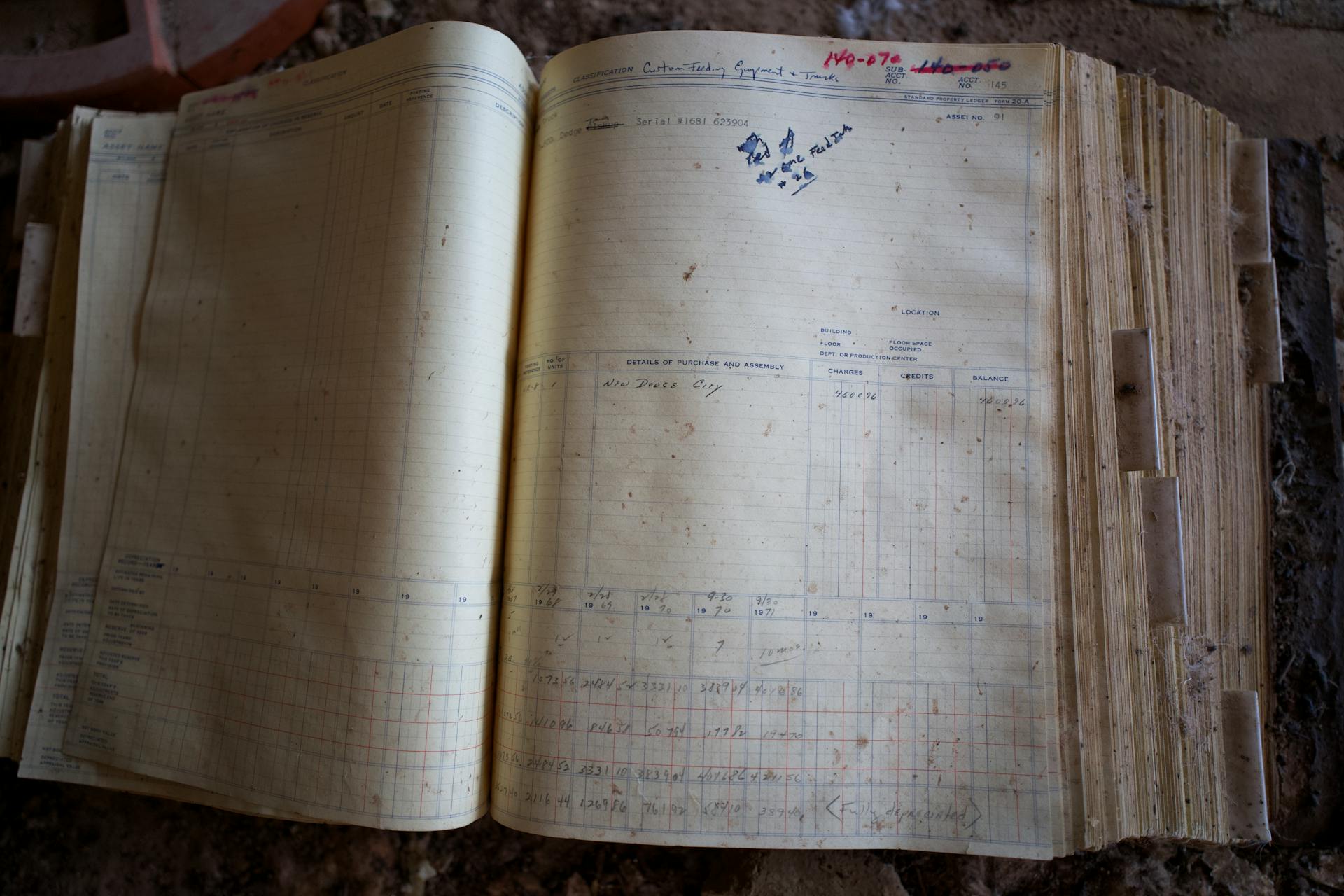
Calculating net capital spending can seem daunting, but it's actually a straightforward process.
To start, you need to identify the total capital expenditures for a given period, which is the total amount spent on acquiring or improving long-term assets.
This includes purchases of property, plant, and equipment, as well as intangible assets such as software and patents.
For example, if a company spent $100,000 on new machinery and $50,000 on software development in a quarter, those would be included in the total capital expenditures.
You also need to consider the net change in working capital, which can affect net capital spending.
What is Net Capital Spending?
Net capital spending is a crucial metric for businesses to assess their investment in physical assets. It's calculated by adding changes in net fixed assets and depreciation.
The net capital spending formula shows whether a company bought enough new assets to replace worn-out ones and possibly add more. This is done by finding the difference between ending and commencing net fixed assets, plus depreciation.
Expand your knowledge: On Which Financial Statement Would the Accumulated Depreciation Account Appear
Net fixed assets are found on the balance sheet and reflect the value of physical assets after subtracting accumulated depreciation. Depreciation is documented as an expense to account for asset age or use. By adding depreciation back to the change in net assets, the formula reveals total cash investment in assets.
This approach helps isolate growth-related spending from basic asset maintenance. It's essential for businesses aiming to assess their investment in physical assets against depreciation.
Here's a breakdown of the net capital spending formula:
- Ending net fixed assets: The value of physical assets after subtracting accumulated depreciation at the end of a period.
- Commencing net fixed assets: The value of physical assets after subtracting accumulated depreciation at the beginning of a period.
- Depreciation: The expense accounted for asset age or use.
Understanding net capital spending is crucial for businesses to determine how much they're investing to grow or maintain their operations.
Calculating Net Capital Spending
To calculate net capital spending, you need to access specific financial data from your company's balance sheet and cash flow statement.
The calculation involves determining the change in net fixed assets by subtracting the beginning net fixed assets from the ending net fixed assets, which can be found in the non-current assets section of the balance sheet.
You'll also need to add depreciation, a non-cash item that represents the capitalized cost recognized in the current period, typically found in the cash flow statement or footnotes and supplementary sections if consolidated with amortization expense.
The net capital spending formula is NCS = (Ending Net Fixed Assets - Beginning Net Fixed Assets) + Depreciation.
To illustrate this, let's consider an example: if a company's depreciation expense is $3 million and the net fixed assets at the start and end of the year are $10 million and $15 million respectively, the net capital spending calculates as NCS = ($15 million - $10 million) + $3 million = $8 million.
This example shows how adjusting for asset changes and depreciation helps compute NCS accurately.
If you don't have access to a cash flow statement, you can still calculate net capital spending using the following steps:
- Find the depreciation and amortization on your income statement
- Locate your current period of property, plant & equipment (PP&E) on your balance sheet
- Find the previous period of PP&E on the same balance sheet
Using the capital expenditure formula, PP&E (current period) – PP&E (previous period) + Depreciation (current period) = CapEx, will give you a net CapEx figure.
Here's an example calculation:
- Depreciation on your income statement is $15,000
- Current period PP&E is $40,000
- Previous period PP&E is $39,000
Plugging these values into the formula, you get: $40,000 – $39,000 + $15,000 = $16,000 CapEx.
Required Financial Data
To calculate net capital spending, you'll need three key pieces of financial data.
The first piece is the ending net fixed assets, which can be found in the non-current assets section of the balance sheet. This represents the current period's balance of fixed assets after accounting for depreciation.
Next, you'll need the beginning net fixed assets, also located in the non-current assets section of the balance sheet. This is the previous period's ending balance of fixed assets.
Depreciation is the third essential piece of data, which can be found in the cash flow statement or included with amortization expenses in the footnotes and supplementary sections of financial reports.
Here's a quick rundown of what you'll need:
These three pieces of data will give you the information you need to calculate net capital spending.
Calculating Net Capital Spending (continued)
To calculate net capital spending, you need access to specific financial data from your company's balance sheet and cash flow statement. This data includes depreciation expense, net fixed assets at the start and end of the year.
The calculation of net capital spending involves adjusting for asset changes and depreciation. Depreciation expense is a key component of this calculation.
An example of calculating net capital spending is when a company's depreciation expense for the year is $3 million, and the net fixed assets at the start and end of the year are $10 million and $15 million respectively. This results in a net capital spending of $8 million.
Understanding net capital spending is essential for evaluating a company's asset investment and forecasting its future valuation. It helps investors and business owners make informed capital budgeting decisions.
You might enjoy: Capitalize Vs. Expense of Expe Fixed Assets
Adjusting for Inflation and Currency
Adjusting for inflation and currency is crucial when calculating net capital spending across years. A $1 million investment in 2014 doesn't carry the same weight in 2024.
To accurately compare net capital spending, apply a standard index like the Consumer Price Index (CPI) to adjust historical values to today's dollars.

This will give you a more accurate picture of your company's financial health over time. It's like comparing apples to apples, not apples to oranges.
For international companies, convert each year's net capital spending into the reporting currency using appropriate exchange rates. This will help you make cross-border comparisons.
To ensure transparency, disclose the conversion rate and inflation method used. This will give your stakeholders a clear understanding of your financials.
Here are the steps to follow:
- Convert each year's net capital spending into the reporting currency using appropriate exchange rates.
- Disclose the conversion rate and inflation method used.
By following these steps, you'll be able to accurately compare net capital spending across years and make informed decisions about your company's financial health.
Using the Formula
To use the net capital spending formula effectively, you need to understand the key components involved. The formula is NCS = (Ending Net Fixed Assets - Beginning Net Fixed Assets) + Depreciation.
The first step is to identify the correct values for net fixed assets. This can be found on the non-current assets section of the balance sheet, where you'll see the current period balance (Ending Net Fixed Assets) and the prior period's ending balance (Beginning Net Fixed Assets).
Make sure to use net fixed assets, not gross fixed assets, as gross fixed assets don't account for depreciation and will overstate spending. If you're looking for the correct value, look for "Net PP&E" or similar on the balance sheet.
Depreciation is a crucial component of the formula and should not be omitted. It's the Capex as recognized in the current period, which can be found on the cash flow statement or in the footnotes and supplementary sections. Depreciation is not cash, but it matters, and you need to add it back to see how much was actually spent.
To avoid errors, ensure that all numbers match the same year. Using depreciation from one year and asset balances from another will give you bad results. Make sure the beginning and ending net fixed assets and depreciation all line up in the same 12-month period.
Here's a quick checklist to help you ensure you're using the formula correctly:
- Use net fixed assets, not gross fixed assets
- Include depreciation in your calculation
- Ensure all numbers match the same year
- Use the correct values for beginning and ending net fixed assets
By following these guidelines, you'll be able to calculate net capital spending accurately and get a clear picture of a company's investment in growth and asset replacement.
Example and Use Cases
Calculating net capital spending is essential for businesses to plan and manage their investments in fixed assets effectively. By analyzing a company's net capital spending, investors and management can track its growth trajectory and understand how it's expanding its operational capabilities.
Analyzing a company's net capital spending allows investors and management to track its growth trajectory. This analysis provides insights into how a company is expanding its operational capabilities.
Companies can compare their net capital spending to that of peers to gauge whether they are investing adequately to maintain competitiveness or are in a high-growth phase, indicating aggressive expansion. This can be done by comparing their net capital spending to that of other companies in the same industry.
Here are some key benefits of calculating net capital spending:
- Helps companies plan and manage their investments in fixed assets effectively
- Provides insights into a company's growth trajectory and operational capabilities
- Helps investors and management make informed decisions about resource allocation
- Enables companies to compare their net capital spending to that of peers
A higher net capital spending indicates that a company is committing big sums of money on acquiring fixed assets crucial to its survival. However, if the investments don't bear the desired results, a company might end up incurring huge losses that might affect cash flows.
Example

Let's take a closer look at how net capital spending works with an example. Company ABC invested $180,000 in net capital spending, which is a significant amount.
This investment is crucial for the company's survival and growth. The value of the net fixed assets at the end of the year was $800,000, a $100,000 decrease from the beginning of the year.
A higher net capital spending indicates that a business is investing heavily in fixed assets. The yearly depreciation charged in the income statement was $80,000, which is a significant expense.
If investments don't bear the desired results, a company might incur huge losses. This can affect cash flows and have a negative impact on the business.
Net capital spending can tell you how much a company is investing in existing and new fixed assets.
Use Cases
Calculating net capital spending helps companies plan and manage their investment in fixed assets effectively.
Analyzing a company's net capital spending allows investors and management to track its growth trajectory, providing insights into how a company is expanding its operational capabilities.

By evaluating NCS, stakeholders can determine whether a company is in an early, mature, or declining growth stage, which is critical for strategic decision-making.
Companies can compare their net capital spending to that of peers to gauge whether they are investing adequately to maintain competitiveness or are in a high-growth phase, indicating aggressive expansion.
Calculating NCS informs decisions related to investing in new technology, crucial for staying competitive in rapidly evolving industries.
Here are some key use cases for net capital spending:
Understanding net capital spending aids companies in managing their financial resources better by highlighting the tangible assets that require heavy investments for maintenance or upgrade.
Pros and Cons
Calculating net capital spending can be a complex task, but understanding the pros and cons can help you approach it with clarity.
One major advantage of calculating net capital spending is that it helps businesses make informed decisions about investments.
Businesses can identify areas where they can optimize their capital spending, leading to increased efficiency and productivity.
Broaden your view: Marchant Calculating Machine Company
However, calculating net capital spending can be time-consuming and requires a significant amount of data.
It's essential to have accurate financial records to ensure the accuracy of the calculation.
Without proper data, businesses may end up with inaccurate net capital spending figures, leading to poor decision-making.
On the other hand, calculating net capital spending can also help businesses identify areas where they can reduce costs and improve profitability.
By understanding the net capital spending, businesses can make strategic decisions about investments and resource allocation.
A different take: Adjustments to Net Income in Calculating Operating Cash Flows Include:
Conclusion
Calculating net capital spending can be a complex task, but it's essential for businesses to make informed investment decisions.
By understanding the concept of capital spending and the different types of assets, businesses can accurately calculate their net capital spending.
Capital expenditures can include purchases of new equipment, property, and software, as well as upgrades and replacements of existing assets.
For example, a company may spend $100,000 on new equipment, $50,000 on property upgrades, and $20,000 on software.
Explore further: Do Businesses Prefer Cash or Credit
However, not all capital expenditures are created equal. Depreciable assets, such as equipment and property, can be written off over their useful life.
In contrast, non-depreciable assets, like land, are not subject to depreciation.
By accurately accounting for depreciation, businesses can determine their net capital spending.
A company may have a capital expenditure of $170,000, but if $100,000 of that is depreciated over 5 years, their net capital spending would be $70,000.
Featured Images: pexels.com