
Investing in gold and silver can be a great way to diversify your portfolio and protect your wealth. Gold is a popular choice because it's a tangible asset that tends to hold its value over time, with a price that's historically increased during periods of economic uncertainty.
To start investing in gold, you can buy physical gold coins or bars, or invest in gold mining stocks or exchange-traded funds (ETFs). Gold coins, such as the American Gold Eagle, are a popular choice for investors because they're widely recognized and can be easily sold or traded.
You can also buy gold online from reputable dealers, or through a local coin shop. Online dealers often offer competitive prices and a wide selection of gold products, making it easy to find the right investment for your needs.
A fresh viewpoint: Is Gold Coins a Good Investment
Understanding Precious Metals
Gold has been a highly valued precious metal for centuries, with its value often used as a benchmark for other investments.
The price of gold is determined by supply and demand, with the majority of gold being used for jewelry, coins, and other industrial applications.
One ounce of gold is equivalent to 31.1 grams, making it a precise and portable investment option.
Silver, on the other hand, has a lower value than gold but is still highly sought after for its versatility and industrial uses.
Challenges with Precious Metals
Investing in precious metals can be a challenging game. Directly investing in commodities like gold and silver is filled with headwinds against you.
Commodities don't produce any cash flows like a profitable business or an interest-paying bond does. They just sit there, hoping to go up in price.
The problem with commodities is that you're betting on what someone else will pay for them in six months. The commodity itself won't do anything for you.
Transaction costs are another challenge with precious metals investing. If you buy physical gold, there's a company in the middle making a profit, and you'll pay more for it than the wholesale price.
A unique perspective: Allspring Precious Metals Fund
Shipping costs, security and storage costs, and the risk of theft or loss are all additional expenses to consider. These costs can add up quickly, making it harder to profit from your investment.
Investing in an ETF that holds precious metals also comes with its own set of expenses, including an expense ratio that covers security and administrative costs.
Uses and Valuation
Precious metals have numerous uses beyond their value as a store of wealth. They're highly versatile and can be used in various industries.
Gold, for example, is an excellent conductor of electricity and is used in electronics. It's also used in dental work due to its biocompatibility.
Silver is used in solar panels to increase their efficiency. It's also used in medicine to create antimicrobial coatings.
Platinum is used in the automotive industry to reduce emissions. It's also used in jewelry due to its durability and rarity.
Precious metals are highly valued due to their rarity and the difficulty of extracting them. The value of a precious metal is often determined by its market demand and supply.
The price of precious metals can fluctuate based on market conditions, such as inflation or economic uncertainty.
For more insights, see: Live Gold & Silver Spot Prices
Physical vs. Paper
Physical gold and silver are the original ways people invested in these precious metals. They come in forms like coins, bars, and jewelry.
Owning physical metals means you have direct control over them, free to sell or trade as you see fit, and no third party has access to them. This is considered the "true" way of owning precious metals by many investors.
However, physical metals have higher transaction costs than their paper counterparts. You'll need to consider costs like storage and insurance when investing in physical gold and silver.
In contrast, "paper" metal investments allow you to buy shares in precious metals without taking possession of the physical metal itself. Options include precious metal ETFs, mining stocks, and precious metals futures.
But with "paper" metal investments, you may have limited accessibility and risk losing your precious metals in a financial crisis, as a third-party company or institution controls them.
Investors seeking more security and personal control over their precious metal assets often prefer physical metal investments.
Worth a look: Physical Gold Investment
Investment Options
You can invest in gold and silver through various options, each with its own benefits and requirements. To invest in gold and silver funds, you'll need a traditional brokerage account, and the documents required are the standard ones for investment accounts.
Investing in gold and silver ETFs provides liquidity and convenience, allowing you to buy or sell shares through your existing brokerage account with just a few clicks. Annual management fees for gold ETFs typically range from 0.20% to 0.40%, and some popular gold ETFs even maintain fees below 0.20%.
Consider factors beyond just the expense ratio when selecting a precious metals ETF, such as the fund's tracking error, trading volume, and physical backing.
Opening a Brokerage Account
To open a brokerage account, you'll need to choose the right type, depending on your investment goals. For investing in silver and gold funds and mining stocks, a simple brokerage account will suffice.
You'll need to confirm that the brokerage you choose provides options for trading futures, if that's what you're interested in.
The documents required are the standard ones for investment accounts, which typically include standard identification documents.
Portfolio Role

As a savvy investor, you're likely considering a portfolio role to diversify your investments. This involves spreading your money across different asset classes to minimize risk.
A portfolio role typically includes a mix of low-risk investments like bonds and cash, which can provide a steady income stream.
Stocks, on the other hand, can offer higher returns but come with more volatility. Historically, stocks have outperformed bonds over the long term, with an average annual return of 7% compared to 4% for bonds.
A common portfolio allocation is to put 60% of your money into stocks and 40% into bonds, but this can be adjusted based on your individual risk tolerance and financial goals.
See what others are reading: Gold Star Investments
ETFs & Mutual Funds
ETFs and mutual funds can be a convenient way to invest in gold and silver, offering liquidity and flexibility to buy and sell shares throughout the trading day.
You can buy shares of gold and silver ETFs through a brokerage, rather than having to buy on a separate marketplace. They're designed to be traded like normal equities.
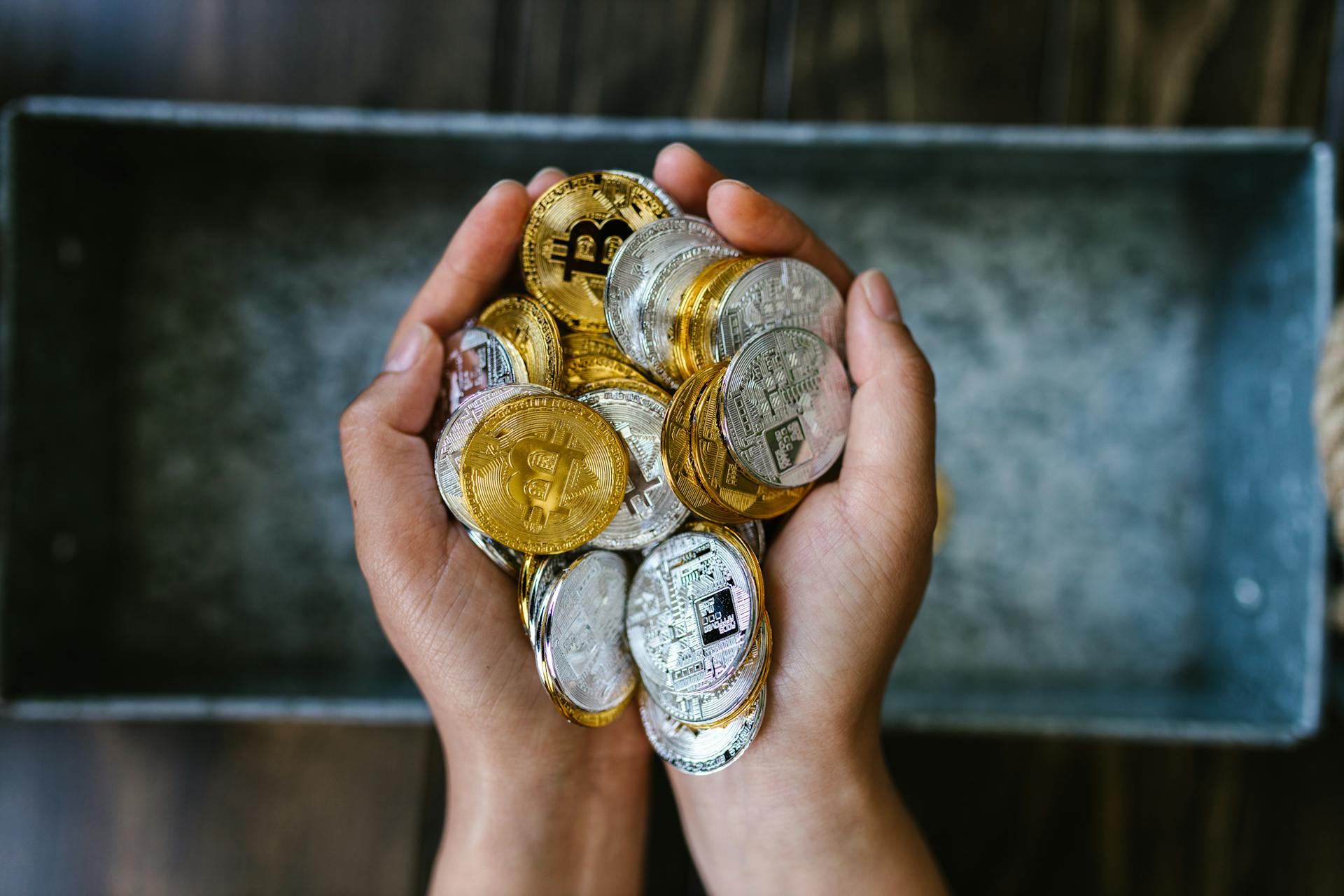
Annual management fees for gold ETFs typically range from 0.20% to 0.40%, which is often lower than the premiums charged for physical metals or storage fees associated with bullion.
Some popular gold ETFs even maintain fees below 0.20%, making them among the most cost-efficient ways to maintain precious metals exposure in your portfolio.
Consider factors beyond just the expense ratio when selecting a precious metals ETF, such as the fund's tracking error, trading volume, and physical backing.
Liquidity gives investors flexibility to buy and sell shares of the ETF throughout the trading day, providing a convenient way to adjust their positions frequently.
The minimal spread between buying and selling prices makes ETFs especially cost-effective for investors who may want to adjust their positions frequently.
Gold and silver funds can be thought of as an investment in precious metals without the actual hassle of storing, buying, or selling them.
You might enjoy: How to Purchase Gold Etf
Buying and Storage
When buying gold and silver, it's essential to consider storage options to protect your investment.
Physical gold and silver can be stored in a home safe, but this requires a significant upfront investment in a high-quality safe.
Consider storing your precious metals in a secure third-party facility, such as a bank vault or a reputable storage company.
These facilities offer 24/7 access, insurance coverage, and climate control, providing a secure and convenient solution for storing your gold and silver.
Many investors also store their gold and silver in a secure location outside of their primary residence, such as a vacation home or a trusted friend or family member's home.
This can help mitigate the risk of loss or theft in the event of a home burglary or natural disaster.
It's also crucial to store your gold and silver in a way that prevents damage, such as keeping them away from direct sunlight and moisture.
Proper storage can help maintain the value and integrity of your investment over time.
Consider reading: Buy Gold Safe Wow
IRAs
IRAs can be a great way to invest in gold and silver, but it's essential to understand the process and requirements. You can use a traditional or Roth IRA to purchase gold and silver, and you'll need to go through a designated gold IRA custodian to set up the account.
For another approach, see: Gold in Your Ira
To invest through an IRA, you'll need to store your metals in a qualifying depository for safekeeping, which means you can't keep your investments at home. There are both traditional and Roth silver and gold IRAs, so you can purchase your metals using either pre-tax or post-tax dollars, depending on your retirement strategy.
Fees can be higher for specialized IRAs compared with regular IRAs, and you may take on one-time account setup fees, annual management fees, and even separate storage fees for the custodian that keeps your gold bullion. However, fees for gold IRAs and silver IRAs can vary, based on a number of factors.
To open a gold IRA, you'll need to establish a self-directed IRA, select a custodian to administer the account, select an approved depository to hold the assets, and then choose a broker/dealer to buy the gold through. Custodians specializing in gold IRAs will help refer clients to an approved depository as well as gold dealers.
Here are the minimum deposits required for a gold IRA:
It's worth noting that some gold IRAs do not advertise a minimum, but there are others that start at $10,000, $25,000, and even $60,000.
JM Bullion and Mining Stocks
JM Bullion and Mining Stocks can be a great way to invest in gold and silver, but it's essential to understand the differences between the two.
You can buy stock in specific mining companies, much as you would trade tech stocks, for instance.
Fees for mining ETFs may cost a bit more than bullion ETFs.
Indirect investments like mining stocks can be more complex, with additional factors affecting stock prices beyond precious metals prices.
For your interest: Diamond Mining
JM Bullion purchases
Purchasing from JM Bullion offers numerous benefits, including wider selections and lower prices.
You can browse their online selection to find the perfect gold or silver products, and enjoy free shipping on orders over $199, which can be a significant cost savings.
Their website also features a secure and safe transaction process, giving you peace of mind when making a purchase online.
JM Bullion accepts major payment methods, making it easy to complete your purchase.
If you have any questions or need assistance, their customer care team is available to help, and you can reach out to them through live chat or online forms.
Broaden your view: How Do I Buy Gold Bullion
Evaluate Mining Stocks
Evaluating mining stocks can be a bit more complex than buying gold bars or coins, but it's a viable option if you're looking for a more indirect investment.
You can buy stock in specific mining companies, just like you would trade tech stocks.
Mining stocks can increase in value if precious metals prices go up, but other factors can also influence stock prices.
Some mining companies may have higher operating costs or less efficient production methods, which can impact their stock performance.
Investing in an ETF that tracks a variety of gold or silver mining companies can provide a more diversified portfolio, but fees may be slightly higher than bullion ETFs.
It's essential to research and understand the operations and financials of the mining companies you're considering before investing.
Curious to learn more? Check out: Gold Stock Investment
Physical vs. Digital
Physical bullion is a nice off-the-grid store of value. You can buy physical gold and silver coins or bars from a reputable vendor and hold them in a safe place.
Discover more: How to Buy Physical Gold Online
The safest way to invest in gold and silver is by buying physical coins or bars, as it's the least complex way to do so. This way, you have physical assets that can't be hacked or frozen.
In times of crisis, like economic or weather-related devastation, having some hard assets on hand is a good idea. In 2015, a run on banks in Greece resulted in withdrawals being limited to 60 euros per day.
Having some physical cash and gold/silver coins stashed around for emergency situations is not a bad idea. In 2017, when Puerto Rico was devastated by a hurricane, business couldn't accept credit cards and cash was needed for everything.
However, storing large amounts of physical gold and silver at home is unsafe. If you want to hold more, it's essential to store it offsite professionally with security, which comes with regular fees that eat away at your investment.
Buying physical gold and silver generally involves going through a dealer, either online or in person. Reputation is the key factor in choosing a dealer, followed by markup and fees.
You can also find some physical stores that buy and sell gold and silver, but you'll often pay a premium there. The prices of physical gold and silver for purchase may be significantly higher than the current trading price, or spot price, of the commodities.
Consider reading: Buying Gold Price
Frequently Asked Questions
Which is the best gold and silver ETF?
The SPDR Gold Shares (GLD) is considered the best gold ETF due to its large assets under management and high tracking accuracy. For silver, the iShares Silver Trust (SLV) is a popular choice among investors.
Featured Images: pexels.com