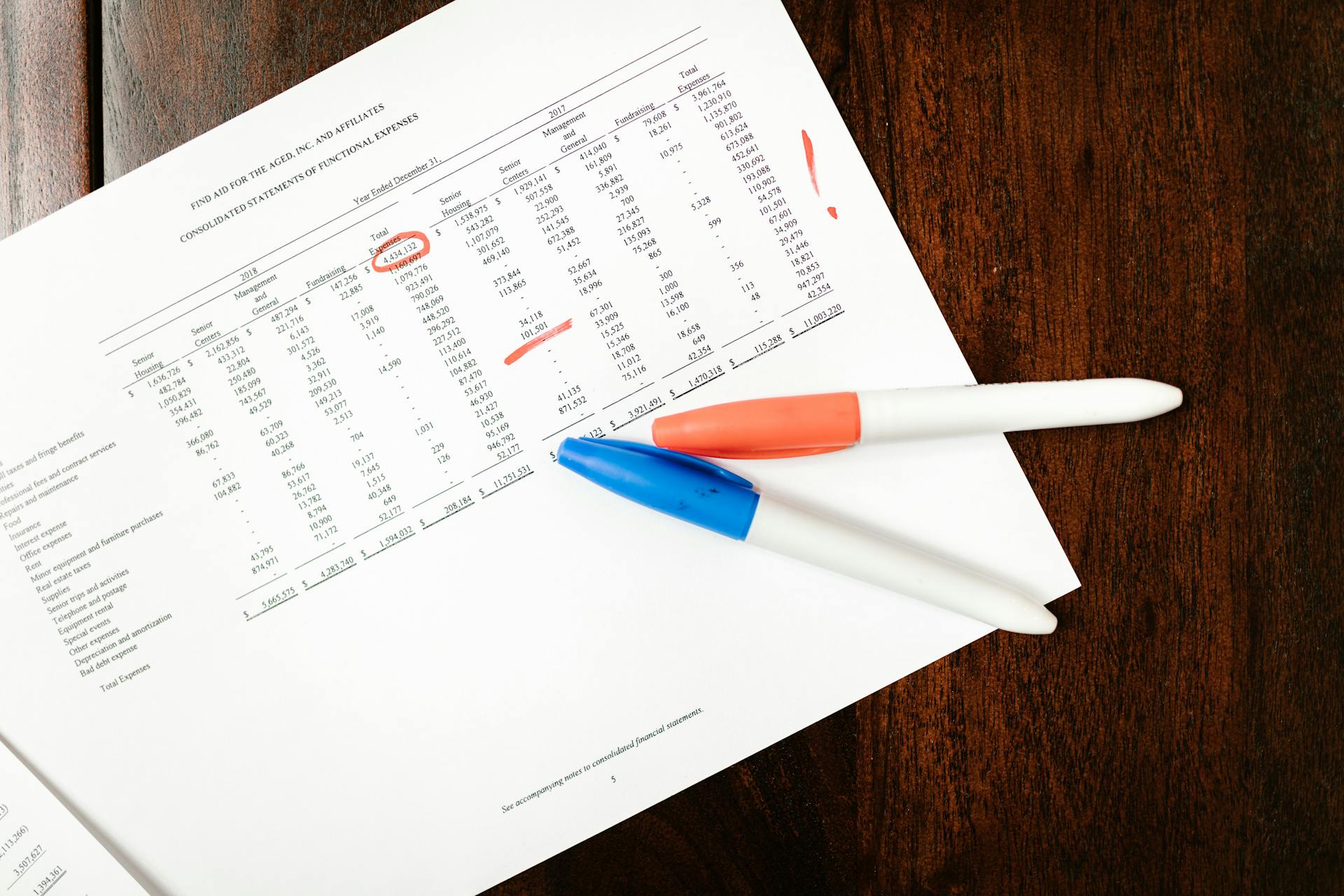
Accrual accounting is a method of accounting that recognizes revenues and expenses when they are earned or incurred, regardless of when the payment is received or made. This means that businesses can match their income and expenses in the same period, providing a more accurate picture of their financial performance.
Accruals are a key component of accrual accounting, and they refer to the recognition of revenues or expenses that have been earned or incurred, but not yet received or paid. For example, if a business provides a service to a customer in December, but the customer doesn't pay until January, the business would recognize the revenue as an accrual in December.
Accruals can be either assets or liabilities, depending on whether they represent revenue or expenses. In the case of the service example, the revenue would be recognized as an asset, while the customer's payment would be recognized as a reduction in that asset.
Here's an interesting read: An Example of Deferred Revenue Is Unearned Rent
What Are Accruals?
Accruals are a record of revenue or expenses that have been earned or incurred but haven't yet been recorded in the company's financial statements.
This can include things like unpaid invoices for services provided or expenses that have been incurred but not yet paid. Accruals are important because they help to ensure that a company's financial statements accurately reflect its true financial position.
Revenue is recognized when it's earned in accrual-based accounting, regardless of when the payment is received. This means that revenue received from a service would be recorded in December when it was earned, even if the payment wasn't received until January of the following year.
Expenses are recorded when they're incurred, regardless of when they're paid. An expense would be recorded in December if a company incurs expenses in December for a service that will be received in January.
Accruals are used to properly expense goods and services that were delivered in one fiscal year but the invoice was received in the next year. This helps to ensure that the correct expenses are recognized in the correct fiscal year.
Revenue from sales transactions is recorded at the time of sale, even if the customer hasn't yet paid cash. This revenue is accrued in the current period to match when it was earned and the product or service was delivered.
Readers also liked: Accrued Service Revenue
Recording Accruals
Recording accruals is an essential part of accrual accounting, and it's done through journal entries. This involves debiting the "accounts receivable" account and crediting the "revenue" account on the income statement when a service is provided but payment hasn't been received yet.
To record expenses as an accrual, the company debits the "expenses" account on the income statement and credits the "accounts payable" account. This is done when expenses are incurred but not yet paid.
Accruals are also used to record interest expenses, which accrue each month based on the principal balance of debt and the interest rate. An adjusting entry each month credits Interest Payable and debits Interest Expense.
Here are some common examples of accruals:
- Accrued interest: $1,000 x 10 days = $10,000
- Accrued wages: $1,000 x 10 days = $10,000
- Change in accounts receivable reflecting accrued revenue
Accruals must also be reflected in the general ledger through adjusting journal entries. This updates account balances at the end of the fiscal period to match revenues and expenses to the correct accounting period.
Here's an interesting read: Time Period Assumption Accounting
Common accrual journal entries include:
- Accruing revenue as a credit to the revenue account and a debit to accounts receivable
- Accruing expenses as a debit to the expense account and a credit to accounts payable
Accruals are used to match revenues and expenses to the correct accounting period, providing a more accurate picture of financial performance.
Types of Accruals
Accruals are a fundamental concept in accounting, and there are several types of accruals that businesses need to understand. Accrued revenues refer to the recognition of revenues that have been earned but not yet recorded in the company's financial statements.
For example, if a company provides a service to a customer in December but doesn't receive payment until January of the following year, the revenue received for that service would be recorded as an accrual in December. This ensures that the revenue is matched with the period in which it was earned.
Accrued expenses, on the other hand, refer to the recognition of expenses that have been incurred but not yet recorded in the company's financial statements. This could be expenses incurred in December for a service that will be received in January, such as office supplies.
Accrued interest refers to interest that's been earned on an investment or a loan but hasn't yet been paid. For instance, if a company has a savings account that earns interest and the interest has been earned but not yet paid, it would be recorded as an accrual on the company's financial statements.
Here's a breakdown of the different types of accruals:
Accrued salaries and wages are another type of accrual that businesses need to consider. This occurs when employees work in one accounting period but don't get paid until the following accounting period.
Accruals vs Cash Basis
Accruals accounting recognizes revenue and expenses when they're earned or incurred, not just when cash is received or paid out. This is a key difference from cash basis accounting.
The cash basis method only records transactions when cash is exchanged, which can lead to inaccurate financial statements. This is because revenues and expenses aren't matched to the period they were earned or incurred.
For more insights, see: Is Depreciation a Non Cash Expense
With accruals, revenues are recorded when sales are made, and expenses are recorded when they're incurred. This means you'll see revenues and expenses in your financial statements even if you haven't received or paid cash yet. This approach is preferred under Generally Accepted Accounting Principles (GAAP) because it provides a more accurate picture of your financial health.
Accrual Accounting Principles
Accrual accounting is built on two fundamental principles: the matching principle and the revenue recognition principle. These principles help you understand how accrual accounting works in practice.
The matching principle requires businesses to record expenses in the same period as the revenues they help generate. This means that if you incur a cost to produce income in a specific period, you should record it in that period—even if you receive the payment at a later date.
The revenue recognition principle says companies should recognize revenue when earned, regardless of when they receive the payment. In other words, businesses record revenue when they provide goods or services, not when the customer pays.
Related reading: Statutory Accounting Principles
Accrual accounting follows the matching principle, which states that revenues and expenses should be recorded in the same period. This principle is interlinked with accrual accounting’s aim of recognizing economic events in the correct reporting period.
Accrual accounting is encouraged by International Financial Reporting Standards (IFRS) and Generally Accepted Accounting Principles (GAAP). As a result, it has become the standard accounting practice for most companies except for very small businesses and individuals.
Here are the two fundamental principles of accrual accounting in a concise table:
By recognizing costs in the period when corresponding revenues are earned, accrual accounting enables adherence to the matching principle and connects expenses to related revenues. This results in a more accurate determination of net income during a period as both revenues and expenses are aligned and matched.
Calculating Accruals
Accruals are calculated by recognizing revenues and expenses as they occur, regardless of when cash changes hands. This means that both earned revenues and incurred expenses must be taken into account.
To accurately calculate accruals, you need to identify both accrued revenues and accrued expenses. Accrued revenues are revenues that have been earned but not yet received as cash, such as contributions receivables for pledges made by donors.
Accrued expenses, on the other hand, are expenses that have been incurred but not yet paid out in cash. For example, vendor invoices received in early June for goods and services delivered in May require an accrual to be booked by a journal entry.
To calculate net income under the accrual method, subtract total expenses from total revenues, incorporating adjustments for any accrued revenues and accrued expenses into the calculation.
Curious to learn more? Check out: Cash Net Realizable Value
Financial Statement Impact
Accruals play a significant role in shaping the three main financial statements: the income statement, balance sheet, and cash flow statement. Accruals impact the income statement, allowing for a more accurate representation of net income by matching revenues with their associated expenses.
A different take: Accounting Income Is a Function of
The accrual basis of accounting is the preferred method according to Generally Accepted Accounting Principles (GAAP). Under this method, revenues and expenses are recorded in the period they are earned or incurred, regardless of whether cash has been exchanged.
Accruals can be found on the income statement, balance sheet, and cash flow statement. On the income statement, accrued revenues increase net income in the period earned, while accrued expenses decrease net income. This allows the income statement to better match revenues with their associated expenses per the matching principle under GAAP.
To calculate net income under accrual accounting, you must recognize all revenue earned during the period, regardless of whether cash has been received yet. This includes recognizing revenue from a project completed in one period but not billed until the next as accrued revenue in the first period.
The use of accruals also affects the balance sheet by recognizing assets and liabilities that are not yet reflected in the cash flow statement. For example, accounts receivable and accounts payable are examples of assets and liabilities that are recognized on the balance sheet due to accruals.
Here's a summary of how accruals impact the three main financial statements:
Accruals are a critical component of accrual accounting, and understanding their impact on financial statements is essential for making informed business decisions.
Benefits and Best Practices
Accrual accounting provides a more accurate picture of a company's financial position, making it easier to manage current resources and plan for the future.
Accrual accounting is more complex than cash accounting, but it offers several advantages, including better cash flow management and enhanced credibility with lenders and investors.
By matching income and expenses to the correct period, accrual accounting gives you a more realistic view of profitability and cash position, which is crucial for managing day-to-day operations and planning for the future.
Here are some key benefits of accrual accounting:
- More accurate financial picture
- Better cash flow management
- GAAP compliance
- Enhanced credibility with lenders and investors
Accrual accounting also captures economic events like credit sales or services rendered that cash accounting misses, providing a complete picture of a company's financial standing.
Benefits of Accrual Accounting
Accrual accounting provides a more accurate picture of a company's financial position by matching income and expenses to the correct period. This makes it easier for businesses to manage their current resources and plan for the future.
Under accrual accounting, firms have immediate feedback on their expected cash inflows and outflows, making it easier to manage day-to-day operations and plan for the future.
The accrual method is more complex than cash accounting, but it offers several advantages, particularly for businesses aiming to grow, attract investors, or secure financing.
Here are some of the benefits of accrual accounting:
- More accurate financial picture: Accrual accounting gives you a clearer picture of company performance by matching income and expenses to the correct period.
- Better cash flow management: Accrual accounting provides better insight into upcoming payments and receivables, allowing you to manage cash flow more strategically.
- GAAP compliance: Publicly traded companies and other businesses that issue GAAP-basis financial statements must use the accrual method of accounting.
- Enhanced credibility with lenders and investors: Businesses using accrual accounting are seen as more credible and reliable, improving their chances of securing financing or attracting potential investors.
Accrual accounting also captures economic events like credit sales or services rendered that cash accounting misses. This provides a more accurate picture of a company's financial position, making it easier to manage day-to-day operations and plan for the future.
Automating with Accounting Software
Accounting software provides automated tools to apply the accruals concept for accurate financial reporting.
Leading solutions like QuickBooks, Xero, and FreshBooks have built-in features to handle accruals.
Automating accrual accounting with QuickBooks can save time and reduce errors.
Key features of QuickBooks' accrual accounting include automatically tracking unpaid customer invoices as accounts receivable.
Readers also liked: Accrual
QuickBooks also reminds users to record recurring accruals for expenses like rent or interest.
Users can set up repeating journal entries for accruals with QuickBooks.
The software generates adjusting entries for accruals during period closing, ensuring revenues are recognized when sales are made and expenses hit the books when used or incurred per GAAP principles.
Frequently Asked Questions
Why are accruals reversed every month?
Accruals are reversed every month to make room for actual revenue or expenses to be recorded accurately in the accounting period. This process ensures that financial records reflect the true financial position of a business.
Featured Images: pexels.com