Hindustan Aeronautics Limited is a leading aerospace and defense company in India. Founded in 1940, it has a rich history of innovation and growth.
The company's headquarters is located in Bangalore, Karnataka, India. It's a strategic location that allows for easy access to major markets and suppliers.
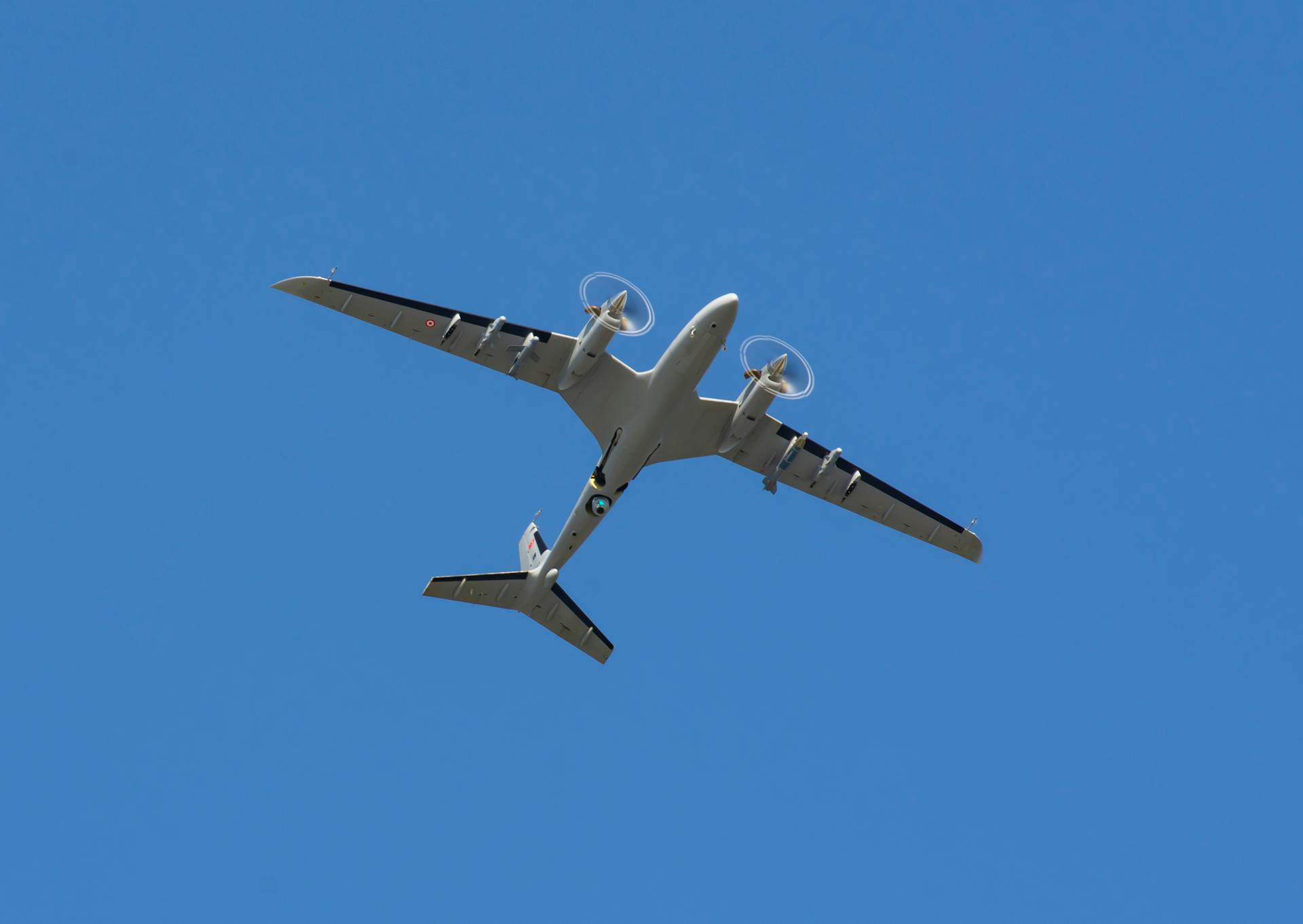
Hindustan Aeronautics Limited has a diverse range of products and services, including aircraft design and development, manufacturing, and maintenance. Its product portfolio includes fighter jets, transport aircraft, helicopters, and drones.
The company has a strong presence in the Indian defense sector, with a significant share of the country's defense procurement market.
Products and Services
Hindustan Aeronautics Limited has a diverse range of products and services that cater to various needs of the Indian Air Force and Navy.
The company has designed and manufactured several fighter aircraft, including the HAL HF-24 Marut, HAL Tejas, and HAL Tejas MK2. These aircraft are capable of meeting the demands of modern air warfare.
Here are some of the notable fighter aircraft developed by HAL:
- HAL HF-24 Marut: A retired fighter aircraft with over 200 units built.
- HAL Tejas: A 4.5 generation light combat aircraft currently in service.
- HAL Tejas MK2: A 4.5+ generation medium weight fighter under development, expected to have its first flight in 2025.
- HAL TEDBF: A twin-engine deck-based fighter for the Indian Navy's aircraft carriers, under development with an ORCA version planned for the IAF.
The company also has a rich experience in designing and manufacturing trainer aircraft, including the HJT-16 Kiran, which is still in service, and the HTT-40, a basic trainer that has been in production since 2016.
Fighter Aircraft
The HAL Tejas is a 4.5 generation light combat aircraft (LCA) that's currently in service.
It's a significant improvement over its predecessor, the HAL HF-24 Marut, which had over 200 units built.
The HAL Tejas MK2 is an upgraded version of the Tejas, classified as a 4.5+ generation Medium weight fighter.
This new variant is expected to take to the skies for the first time in 2025.
The HAL Tejas MK2 and the HAL TEDBF (Twin Engine Deck Based Fighter) are both under development, with the latter being designed specifically for the Indian Navy's aircraft carriers.
Here's a brief overview of the current fighter aircraft lineup:
- HAL HF-24 Marut (retired)
- HAL Tejas (in service)
- HAL Tejas MK2 (under development)
- HAL TEDBF (under development)
Trainer Aircraft
The Indian Air Force has a long history of developing and using trainer aircraft to train its pilots. The HT-2 is the first company design to enter production, which was exported to Ghana and retired in 1990.
Over the years, the IAF has used various trainer aircraft, including the HAL-26 Pushpak, a basic trainer based on the Aeronca Chief, which was out of production by the 1960s.
The HJT-16 Kiran has been in service since 1964 and is still used today, with three different variants: the Mk1, Mk1A, and Mk2. These trainers are scheduled to be replaced with the HJT-36 Yashas, an intermediate jet trainer that's currently under development.
The HPT-32 Deepak was a basic trainer that served the IAF for over three decades before being retired in 2009. Its turboprop version, the HTT-34, was also retired.
A proposed replacement for the HPT-32, the HTT-35, was cancelled in the early 1990s. However, the HTT-40, a basic trainer, is currently in production and has already flown its first prototype on May 31, 2016.
Consider reading: Illinois Retired Teachers Dental Insurance
Here's a brief overview of the trainer aircraft used by the IAF:
- HT-2: First company design to enter production, exported to Ghana, and retired in 1990.
- HAL-26 Pushpak: Basic trainer based on Aeronca Chief, out of production by the 1960s.
- HJT-16 Kiran: In service since 1964, scheduled to be replaced with HJT-36 Yashas.
- HPT-32 Deepak: Basic trainer that served the IAF for over three decades, retired in 2009.
- HTT-34: Turboprop version of HPT-32 Deepak, retired.
- HTT-40: Basic trainer, currently in production, first prototype flew on May 31, 2016.
Passenger and Utility Aircraft
The Saras is a multi-purpose civilian light transport aircraft that can seat up to 19 people. It was jointly developed with NAL.
One of the key features of the Saras is its 14-19 seater capacity, making it a versatile option for various transportation needs.
The Indian Regional Jet (IRJ) is another notable project, currently under development to be jointly developed with NAL. It's designed to seat 70-100 people, making it an ideal option for regional airliners.
Here are some key details about these aircraft:
- Saras: 14-19 seater capacity
- Indian Regional Jet (IRJ): 70-100 seater capacity
Helicopters
The Indian defense industry has made significant strides in developing advanced helicopters.
The HAL Dhruv is an advanced light helicopter in production.
The Rudra is an armed and reconnaissance version of the Dhruv, also in production.
The Prachand is a light attack helicopter in production.
The Light Utility Helicopter is in limited series production, designed for light utility purposes.
The Indian Multi Role Helicopter is under development, including a naval version.
Here's a breakdown of the helicopters in various stages of production and development:
Unmanned Aerial Vehicles
Unmanned Aerial Vehicles are an exciting area of development in the industry. India has been actively working on various types of UAVs.
The PTA Lakshya is a target drone, designed for training purposes. It's an example of India's focus on developing drones for military use.
The Rustom UAV family is another notable development. It's a series of unmanned aerial vehicles designed for reconnaissance and surveillance missions.
The Nishant is a reconnaissance UAV that's part of India's efforts to develop advanced unmanned aerial systems. It's designed to gather intelligence and conduct surveillance.
The HAL Combat Air Teaming System (CATS) is a more recent development. It's a system that enables multiple drones to work together to achieve a common goal.
Here are some examples of Indian UAVs:
- PTA Lakshya (Target drone)
- PTA Lakshya 2 (Target drone)
- Rustom (UAV family)
- Nishant (Reconnaissance UAV)
- NRUAV (Unmanned rotorcraft)
- HAL Combat Air Teaming System (CATS)
Engines
HAL has been producing a range of engines for various aircraft and helicopters, including the Shakti turboshaft engine for the HAL Dhruv Helicopter, which is co-developed with Safran Helicopter Engines.
Intriguing read: GE Honda Aero Engines
The Shakti engine is used on several HAL-developed platforms, including the LUH, Dhruv, Rudra, and Prachand helicopters. It's a testament to HAL's capabilities in developing high-performance engines for their aircraft.
The company is also working on the Aravalli turboshaft engine, which is co-produced with SAFHAL, a joint venture with Safran Helicopter Engines. This engine is designed for the HAL IMRH and HAL DBMRH.
HAL's HTSE-1200 turboshaft engine is another notable development, which can be used as an engine alternative for the HAL-developed LUH, Dhruv, Rudra, and Prachand helicopters.
Here's a list of some of the notable engines developed by HAL:
HAL has also developed the GTX-35VS Kaveri turbofan engine, which is co-developed with GTRE of (DRDO) and Safran Aircraft Engines. This engine is being developed for use in the HAL-developed Tejas and AMCA.
The HTFE-25 turbofan engine is another notable development by HAL, which can be used in single engine trainer jets, business jets, and UAVs weighing up to 5 tonnes, and in twin engine configuration for the same weighing up to 9 tonnes.
Broaden your view: Developed Markets vs Emerging Markets
Research and Development
Hindustan Aeronautics Limited has a dedicated Research and Development (R&D) focus, as evident from the HAL Aero Engine Research and Development Centre (AERDC) in Bengaluru.
AERDC is involved in the development, testing, and commercialization of HAL's in-house aero-engines. This facility has been a game-changer for the company's growth.
The centre has a notable past project, the HA-31 Basant, which was in production from 1972 to 1980.
Aero Engine R&D Centre
The Aero Engine Research and Development Centre (AERDC) in Bengaluru is a hub for innovation and progress. It was opened on 29 December 2023 by Defence Secretary Giridhar Aramane.
AERDC is involved in the development, testing, and commercialization of HAL's line of in-house aero-engines. HAL has a rich history in engine development, with its first engine, the HA-31 Basant, being produced from 1972 to 1980.
The centre is working on several projects, including the GTX-35VS Kaveri, a turbofan engine co-developed with GTRE of DRDO and Safran Aircraft Engines. This engine is being developed for use in the HAL-developed Tejas and AMCA.
AERDC is also working on the HTFE-25, a turbofan engine for single engine trainer jets, business jets, and UAVs weighing up to 5 tonnes. In a twin engine configuration, it can be used for aircraft weighing up to 9 tonnes.
Here are some of the notable engines developed by HAL:
- CE-7.5 — cryogenic rocket engine (in production, used on GSLV Mk.II Cryogenic upper stage CUS15)
- CE-20 — cryogenic rocket engine (in production, used on C25 upperstage of LVM-3)
- Shakti — a turboshaft engine for HAL Dhruv Helicopter, co-developed with Safran Helicopter Engines (in production and used on LUH, Dhruv, Rudra, Prachand)
- Aravalli—a turboshaft engine for the HAL IMRH and HAL DBMRH. Co-produced with SAFHAL, a joint venture with Safran Helicopter Engines (under development)
- HTSE-1200 — a turboshaft engine can be used as engine alternatives for the HAL-developed LUH, Dhruv, Rudra and Prachand helicopters (under development)
ICT Spending & Priorities
Research and Development often requires significant investments in information and communication technology (ICT).
IT Client Prospector provides intelligence on Hindustan Aeronautics Ltd’s likely spend across technology areas enabling you to understand the digital strategy. This can be crucial for informed decision-making.
Understanding ICT spending and priorities is essential for effective research and development.
Hindustan Aeronautics Ltd’s ICT spend can be broken down into various technology areas, including software, hardware, and services.
Suggestion: Can You Use Dollars in Canada
International Operations
Hindustan Aeronautics Limited has a significant presence in the international market, with exports accounting for a substantial portion of its revenue. The company has exported aircraft and defense equipment to several countries, including Malaysia, South Africa, and the UK.
The company has a joint venture with Russia's Rosoboronexport, which has enabled it to manufacture and export Russian-origin defense equipment. This partnership has been instrumental in expanding HAL's global reach.
HAL has also established a subsidiary in the UK, Hindustan Aeronautics (UK) Limited, which serves as a marketing and sales arm for the company's products. This subsidiary has helped HAL to tap into the European market.
The company has a strong presence in the Middle East, with a significant share of the market for defense equipment. HAL's exports to the region have been driven by the growing demand for defense products.
HAL's international operations are governed by a robust quality management system, which ensures that the company's products meet international standards. This system has been certified by several international organizations, including the ISO 9001:2015 standard.
Related reading: Adidas Subsidiary Companies
Financial Information
The company's Debtor Days have fluctuated over the years, reaching a high of 227 days in March 2019 and decreasing to 55 days by March 2025.
Recommended read: Reg B 30 Days
A look at the Inventory Days shows a more gradual decline, from 1,104 days in March 2015 to 736 days in March 2025.
The Days Payable also experienced a significant increase, from 103 days in March 2015 to 156 days in March 2025.
Here's a summary of the company's Cash Conversion Cycle and Working Capital Days:
The company's ROCE % has shown an upward trend, reaching 39% in March 2024 and remaining at 34% in March 2025.
Ratios
Let's dive into the ratios that help us understand a company's financial health. The Debtor Days ratio decreased from 144 in March 2015 to 55 in March 2025, showing a significant improvement in the company's ability to collect payments from its customers.
The Inventory Days ratio fluctuated over the years, ranging from a high of 1,104 in March 2015 to a low of 527 in March 2023. This indicates that the company had varying levels of inventory on hand, but overall, it was able to manage its inventory more efficiently in 2023.
A unique perspective: 60 Days in Tv Show Payment Terms
The Cash Conversion Cycle, which is a key ratio that combines Debtor Days, Inventory Days, and Days Payable, also showed improvement over the years, decreasing from 1,145 in March 2015 to 634 in March 2025. This suggests that the company was able to generate more cash from its sales and reduce its reliance on external financing.
The Working Capital Days ratio, which measures the average number of days it takes for a company to collect its accounts receivable and pay its accounts payable, also showed improvement, decreasing from 39 in March 2015 to 121 in March 2025. This indicates that the company was able to manage its working capital more effectively and reduce its risk of liquidity problems.
Here's a summary of the key ratios:
The ROCE% (Return on Capital Employed) ratio, which measures a company's profitability, showed a significant improvement over the years, increasing from 23% in March 2016 to 39% in March 2024. This indicates that the company was able to generate more profits from its investments in March 2024.
Announcements
Hindustan Aeronautics Limited (HAL) has been making some significant announcements recently. They attended the Antique Defense & Aerospace conference on October 13, 2025, in Mumbai.
HAL has also received a major contract from the Ministry of Defence (MoD) worth Rs.62,370 crore for 97 LCA Mk1A, with deliveries scheduled from 2027-28 over six years.
ICRA reaffirmed HAL's [ICRA]AAA Rs4,000cr and A1+ Rs2,050cr ratings on September 25, 2025.
HAL appointed M/s Gupta Nayar & Co. as statutory auditors for FY2025-26, as appointed by the Comptroller and Auditor General (C&AG).
Here's a list of HAL's recent announcements:
- Announcement under Regulation 30 (LODR) - Analyst/Investor Meet - Intimation (October 8, 2025)
- Closure of Trading Window (September 26)
- Announcement under Regulation 30 (LODR) - Award_of_Order_Receipt_of_Order (September 25)
- Announcement under Regulation 30 (LODR) - Credit Rating (September 25)
- Announcement under Regulation 30 (LODR) - Appointment of Statutory Auditor/s (September 12)
Related Party Transactions
Related Party Transactions are an important aspect of financial information.
You can find all Related Party Transactions submitted by the Company for quarter ended March 2025 and thereafter under Integrated Filing - Financials.
To access these transactions, simply click here.
Note that this is the only source for such transactions, so make sure to check here regularly for updates.
Curious to learn more? Check out: Fair and Accurate Credit Transactions Act
Financial Performance
Hindustan Aeronautics Limited has shown a steady increase in sales over the years, with a growth rate of 30,381 in Mar 2025 compared to 15,939 in Mar 2015.
The company's operating profit has also seen a significant rise, with a growth rate of 9,900 in Mar 2024 compared to 2,379 in Mar 2015. This represents an operating profit margin (OPM) of 31% in Mar 2024.
Hindustan Aeronautics Limited's net profit has grown by 8,311 in Mar 2024 compared to 2,399 in Mar 2015. The company's earnings per share (EPS) have also seen a significant increase, reaching 124.27 in Mar 2024.
Here is a summary of the company's financial performance over the years:
The company's compounded profit growth over the past 10 years has been 13%, indicating a steady and consistent growth in profits.
Industry Insights
Hindustan Aeronautics Limited has a long history dating back to 1940. It was established by the Indian government as the Hindustan Aircraft Limited.
The company's primary goal is to design, manufacture, and repair aircraft and helicopters for the Indian military and civil aviation sectors. Its products include fighter jets, transport aircraft, and helicopters.
Hindustan Aeronautics Limited has played a significant role in India's defense sector, supplying aircraft and helicopters to the Indian Air Force and Navy.
Competitor Comparison
In the aerospace industry, it's essential to understand the competitive landscape. The key players in this field have headquarters in the United States of America, India, and Japan.
Let's take a look at the number of employees each company has. Hindustan Aeronautics Ltd has 23,999 employees, while Lockheed Martin Corp has a significantly larger workforce with 121,000 employees.
The Boeing Co has the largest workforce among the competitors with 172,000 employees. This is a substantial difference from the other companies listed.
Here's a summary of the competitors' headquarters:
Industry Analytics
The manufacturing industry is expected to grow by 4% annually, reaching a global value of $12.4 trillion by 2025. This growth is driven by increasing demand for consumer goods and industrial equipment.
The use of automation in manufacturing is on the rise, with 70% of companies planning to invest in robotics and artificial intelligence in the next five years.
Companies that adopt data-driven decision making are 23% more likely to outperform their competitors.
The average return on investment for companies that implement data analytics is $13.01 for every dollar spent.
Manufacturers that use predictive analytics can reduce production costs by up to 15% and increase productivity by up to 20%.
The use of IoT sensors in manufacturing can reduce equipment downtime by 30% and increase energy efficiency by 25%.
Frequently Asked Questions
Who owns Hindustan Aeronautics Limited?
Hindustan Aeronautics Limited is owned by the Government of India. It is a fully owned Government of India undertaking.
What is the future of HAL share?
HAL's share price is predicted to reach ₹5635.18, indicating a potential 28.55% increase from its current price. According to 17 analysts, this target suggests a promising future for the company's stock.
Featured Images: pexels.com