Google Pay is a digital wallet that lets you make payments with your phone, and it's been around since 2015. It's available in over 40 countries and supports over 150 currencies.
To use Google Pay, you need to set it up on your Android device, and it's linked to your debit or credit card. Google Pay uses a technology called tokenization to protect your card information.
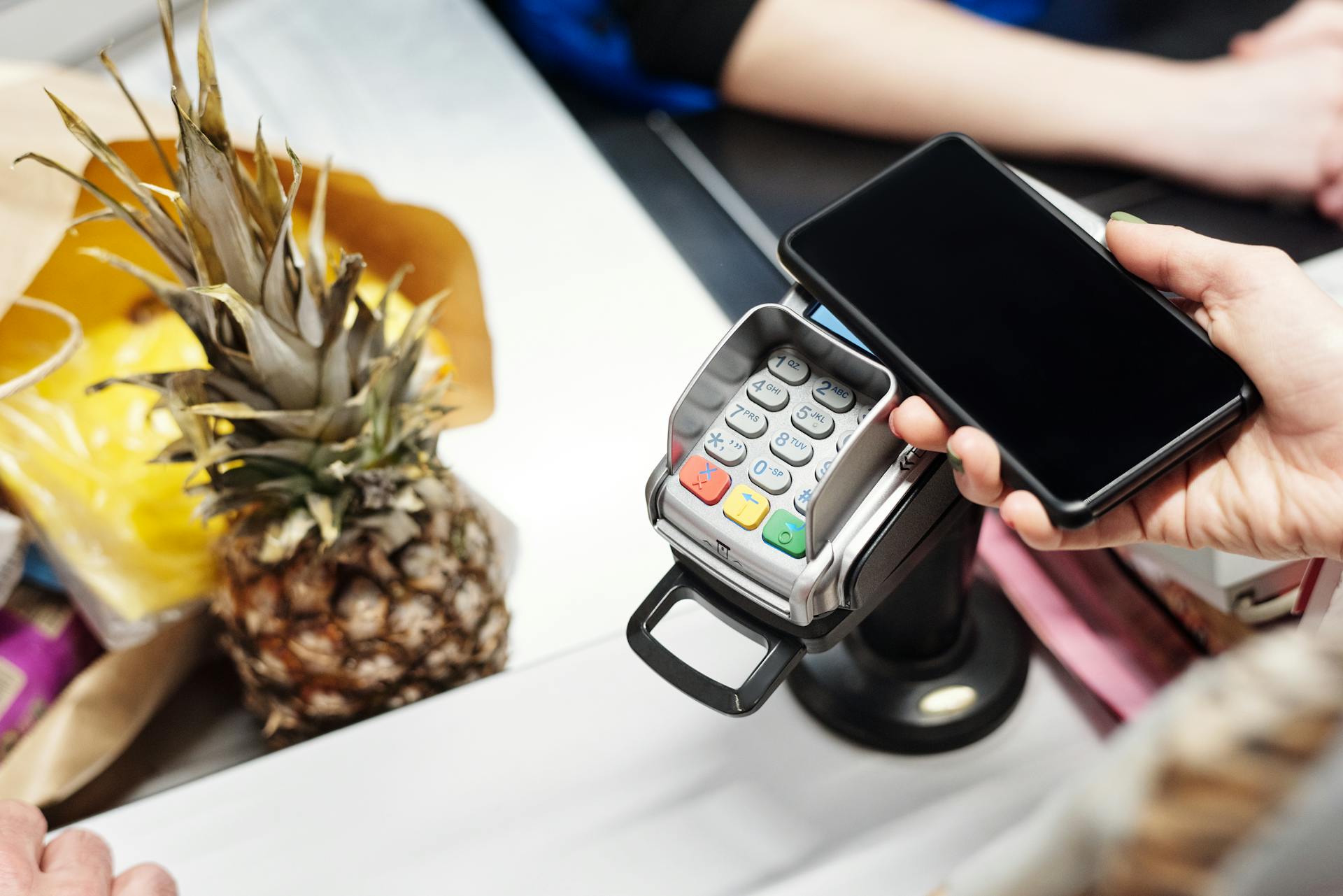
One of the key features of Google Pay is that it uses near-field communication (NFC) technology to make payments. This means you can tap your phone on a payment terminal to complete a transaction.
On a similar theme: Technology behind Credit Cards
History and Evolution
Google Pay has a rich history that dates back to 2011 with the launch of Google Wallet. Google Wallet was first demonstrated at a press conference on May 26, 2011, and was released in the US on September 19, 2011.
Initially, Google Wallet only supported Mastercard cards issued by Citibank, but it paved the way for future digital wallet innovations. The app allowed users to make point-of-sale purchases using near-field communication (NFC) technology.
Consider reading: B of a Mobile Banking App
In 2013, Google integrated Google Wallet with Gmail, enabling users to send money through Gmail attachments. This integration was made available in the US and the UK.
A physical Google Wallet card was launched in 2015, offering users a convenient way to make purchases and withdraw cash at ATMs. However, this card was discontinued on June 30, 2016, and replaced with Android Pay.
Android Pay, launched in 2015, built on the foundation established by Google Wallet and used technology from Softcard, which Google had acquired earlier that year. At launch, Android Pay was compatible with 70% of Android devices and accepted at over 700,000 merchants.
In 2016, Google began testing a mobile app called Hands Free in Silicon Valley, allowing customers to make payments without presenting a phone or card.
International Deployment
Google Pay has made significant strides in its international deployment, expanding its reach to various countries and regions. Android Pay was initially launched in the UK, supporting Mastercard, Visa, and debit cards from major financial institutions.
Google Pay launched in Singapore on June 28, 2016, and in Australia on July 14, 2016. The service was also introduced in Ireland on December 7, 2016, initially available to customers of AIB and KBC.
In 2018, Google Payment obtained an e-money license in Lithuania, enabling Google to process payments and issue e-money in the EU. This move marked a significant step towards expanding Google Pay's international presence.
Here's a list of some of the countries where Google Pay is available:
- Albania
- Andorra
- Argentina
- Armenia
- Australia
- Austria
- Azerbaijan
- Bahrain
- Belgium
- Bermuda
- Bosnia and Herzegovina
- Brazil
- Bulgaria
- Cambodia
- Canada
- Chile
- Colombia
- Costa Rica
- Croatia
- Cyprus
- Czech Republic
- Denmark
- Dominican Republic
- Ecuador
- El Salvador
- Estonia
- Faroe Islands
- Finland
- France
- Georgia
- Germany
- Gibraltar
- Greece
- Greenland
- Guatemala
- Guernsey
- Honduras
- Hong Kong
- Hungary
- Iceland
- India
- Ireland
- Isle of Man
- Israel
- Italy
- Japan
- Kazakhstan
- Kosovo
- Kuwait
- Kyrgyzstan
- Latvia
- Liechtenstein
- Lithuania
- Luxembourg
- Macau
- Malaysia
- Malta
- Mexico
- Moldova
- Monaco
- Montenegro
- Morocco
- Netherlands
- New Zealand
- Nicaragua
- Norway
- North Macedonia
- Panama
- Paraguay
- Peru
- Poland
- Portugal
- Qatar
- Romania
- San Marino
- Serbia
- Singapore
- Slovakia
- Slovenia
- South Africa
- Spain
- Sweden
- Switzerland
- Taiwan
- Tajikistan
- Thailand
- Ukraine
- United Arab Emirates
- United Kingdom
- United States
- Uruguay
- Vietnam
Features
Google Pay's digital wallet allows users to store a variety of items, including payment cards for use via Google Pay, as well as passes like loyalty cards, digital keys, digital identification cards, transit passes, event tickets, and health passes.
You can use digital car keys in Google Wallet even when the screen is off or the battery is depleted, which is super convenient.
Google Pay provides expanded support for passes of all types, including loyalty cards, transit passes, and event tickets, which will be coming to Wear OS and Fitbit OS soon.
The service has a long-term goal of achieving feature parity on both watches and phones, although new features are still being launched without parity on all platforms as of 2024.
Google Pay has taken over the branding of Google Chrome's autofill feature, making it a more comprehensive payment service.
If this caught your attention, see: How to Add Tickets to Digital Wallet
What's the Difference?
Google Wallet and Google Pay are two related but distinct services. Google Wallet is an all-in-one digital organizer for various payment methods and personal passes.
Google Wallet stores and offers fast access to digitalized personal items and payment methods, including debit card information, concert tickets, and gym membership passes. You can access all your digital items in one location.
Google Pay, on the other hand, is a singular tool for swift and seamless transactions online, in-app, and in physical stores. It's designed for quick and easy payments.
The transition from Google Pay to Google Wallet aims to provide a more intuitive and efficient user experience regarding digital payments and organization.
For another approach, see: Samsung Wallet Nfc Access Card
Security and Authentication
Google Pay offers a secure way to make digital payments, with built-in payment authentication and transaction encryption.
Your private information is kept safe with Google Pay's fraud protection, giving you peace of mind when making online transactions.
Google Pay also supports secure authentication, but it's not required for all users, meaning some may have to complete separate Strong Customer Authentication (SCA) methods for certain transactions.
3D Secure Authentication
Google Pay helps keep your private information safe with built-in payment authentication.
The Huntington Cashback Credit Card earns 1.5% unlimited cash back on every purchase, but that's not what matters here. We're talking about security.
Apple Pay requires users to authenticate digital wallet transactions using a secure method like a fingerprint scan, eliminating the need for Strong Customer Authentication (SCA) methods like 3D Secure.
Google Pay supports secure authentication, but it's not required, which means users who don't use it may have to complete SCA separately.
Your Apple Pay users don't need to separately complete a SCA method like 3D Secure, thanks to their fingerprint scan.
Google Pay's secure authentication is optional, so users can choose how they want to manage their transactions.
For your interest: Google Tap to Pay Not Working
Restrictions of Payments
While digital wallets like Apple Pay and Google Pay offer a convenient way to make payments, there are some restrictions to be aware of.
One restriction is that GOV.UK Pay cannot apply corporate card surcharges to payments made with a corporate card through Apple Pay or Google Pay.
This means that if you're using a corporate card to make a payment through one of these digital wallets, you won't be charged extra fees.
In some cases, you might still be charged interest on your corporate card, even if you're using a digital wallet to make a payment.
Consider reading: Do I Earn Play Points for Using Google Pay
Loyalty Programs and Rewards
Google Pay's digital wallet offers a range of loyalty programs that can be added through NFC technology. Some of these programs can be added directly through the Google Wallet app, while others require a visit to the retailer's app or website.
One Tap loyalty programs are convenient, as they're conveyed at the same time as a payment card stored in Google Wallet. This means you can access your rewards with just one tap.
In the United States, you can use One Tap with programs like Coca-Cola's Vending Pass, Dave & Buster's Power Card, and Jimmy John's Freaky Fast Rewards. These programs are a great way to earn rewards and discounts on your favorite purchases.
Two Tap loyalty programs, on the other hand, require a sequential process, where you scan your loyalty pass first, and then present your payment. This might seem like a hassle, but it's still a great way to earn rewards.
A different take: Credit Cards That Offer Flashy Rewards like Airline Miles Often
Some popular Two Tap programs include Woolworths' Everyday Rewards in Australia and New Zealand, and Nando's Nando Card in Ireland and the United Kingdom. These programs are worth checking out, especially if you're a frequent customer.
Here's a list of some popular loyalty programs supported by Google Pay:
Public Transport and Car Keys
With Google Pay, you can ditch your old car keys and use your phone to unlock and start your car. This feature is available on select cars from brands like Ford and Lincoln.
You can also use Google Pay to pay for public transportation, making it a convenient option for daily commutes. For example, in some cities, you can tap your phone to pay for bus fares, eliminating the need for cash or cards.
Google Pay also integrates with your public transportation cards, making it easy to keep track of your balances and payments.
Smart Tap
Smart Tap technology allows businesses to store NFC passes in customers' Google Wallet for use at compatible terminals, eliminating the need for physical tickets or membership cards.

Google offers Smart Tap technology free of charge to developers and merchants through the Google Pay & Wallet Console. Each pass issuer is given a Collector ID to configure their terminals.
Walt Disney World Resort uses Smart Tap for ticketing, allowing customers to store their tickets in their Google Wallet and tap to enter the park.
Multiple passes can be stored in a user's Wallet, and if they match a terminal's Collector ID, a carousel will appear when tapping, allowing the user to select the desired pass.
Ticketmaster and Pathé Cinémas also use Smart Tap for ticketing, providing a convenient and contactless experience for their customers.
By using Smart Tap, businesses can streamline their operations and reduce the need for physical infrastructure, such as ticket booths or membership kiosks.
In addition to ticketing, Smart Tap is also used for loyalty programs, such as Redbox and Nando's, and for memberships, such as Anytime Fitness and David Lloyd Clubs.
Public Transport Systems

In Australia, transit cards are not directly supported in Google Wallet, but users can link their payment cards to make payments.
Users in Singapore can link their payment cards to make payments, but the transit card is not stored directly within Google Wallet.
In the United States, some cities like Chicago and San Francisco support transit cards, but they are not stored directly within Google Wallet.
Here's a list of some cities and their supported transit cards:
In some cities like London and New York City, users can link their payment cards to make payments, but the transit card is not stored directly within Google Wallet.
In Hong Kong and Japan, users need to download separate apps to manage their transit cards, which are stored securely within their devices.
Car Keys
Using digital keys on your watch requires some setup. The Pixel Watch 3 must be paired with a compatible Pixel phone to use digital keys.
Some devices may need updates before being compatible. Android OS or Play System updates might be necessary to get your device working with digital keys.
If you're planning to use digital keys, make sure your watch is paired with a compatible phone.
A fresh viewpoint: Google Wallet in Samsung Watch
Device-Specific and Region-Locked Features
Some features in Google Pay's digital wallet are locked to certain devices that have additional hardware or software.
These devices often include secure elements that provide an extra layer of security for transactions.
Certain region-specific middleware requires licenses that aren't available on all Android/Wear OS devices.
This can limit the availability of specific features in Google Pay, depending on your device and location.
Worth a look: Online Banking Features
What Is It?
Google Pay is a digital wallet on your Android device that securely stores your credit and debit card information.
It allows you to pay for goods and services online and in person directly through your Android devices.
Google Pay users can still make purchases online and tap-to-pay in stores, but peer-to-peer payments and adding money to Google Pay balances are no longer available.
You can still manage your payment methods and transfer Google Pay funds to your bank account.
Worth a look: Why Do Stores Have Credit Cards
Testing and Comparison
Google Pay is a widely accepted digital wallet, accepted by over 2 million merchants worldwide. It's available in the US, UK, Australia, and Singapore, among other countries.
Discover more: Accepted Platinum Credit Card
In terms of security, Google Pay uses tokenization to protect card numbers, and also offers a feature called "Purchase Protection" which provides refunds for unauthorized transactions. Google Pay also offers a feature called "Transaction Alerts" which sends users notifications about their transactions.
Google Pay has a user-friendly interface, making it easy to add and manage payment methods, and also allows users to make payments using their Android or iOS devices.
Phone vs. Wearable Comparison
When testing and comparing different devices, one of the key features to consider is payment functionality. Some devices, like Android phones, allow users to pay with EMV payment cards via Google Pay, but only partial support is available on Wear OS and Fitbit OS.
You can pay with FeliCa payment cards via Google Pay on some Pixel Watches, Galaxy Watch Ultra, and Galaxy Watch6 or later devices purchased in Japan. This is a notable limitation, as it restricts the use of these devices for FeliCa payment cards outside of Japan.
For more insights, see: Google Wallet Is Coming to Samsung Galaxy Devices.

The ability to pay via QR code is also limited, with this feature only available on Android devices in Brazil. This means that users in other regions may not be able to use this convenient payment method.
Store passes are also available on some devices, but with limitations. For example, private passes are not supported on Wear OS, and smart tap passes only show their fallback QR code/barcode/number.
Here's a breakdown of the payment features available on different devices:
It's also worth noting that some devices have limited support for storing digital car keys, with only BMW & MINI keys supported on Wear OS for Pixel Watch 3. Similarly, some devices have limited support for storing transit cards, such as iPASS on Xiaomi 14T/14T Pro or Suica cards on Fitbit OS for users with a Fitbit account region set to Japan.
Test
Testing is an essential part of any payment system, and Google Pay is no exception. You'll need a Google account to test Google Pay, and you must add a credit or debit card to that account.
You can add a real credit or debit card, or use Google Pay's test cards to avoid any real transactions. This is a great way to test the system without actually spending any money.
To test Google Pay, you'll need to create a payment through the API or create a payment link through the GOV.UK Pay admin tool. This will give you a next_url to use for testing.
You can test Google Pay on a desktop or Android device using Google Chrome. Simply sign in to a Google account and visit the next_url you received.
If you're using an iOS device, you can test Google Pay in a browser that supports Apple Pay, such as Safari, Google Chrome, or Microsoft Edge. You can also use a Mac and open Safari.
You can complete the test payment using a real card or a test card, and don't worry, you won't be charged any money.
Here are the steps to test Google Pay:
- Create a payment through the API or create a payment link through the GOV.UK Pay admin tool.
- Open Google Chrome on a desktop or Android device.
- Sign in to a Google account.
- Visit the next_url you received when you created the test payment or visit the payment link.
- Complete the test payment using a real card or a test card.
You can also test Google Pay on an iOS device by following these steps:
- Create a payment through the API or create a payment link through the GOV.UK Pay admin tool.
- On an iOS device, open a browser that supports Apple Pay.
- Visit the next_url you received when you created the test payment or visit the payment link.
- Complete the test payment using the credit or debit card you added to your Apple Wallet.
Android Pay and Google Pay
Android Pay was initially launched in 2015 at Google I/O, replacing Google Wallet and using technology from Softcard. It was compatible with 70% of Android devices and accepted at over 700,000 merchants.
The service was a huge success, and in 2016, Google began a public trial in Silicon Valley of a related mobile app called Hands Free. This allowed customers to make payments without presenting a phone or card.
Hands Free used a customer's phone and geographic location system to verify their identity and authorize payment. It was a convenient and seamless way to make payments.
In 2018, Google announced that Android Pay and Google Wallet would be merged into a single service called Google Pay. This merger extended the platform into web-based payments integrated into other Google and third-party services.
The rebranded service provided a new API that allowed merchants to add the payment service to websites, apps, Stripe, Braintree, and Google Assistant. This made it easier for users to make payments online and in-store.
Google Pay is now available in all the same countries as Wallet, making it a global payment service. It's a convenient and secure way to make payments using your phone.
Discover more: Free Cash App Atm near Me No Fees
What's New
Google Pay's digital wallet has some exciting new features that make it easier to use and more convenient than ever. You can use your phone or smartwatch to tap to pay in stores, board a plane, ride transit, attend an event, use your loyalty card at your favorite merchants, or even start your car.
To add a new card or pass, simply tap the Add to Wallet button on the home screen. On websites and apps with an “Add to Google Wallet” or “Add to Google Pay,” you can save items to Google Wallet as well.
Here are the steps to view transaction details:
- Tap on a payment card.
- At the top right, tap Transaction details.
You can also switch Google Accounts, get tips for Google Wallet, access app settings, and more by tapping your Profile picture at the top right of the home screen.
Frequently Asked Questions
How do I access my Google digital wallet?
To access your Google digital wallet, swipe down from the top of your screen, then tap the Wallet tile in the Quick Settings menu. Your added debit and credit cards will be displayed for easy use.
Featured Images: pexels.com